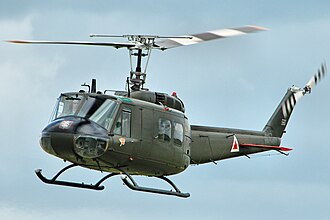
Bell UH-1 Iroquois — The Helicopter That Redefined Modern Warfare
Few aircraft have shaped both military doctrine and popular imagination as profoundly as the Bell UH-1 Iroquois. Known worldwide by its iconic nickname, the “Huey,” this helicopter became a symbol of an era, a revolution in air mobility, and a technological milestone that transformed how wars were fought—and how lives were saved.
From the jungles of Southeast Asia to humanitarian missions across the globe, the UH-1 was more than just a machine. It was a workhorse, a lifeline, and often the thin line between survival and disaster.
This article explores the Bell UH-1 Iroquois in comprehensive detail—its origins, engineering, combat use, variants, and legacy—culminating in a full technical breakdown of its specifications.
Origins: The Need for a New Kind of Aircraft
In the early 1950s, military planners began to recognize the limitations of traditional ground-based mobility. The lessons of World War II and the Korean War showed that rapid troop deployment, medical evacuation, and battlefield logistics required a new approach.
Helicopters existed, but they were:
- Underpowered
- Limited in payload
- Mechanically complex
The U.S. Army sought a new utility helicopter that could:
- Transport troops quickly
- Operate reliably in harsh conditions
- Be easy to maintain in the field
To meet this demand, Bell Helicopter—building on its earlier success with the Bell 47—began developing a revolutionary design.
The Birth of the Huey
XH-40 Prototype
The UH-1 originated as the XH-40 prototype, which first flew in 1956. It represented a significant leap forward in helicopter technology.
Unlike earlier piston-engine helicopters, the XH-40 used a turbine engine—a decision that would define the aircraft’s success.
Official Designation
Initially designated HU-1 (Helicopter Utility), the aircraft later became known as UH-1 under a revised naming system. The nickname “Huey” stuck, derived from its original designation.
The Turbine Revolution
The most important innovation of the UH-1 was its use of a turboshaft engine.
Why Turbines Matter
Compared to piston engines, turbine engines offered:
- Higher power-to-weight ratio
- Greater reliability
- Smoother operation
- Reduced maintenance
The UH-1 was powered by the Lycoming T53 turboshaft engine, which delivered significantly more power than earlier helicopter engines.
Design and Engineering
General Layout
The UH-1 featured a conventional helicopter configuration:
- Single main rotor
- Tail rotor for anti-torque
- Skid landing gear
However, its internal design emphasized simplicity and ruggedness.
Cabin Design
The Huey’s cabin was:
- Spacious and modular
- Easily configurable for different missions
- Accessible via large side doors
This flexibility allowed it to serve in roles ranging from troop transport to medical evacuation.
Rotor System
The UH-1 used a two-blade main rotor system.
Characteristics
- Semi-rigid design
- Simple mechanical structure
- High reliability
The rotor system produced the distinctive “wop-wop” sound that became synonymous with the Huey.
Flight Characteristics
Pilots often describe the UH-1 as:
- Stable and predictable
- Responsive but forgiving
- Capable of handling difficult environments
It was not the fastest helicopter, but it was highly dependable.
Vietnam War: The Huey’s Defining Role
The Vietnam War is inseparable from the story of the UH-1.
Air Mobility Revolution
The Huey enabled a new doctrine: air mobility.
Troops could be:
- Inserted directly into combat zones
- Extracted quickly
- Supplied efficiently
This transformed battlefield tactics.
MEDEVAC Missions
Perhaps the most important role of the UH-1 was medical evacuation.
The helicopter dramatically reduced the time it took to transport wounded soldiers to medical facilities.
Combat Roles
The UH-1 was incredibly versatile.
Troop Transport
Carried soldiers into and out of combat zones.
Gunship
Armed variants provided close air support with:
- Machine guns
- Rocket pods
Command and Control
Used by commanders to coordinate operations.
Variants of the UH-1
The Huey family includes numerous variants.
UH-1A/B/C
Early models with incremental improvements.
UH-1D/H
- Larger cabin
- More powerful engines
- Most widely used versions
AH-1 Cobra Connection
The limitations of armed Hueys led to the development of the Bell AH-1 Cobra, a dedicated attack helicopter derived from UH-1 technology.
Engineering Strengths
Simplicity
The UH-1 was designed for field maintenance.
Durability
It could withstand:
- Harsh weather
- Combat damage
Versatility
Adaptable to multiple missions.
Limitations
Despite its strengths, the UH-1 had drawbacks:
- Limited speed
- Vulnerability to enemy fire
- Noise signature
Post-Vietnam Service
The UH-1 continued to serve worldwide after Vietnam.
Global Adoption
Used by dozens of countries.
Civilian Roles
- Firefighting
- Rescue operations
- Law enforcement
Cultural Impact
The UH-1 became a cultural icon.
It appeared in films, documentaries, and media, symbolizing both the intensity and complexity of modern warfare.
Comparison with Modern Helicopters
Compared to modern rotorcraft, the UH-1 is:
- Less advanced electronically
- Slower
- Mechanically simpler
Yet many remain in service today.
Legacy
The UH-1’s influence extends far beyond its operational life.
Doctrinal Impact
It changed how militaries think about mobility.
Technological Influence
Set the standard for utility helicopters.
Humanitarian Role
Saved countless lives.
Conclusion
The Bell UH-1 Iroquois is more than just a helicopter—it is a milestone in aviation history.
It redefined warfare, revolutionized medical evacuation, and proved the true potential of rotary-wing aircraft.
Even decades after its introduction, the Huey remains one of the most recognizable and respected helicopters ever built.
Technical Specifications — Bell UH-1 Iroquois (UH-1H)
| Parameter | Value |
|---|---|
| Manufacturer | Bell Helicopter |
| Role | Utility Helicopter |
| First Flight | 1956 |
| Crew | 2–4 |
| Capacity | Up to 14 troops or 6 stretchers |
| Length | 17.62 m (with rotors) |
| Rotor Diameter | 14.63 m |
| Height | 4.41 m |
| Empty Weight | ~2,360 kg |
| Maximum Takeoff Weight | ~4,300 kg |
| Powerplant | 1 × Lycoming T53 turboshaft |
| Power Output | ~1,400 shp |
| Maximum Speed | ~220 km/h |
| Cruise Speed | ~205 km/h |
| Range | ~480 km |
| Service Ceiling | ~5,900 m |
| Rate of Climb | ~8.5 m/s |
.jpg)