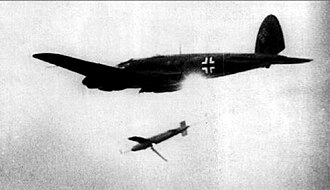
Blohm & Voss BV 143 – Germany’s Experimental Guided Glide Bomb Project
The history of military aviation is filled with famous fighters, bombers, reconnaissance aircraft, and transport planes that achieved legendary status through combat service or technological innovation. Hidden behind these well-known machines, however, lies an equally fascinating collection of experimental projects that never entered mass production but nevertheless contributed valuable engineering knowledge. One of these little-known developments was the Blohm & Voss BV 143, an ambitious German guided glide bomb conceived during the Second World War. Although the project never matured into an operational weapon, it represented an important step in the evolution of precision-guided munitions and reflected the increasingly urgent search for technologies capable of overcoming heavily defended naval targets from a safe stand-off distance.
Unlike conventional aircraft that carried pilots into combat, the BV 143 was designed as an unmanned precision weapon intended to strike ships with greater accuracy than traditional gravity bombs. During an era when anti-aircraft defenses around warships became progressively stronger, military planners recognized that bombers faced mounting risks during low-level or dive-bombing attacks. Engineers therefore explored methods that would allow aircraft to release guided weapons from safer distances while still maintaining acceptable accuracy. The BV 143 emerged within this broader effort to transform aerial bombing from an area weapon into a more precise method of attack, decades before precision-guided munitions became standard equipment throughout the world’s armed forces.
Although the project ultimately failed to reach operational deployment, its technical concepts reveal much about German wartime research into radio guidance, aerodynamic stability, weapon control, and terminal attack profiles. The aircraft industry of the Third Reich devoted significant resources to numerous advanced weapons during the later stages of the war, including guided bombs, anti-ship missiles, rocket-powered interceptors, and surface-to-air missiles. The BV 143 occupied an interesting place within this landscape, representing both the ingenuity and the limitations of wartime technological development under increasingly difficult industrial and military conditions.
The Strategic Background Behind Guided Weapons
By the early years of the Second World War, naval warfare had changed dramatically compared with the First World War. Modern battleships, cruisers, destroyers, and aircraft carriers were equipped with increasingly sophisticated anti-aircraft artillery capable of creating dense defensive fire around valuable vessels. Conventional bombing techniques required attacking aircraft to fly directly over or near heavily defended targets, exposing crews to concentrated anti-aircraft fire and interception by defending fighters. Although dive bombers could achieve relatively high accuracy against stationary or slow-moving objectives, their attack profiles placed both aircraft and crews in considerable danger.
German military planners therefore sought alternatives that would preserve bombing accuracy while reducing exposure to defensive fire. One promising solution involved guided bombs capable of being released well outside the most dangerous engagement zones before being directed toward their targets using radio control or other guidance methods. This concept offered several theoretical advantages. Bombers could remain at safer altitudes, attack from greater distances, avoid repeated attack runs, and potentially achieve higher hit probabilities against moving ships. While these ideas appear entirely familiar today, they represented revolutionary thinking during the early 1940s, when most aerial bombs remained entirely unguided after release.
The Luftwaffe and German aviation industry consequently sponsored numerous guided weapon programs involving different manufacturers and competing technical approaches. Some projects emphasized radio guidance, others experimented with television guidance, while additional concepts investigated wire guidance or infrared homing. Blohm & Voss became one of several companies participating in this technological race, applying its engineering expertise to the development of the BV 143.
Blohm & Voss and Advanced Wartime Engineering
The Company’s Expanding Role
Although Blohm & Voss achieved international prominence primarily as a shipbuilding company, its aviation division rapidly established itself as one of Germany’s most innovative aircraft manufacturers during the 1930s and early 1940s. Under the leadership of engineer Dr. Richard Vogt, the company became known for unconventional structural arrangements, creative aerodynamic solutions, and a willingness to challenge traditional aircraft design principles. Numerous Blohm & Voss projects featured asymmetrical fuselages, unusual wing layouts, advanced structural techniques, and highly specialized military applications that distinguished the company from more conservative manufacturers.
The same spirit of experimentation naturally extended beyond conventional aircraft into guided weapons. Engineers recognized that developing an effective guided bomb required expertise not only in aerodynamics but also in control systems, structural engineering, communications technology, and explosive ordnance. Blohm & Voss possessed substantial experience in many of these fields, making the company well positioned to undertake such an ambitious project.
The Influence of Richard Vogt
Richard Vogt consistently demonstrated an ability to view engineering problems from unconventional perspectives. Rather than merely refining established concepts, he frequently pursued entirely new solutions when confronted with technical challenges. Although not every project achieved practical success, many incorporated innovative ideas that anticipated developments appearing decades later. The BV 143 reflected this engineering philosophy by attempting to combine aerodynamic efficiency with externally controlled guidance in a weapon optimized specifically for anti-shipping operations.
The Concept Behind the BV 143
The Blohm & Voss BV 143 was conceived as an unmanned glide bomb rather than a powered missile. This distinction is important because the weapon depended primarily upon altitude and aerodynamic lift rather than continuous propulsion after release. Carried beneath a bomber aircraft to the target area, the weapon would separate and begin a controlled glide toward its objective. During this descent, an operator aboard the launching aircraft would transmit radio commands that adjusted the weapon’s flight path, enabling corrections for target movement, release errors, or changing environmental conditions.
This concept represented a compromise between simplicity and effectiveness. Eliminating a propulsion system reduced weight, manufacturing complexity, and production cost while simultaneously increasing payload available for the warhead. At the same time, reliance upon aerodynamic glide required careful planning regarding release altitude, release distance, aircraft speed, and weather conditions. Every operational mission would therefore demand accurate calculations long before the weapon separated from its carrier aircraft.
The intended targets consisted primarily of medium and large naval vessels. Ships represented particularly attractive objectives because their destruction could significantly influence military campaigns while their relatively predictable movement simplified guidance compared with smaller land targets. Nevertheless, accurately striking even a large warship with a manually guided weapon remained an exceptionally demanding task given the technological limitations of the period.
Design Characteristics
Aerodynamic Layout
Although surviving documentation concerning the BV 143 remains relatively limited compared with better-known German weapons, available information indicates that the weapon incorporated carefully designed aerodynamic surfaces intended to maximize glide efficiency and directional stability. Engineers sought a balance between maneuverability and inherent stability, recognizing that excessive responsiveness would complicate manual guidance while excessive stability would reduce the operator’s ability to make necessary course corrections during the terminal approach.
The wings generated sufficient lift to extend range considerably beyond that achievable by conventional free-fall bombs. Tail surfaces maintained directional control while movable control surfaces responded to radio commands transmitted from the launching aircraft. Every aerodynamic element contributed toward maintaining predictable flight characteristics despite varying atmospheric conditions encountered during operational use.
Structural Construction
Weight reduction remained a critical design objective throughout development. Engineers employed lightweight structural arrangements wherever practical while ensuring adequate strength to withstand aerodynamic loads experienced during release, glide, maneuvering, and terminal impact. Because the weapon carried no crew, designers enjoyed greater flexibility regarding internal arrangement than would have been possible within a conventional aircraft. Space could instead be allocated efficiently among guidance equipment, control mechanisms, structural members, and the explosive payload.
Radio Guidance Technology
Perhaps the most technically ambitious aspect of the BV 143 involved its radio guidance system. Following release, operators aboard the launching aircraft monitored the weapon visually while transmitting steering commands through specialized radio equipment. These commands actuated control surfaces that altered heading or glide angle, allowing continuous correction throughout the attack sequence.
Although revolutionary for its time, manual radio guidance presented considerable operational challenges. Maintaining visual contact with both weapon and target became increasingly difficult at longer distances or under poor weather conditions. Smoke, clouds, haze, enemy defensive fire, and rapid maneuvering complicated the operator’s task even further. Moreover, successful guidance demanded close coordination between pilot, bombardier, and radio operator throughout the engagement.
Electronic countermeasures represented another concern. Although wartime electronic warfare remained relatively primitive compared with modern standards, radio guidance systems inherently introduced vulnerability to interference, signal disruption, or accidental loss of communication. Engineers therefore devoted considerable effort toward maximizing reliability within the technological constraints of contemporary electronics.
Intended Operational Employment
Had the BV 143 entered operational service, missions would likely have begun with conventional bomber aircraft carrying one or more weapons beneath their wings or fuselage. After approaching the target area while remaining outside the densest anti-aircraft defenses whenever possible, crews would identify suitable targets and calculate release parameters based upon altitude, speed, wind conditions, and estimated target movement.
Following release, the glide bomb would begin descending toward its objective while the launching aircraft maintained a flight path permitting continuous radio control. Operators would observe the weapon visually and transmit steering corrections until impact. Ideally, this approach allowed bombers to remain beyond the most dangerous defensive zones while preserving sufficient accuracy to threaten heavily defended naval vessels.
In theory the concept offered substantial tactical advantages compared with traditional bombing methods. In practice, however, numerous operational variables—including visibility, weather, enemy maneuvering, communication reliability, and operator skill—combined to make consistent success difficult to achieve.
Testing and Development Challenges
As with many experimental guided weapons of the era, development encountered numerous technical obstacles. Flight testing sought to evaluate aerodynamic stability, control responsiveness, structural integrity, release characteristics, and guidance accuracy under realistic operational conditions. Each test generated valuable engineering data while frequently revealing previously unanticipated problems requiring redesign or refinement.
Engineers discovered that maintaining stable controlled flight throughout the glide profile demanded careful balancing of aerodynamic forces. Small deviations in weight distribution, control surface effectiveness, or release conditions could significantly influence overall performance. Likewise, ensuring reliable radio communication between aircraft and weapon proved considerably more complicated than laboratory demonstrations suggested.
Manufacturing realities compounded these technical issues. As the war progressed, Germany faced increasing shortages of skilled labor, raw materials, industrial capacity, and testing facilities. Allied bombing campaigns further disrupted research programs, delaying development schedules and limiting opportunities for comprehensive evaluation. Under such circumstances many promising projects struggled to progress beyond experimental stages regardless of their theoretical potential.
Comparison with Other German Guided Weapons
Fritz X
The most famous German guided bomb remains the Ruhrstahl Fritz X, which successfully sank or severely damaged several Allied warships. Unlike the BV 143, the Fritz X emphasized armor penetration against heavily protected capital ships through a relatively compact, high-speed guided bomb design. Operational success demonstrated that radio-guided weapons possessed genuine military value when employed under favorable conditions.
Henschel Hs 293
Another important contemporary project, the Henschel Hs 293, combined glide bomb characteristics with a rocket booster that extended range following release. This weapon achieved considerably greater operational success than the BV 143 due to more mature development and successful deployment before Allied countermeasures became widespread. The Hs 293 illustrated how powered assistance could expand tactical flexibility compared with purely gliding designs.
Although ultimately less successful than either of these better-known weapons, the BV 143 contributed to the broader German effort to explore multiple engineering approaches toward precision-guided aerial attack.
Engineering Significance
The historical importance of the BV 143 lies less in operational achievement than in technological exploration. Every experimental program generates engineering knowledge regardless of whether it reaches production. Research into aerodynamic control, structural optimization, radio command systems, flight stability, and precision attack methods informed later developments both during and after the Second World War.
Many concepts investigated within projects like the BV 143 anticipated principles that later became fundamental to guided missile technology. Modern precision-guided munitions routinely employ aerodynamic control surfaces, remote guidance, sophisticated stabilization systems, and optimized glide profiles far beyond anything achievable during the 1940s. Although separated by enormous advances in electronics and computing, these systems share common conceptual foundations established through pioneering wartime experimentation.
Why the Project Never Reached Operational Service
Several factors prevented the BV 143 from progressing beyond the experimental phase. Technical difficulties delayed development while competing projects demonstrated greater immediate promise. Military authorities naturally prioritized weapons capable of entering service quickly, especially as Germany’s strategic situation deteriorated during the later years of the war. Limited industrial resources further restricted simultaneous production of multiple advanced weapons.
Changing battlefield conditions also influenced procurement decisions. Increasing Allied air superiority complicated bomber operations over heavily defended targets regardless of weapon sophistication. Even an effective guided bomb required launching aircraft capable of reaching suitable release positions, a task becoming progressively more dangerous as Allied fighter coverage expanded across Europe.
Consequently, although the BV 143 represented an intellectually interesting engineering project, it never reached the maturity necessary for operational deployment before the collapse of the German war effort.
The Legacy of the BV 143
Today the Blohm & Voss BV 143 remains one of the lesser-known experimental weapons developed during the Second World War, overshadowed by more famous guided bombs and missiles. Nevertheless, historians regard it as part of the broader transition from unguided aerial bombing toward precision strike capabilities that would fundamentally reshape military aviation during the second half of the twentieth century.
Its development demonstrates the remarkable level of innovation occurring within wartime aerospace engineering despite severe practical constraints. Engineers confronted unprecedented challenges involving aerodynamics, electronics, communications, structural design, and weapons integration using technology that now appears remarkably primitive. Their solutions, successful or otherwise, expanded scientific understanding and laid conceptual foundations for future generations of guided weapons.
The BV 143 also serves as a reminder that aviation history encompasses far more than aircraft alone. Experimental weapons, propulsion systems, avionics, guidance technologies, and control methods all contributed to the rapid technological evolution that characterized the twentieth century. Many projects disappeared into obscurity after cancellation, yet their influence persisted indirectly through lessons applied elsewhere. In this respect, the Blohm & Voss BV 143 occupies an important, if understated, position within the broader story of aerospace innovation.
Technical Specifications
| Specification | Blohm & Voss BV 143 |
|---|---|
| Manufacturer | Blohm & Voss Flugzeugbau |
| Country of Origin | Germany |
| Project Type | Experimental radio-guided glide bomb |
| Designer | Blohm & Voss engineering team |
| Development Period | World War II (early-to-mid 1940s) |
| Operational Status | Experimental; never entered operational service |
| Guidance System | Manual radio command guidance |
| Launch Platform | Intended for carriage by bomber aircraft |
| Propulsion | None (unpowered glide weapon) |
| Flight Method | Aerodynamic glide following aerial release |
| Primary Intended Target | Enemy naval vessels |
| Control Method | Movable aerodynamic control surfaces |
| Warhead | High-explosive payload (planned) |
| Navigation | Visual tracking by launch aircraft crew |
| Main Advantage | Stand-off precision attack concept |
| Main Limitation | Complex manual guidance and developmental challenges |
| Historical Significance | Early precision-guided weapon research |
| Production | Prototype and experimental testing only |
