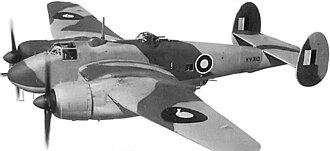
Bristol Buckingham: The Forgotten High-Speed Bomber of the RAF
The Bristol Buckingham was one of the more intriguing British aircraft projects of the Second World War, combining ambitious performance goals with a development history that ultimately left it overshadowed by faster, more successful and more adaptable aircraft. Designed by the Bristol Aeroplane Company as a twin-engined medium bomber, the Buckingham emerged from a requirement to replace older bomber types and was intended to provide the Royal Air Force with a fast, heavily armed aircraft capable of carrying a substantial bomb load over considerable distances. Yet by the time the Buckingham was ready for production, the strategic and technological circumstances that had originally justified it had changed dramatically. The arrival of American-built bombers and the growing success of the de Havilland Mosquito meant that the RAF had much less need for the aircraft in its intended bomber role. Only a small number were completed as bombers, while others were converted into high-speed courier transports or used as the basis for the Bristol Buckmaster trainer. The Buckingham is therefore an excellent example of how rapidly wartime aviation requirements could change, sometimes rendering an otherwise sophisticated aircraft obsolete before it had the opportunity to establish a significant combat record. The prototype first flew on 4 February 1943, and production aircraft followed in 1944.
The Origins of the Bristol Buckingham
From the Beaufort to the Beaumont
The Buckingham’s ancestry can be traced to Bristol’s efforts to develop new aircraft from existing designs. In the early stages of the Second World War, British aircraft manufacturers were under enormous pressure to produce large numbers of combat aircraft, and the use of established components and structures could potentially shorten development time. Bristol initially investigated a bomber based upon the successful Beaufighter and its related Beaufort family. This work eventually resulted in the Type 162 Beaumont concept, which was intended to meet Air Ministry requirements for a new medium bomber. The early design drew upon elements of the Beaufighter, particularly around the rear fuselage and tail, but incorporated a new forward and central fuselage.
The requirements subsequently became considerably more demanding. Instead of simply producing an aircraft that could replace an older bomber, the Air Ministry wanted significantly greater performance, a larger bomb load and a longer range. The revised requirements called for an aircraft capable of carrying up to 4,000 pounds of bombs, reaching approximately 360 mph and possessing a range of around 1,600 miles. These demands made the original Beaumont concept unsuitable, prompting Bristol to undertake a substantial redesign. The resulting aircraft received the designation Type 163 Buckingham and was powered by the much more powerful Bristol Centaurus radial engine.
A New Aircraft Takes Shape
Although the Buckingham retained some conceptual links with the earlier Bristol designs, it was substantially larger and more powerful than the original Beaumont. Its enlarged wing was designed to accommodate the increased performance and weight requirements, while the powerful Centaurus engines provided the necessary propulsion. The result was a substantial twin-engined aircraft with a long, streamlined fuselage and a relatively large wing.
One of the Buckingham’s most unusual features was the position of the bomb-aimer and navigator. Rather than placing these crew members in a conventional glazed nose, Bristol housed them in a ventral gondola beneath the forward fuselage. This arrangement gave the navigator and bomb-aimer excellent visibility and was also intended to provide better communication and movement between crew positions. It was an unusual solution, giving the Buckingham a distinctive appearance and making it instantly recognizable among wartime British aircraft.
The design was heavily armed as well. The planned defensive arrangement included four forward-firing .303-inch Browning machine guns, a dorsal turret containing four more Brownings and a ventral turret with two additional guns. The internal bomb bay could accommodate a variety of loads, including a single 4,000-pound bomb, two 2,000-pound weapons, four 1,000-pound bombs or six 500-pound bombs. In theory, this combination of speed, defensive armament and bomb-carrying capacity could have made the Buckingham a formidable medium bomber.
Flight Testing and Development Problems
The First Flight
The Buckingham prototype made its first flight on 4 February 1943, powered by two Bristol Centaurus IV engines. Its arrival represented the culmination of several years of design work, but flight testing soon revealed that the aircraft was not yet ready for operational service. One of the principal difficulties involved stability and handling. The aircraft’s twin-fin tail arrangement was modified, with the fins enlarged in an effort to improve stability.
These problems were especially unfortunate because the Buckingham was being developed at a time when aircraft technology was advancing exceptionally quickly. Every month of delay risked making a new design less relevant. While the Buckingham was being refined, other aircraft were becoming increasingly capable, and the RAF’s operational priorities were changing. Consequently, the aircraft faced not merely the normal challenges of testing a new design but also the strategic problem of entering a rapidly changing aircraft market.
The Problem of Changing Requirements
The Buckingham’s greatest weakness ultimately had little to do with its basic engineering. The aircraft was simply overtaken by events. When the project was conceived, the RAF needed modern medium bombers capable of replacing older aircraft and providing high-speed daytime bombing capability. By the middle of the war, however, the Allies had access to large numbers of American aircraft, while the Mosquito had demonstrated that a relatively light aircraft could conduct high-speed bombing operations with remarkable effectiveness.
This changed the Buckingham’s position completely. The RAF no longer had the same urgent requirement for a new British twin-engined day bomber. In January 1944, it was decided that Buckingham aircraft would instead be sent overseas to replace Vickers Wellington aircraft, but even this plan was undermined by doubts about the aircraft’s usefulness. The Buckingham was not considered particularly suitable for unescorted daytime operations over Europe, while its performance and handling issues further reduced its attractiveness.
The Buckingham as a Bomber
Limited Production
An order for hundreds of aircraft had originally been contemplated, but the production requirement was repeatedly reduced. Ultimately, only 119 Buckinghams were completed, and just 54 of these were finished as bombers. The remainder found other uses or were converted into different aircraft.
This small production run means the Buckingham never became a major operational RAF bomber in the way aircraft such as the Wellington, Lancaster or Mosquito did. It also means that the aircraft has sometimes been overlooked in popular accounts of British wartime aviation. Nevertheless, its design is worth studying because it illustrates an important transitional period in British aircraft development, when piston-engine aircraft were reaching impressive levels of performance just as changing tactics and emerging technology were beginning to make some conventional bomber concepts unnecessary.
The Buckingham was capable of carrying a 4,000-pound internal bomb load, giving it considerable theoretical striking power for a twin-engined aircraft. Its Centaurus engines also provided substantial power, while the aircraft’s relatively clean aerodynamic form was intended to give it a useful combination of speed and range. In another strategic environment, it might have become a more important aircraft.
The Bristol Buckingham Becomes a Transport
The C.1 Courier
Once its bomber role disappeared, Bristol engineers and the RAF looked for alternative uses for the aircraft. One of the most interesting solutions was to convert the Buckingham into a fast courier transport. The resulting Buckingham C.1 had its weapons and much of its military equipment removed, while the fuselage was modified to accommodate four passengers. Additional fuel capacity could also be installed to increase its range.
A high-speed transport version made some sense on paper. The Buckingham could reportedly reach around 330–336 mph depending on configuration, giving it considerably more speed than many conventional transport aircraft of the period. It also had a substantial range. Yet there was a fundamental problem: the aircraft could carry only four passengers. For a large twin-engined aircraft, this was an inefficient use of space and operating resources. The RAF already had other transport aircraft better suited to moving personnel and cargo, so the Buckingham C.1 never became an important transport type.
This conversion nevertheless demonstrates the versatility of the basic airframe. The Buckingham could be stripped of its military equipment and turned into a relatively fast long-distance courier aircraft. Its speed made it attractive for specialized communications duties, even if its limited passenger capacity prevented it from becoming a practical general-purpose transport.
The Buckingham and the Birth of the Buckmaster
A Second Life as a Trainer
Perhaps the Buckingham’s most important legacy came through the Bristol Buckmaster, an advanced trainer derived from the same basic design. By the final years of the war, the RAF faced a growing problem in preparing pilots for increasingly sophisticated combat aircraft. Conventional trainers often lacked the performance necessary to bridge the gap between elementary flying and the handling characteristics of modern twin-engined operational aircraft.
The Buckmaster addressed this problem by adapting the Buckingham into a dedicated advanced trainer. It retained the powerful Centaurus engines but received a redesigned forward fuselage with improved accommodation for the instructor and trainee. The first Buckmaster flew on 27 October 1944, and the type subsequently served the RAF into the postwar period. Aerospace Bristol describes the Buckmaster as an advanced trainer that was regarded as the RAF’s “highest performance trainer” when introduced.
The Buckmaster therefore gave the Buckingham design a much more successful second life. While the bomber itself disappeared from operational significance, the underlying airframe proved useful for training pilots who would go on to fly more advanced aircraft. This is an interesting contrast: the Buckingham failed to achieve its original purpose, but elements of its design continued to serve because they possessed qualities that remained valuable in the postwar transition.
The Buckingham’s Relationship with the Bristol Brigand
Another important descendant was the Bristol Brigand, which used the Buckingham’s wings and tail while introducing a new fuselage. The Brigand became a successful postwar British light attack and torpedo aircraft, demonstrating that the Buckingham project had not been entirely wasted. Bristol’s experience with the Buckingham’s airframe, engines and systems contributed to the development of a subsequent aircraft that had a more clearly defined postwar role.
This family relationship is particularly significant when considering the Buckingham’s place in aviation history. Aircraft development rarely follows a simple pattern in which one successful aircraft directly replaces another. Designs frequently provide structures, engineering knowledge and components that influence later aircraft. In the Buckingham’s case, the project helped establish a technical foundation that could be adapted into both a trainer and an operational strike aircraft.
Performance and Technical Characteristics
Powerful Centaurus Engines
The Buckingham’s most impressive technical feature was undoubtedly its propulsion system. Later production aircraft were powered by Bristol Centaurus engines, large 18-cylinder air-cooled sleeve-valve radial engines capable of producing approximately 2,520 horsepower each in the Centaurus VII configuration. With two such engines, the aircraft possessed an enormous amount of installed power for its size.
The Centaurus was itself an important Bristol engineering achievement. Its sleeve-valve configuration allowed the engine to deliver substantial power while maintaining a relatively compact arrangement for its output. In the Buckingham, these engines drove four-bladed constant-speed propellers and gave the aircraft a maximum speed of approximately 336 mph at 12,000 feet in the C.1 configuration. Its published range figures varied according to fuel load and operating conditions, with a ferry range of approximately 3,000 miles possible when additional tanks were carried in the bomb bay.
A Large Aircraft with Considerable Range
The Buckingham had a wingspan of approximately 71 feet 10 inches and a length of 46 feet 10 inches. Its empty weight in C.1 configuration was around 24,042 pounds, while gross weight was approximately 34,000 pounds. These dimensions made it a substantial aircraft, particularly when compared with the smaller Mosquito that increasingly displaced it in the fast-bomber concept.
The aircraft’s range was one of the characteristics that initially helped justify the project. The Buckingham could potentially cover thousands of miles under favorable conditions, making the type attractive for overseas operations and long-range communications work. Its ability to combine range with relatively high speed was impressive for a piston-engined aircraft of its era.
Why the Bristol Buckingham Was Forgotten
The Buckingham is sometimes described as a failure, but that judgment requires some qualification. From a purely operational perspective, the aircraft certainly failed to become the important medium bomber its designers had hoped to create. Production was drastically reduced, its bomber role was abandoned, and only a small number entered service in the intended configuration. Yet the reasons were largely external to the aircraft itself.
The Second World War was transforming aviation at extraordinary speed. Aircraft conceived before the war could become obsolete within only a few years, while strategic bombing requirements changed alongside radar, fighter tactics, engines and weapons. The Buckingham was caught precisely at this point of transition. The Mosquito demonstrated the effectiveness of speed and low weight, while American bomber production provided Britain with other solutions to the medium- and heavy-bomber problem. The Buckingham consequently arrived at a time when the RAF had fewer reasons to accept the compromises inherent in its design.
Its limited production also contributed to its disappearance from public memory. Aircraft that serve with dozens of squadrons naturally leave behind more photographs, combat stories and surviving examples than aircraft produced in small numbers. The Buckingham had no opportunity to establish the kind of operational reputation enjoyed by the Wellington, Lancaster or Beaufighter.
Legacy of the Bristol Buckingham
The Bristol Buckingham remains an intriguing example of a technologically ambitious aircraft that was overtaken by changing circumstances. Its story begins with the search for a fast medium bomber, progresses through increasingly demanding performance requirements, and ends with an aircraft that was redirected into transport and training roles. The fact that only 119 were built makes it a relatively obscure aircraft today, but its engineering lineage is considerably more important than its production figures suggest.
The aircraft also illustrates the enormous difficulty of predicting the future during wartime. The Buckingham was designed around a legitimate requirement, but by the time it was ready, the strategic environment had changed. Instead of being a principal RAF bomber, it became a specialized transport and the foundation for the Buckmaster trainer and Brigand family. Aerospace Bristol records the first flights of both the Buckingham and Buckmaster, highlighting the direct connection between the aircraft and its subsequent training derivative. (Aerospace Bristol)
Ultimately, the Bristol Buckingham should not be remembered simply as an unsuccessful bomber. It was a fascinating product of Britain’s wartime aircraft industry: powerful, fast for its size, heavily armed in its intended form and technically sophisticated, yet rendered unnecessary by developments elsewhere. Its limited operational career makes it easy to overlook, but its story provides valuable insight into the speed at which military aviation evolved during and immediately after the Second World War.
Bristol Buckingham Technical Specifications
The figures below primarily represent the Bristol Buckingham C.1, because detailed published specifications are readily available for this variant; bomber specifications and equipment could differ.
| Specification | Bristol Buckingham C.1 |
|---|---|
| Manufacturer | Bristol Aeroplane Company |
| Type | High-speed bomber / courier transport |
| First flight | 4 February 1943 |
| Crew | 2 |
| Passenger capacity | 4 |
| Length | 46 ft 10 in (14.27 m) |
| Wingspan | 71 ft 10 in (21.89 m) |
| Height | 17 ft 6 in (5.33 m) |
| Wing area | 708 sq ft (65.8 m²) |
| Empty weight | 24,042 lb (10,905 kg) |
| Gross weight | 34,000 lb (15,422 kg) |
| Engines | 2 × Bristol Centaurus VII 18-cylinder radial engines |
| Engine power | Approximately 2,520 hp (1,880 kW) each |
| Propellers | Four-bladed constant-speed |
| Maximum speed | Approximately 336 mph (541 km/h) at 12,000 ft |
| Cruising speed | Approximately 285 mph (459 km/h) |
| Range | Approximately 2,300 miles (3,700 km), depending on conditions |
| Ferry range | Approximately 3,000 miles (4,800 km) with additional fuel |
| Rate of climb | Approximately 2,000 ft/min (10 m/s) |
| Service ceiling | Approximately 25,000 ft (7,620 m) |
| Original bomb load | Up to 4,000 lb (1,814 kg) |
| Original defensive armament | Four forward .303-in Brownings, four in dorsal turret and two in ventral turret |
| Production | 119 aircraft |
| Major derivatives | Bristol Buckmaster and Bristol Brigand |
Conclusion
The Bristol Buckingham was a remarkable aircraft caught at the wrong moment in aviation history. Conceived as a fast, long-range and heavily armed medium bomber, it possessed the power and payload necessary to perform demanding missions, but wartime developments meant that the RAF’s need for such an aircraft disappeared before the Buckingham could reach its full potential. Only a small number were completed as bombers, while others were adapted for courier transport or became the foundation of the successful Buckmaster trainer.
Its story nevertheless remains significant. The Buckingham demonstrates that aircraft development is shaped not only by engineering but also by strategy, industrial capacity and technological change. The aircraft’s Centaurus engines, substantial range, high speed and considerable bomb-carrying capability represented impressive achievements, yet those qualities could not overcome the fact that other aircraft were fulfilling the RAF’s requirements more effectively.
In that sense, the Buckingham is more than a forgotten wartime bomber. It is a snapshot of a rapidly changing era, when piston-engined aircraft were approaching the limits of their development and military planners were discovering that speed, versatility and new technology could be more valuable than conventional bomber characteristics. Although its operational career was brief and its production small, the Buckingham left an enduring technical legacy through the Buckmaster and Brigand. Its place in British aviation history is therefore best understood not as that of a simple failure, but as a fascinating aircraft whose potential was eclipsed by the extraordinary pace of change during the Second World War.
