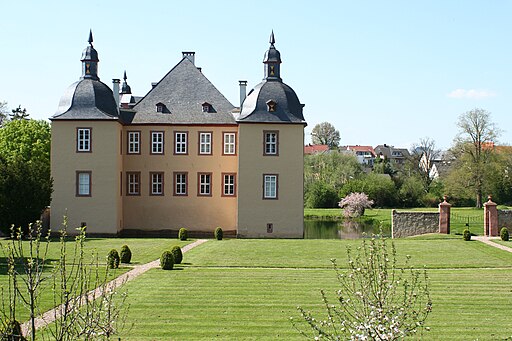
Schloss Eicks, or Eicks Castle, is a picturesque moated castle located in the village of Eicks, near Mechernich in North Rhine-Westphalia, Germany. Nestled in the gentle hills of the Eifel region, the castle combines the charm of Renaissance architecture with the strength and symmetry of medieval defensive design. Surrounded by tranquil water and lush parkland, Schloss Eicks is one of the most beautiful examples of a preserved private estate in western Germany. Though not as large or famous as some of the country’s royal palaces, Schloss Eicks offers an intimate look into the evolution of noble residences from fortified strongholds to elegant manor houses.
Historical Origins
The origins of Schloss Eicks date back to the Middle Ages, when the site was first fortified to control trade routes between the Eifel and the Rhine region. The earliest recorded mention of Eicks appears in the 14th century, at a time when the surrounding lands were held by local knights who served under the Electorate of Cologne.
In the 14th and 15th centuries, the Eicks family, who gave the castle its name, constructed the first fortified manor house on the site. Like many medieval water castles in the Rhineland, it was designed as both a residence and a defensive structure. Its moat, thick walls, and drawbridge reflected the turbulent conditions of the era, when feudal conflicts and territorial disputes were frequent.
As peace gradually returned to the region in the late Middle Ages, the need for purely defensive architecture diminished. The noble owners of Eicks transformed the fortress into a more comfortable and representative residence. By the 16th century, the castle began to take on the appearance it retains today, characterized by elegant façades, decorative gables, and a symmetrical layout.
The Renaissance Transformation
The most significant architectural transformation of Schloss Eicks occurred during the Renaissance period. Around the mid-1500s, the medieval fortress was rebuilt into a two-winged moated castle that reflected the aesthetic ideals of its time.
The reconstruction introduced more balanced proportions and decorative stonework, moving away from military practicality toward domestic refinement. Large windows replaced narrow arrow slits, and the interiors were fitted with ornamental ceilings, fireplaces, and richly carved wood paneling. The surrounding moat and garden were retained but reimagined for beauty rather than defense, creating a harmonious landscape around the residence.
The architectural style of Schloss Eicks from this period represents the transitional phase between the late Gothic and early Renaissance in the Rhineland. The combination of rustic stonework and elegant ornamentation gives the castle its distinctive and enduring charm.
The Von Syberg and Beissel Families
Over the centuries, Schloss Eicks passed through several noble families, each leaving its mark on the estate. In the 16th century, it came into the possession of the von Syberg family, who were instrumental in reshaping the castle’s Renaissance appearance. The von Sybergs were influential landowners with ties to both the ecclesiastical and military elite of the region.
In 1865, the castle was inherited by the Beissel von Gymnich family, one of the oldest noble families in the Rhineland. Under their stewardship, Schloss Eicks was carefully maintained and restored, ensuring its survival through wars and social upheavals. The Beissel von Gymnich family continues to own and inhabit the castle today, preserving it as a private residence while allowing limited public access on select occasions.
This unbroken chain of private ownership has been a key factor in the castle’s exceptional preservation. Unlike many historical buildings that suffered from neglect or over-restoration, Schloss Eicks has retained much of its original character and authentic atmosphere.
Architectural Description
Schloss Eicks is a quintessential example of a Rhenish moated castle. The complex is composed of a main residential building and several outbuildings arranged around an enclosed courtyard, all surrounded by a broad water-filled moat. The castle’s two principal wings are constructed of dark local stone, accented by lighter sandstone details that highlight the windows, doorways, and gables.
The most striking feature of the structure is its symmetrical Renaissance façade, which combines solidity with refinement. The steeply pitched roofs and dormer windows give the building a distinctive silhouette against the backdrop of the surrounding park.
Inside, the castle retains many original architectural elements from the Renaissance and Baroque periods. Wooden staircases, vaulted cellars, and decorative ceilings reflect centuries of careful preservation. The interiors also include a small chapel, historical furnishings, and portraits of the families who once lived there, offering a window into noble life from the 16th to the 19th centuries.
The Moat and Grounds
The moat of Schloss Eicks is not merely decorative but an integral part of the estate’s historical layout. Fed by a nearby stream, it encircles the castle and reflects its walls and towers, enhancing the sense of tranquility and isolation. A stone bridge now replaces the original drawbridge, symbolizing the transformation of the castle from fortress to country estate.
The surrounding parkland and gardens, landscaped in the 18th and 19th centuries, further contribute to the site’s serene atmosphere. Paths wind through manicured lawns, old trees, and flower beds, creating a natural frame around the castle. Although the grounds are privately owned, they occasionally host cultural and social events, such as classical concerts, art exhibitions, and local heritage days.
Role in Regional History
Throughout its long existence, Schloss Eicks has played a quiet but consistent role in the history of the Eifel and Rhineland regions. It served as a local administrative and social center during the feudal era, overseeing agricultural production and providing protection to the surrounding village.
During the Napoleonic period in the early 19th century, like many aristocratic estates in the Rhineland, the castle faced challenges as French troops occupied the region. However, unlike many fortresses that were destroyed or confiscated, Schloss Eicks survived with minimal damage. Its later owners continued to modernize the estate while respecting its historical architecture.
By the 20th century, the castle had become a symbol of regional heritage and continuity. It escaped destruction during both World Wars and remains one of the few privately owned castles in Germany to have been continuously inhabited for over 500 years.
Preservation and Modern Use
Today, Schloss Eicks stands as a rare example of a fully preserved Renaissance moated castle that continues to serve its original purpose as a noble residence. It is not open to the general public on a daily basis, but it occasionally welcomes visitors during cultural heritage events and guided tours arranged by local organizations.
Because of its architectural integrity and historical continuity, Schloss Eicks is protected as a listed monument under German cultural heritage law. The owners maintain the building and grounds with great care, balancing preservation with modern living.
For architecture enthusiasts and historians, Schloss Eicks offers valuable insights into the evolution of aristocratic life in the Rhineland. It demonstrates how medieval castles were gradually transformed into refined residences that reflected both wealth and humanistic ideals.
Cultural and Architectural Significance
Schloss Eicks is more than an architectural relic; it is a living testament to Germany’s noble traditions and rural heritage. Its combination of defensive medieval design, Renaissance elegance, and Baroque refinement makes it a unique representative of architectural continuity in the Eifel region.
Moreover, the castle’s enduring private ownership adds an element of authenticity rarely found in restored or reconstructed sites. Every stone, arch, and gable bears witness to the passage of centuries, yet the building remains warm and alive — a home rather than a museum.
The preservation of Schloss Eicks also highlights the broader efforts within Germany to safeguard its historic manor houses and castles, which form an integral part of the national landscape and cultural identity.
Conclusion
Schloss Eicks stands as a remarkable example of a Rhenish moated castle that has evolved gracefully from medieval fortress to Renaissance residence. With its harmonious architecture, peaceful surroundings, and centuries-long continuity of ownership, it embodies the ideals of stability, elegance, and historical depth that define Germany’s cultural heritage.
