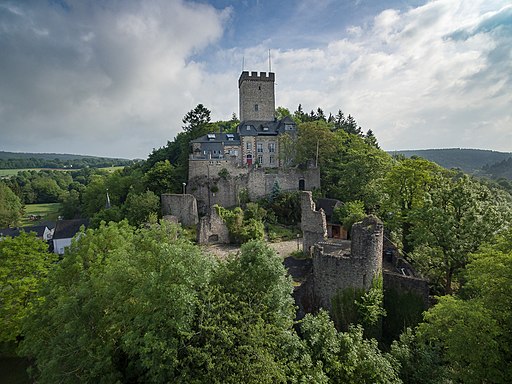
Burg Kerpen stands as a dramatic medieval castle high above the village of Kerpen in the Eifel region of Germany. Perched on a dolomite spur at about 500 meters above sea level, the fortress dominates the surrounding landscape and has witnessed centuries of noble feuds, war-damage, restoration and reuse. Although today it is privately owned and chiefly viewable only from the outside, its story offers a rich window into the history of spur-castles (Spornburgen) in the Eifel and the way historic sites adapt to changing times.
Location and Setting
Burg Kerpen is located above the village of Kerpen (in the Vulkaneifel district of Rhineland-Palatinate), on a prominent dolomite hill spur. The elevated terrain gives the castle a commanding vantage point over the valley and the forested Eifel hills. This hill-top, spur location (Spornlage) was typical for defensive castles seeking natural protection from steep slopes on multiple sides. The site’s altitude, its rock foundation and its visibility from the surrounding terrain all contribute to its significance as both a fortress and a landmark in the region.
Origins and Early History
The precise date of first construction is not definitively known, but historians place the origin of Burg Kerpen in the early 12th century, perhaps around 1150. An individual named Sigibertus de Kerpene, mentioned in 1136, is thought likely to have been its founder or at least the first recorded lord.
In 1265, the estate was entrusted as a fief to the Archbishop of Cologne, Engelbert II of Falkenburg, marking the castle’s integration into larger feudal networks. By 1299 Theoderich III is cited as Lord of Kerpen, whose sons eventually divided ownership into three lines: Kerpen-Linster, Kerpen-Mörsdorf and Kerpen-Illingen. This division turned Burg Kerpen into what is known as a “Ganerbenburg” (a co-owned castle) with complicated shared ownership.
Architectural Layout and Structural Features
Burg Kerpen is a spurred castle built on three terraces. The uppermost terrace holds the main keep (bergfried) and core defensive structures; the middle terrace once had domestic and service buildings; the lower terrace is enclosed by a wall and supported by heavy pillars.
A key defensive feature is a roughly 15-metre-wide neck-ditch (Halsgraben) protecting the spur side of the hill. The bergfried rises to about 23 metres and is topped by crenellations (a later addition) and originally had a dungeon on its top floor.
On the middle terrace almost all original medieval buildings are gone; notably the 35-metre deep well in a circular structure is one of the few surviving features from that era. The lower terrace’s wall and supports hint at the former ensemble of man-houses and service buildings, which were largely destroyed in 1682 by French troops.
Ownership, Conflict and Decline
Ownership of Burg Kerpen saw a long series of shifts and disputes. After the three-way division of 1299, later sales and inheritances gradually moved the castle toward singular ownership: in 1448 Wilhelm II of Sombreff acquired full control. But his death without heirs triggered decades of feuding among noble families: the Manderscheid-Schleiden line, the House of von der Mark, the Counting line of Löwenstein-Wertheim all staked claims.
The conflicts persisted until 1674 when the Imperial Chamber Court (Reichskammergericht) assigned Burg Kerpen to the Duchess of Arenberg.
During the 17th century Burg Kerpen suffered severe damage: in 1682 French troops razed parts of the fortress. Earlier during the Thirty Years’ War the castle and village were also blasted by troops under General Boufflers. The French occupation following 1794 led to the castle’s de-facto ruin status, and in 1803 the French administrators sold it on condition of demolition.
Modern Use and Restoration
By the late 19th century Burg Kerpen was in severe disrepair. In 1893 Johann Heinrich Dün purchased the ruin, cleared out rubble, built the present residence and added the crenellated parapet on the bergfried to give it a romantic silhouette.
In 1911 the Eifel painter Fritz von Wille bought the castle and carried out essential conservation work. He resided there until his death in 1941, and his grave lies on the slope above the castle. After his death the company DEMAG acquired the castle to use it as a training facility. From 1969 to 2007 the County of Neuss (Kreis Neuss) owned it and used it as a country school home (Landschulheim).
In 2010 a Dutch family purchased the property and undertook major renovation. Later, in 2018 a family from Bonn acquired Burg Kerpen with the intent to use it as a private residence.
Significance and Landscape Context
The significance of Burg Kerpen lies not only in its architecture but also in how it reflects feudal, military, and social changes over several centuries. Its location in the Eifel, a region of volcanic geology and rugged terrain, adds further interest: perched on a dolomite spur above forested hills, the castle embodies the adaptation of human settlement to a dramatic natural landscape.
Furthermore, the castle’s successive ownerships, disputes and restorations illustrate the changing nature of aristocratic power, warfare and heritage conservation. Today the fact that Burg Kerpen remains standing (albeit much altered) is a testament to both its initial strategic importance and later romantic revivalism.
Visiting Burg Kerpen Today
While Burg Kerpen is in private ownership, visitors can view the exterior and appreciate its silhouette from the public paths and vantage points around the village of Kerpen. A recommended approach is to follow a hiking trail up from the village or the nearby section of the long-distance trail Eifelsteig, which passes close to the castle and offers splendid views.
Because much of the interior is privately occupied and there have been recent renovation works, access may be restricted and the site should be appreciated respectfully from the outside.
Reflections on Heritage and Conservation
Burg Kerpen illustrates several broader themes in historic castle conservation. Its repeated destruction and rebuilding show how castles are vulnerable to war and politics. Its romantic restoration in the 19th and early 20th centuries aligns with a broader national-historical trend of revitalising medieval architecture for aesthetic and cultural value. The transition to modern uses (school home, private residence) highlights the challenge of finding sustainable functions for historic monuments.
The careful balance between private ownership and public interest also emerges: while full public access is limited, the castle remains an important landmark in the local landscape and culture. Its survival owes much to private initiative and regional tourism interest.
Summary
In summary, Burg Kerpen is a remarkable example of a spur-castle in the German Eifel region. Built in the 12th century and perched high above the village of Kerpen, it has a layered history: division of ownership, feudal conflict, war-damage, restoration, artistic residence and modern private use. Key features such as the triple-terraced layout, the 23-metre bergfried and the well reveal the fortress origins, while later additions reflect changing uses and tastes. For visitors willing to view it from the outside and imagine its dramatic past, Burg Kerpen offers both historical depth and scenic appeal.
