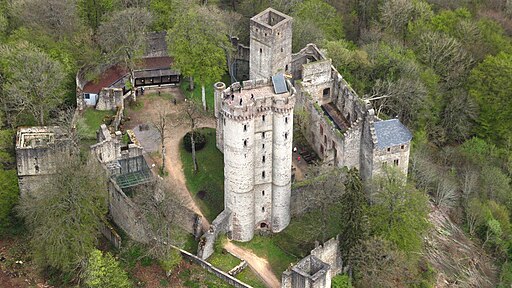
Perched atop a basalt massif at roughly 490 metres above sea level, the fortress known as Kasselburg dominates the skyline above the municipality of Pelm in the Vulkaneifel region of Rhineland-Palatinate, Germany. What remains today is largely a ruin, but it remains remarkably intact in significant parts, and serves as both a monument to medieval and early-modern fortification, and as a dramatic landmark in the Eifel landscape. This article explores its location, origins, architectural evolution, historical roles, later uses and present status—drawing a picture of a castle that has witnessed centuries of power, decay and revival.
Location and Topography
Kasselburg is sited on a steep basalt rock formation rising above the Kyll valley in the county of Vulkaneifel. Its elevated terrain and rugged foundation afforded the castle a dominant position over the surrounding countryside, making it ideal for surveillance and defence. The rocky base and steep slopes mean access is naturally constrained, which in medieval times enhanced its defensive value. The location also contributes to the castle’s dramatic silhouette: the double tower and the remaining fortifications perched on the dark basalt make for a powerful visual marker in the Eifel region.
Origins and Early Construction
While precise construction dates and original builders of Kasselburg remain partly conjectural, historians place its origin in the 12th century, likely between about 1100 and 1200. The earliest documented reference to the castle appears in 1291 under the name “Castilburg”. Some scholars propose that the lords of Castel may have established the initial fortress, though certainty is lacking. The earliest structural elements include a square keep (bergfried) dating to around 1200, which now lies within the inner ward and later became integrated into the castle’s residential transformation.
Architectural Evolution
The Core Fortification
The core of Kasselburg features remnants of its original medieval castle structure: thick curtain walls, the keep, and the inner ward’s palas (the stately residential hall). Around the mid-14th century the nearly 33-metre long palas was constructed, signalling the transition of the castle from purely military to partly residential function. The square keep (as noted) endowed the site with early defensive capacity, and as time passed the castle evolved in response to changing needs of defence, dwelling and representation.
The Double Tower and Outer Bailey
One of the most distinctive features is the 37-metre-high double tower — a gate-and-residential tower combined — built in phases through the 14th century and later. Although visually commanding, it is not to be mistaken for the bergfried (which is smaller and older). From about 1452 onward the castle was expanded significantly, adding a wide outer bailey (Vorburg) with “burgmann” houses and service buildings, showing the growing role of the castle as a settlement node and not strictly a fortress.
Adaptation and Decline
Through the 15th to 17th centuries, Kasselburg’s architecture reflected shifting political and military realities. As ownership changed and defensive warfare altered, parts of the fortress fell into disuse or were repurposed. The castle’s onward decline became apparent by the 18th century, when descriptions mention it already in a dilapidated state.
Historical Roles and Ownership
Kasselburg’s history is one of shifting proprietors and brokering of power. In 1335 the eminent nobleman Gerhard V of Blankenheim inherited the castle, thereby founding the Blankenheim-Kasselburg line. That line died out in 1406, and the castle passed through marriage and treaties into the hands of the Counts of Loen/Heinsberg, then later to the Counts of the Mark and the Dukes of Arenberg, and the Electors of Trier among others. The multiplicity of claims led to a property dispute that was adjudicated by the Imperial Chamber Court (Reichskammergericht) in 1674. Under the Arenberg dukes the castle was used for military purposes (artillery barracks) rather than noble residence, marking a shift to utilitarian use and contributing to the dismantling of the castle’s status as a high-fortress. When French forces took the region in 1794 and later the site entered Prussian ownership in 1815, the castle’s role as power centre effectively ended and its maintenance became sporadic.
Conservation, Revival and Current Use
In the 19th and 20th centuries, conservation efforts brought Kasselburg back into public attention. Notably in 1838 King Frederick William IV visited and initiated repairs. Later the state heritage authorities of Rhineland-Palatinate undertook major restoration. The castle is now under the care of the Directorate for Castles, Palaces and Ancient Monuments of the General Directorate for Cultural Heritage Rhineland-Palinate.
Today, the fortress is open to visitors and offers not only the historical ruins but also an animal park: the adjacent Adler‑ und Wolfspark Kasselburg houses eagles and a large half-wild wolf pack in the grounds linked to the castle. This add-on makes the site attractive to families and a broader audience, combining heritage and wildlife. The castle also hosts seasonal events like falconry shows and wolf nights.
Archaeological and Interpretive Highlights
Visitors to Kasselburg can appreciate several architectural features: the double tower with sweeping views across the Eifel, the inner ward including the palas, the outer bailey with its later buildings, and the dramatic basalt outcrop on which the castle sits. Interpretive signage highlights the construction phases, changing roles, and the castle’s integration into the landscape. The site’s elevated position makes it especially evocative of its original status as a fortress commanding the region.
Visitor Experience and Practical Information
Located near Gerolstein in the Eifel, Kasselburg is accessible by road and is a prominent landmark visible from the valley. The castle grounds and animal park have defined opening hours (for example March 1 to October 31 daily 10 : 00–18 : 00) though closures and seasonality apply. Visitors are advised to wear appropriate footwear—the terrain is steep and uneven in places. The viewpoint from the double tower is highly recommended for its panoramic vistas. The combination of heritage and wildlife makes for an enriching family day out.
Significance and Reflection
Kasselburg stands as a testament to the multifaceted nature of medieval and early-modern castles: not simply defensive strongholds but centres of lordship, administration, residence and symbol. Its layered history—from 12th-century foundation through high-medieval renovation, early-modern decline, to modern conservation—mirrors wider historical trends in the Rhineland and Eifel. Furthermore, its dramatic site on a basalt outcrop amplifies the interplay between nature and human craftsmanship. The addition of the eagle and wolf park takes the heritage beyond stone walls and towers, connecting wildlife, geology and history in one location.
Summary
In summary, Kasselburg is more than just a castle ruin; it is a living landmark that encapsulates centuries of noble endeavours, architectural evolution and landscape dominance. Its striking double tower, the expansive outer bailey, the basalt perch and the surrounding wolf and eagle park all contribute to its distinctiveness. For anyone exploring the Eifel region or interested in medieval castles with a dramatic setting and layered story, Kasselburg offers a compelling destination.
.jpg)