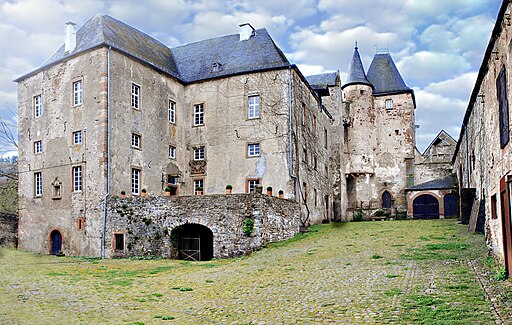
The Living History of Burg Lissingen: A Fortress Through the Ages
Burg Lissingen, located on the banks of the River Kyll near Gerolstein in the Eifel region of Rhineland-Palatinate, Germany, is one of the most fascinating and best-preserved examples of a medieval moated castle complex in western Germany. Unlike many ruins that have succumbed to time, Burg Lissingen remains a vibrant historical site, still standing as a rare testament to centuries of architectural evolution, social transformation, and the enduring spirit of the Rhineland’s fortified heritage.
Early Origins and Strategic Foundations
The story of Burg Lissingen begins in the early Middle Ages, around the 10th or 11th century, when the Eifel region was a frontier landscape dotted with fortifications, monasteries, and estates owned by regional lords and ecclesiastical institutions. The site’s strategic position along the River Kyll made it an ideal location for a fortified residence. The flowing water provided both natural defense and a reliable source of power for mills, while the fertile valley sustained agricultural production to support the estate.
The earliest form of the castle was likely a fortified manor—a combination of residential and defensive structures surrounded by a moat fed by the river. These early strongholds, known as Wasserburgen (water castles), were typical of the Rhineland, where water defenses compensated for the lack of steep terrain. Over the centuries, this modest medieval stronghold grew into an extensive two-part castle complex that survives today.
The Lords of Lissingen and Feudal Development
Throughout the Middle Ages, Burg Lissingen was closely tied to the noble families of the region and their overlords. It is believed that the estate originally belonged to the Abbey of Prüm, one of the most influential monastic institutions in the Eifel. As was common in feudal society, the abbey granted the property to vassals—local knights and noble families—who administered the land in exchange for service and allegiance.
The Lords of Lissingen managed the surrounding lands, collecting tithes, protecting trade routes, and maintaining order in the nearby settlements. Their authority was both administrative and military, reflecting the dual function of the castle as both home and fortress. The castle’s fortified design—with its defensive towers, inner courtyards, and drawbridge—symbolized feudal power and the social hierarchy of the medieval world.
Division into Upper and Lower Castles
One of the most distinctive features of Burg Lissingen is its unique division into two separate parts: the Upper Castle (Oberburg) and the Lower Castle (Unterburg). This division, which occurred in the late Middle Ages, was the result of inheritance and property division among different branches of the owning family.
The Upper Castle served as the main residential area, housing the noble family and featuring representative halls and living quarters. The Lower Castle functioned more as an economic center, containing stables, workshops, storage buildings, and agricultural facilities. Despite their separate ownership, both sections were interconnected by walls and shared the same moat and water defenses.
This split is exceptionally rare among medieval castles in Germany and offers a valuable insight into how noble estates evolved under the complex laws of inheritance and family division.
Architectural Evolution and Renaissance Refinement
By the 16th century, Burg Lissingen had transformed from a purely defensive fortress into a comfortable noble residence. The Renaissance brought new architectural ideals—symmetry, decoration, and livability. The thick medieval walls were modified to include larger windows, elegant stone portals, and more spacious interiors.
Additions such as stair towers, vaulted cellars, and decorative gables reflected changing tastes and the reduced military necessity of castles during peacetime. The castle’s moat and defensive towers, while still intact, became more symbolic of prestige than of active defense.
The construction materials—local basalt, tuff stone, and timber—gave Burg Lissingen its characteristic Eifel appearance, blending durability with aesthetic charm. Despite renovations and expansions, the castle retained its organic medieval layout, reflecting layers of architectural adaptation rather than a single, uniform plan.
Turmoil, War, and Survival
Like many properties in the Rhineland, Burg Lissingen was not immune to the upheavals of European history. During the Thirty Years’ War (1618–1648), the region suffered from plundering armies and shifting political alliances. The castle’s owners faced military occupation and economic hardship, though Burg Lissingen itself avoided total destruction—a fate that befell many neighboring estates.
Later conflicts, including the wars of Louis XIV and the Napoleonic campaigns, once again disrupted the Eifel’s traditional order. The French Revolutionary government abolished feudal privileges, confiscating church and noble properties. Burg Lissingen, once under the jurisdiction of the Abbey of Prüm, became a secular estate and changed hands several times during this period.
Despite these transitions, the castle complex remained remarkably intact, a testament to both its solid construction and its adaptability to new economic and social realities.
From Noble Estate to Modern Enterprise
In the 19th and 20th centuries, Burg Lissingen gradually evolved from an aristocratic residence into a productive agricultural estate. The Lower Castle, with its spacious outbuildings and river access, became the center of a thriving farm operation. The introduction of modern milling equipment, livestock breeding, and later small-scale industry kept the property economically viable well into the modern era.
During the 20th century, the castle’s dual identity—as both a historic monument and a working estate—became its defining characteristic. Even as industrialization and war swept across Europe, Burg Lissingen continued to adapt without losing its historical integrity.
The post-war period brought new appreciation for the site’s cultural value. Efforts to preserve its buildings, archives, and landscape intensified, leading to restoration projects that respected both the historical structure and the functional nature of the estate.
Architectural Highlights and Layout
Visitors to Burg Lissingen today encounter an extensive complex that spans several architectural styles and periods. The castle’s defining features include:
-
The Defensive Towers – Massive round towers flank both the Upper and Lower Castles, their thick stone walls evoking the fortress origins of the site.
-
The Gatehouse and Bridge – The main entrance retains its medieval character, complete with remnants of a drawbridge mechanism that once spanned the moat.
-
Residential Halls – The Upper Castle’s noble halls, with vaulted ceilings and Gothic arches, display centuries of adaptation for comfort and prestige.
-
Agricultural Courtyards – The Lower Castle’s spacious courtyards house barns, stables, and workshops, illustrating the castle’s economic role across time.
-
Moat and River Connection – The flowing Kyll River continues to encircle and feed the moat, maintaining the historic relationship between water, defense, and livelihood.
Every structure, from the smallest gate to the grandest hall, tells a story of practical evolution and aesthetic refinement.
Burg Lissingen in the Modern Era
Today, Burg Lissingen stands as one of the few privately owned castles in the Eifel region that remains largely preserved in its historical form. It is open to the public for tours, cultural events, and exhibitions that highlight the intersection of architecture, history, and rural life.
Visitors can explore both the Upper and Lower Castles, gaining insight into the domestic routines of noble families, the agricultural foundations of the estate, and the architectural details that span nearly a millennium. The castle also hosts markets, concerts, and educational programs that connect the community to its historical roots.
Beyond tourism, Burg Lissingen remains a living estate. Parts of the property continue to serve agricultural or residential purposes, maintaining the continuity between past and present that defines its unique character.
Cultural and Historical Significance
Burg Lissingen is not merely a preserved monument—it is a microcosm of Eifel history. From feudal stronghold to Renaissance manor, from Napoleonic estate to modern heritage site, it encapsulates the adaptability and endurance of European rural nobility.
Its dual structure symbolizes both division and unity—two castles, once separated by inheritance, now reunited as a single cultural landmark. Its survival through wars, reforms, and modernization speaks to the resilience of the people and traditions of the Rhineland.
As a living monument, Burg Lissingen offers an authentic window into the layered history of Germany’s countryside—where architecture, landscape, and human endeavor converge in a story that continues to unfold.
Conclusion
Burg Lissingen stands as one of the finest examples of a medieval water castle that has evolved without losing its soul. Set amid the natural beauty of the Eifel valley, it embodies the harmony between defense, residence, and rural enterprise.
From its origins as a fortified manor to its modern role as a heritage and cultural center, Burg Lissingen has remained steadfast—its towers reflecting in the waters of the Kyll as they have for nearly a thousand years. It is not just a relic of the past but a living symbol of continuity, reminding us that history endures not only in ruins, but in places that still breathe with life, tradition, and timeless dignity.
