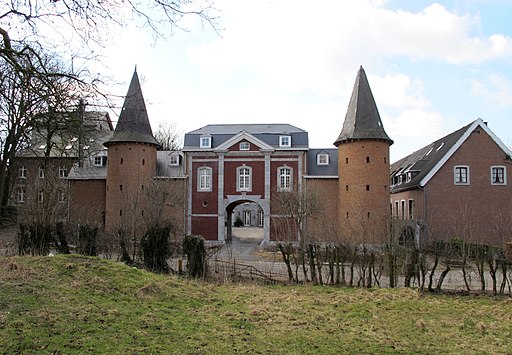
Burg Stockem is a historically significant medieval castle located in the Eifel region of western Germany, near the small village of Stockem in Rhineland-Palatinate. The castle’s origins date back to the High Middle Ages, with its foundations rooted in the complex feudal landscape that characterized this part of the Holy Roman Empire. Over the centuries, Burg Stockem has served various roles ranging from a defensive stronghold and noble residence to a symbol of local power and influence. Today, despite partial ruin, the castle offers rich insights into medieval fortification architecture and the technical prowess involved in its construction and adaptation over time.
Historical Overview and Strategic Importance
The establishment of Burg Stockem likely occurred during the 12th century when territorial lords sought to fortify their holdings in the Eifel, a region marked by rugged terrain and frequent conflict. The castle was strategically positioned on an elevated plateau, providing a commanding view of the surrounding valleys and routes, essential for monitoring and controlling trade and military movements. Its placement reflects a typical medieval defensive strategy of exploiting natural topography to enhance fortification.
Throughout its history, Burg Stockem was subject to multiple ownership changes, sieges, and reconstructions, particularly during the turbulent periods of the Late Middle Ages and early modern era. The castle’s design and structural adaptations reveal a continuous effort to balance military defense with residential comfort and administrative functions, illustrating the evolving needs and technological advancements of the time.
Architectural Layout and Defensive Systems
Burg Stockem is classified as a hilltop castle or Höhenburg, designed to leverage its topographical advantage. The castle complex is organized around a central courtyard, enclosed by thick defensive walls and a series of towers that punctuate the perimeter. The main building includes a keep or bergfried—an imposing tower that served as a last refuge during attacks—and a residential palas, which housed the living quarters of the lord and his retinue.
The castle walls are constructed primarily of locally sourced volcanic rock, predominantly basalt and slate, materials known for their durability and resistance to erosion. These stones were laid using rubble masonry techniques with lime mortar, producing walls approximately 1.5 to 2 meters thick. This thickness was crucial to withstand artillery fire and battering during sieges. The walls’ height averages 10 to 12 meters, providing formidable barriers against climbing and scaling attempts.
Defensive features include a moat—likely dry today but originally filled with water or used as a ditch—designed to impede enemy advances and undermine siege equipment. The entrance is fortified with a gatehouse incorporating a portcullis and murder holes, allowing defenders to target attackers while minimizing exposure. Arrow slits or loopholes are strategically positioned along the walls and towers to enable crossbowmen to deliver precise fire at assailants without compromising their safety.
Structural and Technical Parameters
The foundation of Burg Stockem is a critical element in its longevity and defensive capability. Built on solid volcanic bedrock, the foundation provides an excellent load-bearing base, essential for supporting the heavy stone walls and towers. Excavations suggest the foundations reach depths of 1.5 to 2 meters below the natural ground level, ensuring stability even in the face of natural shifts or external stress from siege activities.
The masonry work exhibits advanced medieval techniques. The walls combine rough-hewn basalt blocks for the core structure with carefully cut ashlar blocks at corners, door frames, and window openings to enhance structural integrity and aesthetic appeal. The lime mortar used was produced from local limestone deposits, mixed with sand and water, and applied in multiple thin layers to optimize adhesion and flexibility. This combination allowed the walls to absorb minor movements without cracking.
The bergfried, approximately 20 meters tall, features walls that taper slightly from base to summit, a design that improves both stability and resistance to projectiles. Internally, the bergfried includes narrow winding staircases embedded within the thick walls, allowing defenders to move vertically while remaining protected. Floors inside the tower were constructed from heavy timber beams supported by stone corbels, with openings for ventilation and light.
Roofing systems on Burg Stockem’s buildings use steeply pitched timber frameworks covered with slate tiles. These roofs are engineered to handle the Eifel’s climatic conditions, particularly heavy rain and snow, with angles often exceeding 45 degrees to facilitate efficient runoff and prevent water infiltration.
Functional Spaces and Residential Features
While Burg Stockem was primarily designed for defense, it also served as a noble residence with dedicated living spaces. The palas—the main residential building—includes great halls with large fireplaces for heating, private chambers with smaller windows for insulation and security, and service rooms for storage and daily operations. The interiors were built to balance comfort with defensibility, with thick walls that maintained stable indoor temperatures.
Chapel spaces within the castle indicate the importance of religion and spiritual life in medieval noble households. These chapels were often adorned with simple frescoes and contained small altars, designed to serve the lord’s family and retainers. The presence of water wells within the courtyard ensured self-sufficiency during sieges, a common feature in castles of the period.
Modern Conservation and Archaeological Insights
Today, Burg Stockem exists largely as a ruin, but significant portions of the walls, gatehouse, and bergfried remain intact. Conservation efforts focus on stabilizing these structures to prevent further deterioration. Preservation techniques include re-pointing masonry with historically accurate lime mortar, removing invasive vegetation that threatens the stonework, and reinforcing weakened sections with discreet support systems.
Archaeological research at Burg Stockem has uncovered artifacts such as pottery shards, metal tools, and weapon fragments, providing valuable data on the daily life of its medieval inhabitants and the military technologies employed. Modern surveying technologies, including 3D laser scanning, have allowed detailed documentation of the castle’s current state, enabling virtual reconstructions and detailed studies without intrusive interventions.
Conclusion: Burg Stockem as a Medieval Engineering Marvel
Burg Stockem stands as a testament to the technical and architectural ingenuity of medieval castle builders in the Eifel region. Its robust basalt construction, sophisticated defensive design, and adaptive use over centuries illustrate a deep understanding of both military engineering and residential requirements. The castle’s strategic siting and well-planned fortifications reflect the complexities of feudal territorial control and warfare during the Middle Ages. Modern preservation and archaeological efforts ensure that Burg Stockem continues to offer valuable insights into medieval life and construction techniques, maintaining its status as an important cultural and historical landmark.
