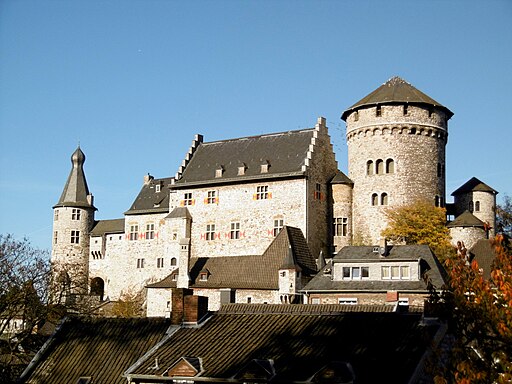
Burg Stolberg, perched dramatically above the town of Stolberg in the Harz region of Saxony-Anhalt, Germany, is a quintessential medieval castle that embodies the strategic military architecture and residential sophistication of its era. Founded in the 12th century, this castle played a pivotal role in the defense and administration of the Stolberg valley, serving as a symbol of noble authority and regional power. Over the centuries, Burg Stolberg has evolved architecturally, reflecting advances in fortification technology and changing residential needs. Today, it stands as a remarkable testament to medieval engineering, blending rugged defensive features with elegant residential quarters.
Historical Development and Strategic Location
Burg Stolberg was constructed around the mid-1100s by the Counts of Stolberg, a noble family whose influence shaped the region for centuries. Its position atop a granite promontory offers commanding views over the surrounding valley, a strategic choice that maximized natural defensive advantages. The elevated site not only provided early warning of approaching enemies but also controlled key trade and transit routes running through the Harz Mountains, highlighting the castle’s dual role in military oversight and economic control.
Throughout its existence, Burg Stolberg underwent several phases of construction and renovation, driven by military conflicts such as regional feuds, the Thirty Years’ War, and the modernization pressures of the Renaissance. These phases introduced distinct architectural styles and fortification improvements, transitioning from purely medieval defensive structures to more comfortable and stately noble residences while still maintaining robust defensive capabilities.
Architectural Composition and Fortification Features
The architectural footprint of Burg Stolberg is characterized by a compact yet complex layout, encompassing a central keep, defensive curtain walls, residential wings, and auxiliary buildings all nested within an irregular polygonal plan that conforms to the rocky outcrop it occupies. The castle’s core is its bergfried—an imposing, cylindrical tower rising approximately 30 meters high, with walls up to 3 meters thick at the base. This tower served as both a lookout and a final refuge during attacks, its solidity testament to medieval masonry techniques.
The surrounding curtain walls, constructed of locally quarried granite and sandstone, vary between 1.5 to 2.5 meters in thickness and extend to heights of 10 to 15 meters. These walls are punctuated by several semi-cylindrical bastions designed to provide flanking fire and eliminate blind spots around the perimeter. The bastions are equipped with embrasures—small openings for firearms or artillery—that reflect adaptations made in the 16th and 17th centuries in response to the increasing use of gunpowder weapons.
Access to the castle is controlled through a fortified gatehouse featuring a portcullis and drawbridge system over a dry moat, originally designed to repel attackers and delay any direct assault on the inner courtyard. The gatehouse itself incorporates murder holes, allowing defenders to target invaders from above with stones, boiling liquids, or arrows. The defensive design integrates multiple layers of protection, including an outer bailey for additional defense and space for service buildings.
Construction Techniques and Material Usage
Burg Stolberg’s construction showcases the skilled use of regional materials and advanced medieval building methods. Granite, abundant in the Harz Mountains, forms the castle’s structural backbone. This igneous rock’s high compressive strength, typically above 130 MPa, enables the construction of massive load-bearing walls and towers capable of resisting both siege engines and natural erosion. The granite blocks are cut and shaped with precision, particularly at corners and doorways, where ashlar masonry provides structural reinforcement and a clean aesthetic finish.
The mortar binding these stones is a lime-based mixture, crafted from local limestone, sand, and water. Its composition allows for slight flexibility, which is crucial in accommodating the natural settling of the structure without significant cracking. The walls feature rubble core masonry between the outer ashlar faces, optimizing the use of irregular stones and providing internal mass for thermal insulation and strength.
The bergfried’s interior is divided into several levels connected by narrow, winding staircases built into the wall thickness. These stairways are constructed with stone steps supported by corbels, showcasing expert stonemasonry. The floors within the tower and other residential buildings utilize heavy timber joists and planks, often reinforced with iron nails and brackets, balancing strength with the flexibility needed for daily use.
Roofs on Burg Stolberg’s buildings are predominantly steeply pitched timber trusses covered with slate tiles, a material native to the region. The steep angles, often exceeding 50 degrees, ensure effective water and snow shedding, crucial in the Harz’s wet and snowy climate. The roofing structures incorporate complex joinery techniques to resist wind uplift and heavy snow loads, including mortise-and-tenon joints and wooden pegs.
Defensive and Residential Integration
While Burg Stolberg was first and foremost a military installation, its design integrates extensive residential and administrative facilities. The palas, or great hall, is a focal point of noble life within the castle, featuring large hearths for heating, expansive windows with wooden shutters for light control, and intricately carved wooden furniture. The interior walls were often plastered and painted, indicating a degree of luxury uncommon in purely military fortifications.
Chapel spaces within the castle emphasize the spiritual role the fortress played in the daily lives of its inhabitants. These chapels, often small but richly adorned, included stained glass windows and stone altars. The presence of wells and cisterns ensured a reliable water supply even during prolonged sieges, a critical feature that speaks to the castle’s planning for sustainability under siege conditions.
The integration of gunports and artillery embrasures in the later construction phases reflects the castle’s adaptation to the advent of gunpowder warfare. These innovations allowed defenders to deploy firearms effectively while maintaining traditional defensive structures, marking Burg Stolberg as an example of military architectural evolution.
Conservation Efforts and Modern Significance
Today, Burg Stolberg is a well-preserved cultural monument undergoing continuous preservation efforts. Conservation teams employ non-invasive techniques to maintain the structural integrity of the granite masonry and restore damaged sections with historically accurate materials. Modern analysis tools, including 3D laser scanning and ground-penetrating radar, assist in diagnosing structural weaknesses and planning restorative interventions.
Archaeological investigations at the site have revealed artifacts ranging from medieval weaponry to domestic ceramics, enriching understanding of both the castle’s military and everyday life aspects. Educational programs and guided tours highlight Burg Stolberg’s historical and technical importance, positioning it as a vital component of regional heritage tourism.
Conclusion: Burg Stolberg’s Enduring Architectural Legacy
Burg Stolberg remains a compelling example of medieval fortress engineering combined with residential sophistication. Its commanding location, robust granite construction, layered defensive systems, and thoughtful integration of living spaces reflect centuries of architectural evolution and strategic necessity. The castle’s ability to adapt from a purely military bastion to a noble residence equipped for gunpowder warfare underscores its technical and historical significance. Continued preservation and scholarly research ensure that Burg Stolberg not only survives as a physical monument but also as a source of knowledge and inspiration for medieval architecture and engineering enthusiasts.
.JPG)