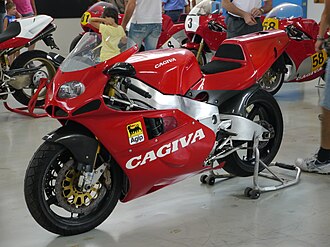
Cagiva F4: The Italian Superbike Project That Became an MV Agusta Legend
The Story Behind the Cagiva F4
The Cagiva F4 is a fascinating chapter in Italian motorcycle history because it represents the meeting point of ambitious engineering, racing-inspired design, and the revival of one of the most celebrated names in motorcycling. Although the production motorcycle eventually became known as the MV Agusta F4, the project was developed under the Cagiva group and grew from the Castiglioni family’s ambition to create an exclusive, high-performance Italian superbike capable of challenging the finest Japanese and European machines. The F4 was conceived as more than a fast road motorcycle: it was intended to demonstrate that Italian manufacturers could combine advanced mechanical engineering with distinctive styling, exceptional component quality, and an emotional character that would make the machine desirable even when parked. Its development involved years of technical work, changes in direction, and the contribution of engineers and designers who helped turn a difficult project into one of the most recognizable superbikes of its generation. The motorcycle eventually reached the public under the MV Agusta name, but Cagiva’s influence was central to its creation, making the F4 an important part of the history of both brands.
The name “Cagiva F4” can be confusing because the production motorcycle most enthusiasts associate with the designation was marketed as the MV Agusta F4 rather than as a Cagiva-branded model. The distinction matters: the F4 emerged from the Cagiva group’s development programme, but its public launch in 1997 marked the return of the MV Agusta marque as a maker of premium sport motorcycles. The production F4 750 entered the market in limited numbers before becoming available in more accessible versions, including the F4 750 S. It combined a 749cc liquid-cooled inline-four engine, sophisticated chassis components, and a striking design by Massimo Tamburini. The machine’s signature four-pipe exhaust arrangement beneath the tail, single-sided swingarm, and red-and-silver styling made it instantly recognizable. For this reason, the most accurate way to understand the Cagiva F4 is as the Cagiva-developed project that gave birth to the modern MV Agusta F4, rather than as a separate mass-produced Cagiva motorcycle.
The Origins of the F4 Project
Cagiva’s ambition to build an Italian superbike
During the late 1980s and 1990s, the Castiglioni family sought to expand Cagiva’s reputation beyond its existing motorcycles and racing activities. Cagiva had already built an identity around Italian engineering, competition, and distinctive design, but the company wanted a flagship superbike that could compete in the increasingly demanding high-performance road-bike market. Japanese manufacturers had established a formidable position with sophisticated four-cylinder sport motorcycles, while Ducati had shown how a European manufacturer could attract worldwide attention through a combination of performance, racing credibility, and design. Cagiva’s proposed answer was an exclusive four-cylinder motorcycle with advanced engineering and a character that would distinguish it from the competition. The project changed considerably during development, but the central ambition remained consistent: to build a superbike that could stand alongside the best machines in the world and restore the prestige of the MV Agusta name.
The project was not straightforward. Creating a completely new engine, developing a production-ready chassis, and preparing a premium motorcycle for manufacture required substantial financial and engineering resources. The company also had to decide how the motorcycle should be positioned: it needed to be technologically impressive, but it also had to be practical enough to manufacture, service, and sell. Early prototypes and design proposals differed from the final production machine, and some of the more ambitious technical ideas had to be reconsidered as development progressed. The eventual F4 was therefore the result of repeated engineering decisions rather than a single unchanging design concept. Its long gestation helps explain why the motorcycle attracted so much interest before production began and why its eventual arrival was viewed as an important moment for Italian motorcycling.
The unusual relationship with Ferrari and Ducati
One of the most intriguing elements of the F4 story is the role of Ferrari-associated engineering in the development of its engine. The original concept involved collaboration with Ferrari Engineering, and the letter “F” in the F4 name is commonly associated with this part of the project’s history. However, it would be misleading to suggest that the production motorcycle simply used a Ferrari car engine adapted for a motorcycle. The F4 power unit was a purpose-designed motorcycle engine, and the design went through substantial development as the project evolved. Cagiva’s engineering team subsequently refined the engine into a production-ready 749cc liquid-cooled inline-four. Ducati was also involved during an earlier phase of the wider project, reflecting the relationships and technical resources available within the Castiglioni group’s motorcycle businesses. The production F4 was ultimately its own machine, created through a complicated process of concept development, engineering revision, and industrial preparation.
This development history is important because it illustrates the difference between an ambitious prototype and a successful production motorcycle. A prototype can explore unusual layouts, advanced materials, and unconventional systems, but a road-going machine must also meet durability, serviceability, manufacturing, and regulatory requirements. The F4’s engineers had to turn the original vision into an engine and chassis package that could be built consistently and maintained by dealers and owners. The production motorcycle retained several distinctive ideas, including radial valve placement, a central cam-chain arrangement, and a removable gearbox, but these features were integrated into a coherent design intended for real-world use. The final F4 was therefore not merely a showpiece; it was the outcome of a lengthy attempt to make a technically ambitious Italian superbike viable as a production product.
Massimo Tamburini and the Design of the F4
A landmark in Italian motorcycle styling
The visual identity of the F4 is inseparable from Massimo Tamburini, the influential designer who led the Cagiva Research Center and was responsible for shaping the motorcycle’s final form. Tamburini had already earned international recognition for his work on high-performance motorcycles, and his design approach emphasized the relationship between mechanical components, proportions, and the overall silhouette. The F4 reflected this philosophy through its compact bodywork, sculpted fuel tank, sharply defined fairing, and carefully integrated rear section. Rather than treating the engine, chassis, exhaust, and bodywork as separate elements, the design brought them together into a visually coherent machine. The result was a motorcycle that looked purposeful from almost every angle, with details that rewarded close inspection and an overall shape that remained distinctive even beside other superbikes of the period.
The F4’s most recognizable styling feature is its four exhaust outlets arranged beneath the seat. This layout became one of the motorcycle’s defining visual signatures and gave the rear of the machine an unusual symmetry. It was also part of a broader design language in which mechanical elements were made visible and celebrated rather than concealed wherever possible. The single-sided swingarm exposed the rear wheel, while the compact tail and layered bodywork created a sense of movement even when the motorcycle was stationary. The red-and-silver color scheme strengthened the association with Italian racing heritage and helped establish the F4 as a flagship product. Its design was distinctive without relying solely on exaggerated angles or decorative graphics; much of its appeal came from the way its components appeared to fit together naturally.
Design inspired by racing, but built for the road
The F4’s appearance was strongly influenced by Cagiva’s experience in Grand Prix racing, although the production motorcycle was not simply a road-legal version of a 500cc two-stroke race bike. The fairing and riding position communicated a racing purpose, while the compact chassis and high-revving four-cylinder engine placed it firmly in the superbike category. The machine also reflected lessons learned from earlier Italian sport motorcycles, especially the importance of creating a strong visual identity that could distinguish a premium product in a competitive market. The design was ambitious, but it still had to accommodate lights, mirrors, cooling systems, road equipment, a fuel tank, and a seating position suitable for public roads. Tamburini’s achievement was to integrate these requirements without sacrificing the motorcycle’s sporting character. The F4 consequently became an example of how a production superbike could feel special not only because of its speed, but also because of its engineering details and overall presentation.
The F4 Engine: Italian Engineering and High-RPM Performance
The 749cc inline-four power unit
At the heart of the original production F4 750 was a 749cc, liquid-cooled, four-stroke inline-four engine with double overhead camshafts and four valves per cylinder. The bore and stroke measured 73.8 × 43.8 mm, giving the engine a markedly oversquare configuration suited to high engine speeds. Early published specifications quoted approximately 126 horsepower at around 12,000–12,500 rpm, although output figures vary slightly between sources and model specifications. The engine was designed to deliver the sort of high-revving performance expected from a premium 750cc superbike while retaining the compact dimensions needed for a carefully packaged chassis. Fuel injection and electronic engine management helped regulate fuel delivery, while the liquid-cooling system maintained operating temperatures under demanding riding conditions. The resulting power unit gave the F4 a technical identity of its own and helped distinguish it from competitors that relied on more conventional engineering layouts.
One of the engine’s most interesting features was its radial-valve arrangement. In a conventional four-valve cylinder head, the valves are generally arranged in a more parallel or symmetrical pattern, whereas the F4’s radial layout positioned the valves at angles intended to support combustion-chamber design and gas flow. This was an unusual feature for a production motorcycle engine and reflected the project’s determination to bring distinctive engineering ideas into the showroom. The design also used a central cam-chain drive, rather than the more familiar side-mounted arrangement used by many competing inline-four engines. This layout helped manage the engine’s overall dimensions and contributed to the compact packaging that the design team wanted. Such features were not simply marketing details: they reflected a coordinated approach to engine architecture, where the cylinder head, camshaft drive, intake, exhaust, and chassis dimensions were developed as parts of the same system.
Removable gearbox and mechanical sophistication
The original F4 engine also featured a removable, cassette-type six-speed gearbox. This arrangement allowed transmission components and gear ratios to be serviced or changed without completely splitting the engine crankcases, a feature particularly attractive in racing and specialist motorcycle engineering. The transmission used a conventional six-speed sequence, giving riders the gearing flexibility expected of a high-performance sport motorcycle. Although a removable gearbox does not by itself make a motorcycle faster, it can simplify certain maintenance operations and reflects a design philosophy that values accessibility for important mechanical components. Combined with the radial-valve cylinder head, central cam-chain drive, and electronic fuel injection, the gearbox helped give the F4 an unusually sophisticated technical specification for a road-going superbike of its era.
The engine’s character was also part of the F4’s appeal. Its four-cylinder configuration produced a smooth mechanical rhythm compared with the more uneven pulse of a large V-twin, while its high-revving nature encouraged riders to explore the upper part of the rev range. The combination of power delivery, intake noise, and the distinctive exhaust system created an experience that felt different from that of many contemporary sport motorcycles. Yet the F4 was not designed around engine output alone. Its performance depended on the interaction between the engine, gearing, chassis, suspension, tires, and rider position. The engine’s compact design helped the engineers achieve the desired overall proportions, while its power and rev range placed the motorcycle firmly among the serious performance machines of the late 1990s.
Chassis, Suspension and Braking
A frame designed around handling and precision
The F4 used a hybrid chassis construction that combined a tubular steel trellis structure with cast or machined aluminium sections. This approach gave the engineers different ways to manage rigidity, component mounting, and overall packaging. The frame needed to be stiff enough to provide accurate steering and stable behavior under braking, but it also had to work with the suspension and tires to preserve grip over uneven road surfaces. A motorcycle’s handling is rarely determined by one component; instead, it emerges from the relationship between steering geometry, wheelbase, weight distribution, frame stiffness, suspension settings, tire construction, and rider input. The F4’s chassis was designed to create a balanced platform for its high-performance engine, allowing the motorcycle to combine stability at speed with the precision needed on winding roads and racetracks.
A particularly notable feature was the single-sided rear swingarm, which left the rear wheel visually exposed and reinforced the F4’s distinctive styling. Single-sided swingarms can simplify wheel removal in some designs and provide a striking appearance, but they must also provide the required structural strength and control of rear-wheel alignment. On the F4, the swingarm was part of the motorcycle’s overall engineering identity, complementing the compact tail and under-seat exhaust arrangement. The chassis and swingarm were not merely decorative features; they contributed to the motorcycle’s rigidity, handling behavior, and ability to transfer engine power to the road. Their design helped the F4 look and feel like a carefully engineered flagship rather than an ordinary sport motorcycle with exotic bodywork.
Suspension and braking components
The original F4 750 used high-quality, fully adjustable suspension components, with specifications varying by version and year. The front suspension was designed to manage the loads created by hard braking and rapid changes of direction, while the rear suspension controlled the movement of the swingarm under acceleration and over uneven surfaces. Adjustment was important because riders could have very different preferences, and the correct settings depended on riding style, rider weight, tires, road conditions, and whether the motorcycle was being used on the street or circuit. A well-balanced suspension setup helps the tires maintain consistent contact with the surface, improves rider confidence, and allows the chassis to respond predictably during transitions between braking, cornering, and acceleration.
The braking system was similarly designed for high-performance riding. Powerful front disc brakes and multi-piston calipers provided the stopping force needed for a fast superbike, while the rear brake offered additional control when slowing or adjusting the motorcycle’s attitude. Effective braking depends on more than the size of the discs: caliper stiffness, pad material, hydraulic response, tire grip, fork behavior, and weight transfer all contribute to the result. The F4’s chassis and suspension had to work with the brakes so that the motorcycle remained stable when the rider applied substantial stopping force. This integrated approach to chassis engineering was essential for a machine intended to compete with established premium sport motorcycles, and it helped support the F4’s reputation for being a complete, carefully developed performance package.
The MV Agusta F4 750 Serie Oro: The First Production Model
A limited-edition beginning
The first production version of the F4 was the MV Agusta F4 750 Serie Oro, or “Gold Series.” The model followed the public unveiling of the F4 at the 1997 Milan motorcycle show, and production examples reached customers in 1999. Production was limited to 300 motorcycles, making the Serie Oro an exclusive flagship designed to re-establish MV Agusta as a premium manufacturer. Its specification included extensive use of lightweight materials, with carbon-fibre bodywork and magnesium components among the features that distinguished it from later, more widely available versions. These materials reduced weight and emphasized the model’s position at the top of the range, while its distinctive design attracted attention from enthusiasts and the wider motorcycle press. The Serie Oro was not simply an expensive paint-and-trim edition; it represented the first production realization of a project that had occupied Cagiva’s engineering and design teams for years.
The Serie Oro also helped create the F4’s early reputation as a motorcycle that could be appreciated as both a performance machine and a collectible design object. Its limited production, unusual technical features, and association with Tamburini made it particularly desirable to enthusiasts who valued rare Italian motorcycles. The use of carbon fibre and magnesium added to its exclusivity, but it also illustrated the cost of building a machine with such a specialized specification. The model demonstrated what the F4 project could achieve when cost and production volume were secondary to engineering ambition. At the same time, the company needed a more accessible version if it wanted the F4 to become more than a rare collector’s motorcycle.
From Serie Oro to the F4 750 S
The introduction of the F4 750 S brought the core design and engineering of the Serie Oro to a wider audience. Although it did not use the same extensive lightweight-material specification, the S retained the 749cc inline-four engine, the distinctive chassis layout, the under-seat exhausts, and the visual character that had made the original motorcycle so striking. The move to a more conventional production specification helped the company establish a broader market for the F4 while preserving its identity as a premium Italian superbike. The range subsequently expanded through different versions and special editions, with variations in power output, equipment, bodywork, and intended use. The F4 family became an important foundation for the revived MV Agusta brand, demonstrating that the design could support more than a single limited-run model.
The F4 and Its Place in the Superbike Market
Competing with Japanese and European superbikes
When the F4 emerged, the superbike market was already highly competitive. Japanese manufacturers had developed sophisticated 750cc sport motorcycles with strong engines, advanced chassis designs, and a reputation for performance and reliability. European competitors, particularly Ducati, had established their own approach through distinctive engine configurations, racing heritage, and a strong design identity. The F4 entered this environment with a different proposition: it offered Italian styling and specialist engineering alongside a high-revving inline-four engine that could compete in the same broad performance category as the leading 750cc motorcycles. Rather than relying exclusively on an unusual engine layout or an established racing record, it sought to combine performance, design, exclusivity, and mechanical sophistication in one package.
The F4’s appeal was not based solely on being the fastest motorcycle in every comparison. In the premium superbike market, buyers often value how a machine feels, how it is constructed, how it looks, and whether it offers something that is difficult to find elsewhere. The F4’s radial-valve engine, cassette gearbox, single-sided swingarm, and four-pipe exhaust layout gave it a distinctive identity. Its design made it recognizable even to people who were not deeply familiar with motorcycle specifications, while its limited-edition origins helped reinforce its exclusive character. These qualities allowed it to occupy a particular place in the market: a high-performance motorcycle for riders who wanted both speed and a strong connection to Italian design and engineering.
Why the F4 became an icon
The F4 became an icon because it united several qualities that do not always appear together. It was technically ambitious without being a pure racing prototype, visually dramatic without losing its mechanical coherence, and exclusive without remaining confined to a single limited edition. The motorcycle also benefited from the reputation of Massimo Tamburini, whose design work helped define the appearance of several influential Italian sport motorcycles. The F4’s under-seat exhausts and single-sided swingarm became instantly recognizable, while the engine’s unusual details gave enthusiasts reasons to look beyond the bodywork. For many owners and collectors, the motorcycle represented an ideal of Italian superbike design: a machine in which performance and aesthetics were treated as equally important parts of the product.
Its legacy also reflects the successful revival of the MV Agusta name. The brand’s return with the F4 gave it a modern flagship and a visual identity that could support subsequent models. Without the Cagiva group’s willingness to invest in the project and carry it through years of development, the F4 might never have reached production. The motorcycle therefore occupies a special place in both Cagiva and MV Agusta history. It is a reminder that the identity of a motorcycle can be shaped by the company that initiates a project, the engineers who develop it, and the brand that eventually brings it to market.
The Legacy of the Cagiva F4 Project
A turning point for MV Agusta
The F4 helped reintroduce MV Agusta to a new generation of motorcyclists after the historic marque had been absent from modern production for many years. Its unveiling in 1997 created enormous interest, and the arrival of the Serie Oro and subsequent production versions turned that interest into a real motorcycle range. The project also gave the company a foundation on which to develop larger-displacement models and later variations. Although the F4’s early production history was affected by financial and manufacturing challenges within the wider Cagiva group, the motorcycle became central to MV Agusta’s modern identity. Its design and engineering demonstrated that the revived marque intended to occupy the premium end of the market rather than compete solely on price or production volume.
The F4’s influence can also be seen in the way it connected design with brand identity. Its distinctive shape and mechanical features were recognizable enough to give MV Agusta a clear flagship, while its engine and chassis gave the company a technical platform that could be refined over time. Subsequent F4 versions increased displacement and power, and the model remained an important part of the brand’s sportbike range for many years. The original 750’s significance lies not only in its own specifications but in the role it played in establishing the modern MV Agusta superbike as a recognizable category of motorcycle.
Collectability and ownership considerations
Today, the F4 is of interest to collectors because it combines a distinctive design with a meaningful place in Italian motorcycle history. The limited-production Serie Oro is especially significant, while early F4 750 S models appeal to enthusiasts who want the original design in a more conventional production specification. As with any high-performance motorcycle of this age, condition and maintenance history matter greatly. A well-maintained example with clear documentation can be more attractive than a cheaper motorcycle with uncertain servicing, modifications, or incomplete parts. Prospective owners should pay attention to service records, engine condition, cooling-system maintenance, electrical components, suspension, brakes, and the availability of model-specific parts. Originality is also important to collectors, particularly for limited editions whose value depends partly on the presence of factory components and documented provenance.
The F4 should be understood as a specialist motorcycle rather than a low-cost way to obtain superbike performance. Its premium engineering and age mean that maintenance can be more demanding than on a mass-produced Japanese sportbike, and certain parts may require specialist knowledge or careful sourcing. Nevertheless, for enthusiasts who appreciate its design and history, ownership offers a connection to one of the most memorable Italian superbikes of the late twentieth century. The F4 is not important simply because it is rare or visually striking; it is important because it represents the culmination of a long development project that transformed Cagiva’s ambitions into the modern revival of MV Agusta.
Cagiva F4 Technical Specifications
The table below summarizes the specifications of the original MV Agusta F4 750, the production motorcycle developed through the Cagiva group. Figures can vary slightly by model year and version, particularly for power, weight, and equipment. The Cagiva F4 project and the production MV Agusta F4 should not be treated as separate, unrelated motorcycles: the latter was the production outcome of the former’s development programme.
| Specification | MV Agusta F4 750 |
|---|---|
| Project origin | Developed under the Cagiva group |
| Production brand | MV Agusta |
| Designer | Massimo Tamburini |
| Public unveiling | 1997 Milan motorcycle show |
| Initial production model | F4 750 Serie Oro |
| Serie Oro production | Limited to 300 examples |
| Motorcycle category | High-performance sportbike / superbike |
| Engine type | Liquid-cooled, four-stroke inline-four |
| Displacement | 749cc |
| Bore × stroke | 73.8 × 43.8 mm |
| Valve arrangement | DOHC, 16 valves with radial valve layout |
| Fuel system | Electronic fuel injection |
| Engine management | Weber-Marelli electronic system on early production models |
| Maximum power | Approximately 126 hp, depending on specification |
| Transmission | Six-speed gearbox |
| Gearbox design | Removable cassette-type gearbox |
| Final drive | Chain |
| Frame | Hybrid tubular steel and aluminium construction |
| Rear swingarm | Single-sided |
| Front suspension | Upside-down telescopic fork; specifications vary by version |
| Rear suspension | Monoshock |
| Front brakes | Twin disc brakes |
| Rear brake | Single disc |
| Exhaust | Four outlets positioned beneath the seat |
| Wheelbase | Approximately 1,390–1,430 mm, depending on model and specification |
| Weight | Varies by version; Serie Oro used extensive lightweight materials |
| Bodywork | Carbon fibre on Serie Oro; more conventional materials on standard versions |
| Distinctive features | Radial valves, central cam-chain drive, under-seat four-pipe exhaust |
| Successor development | F4 750 S and later F4 variants |
Conclusion: The Cagiva F4’s Enduring Appeal
The Cagiva F4 stands as an important example of what can happen when ambitious engineering, visionary design, and a strong brand identity come together in a single motorcycle project. Although the production machine ultimately carried the MV Agusta name, the Cagiva group provided the environment and resources that allowed the F4 to progress from a complicated engineering concept to a celebrated production superbike. Its 749cc inline-four engine, radial-valve cylinder head, removable gearbox, single-sided swingarm, and unmistakable under-seat exhausts made it technically interesting, while Massimo Tamburini’s design gave it a distinctive appearance that has remained memorable decades later.
More than a fast motorcycle, the F4 represented the revival of MV Agusta as a modern premium manufacturer. Its journey from early development to the limited Serie Oro and subsequent production models was not without financial and engineering difficulties, but the final result helped establish a new chapter in Italian motorcycling. For enthusiasts, the F4 remains an example of how a motorcycle can become a classic through the combination of mechanical innovation, aesthetic quality, exclusivity, and historical significance. Its story is also a reminder that the name on a motorcycle’s tank does not always tell the whole story: behind the MV Agusta F4 stands the Cagiva project that made its creation possible.
