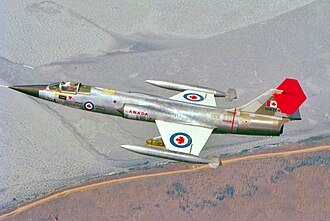
Canada’s High-Speed Cold War Warrior
The Canadair CF-104 Starfighter occupies a distinctive place in the history of Canadian military aviation, combining extraordinary speed, a radical aerodynamic design, and a demanding operational role during one of the most tense periods of the twentieth century. Developed from the American Lockheed F-104 Starfighter and manufactured under licence by Canadair in Montreal, Quebec, the CF-104 entered service as the Royal Canadian Air Force sought a modern replacement for its Canadair-built F-86 Sabre fighters assigned to NATO operations in Europe. At a time when Western military planners were deeply concerned about the possibility of a conflict with the Soviet Union and its Warsaw Pact allies, the Starfighter was expected to provide a rapid, capable platform for high-speed strike missions, reconnaissance, and the delivery of conventional or potentially nuclear weapons. Its slender fuselage, extremely small wings, powerful turbojet engine, and ability to fly at more than twice the speed of sound gave it a distinctive appearance and an equally distinctive reputation. Yet the CF-104 was much more than a fast aircraft: it was a specialized military system whose effectiveness depended on extensive pilot training, disciplined maintenance, carefully planned missions, and close coordination with Canada’s NATO partners. The type also became associated with the difficult realities of operating advanced jet aircraft at very low altitude and high speed, particularly in the often challenging weather conditions of northern and central Europe. Today, the CF-104 remains a memorable symbol of Canada’s Cold War commitments, the industrial capabilities of Canadian aircraft manufacturing, and the technical ambition that shaped the jet age.
The Origins of the Starfighter
The Cold War Requirement for a New Fighter
The origins of the Starfighter can be traced to the early 1950s, when the Korean War and the rapid evolution of jet combat encouraged aircraft designers to rethink the balance between speed, altitude, manoeuvrability, and weapons capability. Lockheed’s celebrated engineer Clarence “Kelly” Johnson and his team at the company’s advanced development organization, commonly known as the Skunk Works, developed an aircraft intended to climb rapidly, intercept hostile aircraft at high altitude, and use exceptional speed to reach its target before an opponent could escape. Rather than creating a large fighter with broad wings and substantial internal fuel capacity, the design team pursued a comparatively compact aircraft with a narrow fuselage and exceptionally thin wings. The resulting F-104 first flew in 1954 and became one of the earliest operational fighter designs capable of sustained flight at approximately Mach 2, or twice the speed of sound under suitable conditions. Its performance represented an important milestone in the development of supersonic military aircraft, although achieving such speed required trade-offs in endurance, low-speed handling, and payload capacity. The Starfighter’s original design priorities reflected the interceptor mission for which it had been conceived, but its potential attracted international attention as NATO countries began looking for aircraft capable of fulfilling a broader range of Cold War responsibilities.
Why Canada Selected the CF-104
By the late 1950s, Canada needed a successor to the F-86 Sabre aircraft serving with its forces in Europe. The Royal Canadian Air Force was committed to NATO defence plans, and the requirement was not simply for an aircraft that could perform well in a demonstration or intercept an enemy at high altitude. Canada needed a jet suited to the particular mission assigned to its European-based squadrons, including low-level strike operations and tactical reconnaissance in a potential conflict with Warsaw Pact forces. The cancellation of the ambitious Avro Canada CF-105 Arrow interceptor program in 1959 formed part of the wider political and defence context in which Canadian aircraft procurement decisions were made, although the Arrow and Starfighter had fundamentally different intended roles. The Arrow had been designed around long-range air defence and interception, while the CF-104 was selected as a compact, high-performance strike and reconnaissance aircraft for NATO service. Canadair was chosen to build 200 single-seat aircraft under licence from Lockheed, with the Canadian version incorporating equipment and changes suited to the Royal Canadian Air Force’s operational requirements. Canada also acquired two-seat training aircraft built by Lockheed in the United States. The CF-104 thus became an important example of Canada combining a foreign aircraft design with domestic industrial production, locally manufactured engine components, and a specialized national operational doctrine.
Canadair Production and the Development of the CF-104
Canadian Manufacturing and Engineering
Canadair’s production of the CF-104 demonstrated the country’s ability to manufacture a sophisticated supersonic combat aircraft during the Cold War. Based in Montreal, the company was responsible for producing the 200 single-seat aircraft ordered for Canadian service, while Lockheed manufactured the two-seat CF-104D trainers. The first Canadian-built Starfighter flew in August 1961, marking a significant stage in the introduction of the type. The aircraft was based on the F-104 family but was adapted to suit the strike and reconnaissance duties expected of Canada’s NATO squadrons. Its General Electric J79 turbojet engine was manufactured in Canada under licence by Orenda Engines, an important element of the domestic industrial contribution. Licensed production involved much more than assembling an aircraft from imported parts: it required manufacturing expertise, quality control, systems integration, engine support, and the development of maintenance practices capable of sustaining a high-performance aircraft fleet. The program also connected Canadian aerospace workers, military technicians, test pilots, engineers, and operational squadrons in a shared undertaking that extended well beyond the aircraft factory. The CF-104 became one of the most recognizable products of Canada’s Cold War aerospace industry, even though the aircraft’s fundamental aerodynamic concept and much of its systems architecture originated with Lockheed.
The CF-104 and CF-104D Variants
The principal Canadian production model was the single-seat CF-104, sometimes described in historical records as the Mark I version, while the two-seat CF-104D served as a conversion and training aircraft. The CF-104D retained the Starfighter’s essential performance characteristics but added a second cockpit so an instructor could accompany a pilot learning to operate the aircraft. Transitioning to a supersonic jet of this type demanded considerably more than familiarity with basic jet flight: pilots had to understand the engine’s response, high-speed aerodynamics, fuel management, navigation systems, weapons procedures, emergency actions, and the demanding requirements of low-level flight. The two-seat aircraft therefore played an essential role in preparing aircrew for operational assignments. Although it could be tempting to regard a trainer as a secondary support aircraft, the CF-104D was a central component of the overall weapon system because the quality of training directly influenced mission execution and flight safety. The Starfighter family also included numerous versions operated by other countries, including the widely exported F-104G, but the Canadian CF-104 was configured around Canada’s own requirements and should not be treated as identical to every other Starfighter model. Differences in equipment, weapons fit, fuel arrangements, and operating procedures could affect individual aircraft, so technical figures and descriptions are best understood as representative of the Canadian variant rather than universal specifications for the entire F-104 family.
Design and Aerodynamic Characteristics
A Fuselage Built Around Speed
One of the most striking features of the CF-104 Starfighter was its long, narrow fuselage, which gave the aircraft the appearance of a missile fitted with a cockpit, tail surfaces, and wings. Its shape was intended to reduce aerodynamic drag at high speed while accommodating the engine, fuel, cockpit, avionics, and supporting systems in a relatively compact structure. The fuselage tapered toward the nose, and the overall design reflected a clear emphasis on supersonic performance. The aircraft’s proportions were unlike those of many contemporary fighters, which often used larger wings to support manoeuvrability and low-speed handling. The Starfighter instead prioritized the ability to accelerate and climb rapidly, reach high altitude, and operate at exceptional speed. That focus helped create a machine capable of remarkable performance for its era, but it also meant pilots had to respect its operating limitations and manage energy carefully throughout a mission. At low altitude, where the air is denser and aerodynamic forces become more significant, high speed could leave little time to react to unexpected obstacles, weather changes, navigation errors, or mechanical problems. The CF-104’s shape was therefore not merely an aesthetic statement; it embodied a specific set of engineering choices that influenced how the aircraft was flown, maintained, and employed in combat training.
The Starfighter’s Remarkably Small Wings
The Starfighter’s extremely thin, short-span wings were perhaps its most famous design feature. Their small area helped reduce drag at high speed, and their sharp leading edges gave the aircraft an unmistakable profile when viewed from the front or side. The wings were optimized for the supersonic regime, but they offered less generous low-speed characteristics than the broader wings of many conventional fighters. To improve performance during slower flight, take-off, and landing, the aircraft used movable leading- and trailing-edge surfaces, along with systems that helped maintain airflow over the wing. These features allowed the Starfighter to operate across a wider range of flight conditions than the wing’s minimal appearance might suggest, but they did not turn it into a forgiving, slow-speed aircraft. The narrow wing also created practical considerations for ground crews and pilots, as its thin edges demanded careful handling around personnel and equipment. The design made the CF-104 instantly recognizable and helped define its reputation as a machine built around speed, but it also illustrates a fundamental principle of aviation engineering: optimizing an aircraft for one flight regime can impose compromises in others. The Starfighter was highly capable when flown within the conditions for which it had been designed, yet it required training and discipline to manage the characteristics that followed from its unusual aerodynamic configuration.
Tail, Landing Gear, and Cockpit
The CF-104 used a conventional tricycle landing gear arrangement and a distinctive tail assembly, with its horizontal stabilizing surface positioned high on the vertical fin. This layout formed part of the aircraft’s carefully integrated aerodynamic design and contributed to its unusual silhouette. The cockpit was positioned forward in the fuselage, giving the pilot a view over the nose while retaining the streamlined shape required for high-speed flight. However, cockpit visibility and situational awareness depended on the direction of flight, aircraft attitude, canopy framing, and the environment in which the Starfighter was operating. High-speed, low-level navigation required pilots to interpret terrain, weather, and instrument information quickly while maintaining precise control of the aircraft. The ejection system was another important element of the cockpit’s design history. Early versions of the broader F-104 family used downward-firing ejection seats because designers feared that an upward-firing seat might strike the tall tail during escape. That arrangement created serious limitations at low altitude, where there might be insufficient height for the pilot to clear the aircraft and deploy a parachute. Later improvements introduced upward-firing seats capable of clearing the tail, and the Canadian Starfighters were equipped with the later arrangement. The history of the ejection seat remains a reminder that high-performance aviation involves not only maximizing speed and capability, but also developing reliable escape systems for emergencies that pilots may have only seconds to recognize and respond to.
Engine and Flight Performance
The General Electric J79-OEL-7 Turbojet
At the heart of the CF-104 was a single General Electric J79-OEL-7 turbojet, produced in Canada under licence by Orenda. The engine was one of the defining technologies of the Starfighter era, providing the thrust required to accelerate the aircraft into the supersonic regime and sustain high-speed flight. Like other turbojets of its generation, the J79 relied on the compression of incoming air, combustion of fuel, and expansion of hot gases through a turbine and exhaust system to generate thrust. An afterburner could inject and burn additional fuel in the exhaust stream, substantially increasing thrust for acceleration, interception, and other demanding phases of flight. Afterburning operation consumed fuel rapidly, so pilots had to balance the need for performance against the limited endurance available during a mission. The engine’s power and responsiveness were central to the CF-104’s ability to climb quickly and operate at high speed, but it also required specialized inspection, servicing, and maintenance. Engine performance was only one part of the operational picture: reliability depended on the condition of components, the quality of servicing, the operating environment, and the procedures followed by both aircrew and ground personnel. Orenda’s licensed production of the engine also meant that Canadian industry supported a critical part of the aircraft’s performance, linking the Starfighter’s speed directly to the broader national effort to maintain a capable military aviation system.
Supersonic Speed and High-Altitude Flight
The CF-104 was capable of reaching approximately Mach 2.2 under suitable conditions, equivalent to roughly 2,334 kilometres per hour in commonly published specifications. Mach number describes an aircraft’s speed relative to the local speed of sound, which changes with atmospheric conditions, particularly temperature; consequently, the exact conversion from Mach to kilometres per hour is not constant at every altitude. The Starfighter’s high-speed capability made it one of the most impressive aircraft in Canadian military service during the 1960s and 1970s, but maximum speed was not a figure that could be maintained throughout an ordinary operational sortie. Fuel consumption, external stores, altitude, temperature, aircraft condition, and mission requirements all affected the practical performance available to a pilot. The aircraft’s service ceiling was commonly listed at approximately 58,000 feet, although actual operating altitude depended on configuration and conditions. Its climb performance and supersonic capability were valuable features, yet the CF-104’s Canadian role increasingly emphasized high-speed flight at low altitude rather than simply operating as a high-altitude interceptor. This distinction is important when assessing the aircraft: its greatest operational challenge was not necessarily reaching its maximum speed, but safely and accurately carrying out assigned tasks in a complex environment while preserving sufficient fuel and maintaining the required flight profile.
Range, Fuel, and Mission Endurance
Although the Starfighter was fast, its mission endurance could be limited when compared with aircraft designed around long-range patrol or sustained combat manoeuvring. The aircraft’s compact form and emphasis on performance constrained the space available for internal fuel, and high-thrust afterburner use could rapidly reduce the amount of time available before the aircraft needed to return to base. External fuel tanks could extend range, but they also changed the aircraft’s drag, weight, and handling characteristics, and their use depended on mission requirements. Published range figures for the CF-104 should therefore be treated as indicative rather than as a guarantee of operational radius. Ferry range, maximum range under a particular flight profile, and combat radius are different measurements, and each depends on assumptions about fuel reserves, speed, altitude, payload, and flight time. In NATO service, mission planning had to take account of departure and recovery bases, navigational requirements, weather, weapons load, and the possibility that a planned flight could be delayed or altered. For a low-level strike aircraft, fuel planning was particularly important because a fast flight near the ground could combine relatively high fuel consumption with strict timing requirements. The CF-104’s performance was impressive, but its effectiveness depended on how well its speed, fuel supply, navigation equipment, and mission profile were balanced.
Operational Service with the Royal Canadian Air Force
Entering Service in the Early 1960s
The CF-104 entered Canadian service in the early 1960s, as the Royal Canadian Air Force reorganized its forces around NATO’s Cold War requirements. Canadian Starfighters were assigned to units responsible for operational strike, reconnaissance, training, and test work, with Cold Lake, Alberta, serving as an important base for conversion training and specialized operations. The aircraft’s arrival required a new level of technical proficiency from pilots, mechanics, engine specialists, weapons personnel, and planners, all of whom had to become familiar with the equipment and procedures associated with a supersonic aircraft. The CF-104 was not simply a faster replacement for the Sabre: it brought a different set of mission expectations, particularly in relation to low-level flight and tactical strike operations. Training had to prepare pilots to manage high speeds, changing weather, instrument navigation, weapons delivery, emergency procedures, and the demanding task of maintaining accurate flight paths close to the ground. Ground crews were equally important, since a high-performance jet could only deliver reliable operational capability when its engines, avionics, flight controls, landing gear, and other systems were properly serviced. The Starfighter’s entry into service thus represented a transformation in both aircraft technology and the daily working practices of the Canadian military aviation community.
Canada’s NATO Commitment in Europe
A central purpose of the CF-104 was to support Canada’s contribution to NATO in Europe, where Canadian air units formed part of a larger multinational force intended to deter aggression and respond to a possible Warsaw Pact attack. During the Cold War, Canada maintained a significant military presence in Europe, and its tactical aircraft were expected to operate in close coordination with allied forces. The Starfighter’s mission was shaped by the strategic assumption that a conflict could involve fast-moving ground operations, heavily defended airspace, and a need to deliver conventional or nuclear weapons against designated targets. Canada’s CF-104 units trained for this demanding environment, practising navigation, low-level strike tactics, reconnaissance, and the procedures necessary to operate as part of a coordinated NATO force. Their work required pilots to maintain proficiency not only in aircraft handling but also in mission planning, communications, weapons systems, and cooperation with other military organizations. European basing also exposed the aircraft to operational conditions that could differ substantially from those experienced during training in Canada, including dense air traffic, varied terrain, restricted flight corridors, and frequently changing weather. The CF-104’s history cannot therefore be separated from Canada’s broader NATO policy: the aircraft was a practical expression of the country’s commitment to collective defence and a tool designed to fulfil a particular role within a multinational military strategy.
Low-Level Flight as a Core Mission Requirement
The CF-104 became closely associated with high-speed, low-level flight, a technique intended to reduce the time an aircraft spent exposed to enemy radar and air defences. Flying close to the terrain could make detection and engagement more difficult for an opponent, but it also increased the importance of accurate navigation, rapid decision-making, and precise control. At low altitude, pilots had less time to respond to terrain changes, unexpected obstacles, mechanical warnings, or deteriorating visibility. The aircraft’s high speed compressed the time available to recognize a problem and take corrective action, while European weather could complicate visual navigation and reduce the margin for error. These factors made low-level strike operations exceptionally demanding and help explain why the Starfighter’s service record cannot be evaluated by its maximum speed alone. Successful missions required well-rehearsed procedures, thorough intelligence and route planning, reliable navigation equipment, and pilots capable of maintaining concentration under intense workload. The same tactical profile that offered potential advantages in a hostile environment also imposed significant operational risks, particularly when flown repeatedly in difficult weather and across varied terrain. The CF-104’s low-level mission was therefore a defining aspect of its Canadian identity: it shaped how the aircraft was trained, how its crews approached their work, and how the aircraft came to be remembered by those who served with it.
The Nuclear Strike Mission
During the 1960s, the CF-104 was assigned a nuclear strike role as part of NATO’s deterrence strategy. Under the arrangements of the period, the aircraft could be configured to deliver United States-supplied nuclear weapons in the event that the appropriate political and military authorization was given. These weapons remained under American control, and their possible employment formed part of the wider NATO nuclear planning system rather than an independent Canadian nuclear arsenal. The role placed the CF-104 within one of the most consequential aspects of Cold War military strategy, in which nuclear deterrence depended on the perceived ability of allied forces to respond to a major attack. Training and readiness for this mission involved specialized procedures, secure handling arrangements, and strict controls over the weapons and their release. The existence of the nuclear role did not mean that every operational sortie involved nuclear weapons; rather, it meant that the aircraft and its crews were part of a broader deterrence posture intended to discourage aggression by making the potential cost of conflict unmistakable. In 1971, Canada’s CF-104 nuclear strike role ended, and the aircraft moved toward a conventional attack mission. That transition reflected changes in Canadian policy and NATO planning, and it altered the weapons and operational context in which the Starfighter was employed. The nuclear chapter remains essential to understanding the CF-104 because it illustrates how the aircraft’s technical capabilities were tied to political decisions and the strategic priorities of its era.
Conventional Strike and Tactical Reconnaissance
After the nuclear strike mission ended, the CF-104 continued in a conventional attack role, carrying weapons such as bombs and rockets for use against designated military targets. It could also be equipped for tactical photographic reconnaissance through specialized equipment carried in a pod beneath the fuselage. Reconnaissance missions required pilots to follow planned routes and altitudes so that imagery could be collected for intelligence and operational assessment. Such flights could be demanding because the aircraft had to reach the target area, follow the required profile, operate its reconnaissance equipment, and return with sufficient fuel while navigating potentially defended airspace. The combination of strike and reconnaissance capabilities gave the CF-104 flexibility within its assigned mission set, although it was never a universal solution for every type of tactical air operation. Its design favoured speed and low-level penetration, while payload, endurance, and the ability to remain over a target area were more limited than in some other aircraft. The aircraft’s conventional weapons fit also evolved over its career, and the reinstatement of the 20 mm M61A1 Vulcan cannon expanded its armament options compared with earlier configurations in which a fuel tank had occupied the relevant space. As with any military aircraft, its actual capability depended on the configuration selected for a particular mission, and not every Starfighter carried the same weapons or reconnaissance equipment at all times.
Weapons and Mission Equipment
The M61A1 Vulcan Cannon
The M61A1 Vulcan was a six-barrel 20 mm rotary cannon associated with several American-designed combat aircraft of the period, including later configurations of the Canadian Starfighter. Its high rate of fire gave pilots a powerful close-range weapon, although the gun’s practical effectiveness depended on aiming, range, target movement, ammunition supply, and the short time available during a firing pass. In the CF-104’s original Canadian configuration, the standard cannon installation was replaced by a 120-US-gallon external fuel tank, reflecting the aircraft’s particular strike and reconnaissance requirements. The cannon was later reinstalled as the aircraft returned to a conventional strike role. This evolution demonstrates that the CF-104 was not a fixed, unchanging platform: its configuration could be modified as doctrine and operational needs changed. The Vulcan’s rotary mechanism allowed a high volume of fire, but it also required careful maintenance and inspection, just like the aircraft’s engine and other complex systems. The cannon was only one element of the aircraft’s wider weapons capability, which included external stores and specialized mission equipment. When describing the CF-104’s armament, it is therefore important to distinguish between what the airframe could be configured to carry and what a particular aircraft actually carried on a specific sortie.
Bombs, Rockets, and External Stores
The CF-104 could carry conventional bombs, rockets, and fuel tanks on external attachment points, enabling it to perform its assigned strike missions. The exact combination of stores depended on the task, operational requirements, and aircraft configuration, with weapon weight and drag influencing acceleration, fuel consumption, and flight performance. Conventional weapons could be employed against designated targets as part of NATO tactical planning, while rocket and bomb options provided different delivery characteristics for different mission types. External stores were not simply additions to the aircraft’s load: they affected the aircraft’s aerodynamic behaviour and could reduce the speed or range achievable in a particular configuration. Pilots and planners therefore had to consider the relationship between payload, fuel, route, altitude, and recovery requirements. Some of the weapon systems associated with the Starfighter’s international service were not necessarily standard on every Canadian aircraft, so lists of weapons should be understood as examples of compatible or documented stores rather than a claim that all CF-104s carried every item. The aircraft’s weapons capability reflected its intended tactical role, but its effectiveness depended on the quality of the targeting information, the accuracy of navigation, the reliability of the release system, and the training of the crew. These practical requirements often mattered as much as the raw performance figures printed in a technical specification.
Reconnaissance Pods and Avionics
The CF-104 could carry a specialized reconnaissance pod beneath the fuselage, allowing it to gather photographic information without requiring a separate dedicated reconnaissance aircraft for every task. The pod could be configured with cameras and supporting equipment intended to record imagery during a planned flight profile. Reconnaissance was valuable because commanders needed timely information about terrain, facilities, troop movements, and other features relevant to military planning. However, obtaining useful imagery required more than simply flying over a target: the aircraft had to follow an appropriate route and altitude, maintain the necessary orientation and timing, and ensure that the equipment operated correctly. The CF-104’s navigation and avionics systems supported the demands of supersonic and low-level flight, although their precise fit and capability varied across aircraft and periods of service. Avionics were especially important when visual references were limited by darkness, cloud, haze, or the speed at which terrain passed beneath the aircraft. The aircraft’s mission equipment illustrates the balance between a specialized airframe and the systems that made it operationally useful. Its narrow fuselage and small wings attracted attention, but the ability to navigate, communicate, carry weapons, and collect intelligence was what connected the aircraft’s engineering to its military purpose.
Training, Maintenance, and Daily Operations
Preparing Pilots for the Starfighter
Transitioning to the CF-104 was a major step in a pilot’s career because the aircraft demanded a different combination of skills from those required for basic jet training or earlier fighter types. Pilots had to become familiar with the Starfighter’s engine, cockpit layout, performance envelope, navigation equipment, weapons procedures, and emergency actions before they could be trusted with demanding operational sorties. The two-seat CF-104D played a key role in this process by allowing an instructor to demonstrate procedures, monitor performance, and guide a trainee through increasingly complex flights. Training was not confined to take-off, landing, and basic handling: it included instrument flying, high-speed navigation, low-level tactics, fuel management, formation procedures, and the discipline needed to execute a mission under time pressure. The aircraft’s unusual wing design and high performance made accurate energy management particularly important, while the risks associated with low-level operations reinforced the value of strict adherence to procedures. Pilots also had to learn how to recognize developing problems and respond without hesitation, because a fast aircraft operating close to the ground offered little opportunity for lengthy deliberation. The training system was therefore central to the CF-104’s operational capability, linking the aircraft’s impressive engineering to the judgement and proficiency of the people who flew it.
The Contribution of Ground Crews
The Starfighter’s reputation for performance depended on the often less visible work of ground crews, who kept the aircraft serviceable and prepared for demanding flight schedules. Technicians inspected engines, maintained fuel systems, checked flight controls, serviced landing gear, repaired electrical and avionics equipment, and ensured that weapons and external stores were handled according to established procedures. The J79 engine and its afterburner system required particular attention, while the aircraft’s high-performance structure and complex equipment demanded systematic inspection. Maintenance work could be affected by weather, spare-parts availability, operating tempo, and the need to complete checks within a limited time before a scheduled sortie. Ground crews also worked closely with pilots to investigate technical concerns, review aircraft condition, and prepare the jet for the next flight. Their responsibilities were especially important because the CF-104 was designed around demanding performance requirements and operated in an environment where a small technical issue could have serious consequences. A successful military aviation unit is never defined solely by the aircraft it possesses; it depends on the combined expertise of aircrew, technicians, logisticians, planners, and commanders. The Starfighter’s service history should therefore include the people who maintained and supported it, not only the pilots whose flights made the aircraft visible to the public.
Life at Cold Lake and Overseas Bases
Cold Lake, Alberta, became closely associated with Canadian Starfighter operations, particularly training and specialized work. The base provided the environment in which pilots could develop proficiency before being assigned to operational units, while test and evaluation organizations used the aircraft to assess systems, procedures, and performance. For those stationed at Cold Lake, the Starfighter was not merely a remarkable machine seen at an airshow; it was a daily presence that shaped work routines, technical training, and the tempo of military life. Overseas, Canadian personnel operated within the larger NATO framework, coordinating with allied units and adapting to the demands of European airfields, weather, terrain, and airspace. Deployments required a substantial support network, including spare parts, specialized equipment, maintenance facilities, administrative services, and arrangements for the movement of personnel and supplies. The aircraft’s operation thus involved a broader system extending from the cockpit to the workshop, the flight line, the planning room, and the command structure. These bases and units became part of the Starfighter’s identity, and the memories of the aircraft remain connected to the experiences of the people who worked around it. The distinctive sound of its engine and afterburner, its narrow silhouette, and the demanding nature of its missions helped make it a lasting feature of Canadian Cold War aviation history.
Safety, Accidents, and the Starfighter’s Controversial Reputation
Why the Aircraft Was Called the “Widowmaker”
The F-104 family acquired an enduring reputation for accidents, leading to nicknames such as “Widowmaker” and “flying lawn dart.” These labels reflected genuine concern about the losses experienced by some operators, but they can oversimplify the factors that shaped the aircraft’s safety record. The Starfighter’s high performance and specialized design imposed demanding handling and operational requirements, and its use in high-speed, low-level missions created risks that differed from those associated with high-altitude interception. Weather, visibility, terrain, bird strikes, engine failures, human factors, training, and maintenance could all contribute to accidents. It is therefore misleading to attribute every crash to a single inherent defect in the airframe, just as it would be wrong to dismiss the aircraft’s operational hazards merely because many accidents had causes beyond the design itself. The CF-104 was often flown in an environment that offered little time to recover from an unexpected event, and the aircraft’s mission profile made careful judgement essential. Its reputation must be considered alongside the actual requirements imposed on its crews, the procedures used by different air forces, and the changing standards of training and equipment over time. The aircraft could achieve extraordinary performance, but the conditions in which it was expected to operate could be unforgiving.
Canadian Losses and the Human Cost
Canada’s Starfighter era involved a serious human cost. Historical accounts from the Air Force Museum of Alberta report that 113 Canadian aircraft were lost during the approximately 24-year period described in its history of the type, and that 37 pilots lost their lives while flying the CF-104. These figures are associated with that museum’s account of the Canadian Starfighter experience and should be read in the context of its stated service period and definitions of losses. The causes were not uniform: the museum identifies bird strikes and other events resulting in engine failure, as well as accidents associated with high-speed, low-level operations and poor visibility. The figures underline the risks faced by pilots and the wider community of personnel who supported the aircraft, but they should not be used as a simplistic measure of aircraft quality without considering operational exposure, mission profile, weather, and the standards of the era. Each loss represented more than a damaged airframe or a statistic in a history book; it meant the loss of a pilot, grief for families and colleagues, and a lasting impact on the squadrons involved. Understanding the CF-104 requires acknowledging these tragedies directly while also recognizing the efforts made to improve training, maintenance, equipment, and operational procedures. The Starfighter’s history is compelling partly because it combines impressive technological achievement with the very real human consequences of operating advanced military aircraft in difficult conditions.
Managing Risk in a Demanding Operating Environment
The risks associated with the CF-104 were closely connected to the interaction between aircraft design and mission demands. High-speed flight near the ground reduced reaction time, while adverse weather and poor visibility could make it harder to identify terrain and maintain a safe flight path. Bird strikes could damage an engine or otherwise compromise a sortie, and mechanical problems could become particularly serious when an aircraft was moving quickly at low altitude. The Starfighter’s limited endurance also meant that fuel planning was an important part of mission management, especially when the aircraft carried external stores or had to alter its planned route. Training, navigation aids, maintenance standards, operational rules, and emergency procedures all contributed to managing these risks, although no system could eliminate every hazard. It is important to avoid treating the aircraft’s reputation as either entirely deserved in every detail or entirely unfair: the Starfighter was a specialized aircraft with genuine limitations, and it was often assigned demanding missions under conditions that challenged both technology and human performance. The history of military aviation repeatedly demonstrates that aircraft safety depends on more than a design drawing. It emerges from the combined effects of engineering, doctrine, weather, training, maintenance, leadership, and the decisions made by people under pressure.
The Canadian Starfighter and the Wider F-104 Family
An International Aircraft with Different National Roles
Although Canada operated the CF-104, the broader F-104 family served with many air forces around the world. Different countries acquired different versions and adapted them to their own defence requirements, which meant that the Starfighter did not have one universal operational identity. Some operators emphasized interception, while others used versions adapted for strike, reconnaissance, or multirole tasks. The F-104G, in particular, became widely associated with NATO countries seeking a fast tactical aircraft, but it should not be confused in every technical detail with Canada’s CF-104. National versions could differ in avionics, radar, weapons systems, fuel arrangements, structural features, and the procedures used by their air forces. Those differences influenced how the aircraft performed and how it was employed. The international success of the Starfighter reflected the demand for high-performance combat aircraft during the Cold War, as well as the appeal of a design that could be manufactured or supported by different industrial partners. At the same time, the aircraft’s varied safety records and operational experiences show why comparisons between national fleets require care. An aircraft type’s reputation could be shaped by its configuration, training system, mission profile, and operating environment, not simply by the shared outline of its fuselage and wings.
The Starfighter’s Influence on Canadian Aerospace
Canadair’s CF-104 program was part of a larger story about Canadian participation in advanced military aviation. Licensed production helped sustain engineering and manufacturing expertise, while the domestic production of the J79 engine by Orenda added an important industrial dimension. The aircraft also required Canadian organizations to develop and maintain the technical knowledge necessary to support a supersonic jet over many years. This included engine servicing, systems inspection, pilot conversion, operational testing, and the handling of specialized weapons and reconnaissance equipment. The program demonstrated the practical value of international cooperation in aerospace, with the original design developed in the United States, the Canadian aircraft manufactured by Canadair, and key engine work undertaken by a Canadian company under licence. It also illustrated the complexity of defence procurement: acquiring an aircraft was only the beginning of a long commitment involving training, maintenance infrastructure, spares, upgrades, and the development of doctrine. The CF-104 did not eliminate the challenges of operating advanced aircraft, but it gave Canada extensive experience with a supersonic strike and reconnaissance platform during a critical period in military aviation. Its industrial legacy is therefore as significant as its place in the history of Canadian squadrons.
Retirement and Replacement by the CF-18 Hornet
The End of Canadian Starfighter Operations
By the late 1970s and early 1980s, the Canadian Forces began preparing to replace several older combat aircraft, including the CF-104. Advances in avionics, weapons, operational doctrine, and aircraft design were changing the requirements for modern tactical aviation, while the Starfighter’s specialized performance profile increasingly had to be considered against newer options. Canada selected the CF-18 Hornet as the replacement for the CF-104 and other aircraft in its broader tactical and air-defence modernization effort. The Hornet offered a different combination of capabilities, including modern sensors and weapons integration, and was better suited to the changing range of missions expected of Canada’s combat aircraft. The transition was gradual rather than instantaneous, as new aircraft had to be delivered, crews trained, maintenance systems established, and operational units reorganized. Official Canadian historical summaries list the CF-104 as having entered service in 1961 and being struck off strength in 1984, while museum histories often describe the final retirement period as extending to 1987. These dates can reflect differences between formal administrative status, individual aircraft retirement, and the final withdrawal of the type from operational service. The important point is that the Starfighter’s Canadian career ended during the transition to the CF-18, closing a chapter that had begun with the rapid modernization of Canada’s Cold War air forces.
The Last Flights and the Aircraft’s Afterlife
After their Canadian service, many surviving Starfighters were transferred to Turkey, where they continued to serve for a number of years. Other aircraft entered museums, were placed on static display, or were preserved by organizations dedicated to aviation history. The Starfighter’s retirement did not erase its influence on the people who had flown or maintained it; former personnel continued to share memories, technical knowledge, and accounts of service with an aircraft that had demanded a high degree of skill and discipline. Preserved CF-104s can now be found in Canadian museum collections, where they provide a tangible link to the Cold War and to the country’s NATO commitments. These aircraft help visitors understand the physical scale and unusual proportions of a supersonic jet, while accompanying exhibits explain its mission, engine, weapons, and operational history. Restoration work can be particularly demanding because historical aircraft may require specialized parts, careful conservation, and research to establish the correct configuration and markings. A preserved Starfighter is therefore more than a display object: it represents the labour of the people who built it, the personnel who maintained it, the pilots who flew it, and the institutions that have chosen to preserve its story for future generations.
Preserving the CF-104 Starfighter’s Legacy
Museums, Veterans, and Public Memory
The CF-104 continues to attract interest from aviation enthusiasts, historians, veterans, and visitors to Canadian military museums. Its distinctive design makes it easy to recognize, but the deeper significance of the aircraft becomes clearer when its technical features are connected to the historical circumstances in which it operated. Museum displays can explain why Canada chose the Starfighter, how Canadair manufactured it, what role it played in NATO, and why its low-level mission profile was so demanding. Veterans’ recollections add another dimension by describing the everyday realities of flying, maintaining, and supporting the aircraft, including the routines that rarely appear in formal technical histories. Preserving these experiences matters because military aviation history is not only a record of aircraft models and performance figures; it is also a record of people, organizations, decisions, and consequences. The Starfighter’s legacy includes both achievement and loss, and a balanced account should acknowledge its remarkable speed without romanticizing the hazards faced by its crews. By combining restored aircraft, archival photographs, technical documents, and personal testimony, museums can present a more complete picture of the CF-104 and the wider Cold War environment in which it served.
What the Starfighter Teaches About Aircraft Design
The CF-104 offers a useful example of how an aircraft’s mission shapes its engineering. Its thin wings, streamlined fuselage, powerful engine, and high-speed performance were not accidental stylistic choices; they followed from a design philosophy that prioritized rapid interception and supersonic flight. Those priorities brought genuine advantages, but they also imposed constraints in endurance, low-speed handling, payload, and operational flexibility. When Canada adapted the aircraft for low-level strike and reconnaissance, its performance had to be evaluated within a mission context that differed from the high-altitude interceptor role for which the original F-104 had been conceived. The resulting experience illustrates why maximum speed alone is an incomplete measure of military effectiveness. A successful combat aircraft must fit the mission, operate reliably, carry appropriate equipment, integrate with command and support systems, and allow crews to complete tasks within acceptable risk. The Starfighter also shows how the wider system around an aircraft matters: training, maintenance, weapons integration, navigation, and tactics can determine whether its technical strengths translate into operational success. Its history remains relevant because modern aircraft continue to reflect the same fundamental balancing act between performance, flexibility, reliability, cost, and the realities of the environments in which they must operate.
Conclusion: A Distinctive Chapter in Canadian Aviation History
The Canadair CF-104 Starfighter was one of the most visually distinctive and technically remarkable aircraft ever operated by the Royal Canadian Air Force. Built in Canada from a Lockheed design, powered by a Canadian-produced version of the J79 turbojet, and developed for a demanding NATO strike and reconnaissance role, it represented a significant combination of international aerospace cooperation and domestic industrial capability. Its ability to reach approximately Mach 2.2 made it a symbol of the supersonic age, while its slim wings and long fuselage gave it a silhouette unlike that of many other combat aircraft. Yet the Starfighter’s story cannot be reduced to speed or appearance. It was a specialized aircraft whose low-level missions, fuel limitations, operational complexity, and exposure to difficult weather created serious challenges for its crews. Its nuclear strike assignment during the 1960s placed it within the central strategic concerns of the Cold War, and its later conventional attack and reconnaissance duties reflected changes in Canadian policy and NATO planning. The aircraft eventually gave way to the CF-18 Hornet, but its influence survives in museum collections, historical records, and the memories of those who served with it. Remembered both for its extraordinary performance and for the human cost of its operational career, the CF-104 remains an important part of Canada’s aviation heritage and a compelling example of the opportunities and compromises inherent in high-performance military aircraft design.
Summary Table: Canadair CF-104 Starfighter Technical Specifications
The following figures summarize commonly published specifications for the Canadian CF-104. Exact figures may vary by source, aircraft configuration, fuel and weapons load, and the conditions under which performance was measured.
| Specification | CF-104 Starfighter |
|---|---|
| Aircraft type | Supersonic strike fighter and tactical reconnaissance aircraft |
| Original design | Lockheed F-104 Starfighter |
| Canadian manufacturer | Canadair, Montreal, Quebec |
| Engine manufacturer | Orenda, under licence from General Electric |
| Powerplant | 1 × General Electric/Orenda J79-OEL-7 turbojet with afterburner |
| Thrust, dry | Approximately 10,000 lbf (44.5 kN) |
| Thrust, afterburning | Approximately 15,800 lbf (70.3 kN) |
| Crew | 1 pilot in CF-104; 2 in CF-104D trainer |
| Length | 16.69 m (54 ft 9 in) |
| Wingspan | 6.68 m (21 ft 11 in), without tip tanks |
| Height | 4.11 m (13 ft 6 in) |
| Wing area | Approximately 18.21 m² (196 sq ft) |
| Empty weight | Approximately 6,387 kg (14,082 lb) |
| Maximum/gross weight | Approximately 13,510 kg (28,779 lb) |
| Maximum speed | Approximately Mach 2.2; 2,334 km/h (1,450 mph) under suitable conditions |
| Published cruising speed | Approximately Mach 1.2; figures vary by source and flight profile |
| Service ceiling | Approximately 17,660 m (58,000 ft) |
| Published range | Approximately 3,510 km (2,180 miles); actual range depends on configuration and flight profile |
| Main gun | M61A1 Vulcan 20 mm rotary cannon in applicable configurations |
| Other stores | Conventional bombs, rockets, external fuel tanks, and reconnaissance pod, depending on configuration |
| Principal Canadian roles | NATO strike, conventional attack, tactical reconnaissance, training, and test work |
| Canadian production | 200 single-seat aircraft built by Canadair |
| Two-seat trainer | CF-104D, built by Lockheed |
| Canadian service period | Introduced in 1961; withdrawn during the 1980s, with sources using different formal and operational end dates |
| Main replacement | CF-18 Hornet |
