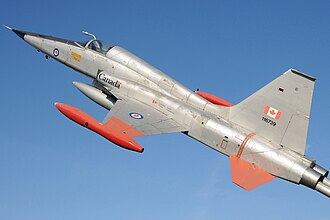
A Small Fighter with a Significant Canadian Legacy
The Canadair CF-5 Freedom Fighter was a compact, twin-engine supersonic combat aircraft that played an important role in Canadian military aviation during the Cold War. Developed in Canada from the American Northrop F-5 Freedom Fighter design, the aircraft combined relatively modest size, straightforward engineering, nimble handling, and the ability to operate at supersonic speeds. Its official Canadian military designation was CF-116, although the aircraft is widely known as the CF-5, and it served with Canadian tactical fighter squadrons before becoming an advanced jet trainer and an adversary aircraft for combat training. Canadair manufactured the aircraft in Montreal, Quebec, adapting Northrop’s original design to meet Canadian requirements and incorporating important changes such as Orenda-built engines, an in-flight refuelling probe, and a reconnaissance nose that could accommodate photographic cameras. The result was not simply an American aircraft assembled in Canada, but a nationally adapted version of a widely used lightweight fighter whose capabilities reflected the particular demands of Canada’s defence policy and NATO commitments. Although the CF-5 was smaller and less heavily equipped than some contemporary combat aircraft, it offered valuable advantages in handling, operating cost, and training utility. Its career also illustrates the complicated choices involved in military procurement: a relatively affordable aircraft could provide useful tactical capability and support a large range of training activities, yet still face limitations when assigned missions that demanded greater range, payload, or all-weather capability. Today, the CF-5 remains a notable part of Canada’s aviation heritage, representing both the achievements of the country’s aerospace industry and the practical compromises that shaped Cold War air power.
The Origins of the Northrop F-5 Freedom Fighter
A Different Approach to Fighter Design
The story of the CF-5 began in the United States during the 1950s, when Northrop Aircraft began exploring the idea of a lightweight, affordable supersonic fighter that could be operated by countries unable or unwilling to acquire larger, more expensive combat aircraft. Many front-line fighters of the era were becoming increasingly complex, with powerful engines, sophisticated radar equipment, substantial weapons systems, and demanding maintenance requirements. Northrop pursued a different philosophy: build a relatively small aircraft with reliable systems, two compact turbojet engines, good manoeuvrability, and enough performance to serve as a practical fighter without the cost and complexity associated with larger designs. This concept eventually produced the F-5 family, whose first prototype, the YF-5A, flew in July 1959. The aircraft was developed with an eye toward international security assistance and the needs of allied nations that required credible defensive air power but had limited budgets or technical infrastructure. Its design also proved attractive for training, because a lightweight aircraft with responsive handling could provide pilots with useful experience in supersonic flight and tactical manoeuvres. The F-5 was not designed to outperform every larger fighter in every category; instead, its appeal lay in delivering a useful combination of speed, manoeuvrability, reliability, and affordability. This philosophy would become central to the CF-5’s later career in Canada, where the aircraft was expected to provide tactical capability while also supporting the training and operational requirements of the Canadian Forces.
Why Canada Chose the F-5
In the mid-1960s, Canada was reassessing its military aircraft requirements and the cost of maintaining its defence commitments at home and abroad. The Royal Canadian Air Force had operated several generations of increasingly capable combat aircraft, but maintaining a sophisticated fleet placed considerable demands on the defence budget. At the same time, Canada remained committed to NATO and needed aircraft capable of contributing to tactical operations in Europe, supporting ground forces, and preparing aircrew for modern combat conditions. In July 1965, the Canadian government selected Northrop’s lightweight F-5 design as the basis for a new tactical aircraft. The decision was controversial. Some observers questioned whether a relatively small fighter was appropriate for a country with an established aerospace industry and demanding NATO responsibilities, particularly when compared with larger aircraft offering greater range, payload, and equipment capacity. Supporters, however, saw the F-5 as a practical and comparatively economical way to provide a modern tactical aircraft while preserving domestic manufacturing work. The choice also reflected the Canadian government’s broader effort to reconsider defence spending and the roles assigned to its armed forces. Rather than purchasing a large, expensive aircraft for every task, Canada opted for a lighter platform that could undertake tactical missions and, later, serve as a useful training aircraft. The CF-5’s subsequent history would reveal both the strengths of that decision and the limitations of using a lightweight fighter for a broad range of demanding military tasks.
Canadair and the Canadian Aerospace Industry
Canadair was selected to manufacture the aircraft under licence, bringing the F-5 design into Canada’s established aerospace manufacturing sector. The company’s Montreal facilities had experience building military and civil aircraft, and the CF-5 program provided work for engineers, production staff, technicians, suppliers, and supporting organizations. Licensed manufacture required more than reproducing the original airframe: Canadair had to establish production processes, integrate Canadian equipment, coordinate engine supply, and ensure that the aircraft could be maintained under Canadian military operating conditions. The program also demonstrated the importance of domestic industrial participation in defence procurement. Manufacturing aircraft locally could support skilled employment and preserve engineering knowledge, while a domestic support network could help the armed forces maintain their fleet over many years. At the same time, a licensed-production program required substantial investment and careful planning, especially when modifications made the Canadian aircraft different from versions operated elsewhere. The CF-5 therefore represented a partnership between Northrop’s original design expertise and Canadair’s manufacturing capability, supported by Canadian engine production and military engineering organizations. Its place in Canadian aviation history is inseparable from this industrial context, because the aircraft became a practical example of how Canada could adapt an international design to national requirements while sustaining an important part of its aerospace sector.
Development and Introduction of the Canadair CF-5
From Northrop Design to Canadian Aircraft
The Canadian version of the F-5 was adapted to meet the needs of the Canadian Forces, which required an aircraft suitable for tactical operations and for training within a NATO framework. The most familiar single-seat version was the CF-5A, while the two-seat CF-5D served as a trainer. The aircraft was officially designated CF-116 in Canadian military nomenclature, although the name CF-5 remained common in public discussion and aviation history. Canadian production began in the late 1960s, and the first aircraft were delivered in 1968. Compared with the basic American F-5A, the Canadian aircraft included a number of distinctive changes intended to improve its usefulness in Canadian service. These included an in-flight refuelling probe, a strengthened windshield to provide greater protection against bird strikes, additional armour, improved gun sights, and an Orenda-built version of the General Electric J85 engine. Some aircraft could also be fitted with a reconnaissance nose containing four cameras, giving the type a photographic reconnaissance capability. These changes reflected the practical needs of an aircraft expected to operate over large distances, train in varied conditions, and support NATO tactical missions. The CF-5 was therefore a national adaptation of an established design, and its Canadian features are an important part of what distinguishes it from the many other F-5 variants that served around the world.
Production Numbers and Aircraft Variants
Canadian production included single-seat fighters and two-seat training aircraft, with official Canadian historical records listing 89 CF-116A single-seat aircraft and 46 CF-116D two-seat aircraft, for a total of 135 aircraft in those two categories. Some historical accounts discuss a larger total of 240 aircraft when Canadian production and the Dutch NF-5 program are considered together, so it is important to distinguish the Canadian Forces fleet from the broader family of aircraft manufactured by Canadair. The single-seat CF-5A was intended primarily for tactical fighter duties, while the CF-5D provided a second cockpit for instructor-led conversion training. The two-seat version was especially important because moving from a basic trainer to a supersonic combat aircraft required pilots to learn new procedures, systems, and handling characteristics under close supervision. The CF-5D allowed instructors to observe student performance directly and introduce increasingly complex tasks as experience grew. The two versions shared the same general design philosophy and much of their equipment, but their different cockpit arrangements meant that they served complementary purposes within the overall training and operational system. Production totals can vary between sources depending on whether a source counts Canadian Forces aircraft alone, all Canadair-built aircraft, or aircraft built for export customers. For a discussion focused specifically on Canada’s air force, the most useful distinction is between the 135 CF-116A and CF-116D aircraft recorded in the official Canadian history and the additional aircraft manufactured for international operators.
Design and Aerodynamic Features
Compact Dimensions and Lightweight Construction
The CF-5’s compact dimensions were central to its design philosophy. At approximately 14.38 metres long, with a wingspan of about 7.87 metres, it was substantially smaller than many of the larger fighters used by NATO during the same period. Its relatively small airframe reduced the amount of structural material required and helped keep the aircraft light, while its twin-engine arrangement provided thrust from two compact turbojets. The aircraft’s small size also made it a useful training platform, particularly for pilots learning tactical manoeuvres and the visual characteristics of opposing fighters. However, a small airframe inevitably imposed limits on fuel capacity, internal equipment volume, and payload compared with larger aircraft. The CF-5 could carry external fuel tanks and weapons, but the choice of stores affected drag, weight, and performance. The aircraft’s design was therefore an exercise in balancing competing priorities: it needed enough speed to operate in the supersonic regime, enough manoeuvrability to be useful in air combat and training, and enough practical capability to undertake tactical missions without becoming prohibitively expensive. The compact airframe also made the aircraft visually distinctive, with a short nose, sharply swept wings, twin engine intakes, and two exhaust outlets at the rear. Its appearance conveyed its purpose clearly: the CF-5 was built to be a nimble, lightweight fighter rather than a large long-range interceptor or heavy strike aircraft.
Swept Wings and Manoeuvrability
The CF-5 used swept wings designed to support efficient flight at high subsonic and supersonic speeds while retaining useful manoeuvrability at lower speeds. Compared with the extremely small wings of aircraft such as the F-104 Starfighter, the F-5 family’s wings offered a different balance between drag, lift, and handling. The design allowed the aircraft to perform tactical manoeuvres and change direction quickly, qualities that were valuable both in operational training and in air-combat exercises. Manoeuvrability, however, is not a single fixed characteristic: it depends on speed, altitude, aircraft weight, fuel load, configuration, and the demands placed on the airframe. An aircraft that handles well in one part of its flight envelope may behave differently when heavily loaded or operating at high altitude. The CF-5’s lightweight design helped it remain responsive, but pilots still had to understand energy management and avoid entering flight conditions from which recovery would be difficult. Its small size could also make it a challenging visual target during training, which later helped make the aircraft useful in adversary exercises. The wings and overall aerodynamic layout were thus important not only for performance but also for the aircraft’s later role as a training opponent, where realistic manoeuvring and visual presentation helped pilots prepare for encounters with different types of aircraft.
Twin Air Intakes and Engine Arrangement
Unlike single-engine fighters such as the CF-104, the CF-5 was powered by two turbojet engines mounted side by side within the fuselage. The engines received air through intakes positioned on either side of the forward fuselage, producing the characteristic profile of the F-5 family. This twin-engine arrangement provided the thrust necessary for supersonic flight while allowing the aircraft to remain relatively compact. It also introduced the maintenance and fuel-management considerations associated with operating two engines rather than one. Ground crews needed to service both powerplants, inspect their supporting systems, and ensure that the aircraft was ready for flight under the conditions expected of its mission. Two engines could provide a different set of operational considerations in the event of an engine problem, but they did not make the aircraft immune to propulsion-related emergencies. As with any high-performance jet, safe operation depended on sound maintenance, careful monitoring, and pilot proficiency. The engines also shaped the aircraft’s external appearance: the side intakes and twin exhausts became defining visual features, making the CF-5 easy to distinguish from many other Canadian combat aircraft. The compact powerplant arrangement was one of the design choices that allowed Northrop to create a lightweight supersonic fighter with a useful combination of speed, agility, and operational economy.
Engines and Flight Performance
The Orenda J85-CAN-15 Turbojet
Canadian CF-5s were powered by two Orenda-built J85-CAN-15 turbojet engines, based on General Electric’s J85 design. The J85 was a compact engine widely associated with lightweight aircraft and other applications, and it provided the CF-5 with the thrust needed to reach supersonic speeds. Each engine produced approximately 2,925 pounds of thrust in dry operation and around 4,300 pounds with afterburning, according to commonly cited specifications. The afterburner increased thrust by injecting additional fuel into the hot exhaust stream, creating a substantial boost for acceleration and other high-power phases of flight. That extra performance came at the cost of greater fuel consumption, making afterburner use a factor in mission planning and endurance. Orenda’s role was particularly significant for Canada because it gave the national aerospace industry responsibility for a key part of the aircraft’s propulsion system. Engine production and support required manufacturing precision, inspection, spare parts, and specialist technical knowledge, all of which contributed to the wider CF-5 program. The J85’s compact size suited the lightweight fighter concept, but the aircraft’s overall performance still depended on the relationship between engine thrust, airframe weight, external stores, atmospheric conditions, and pilot technique. The CF-5’s engine arrangement was therefore an essential part of its identity, joining American design heritage with Canadian industrial capability.
Supersonic Speed and Altitude
The CF-5 was capable of supersonic flight, with published maximum-speed figures varying according to source and aircraft configuration. Canadian historical references commonly list a maximum speed around 1,200 kilometres per hour, while some museum and technical summaries provide higher figures approaching 1,575 kilometres per hour or roughly Mach 1.3 under specified conditions. Such differences can reflect the aircraft version, flight conditions, configuration, and the way a source presents its performance figures. Maximum speed should not be interpreted as the speed at which the aircraft operated throughout a normal mission. External stores, fuel load, altitude, temperature, and the need to preserve fuel for recovery all affected practical performance. The aircraft’s service ceiling is generally listed at approximately 41,000 feet in official Canadian reference material, although some sources report higher figures for related versions or under different definitions. The CF-5’s performance was sufficient for its intended lightweight tactical role and made it a useful aircraft for advanced pilot training. Its value did not rest solely on top speed: responsiveness, handling, reliability, and the ability to simulate tactical situations were also important to its operational usefulness. The range of published performance figures illustrates why technical specifications should always be considered in context rather than treated as universal values applicable to every aircraft and every flight.
Range, Fuel, and In-Flight Refuelling
One of the CF-5’s principal limitations was its relatively modest range when compared with larger tactical aircraft. The compact airframe could not carry unlimited internal fuel, and its twin turbojets consumed fuel rapidly when operated at high thrust. External fuel tanks helped extend endurance, but they increased drag and affected the aircraft’s overall performance. For Canadian operations, the range limitation mattered because the country had wide geographical responsibilities and also needed to support NATO deployments in Europe. The aircraft’s in-flight refuelling probe was therefore an important Canadian modification, allowing the CF-5 to receive fuel from a compatible tanker during flight. Refuelling extended the aircraft’s reach and made certain deployments and longer training missions possible, although it did not eliminate the need for careful planning or remove the aircraft’s underlying endurance limitations. A transatlantic movement required tanker support and a coordinated plan rather than simply relying on the fighter’s own fuel supply. During normal operations, pilots and planners had to consider distance, altitude, speed, payload, reserve fuel, weather, and the location of suitable recovery airfields. These factors were especially relevant when CF-5 squadrons deployed to NATO’s northern flank, where distance from Canada and the demands of operating alongside allied forces required detailed logistical preparation. The refuelling probe became one of the clearest external signs of the Canadian version’s adaptation to national operational needs.
The CF-5 in Canadian Military Service
Introduction into the Canadian Forces
The CF-5 entered Canadian service in 1968, during a period of change in Canada’s military structure and defence policy. It served as a tactical fighter intended to contribute to Canada’s NATO responsibilities while also supporting training and other specialized tasks. The aircraft’s introduction required the development of new procedures for pilots and ground crews, including conversion training, weapons handling, maintenance, and operational planning. Canadian units had to learn how to use the CF-5 effectively within a wider tactical system, coordinating with ground forces, other aircraft, and command organizations. The type was not intended to replace every role performed by Canada’s existing aircraft, and its capabilities were narrower than those of some larger combat platforms. Nevertheless, the CF-5 provided a relatively modern supersonic fighter that could be operated and supported within Canada’s defence budget. Its service also helped maintain Canadian expertise in tactical jet operations at a time when aviation technology was advancing rapidly. The aircraft would eventually become closely associated with the squadrons that flew it in Quebec, Alberta, and New Brunswick, as well as with the training units that used it after its front-line fighter career had ended.
433 and 434 Squadrons
The Canadian CF-5’s operational story is closely linked to No. 433 Squadron and No. 434 Squadron, which operated the aircraft in tactical fighter roles. No. 433 Squadron was associated with Bagotville, Quebec, while No. 434 Squadron operated from Cold Lake, Alberta, and later other Canadian bases during changes in the force structure. These units trained for tactical missions, supported ground-force exercises, and maintained the skills required for NATO operations. Their work involved more than flying routine sorties: crews had to practise navigation, weapons delivery, formation tactics, low-level flight, and coordination with ground controllers. The CF-5’s manoeuvrability made it useful for training and tactical exercises, but its limited range and payload could be restrictive in some operational settings. Squadron personnel therefore had to understand both the aircraft’s advantages and its limitations, using it where its performance and equipment matched the mission. The units also contributed to the wider military community by participating in exercises designed to prepare Canadian and allied forces for potential Cold War contingencies. Through these squadrons, the CF-5 became a familiar part of Canadian military aviation, and the aircraft’s history is closely connected to the professional experiences of the pilots, technicians, and support personnel who operated it.
Supporting Ground Forces and Close Air Support
An important aspect of the CF-5’s Canadian service was its use in training and exercises involving the army. Close air support requires aircraft to work in coordination with ground units, striking designated targets in support of troops while avoiding friendly forces and responding to changing battlefield conditions. This is a demanding task because pilots must navigate accurately, interpret instructions, maintain communication with controllers, and deliver weapons in accordance with the mission’s rules and objectives. The CF-5 squadrons practised these skills with ground-based Tactical Air Control Parties, which helped direct aircraft toward targets and coordinate air operations with the movement of friendly forces. Such exercises were important to NATO, where air and land units had to operate as an integrated force rather than as separate organizations. The CF-5’s relatively small size and responsive handling made it suitable for a variety of training scenarios, although real-world combat effectiveness depended on factors beyond the aircraft alone, including weapons, sensors, intelligence, weather, and the availability of supporting assets. Close air support training also demonstrated that tactical aviation required detailed teamwork: a pilot’s flying skill had to be combined with clear communication, accurate target identification, disciplined weapons employment, and an understanding of the ground situation. The CF-5’s contribution to these exercises was therefore an important part of its service, even when it was not involved in an actual combat deployment.
The NATO Northern Flank and the ACE Mobile Force
The CF-5 also supported NATO’s efforts to reinforce the alliance’s northern flank during the Cold War. NATO planners were concerned that a crisis could develop in northern Europe, particularly in areas where allied forces might be vulnerable to pressure from Warsaw Pact countries. The Allied Command Europe Mobile Force was designed to deploy multinational units rapidly to threatened regions, demonstrating the alliance’s commitment to collective defence. Canadian CF-5 squadrons took part in exercises and deployments connected with this concept, including operations in Norway and Denmark. These missions required the aircraft to operate far from their home bases and alongside personnel from other NATO countries. The CF-5’s in-flight refuelling capability was particularly relevant to long-distance deployments, as tanker support enabled aircraft to travel farther than their internal fuel supply alone would permit. However, moving a squadron overseas involved far more than the flight of the aircraft: maintenance personnel, equipment, spare parts, communications systems, and logistical support also had to be moved and organized. The deployments demonstrated Canada’s willingness to contribute tactical air power to NATO’s collective defence plans, while also exposing the practical challenges of employing a lightweight fighter at considerable distance from its home infrastructure. The CF-5’s northern European role is an important part of its history because it connects the aircraft’s technical features to the political and strategic priorities of the Cold War.
Reconnaissance and Specialized Canadian Modifications
The Camera Nose
One of the most distinctive features of the Canadian CF-5 was its ability to be fitted with a reconnaissance nose housing four 70 mm cameras. This arrangement allowed the aircraft to gather photographic intelligence during suitable missions, broadening its usefulness beyond the conventional fighter role. Tactical reconnaissance was important because military commanders needed current information about terrain, facilities, routes, and other features relevant to planning and operations. An aircraft equipped for photographic reconnaissance could collect imagery while following a carefully planned route and altitude, providing material that could later be interpreted by intelligence specialists. The quality of the information depended on the camera system, lighting, weather, aircraft position, and the accuracy of the flight profile. Reconnaissance equipment therefore required its own maintenance and operational procedures, and pilots had to understand how to fly the aircraft in a way that produced useful imagery. The camera nose was an example of how a relatively compact fighter could be adapted for a specialized mission without requiring an entirely separate aircraft design. It also illustrates why photographs of the CF-5 sometimes show different nose shapes: aircraft configuration could vary according to the role and equipment installed. For historians and enthusiasts, the reconnaissance nose is one of the clearest signs that the Canadian aircraft was modified to suit a wider range of national requirements.
In-Flight Refuelling Probe and Strengthened Windshield
The Canadian aircraft’s refuelling probe and strengthened windshield were among the practical modifications that distinguished it from the basic American F-5A. The probe enabled the aircraft to receive fuel from a tanker in flight, extending its operational reach when suitable support was available. This was especially important for deployments over long distances and for missions in which the aircraft needed to operate away from its home base. The strengthened windshield provided increased protection against bird strikes, an important consideration for an aircraft that could be used at low altitude, where encounters with birds are a known aviation hazard. Additional armour and improved gun sights also reflected the operational environment in which Canada expected the aircraft to serve. These changes did not transform the CF-5 into a heavy fighter with the range and payload of a larger aircraft, but they made it more suitable for the particular demands of Canadian service. Each modification carried implications for weight, maintenance, training, and operating procedures, demonstrating that adapting an aircraft to a national requirement involves a series of linked engineering decisions. The Canadian CF-5 was therefore best understood as a tailored version of the Northrop design, with modifications chosen to improve its usefulness in the missions assigned to the Canadian Forces.
Weapons and Tactical Capability
Internal 20 mm Cannons
The CF-5 was equipped with two 20 mm M39A2 cannons mounted in the nose. These guns provided an internal weapon for air combat and certain attack missions, allowing the aircraft to engage targets without relying entirely on external stores. Cannon armament was a familiar feature of many fighter aircraft of the period, and it remained useful for training in visual combat manoeuvres. The effectiveness of a gun depended on more than its calibre or rate of fire: pilots needed to achieve the correct firing position, estimate range, anticipate target movement, and manage the short window in which a useful burst could be delivered. Cannon ammunition was also finite, so pilots had to exercise discipline rather than firing indiscriminately. In the CF-5, the guns formed part of a relatively straightforward weapons system consistent with the aircraft’s lightweight design philosophy. The internal installation meant the guns were available without occupying an external pylon, leaving those attachment points available for fuel tanks or other stores as required. The combination of internal cannons and external weapon options gave the aircraft a practical level of tactical flexibility, though its limited payload and equipment capacity remained important constraints when compared with larger strike fighters.
Bombs, Rockets, and External Stores
In addition to its internal cannons, the CF-5 could carry conventional bombs, rocket pods, and external fuel tanks, depending on the mission and aircraft configuration. The weapons fit could be changed to suit different training or operational tasks, with payload and fuel requirements influencing which stores were selected. Unguided bombs and rockets required accurate navigation, appropriate attack profiles, and careful coordination with other forces when used in close air support exercises. The aircraft’s external attachment points also allowed fuel tanks to be carried when greater endurance was needed, although external tanks increased drag and changed the aircraft’s handling and performance. The CF-5’s weapons capacity was useful for a lightweight tactical fighter, but it was not unlimited; planners had to balance the desired payload against the need to reach the target area and return safely. It is also important to distinguish between weapons compatible with the broader F-5 family and those documented for particular Canadian aircraft and periods of service. The precise stores available depended on the aircraft’s configuration, national equipment, and operational requirements. The CF-5’s armament therefore reflected its role as a compact tactical aircraft: it could perform a range of useful missions, but its effectiveness depended on matching the weapons and fuel load to the task rather than attempting to carry every possible store on every sortie.
How the CF-5 Compared with Larger Fighters
The CF-5’s strengths and limitations become clearer when it is compared with larger tactical fighters of the same era. Its relatively small size, twin-engine arrangement, and responsive handling made it useful for training, visual combat manoeuvres, and selected tactical missions. Its comparatively economical design also made it attractive to countries that wanted modern supersonic capability without the cost of maintaining a larger and more complex aircraft. However, a smaller airframe limited fuel capacity and payload, while the aircraft’s equipment and mission systems did not provide every capability found in more sophisticated fighters. In Canada’s NATO context, these limits became significant when the aircraft was expected to perform demanding tasks over long distances or in an environment requiring substantial weapons loads and sophisticated systems. The CF-5 could contribute to tactical training and certain combat roles, but it was not a universal substitute for a larger multirole aircraft. This distinction is important because aircraft should be judged against the requirements they were designed and equipped to meet. The CF-5 was successful in several areas, especially as a training platform and lightweight fighter, while the limitations of range, payload, and mission equipment made it less suitable for some of the more demanding tasks considered by Canadian defence planners. Its history is therefore a useful example of the trade-offs that arise when cost and simplicity are balanced against operational reach and capability.
The CF-5 as an Advanced Training Aircraft
Transition Training for New Combat Pilots
As Canadian military aviation evolved, the CF-5’s value increasingly extended beyond its original tactical fighter role. Transitioning from a basic or intermediate trainer to a combat aircraft requires pilots to learn more complex aircraft systems, faster operating speeds, weapons procedures, tactical navigation, formation flying, and emergency actions. A two-seat aircraft such as the CF-5D gave instructors the ability to supervise a student directly during the early stages of conversion. Once pilots gained experience, the single-seat version could be used for further tactical training and mission preparation. The CF-5’s supersonic capability and responsive handling made it a useful bridge between simpler training aircraft and more advanced operational fighters. Training was not simply about mastering the controls; pilots also had to develop judgement, situational awareness, disciplined communications, and the ability to make decisions while managing a high workload. The aircraft’s service in the training role extended its useful life after it was no longer required as a front-line tactical fighter. It also allowed Canada to continue using an established platform and support infrastructure rather than immediately replacing every aircraft with a more expensive type. The CF-5’s later training career was thus a significant continuation of its original purpose: providing Canadian aircrew with the experience needed to operate effectively in modern military aviation.
The Aggressor Role and Dissimilar Air Combat Training
The CF-5 also became valuable as an adversary or “aggressor” aircraft, in which it simulated the behaviour of opposing fighters during training exercises. Modern combat pilots need experience against aircraft that do not necessarily share the same performance characteristics or tactics as their own. Training against a different aircraft type can help pilots recognize unfamiliar silhouettes, respond to changing manoeuvres, and avoid becoming accustomed to a single predictable opponent. The CF-5’s size and manoeuvrability made it a useful training adversary, particularly when its markings and flight profile were adapted to represent opposing forces. In some exercises, aircraft were painted in camouflage patterns associated with Warsaw Pact aircraft, giving trainees a more realistic visual training environment. These activities were not combat operations; they were carefully planned exercises designed to improve readiness and tactical understanding. The aggressor role also showed that an aircraft can remain useful even after its original front-line mission has changed. While the CF-5 did not possess every capability of a modern opponent, it could provide valuable practice in visual detection, manoeuvring, and tactical decision-making. Its role in adversary training helped preserve the aircraft’s operational relevance and gave Canadian pilots opportunities to practise against a distinctive and responsive aircraft before moving to more advanced platforms.
No. 419 Squadron and the Final Years
No. 419 Squadron, based at Cold Lake, became closely associated with the CF-5’s later training role. After the aircraft was withdrawn from front-line tactical fighter service, selected examples continued to be used for advanced training, including preparation for pilots who would move on to the CF-18 Hornet. This phase of service demonstrated the practical value of retaining a proven aircraft for a role that suited its capabilities, even as the Canadian Forces adopted newer combat aircraft. The CF-5 could provide supersonic flight experience and useful tactical training while operating within an established maintenance and support system. However, keeping an older aircraft in service required continued attention to structural condition, engine reliability, avionics, spare parts, and the cost of maintaining the fleet. Upgrades and inspections could extend the aircraft’s usefulness, but they could not eliminate the financial and technical challenges associated with an ageing platform. The final Canadian CF-5s were retired in 1995, bringing an end to nearly three decades of service that had included tactical operations, NATO deployments, and advanced training. The aircraft’s retirement marked a shift in Canadian military aviation, but it did not diminish the importance of its training contribution or its place in the history of the country’s Cold War air force.
The International Legacy of the Canadair CF-5
Canadair’s Dutch NF-5 Program
Canadair’s work on the F-5 family extended beyond the aircraft delivered to the Canadian Forces. The Netherlands selected a related Canadair-built version known as the NF-5, which incorporated modifications for the Royal Netherlands Air Force. Although the NF-5 shared the broad design lineage of the CF-5, it should not be treated as identical in every detail, because export customers could specify different equipment and systems to meet their own operational needs. The Dutch program demonstrated that Canadair’s production expertise had international value and that the company could manufacture aircraft for a foreign customer as well as for Canada’s own military. It also increased the significance of the Canadian F-5 program as an industrial undertaking, because the work involved a broader production effort than the national fleet alone. The NF-5’s existence highlights an important distinction in the history of military aircraft: a common basic design can produce several national variants, each shaped by different requirements, weapons systems, training methods, and maintenance arrangements. For historians, the CF-5 and NF-5 belong to the same wider family, but their individual service records and technical details need to be considered separately.
Service with Other Countries
The F-5 family was exported widely and became one of the more recognizable lightweight fighter designs of the Cold War. Its combination of relatively low cost, compact size, and supersonic performance made it attractive to countries seeking to establish or modernize their combat aviation capabilities. Canadair’s contribution to the family gave the Canadian aerospace industry a place in this international story, while the CF-5 itself remained closely tied to Canada’s NATO commitments and domestic training needs. Some Canadair-built aircraft were sold or transferred to other operators, and surviving examples continued to serve outside Canada after the Canadian Forces retired their fleet. Export service histories varied, because different countries used the aircraft for different missions and introduced their own upgrades. Some operators emphasized tactical fighter duties, while others used the type primarily for training or other specialized roles. This international career illustrates how a comparatively simple and adaptable aircraft could remain useful across different military organizations. It also explains why the name F-5 appears in many different contexts: the family included multiple versions, and not all had the same equipment, performance, or operational history as the Canadian CF-5.
Limitations and the Debate Over the CF-5
Range and Payload Constraints
One of the most persistent criticisms of the CF-5 concerned its limited range and payload compared with larger tactical aircraft. The aircraft was designed to be lightweight and economical, but those priorities restricted the amount of fuel and equipment it could carry. Although external tanks and air-to-air refuelling helped extend its reach, they did not transform the CF-5 into a long-range fighter. Similarly, its ability to carry bombs and rockets was useful for a lightweight aircraft, but the total payload was limited compared with that of larger strike platforms. These restrictions mattered in the Canadian context because NATO operations could involve long transit distances, challenging weather, and demanding tactical requirements. A mission that was practical for a larger aircraft might require additional planning, tanker support, or a reduced weapons load when assigned to the CF-5. This did not mean the aircraft was without value; rather, it meant that its strengths were best exploited when missions were matched to its size and capabilities. The debate over the CF-5 is an example of a broader defence-planning problem: choosing an affordable aircraft can allow a country to acquire and operate more aircraft within a given budget, but the resulting fleet may have less range, payload, or equipment capacity than a more expensive alternative.
Procurement Decisions and Operational Expectations
The decision to select the F-5 design reflected both financial and strategic considerations, and it remained controversial because different observers emphasized different aspects of the requirement. Supporters valued the aircraft’s affordability, manoeuvrability, and potential usefulness as a tactical fighter and trainer. Critics argued that the aircraft was not ideally suited to every mission Canada expected it to perform, especially where range, payload, or more sophisticated systems were important. The CF-5’s later career offers evidence for both perspectives. It provided years of service, supported NATO-related exercises, contributed to close air support training, and became a useful advanced training and aggressor aircraft. At the same time, its limitations were real and influenced how the Canadian Forces used it. A balanced assessment should avoid portraying the procurement as either an unquestionable success or an absolute failure. Military aircraft are acquired as part of a wider system involving budgets, personnel, maintenance, infrastructure, doctrine, and alliance commitments. The CF-5’s story demonstrates that the value of an aircraft depends not only on its performance figures but also on how well it fits the missions assigned to it over the course of its service life.
Retirement and Preservation
The End of Canadian Operational Service
The CF-5’s front-line fighter role ended in 1988, when the CF-18 Hornet replaced it in Canada’s tactical fighter squadrons. The CF-18 offered a more modern combination of sensors, weapons integration, and multirole capability, reflecting the changing requirements of combat aviation in the later Cold War period. Selected CF-5s remained in use for training and related tasks until 1995, when the aircraft was finally withdrawn from Canadian Forces service. This two-stage retirement is important: the end of front-line fighter operations did not mean every CF-5 immediately stopped flying. The continued training role allowed the Canadian Forces to make use of existing aircraft while transitioning pilots to newer equipment. Eventually, however, ageing airframes, maintenance demands, and the cost of sustaining the fleet made continued operation less attractive. Once retired, surviving aircraft entered storage, were transferred to other operators in some cases, or became available to museums and preservation organizations. The CF-5’s retirement marked the end of an important chapter in Canadian tactical aviation, but it also opened a new chapter in which the aircraft would be remembered as a historic symbol of the country’s Cold War air force.
Museum Aircraft and Historical Preservation
Several CF-5s survive in museums and outdoor displays across Canada, where they help tell the story of the Canadian Forces during the Cold War. Museum examples can be found at institutions including The Military Museums in Calgary, the Canada Aviation and Space Museum in Ottawa, the National Air Force Museum of Canada in Trenton, and other aviation heritage sites. Individual aircraft often have their own service histories, having passed through different squadrons, bases, storage facilities, and training assignments before retirement. Some retain markings associated with their final role, including aggressor camouflage used during tactical training. These details make preserved aircraft particularly valuable, because they connect the general history of the CF-5 to the experiences of specific units and personnel. Restoration and conservation require research, technical expertise, and attention to historical accuracy, especially when aircraft have been repainted or modified over their service lives. A preserved CF-5 is more than an example of an aerodynamic design; it represents the work of the people who built, maintained, flew, and supported it. By keeping these aircraft accessible to the public, museums ensure that the story of Canada’s lightweight supersonic fighter remains available to future generations.
Conclusion: A Lightweight Fighter with a Lasting Impact
The Canadair CF-5 Freedom Fighter occupies a distinctive place in the history of Canadian military aviation. Based on Northrop’s F-5 design and manufactured in Montreal, it combined a compact airframe, twin Orenda-built turbojets, supersonic performance, and responsive handling in a comparatively affordable tactical aircraft. Canadian modifications, including an in-flight refuelling probe, a strengthened windshield, additional armour, improved gun sights, and a reconnaissance nose, adapted the aircraft to national requirements and NATO commitments. During its career, the CF-5 served with tactical squadrons, supported ground-force exercises, participated in NATO northern-flank deployments, and later became an advanced trainer and adversary aircraft. Its strengths included manoeuvrability, relatively straightforward design, and continued usefulness in training, while its limitations included restricted range and payload compared with larger combat aircraft. The aircraft’s service history therefore offers a nuanced lesson in military procurement: an aircraft need not be the most powerful or sophisticated in its generation to provide meaningful value, but its capabilities must be matched carefully to the tasks it is expected to perform. The CF-5 eventually gave way to the CF-18 and left Canadian service in 1995, yet its legacy continues through museum collections, historical research, and the memories of those who worked with it. As both a product of Canada’s aerospace industry and a participant in the country’s Cold War defence posture, the CF-5 remains an important and memorable chapter in Canadian aviation history.
Summary Table: Canadair CF-5 Technical Specifications
The table below summarizes commonly published specifications for the Canadian CF-5/CF-116. Performance figures vary among references and can depend on aircraft version, loading, altitude, and flight conditions.
| Specification | Canadair CF-5 / CF-116 |
|---|---|
| Aircraft type | Lightweight supersonic tactical fighter and trainer |
| Original design | Northrop F-5 Freedom Fighter |
| Manufacturer | Canadair, Montreal, Quebec |
| Canadian designation | CF-116 |
| Single-seat variant | CF-5A / CF-116A |
| Two-seat variant | CF-5D / CF-116D |
| Crew | 1 pilot in single-seat version; 2 in trainer |
| Powerplant | 2 × Orenda J85-CAN-15 turbojets with afterburner |
| Thrust per engine, dry | Approximately 2,925 lbf (13.0 kN) |
| Thrust per engine, afterburning | Approximately 4,300 lbf (19.1 kN) |
| Length | 14.38 m (47 ft 2 in) |
| Wingspan | 7.87 m (25 ft 10 in) |
| Height | 4.01 m (13 ft 2 in) |
| Wing area | Approximately 17.28 m² (186 sq ft) |
| Empty weight | Approximately 3,938 kg (8,681 lb) |
| Maximum take-off weight | Approximately 9,249 kg (20,390 lb) |
| Maximum speed | Commonly reported around Mach 1.3; published figures vary by source and conditions |
| Service ceiling | Approximately 12,500 m (41,000 ft) in official Canadian reference data |
| Range | Varies significantly with fuel, stores, and mission profile; published figures are not directly comparable |
| Internal armament | 2 × 20 mm M39A2 cannons |
| External stores | Conventional bombs, rocket pods, and external fuel tanks, depending on configuration |
| Reconnaissance equipment | Optional nose installation with four 70 mm cameras |
| Canadian-specific features | In-flight refuelling probe, strengthened windshield, additional armour, improved gun sights, Orenda-built engines |
| Canadian production | 135 aircraft listed in official records: 89 CF-116A and 46 CF-116D |
| Canadian service | 1968–1995 |
| Front-line fighter service ended | 1988 |
| Principal Canadian units | Nos. 419, 433, and 434 Squadrons |
| Main replacement in fighter role | CF-18 Hornet |
_CF-116A_(CL-219),_Canada_-_Air_Force_AN1952661.jpg)