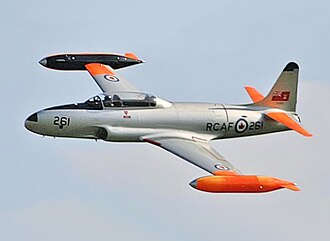
A Classic Jet in Canadian Aviation History
The Canadair CT-133 Silver Star holds a special place in Canadian military aviation as one of the country’s most enduring and versatile jet aircraft. Developed from the American Lockheed T-33 Shooting Star and manufactured under licence by Canadair in Montreal, Quebec, the Silver Star became a cornerstone of Royal Canadian Air Force (RCAF) pilot training during the early Cold War. Its long service life, dependable engineering, and adaptable design allowed it to fulfil a wide range of duties, from preparing young pilots for the challenges of jet flight to supporting weapons training, reconnaissance, electronic warfare exercises, and specialized testing. While it was not designed to be a frontline supersonic fighter, the CT-133 played a crucial role in the development of Canada’s military aviation capabilities by helping generations of aircrew acquire the skills required to operate increasingly sophisticated combat aircraft.
Often affectionately known as the T-Bird, the Silver Star combined the performance of an early jet aircraft with the dual-seat configuration and handling characteristics needed for advanced flight instruction. Its relatively straightforward design, swept wings, distinctive wingtip fuel tanks, and single turbojet engine made it recognizable on Canadian airfields for decades. More importantly, the aircraft occupied a vital position in the transition from propeller-driven trainers to the high-performance jets that transformed military aviation after the Second World War. Pilots who learned to fly the Silver Star gained experience with jet speeds, energy management, instrument flying, formation work, and tactical manoeuvres before moving on to operational aircraft such as the CF-100 Canuck, CF-101 Voodoo, and CF-104 Starfighter.
The CT-133’s significance extended well beyond flight schools. As the demands placed on military aviation evolved, Canadian operators continued to find useful work for the aircraft long after newer trainers had entered service. Silver Stars were employed in target towing, communications, electronic warfare training, and other support roles, while selected airframes remained useful for specialist testing. Its final retirement in 2005 marked the end of an extraordinary period of Canadian military aviation history. The Silver Star was more than a licensed Canadian version of an American aircraft: it was a practical and long-lived training platform that helped shape the skills, experience, and professionalism of Canadian military pilots throughout the second half of the twentieth century.
Historical Background and Development
The Emergence of Jet Training After the Second World War
The origins of the Canadair CT-133 Silver Star can be traced to the rapid development of jet propulsion during the Second World War and the revolutionary changes it brought to military aviation. Early operational jet fighters offered the potential for higher speeds and different performance characteristics than piston-engine aircraft, but they also introduced new challenges for pilots. Jet aircraft responded differently to throttle inputs, managed energy differently during manoeuvres, and demanded a new understanding of acceleration, high-speed flight, and approach planning. As air forces began replacing piston-engine fighters with jet-powered aircraft, conventional training methods needed to evolve accordingly. Pilots could no longer rely solely on experience gained in propeller-driven aircraft if they were to operate increasingly fast and technically demanding jets safely and effectively.
The United States and its allies therefore sought jet trainers that could introduce pilots to the essential characteristics of jet flight without exposing them immediately to the full complexity of frontline combat aircraft. A two-seat trainer offered an important advantage because an instructor could accompany a student, demonstrate procedures, monitor performance, and intervene when necessary. The ideal aircraft needed enough performance to prepare students for operational jets while remaining manageable enough for structured training. It also had to be robust, economical to maintain relative to frontline fighters, and capable of conducting a broad curriculum that included basic jet handling, instrument flying, navigation, formation work, and tactical training.
The Lockheed T-33 Shooting Star emerged as one of the most successful answers to this challenge. Its design was derived from the P-80 Shooting Star, one of the United States’ earliest operational jet fighters, but the trainer was lengthened to accommodate a second cockpit and additional equipment. This created a practical training aircraft that retained the essential flying characteristics of a jet fighter while providing the space and visibility required for instruction. Its widespread adoption demonstrated that an aircraft developed from an operational fighter could become equally important in preparing the next generation of military aviators.
From the Lockheed T-33 Shooting Star to the Silver Star
The Lockheed T-33 first flew on 22 March 1948 and was developed to provide a dedicated two-seat training platform based on the P-80 Shooting Star. The basic concept was relatively straightforward: preserve the general aerodynamic layout and flight characteristics of the original fighter, extend the fuselage to accommodate a second crew member, and modify the cockpit arrangement to support instruction. This approach produced an aircraft that could expose student pilots to the demands of jet flight without requiring them to begin their training in a single-seat combat aircraft.
The T-33 soon attracted the attention of air forces outside the United States, including the Royal Canadian Air Force, which needed a modern training aircraft to support its transition to jet-powered fighters. Canada was expanding and modernizing its air force during the early Cold War, when NATO commitments and concerns about Soviet military capabilities made effective pilot training an important national defence priority. A reliable jet trainer was essential to ensure that Canadian pilots could progress from basic flying instruction to the more demanding operational requirements of high-performance fighter aircraft.
Canadair entered into an arrangement with Lockheed to manufacture the T-33 in Canada, providing the country with an opportunity to strengthen its domestic aerospace manufacturing capability while meeting an important military requirement. The Canadian-built aircraft became known as the Silver Star, with the designation CT-133 eventually becoming familiar to Canadian military personnel and aviation enthusiasts. Although the aircraft shared its fundamental design with the American T-33, the Canadian version incorporated a different engine, making it a distinctive variant within the wider T-33 family.
Canadair’s Manufacturing Programme in Montreal
On 13 September 1951, Canadair signed the licence agreement that established the Canadian production programme for the T-33. The company, based in Montreal, Quebec, had considerable experience manufacturing military aircraft and was well positioned to undertake the production of a modern jet trainer. The programme required the coordination of airframe manufacturing, engine integration, systems installation, testing, quality control, and military acceptance procedures. Building a jet aircraft under licence was not simply a matter of assembling imported components; it required Canadian industrial facilities and personnel to produce a complex machine that met the engineering standards and operational requirements established for the aircraft.
Canadair’s version was designated the CL-30 by the manufacturer and became known as the T-33AN or Silver Star Mk. III in its early Canadian military context, with CT-133 becoming the familiar Canadian Forces designation. The aircraft used a Rolls-Royce Nene 10 turbojet produced under licence in Canada, rather than the Allison J33 engine fitted to the original American-built T-33A. This change gave the Canadian variant a different propulsion arrangement while retaining the aircraft’s fundamental training role.
The first Canadair-built aircraft flew in December 1952, and the Silver Star entered RCAF service in 1953. Production continued into 1959, and Canadair ultimately built 656 aircraft for Canadian military use. The scale of the programme represented a major commitment to jet training and demonstrated the capacity of Canadian industry to manufacture a sophisticated military aircraft in substantial numbers. It also ensured that the RCAF could operate a relatively standardized fleet of trainers, supported by domestic manufacturing expertise and an established supply and maintenance system.
Design and Engineering Characteristics
Airframe and General Configuration
The CT-133 Silver Star featured a compact, streamlined airframe with swept wings, a single jet engine, and a conventional tail arrangement. Its overall configuration was inherited from the Lockheed T-33, itself derived from the P-80 Shooting Star, but the longer fuselage accommodated two crew members seated in tandem. This arrangement allowed an instructor in the rear cockpit to supervise the student in the forward cockpit, providing direct guidance during flight and enabling a structured transition from basic flying skills to more advanced jet operations.
The aircraft’s swept-wing design reflected the aerodynamic research and engineering priorities of the early jet age. As aircraft speeds increased, designers had to account for compressibility effects and changes in aerodynamic behaviour that became increasingly important as aircraft approached transonic speeds. The T-33 family was not a supersonic design, but its swept wings and streamlined fuselage gave student pilots experience with an aircraft that behaved more like the jet fighters they would eventually fly than the propeller-driven trainers they had previously used. This made the Silver Star a useful bridge between elementary flight training and operational jet conversion.
The CT-133 also featured prominent wingtip fuel tanks, which extended its practical endurance and became one of its most recognizable visual characteristics. These tanks helped provide the fuel capacity required for training sorties and longer flights, although the aircraft’s range depended on its configuration, fuel reserves, altitude, and flight profile. Its relatively compact size compared with frontline fighters made it suitable for training operations, while its robust construction enabled it to tolerate the repeated takeoffs, landings, and manoeuvres associated with a busy military flying programme.
Dimensions and Structural Characteristics
The Canadair CT-133 was approximately 37 feet 8 inches (11.49 metres) long, with a wingspan of about 42 feet 5 inches (12.93 metres) and a height of approximately 11 feet 8 inches (3.56 metres). Its relatively small physical dimensions reflected its origins as a lightweight jet fighter adapted for training. Compared with larger bombers, transports, or modern multirole fighters, the Silver Star was a compact aircraft, but it still provided the space needed for two pilots, cockpit instrumentation, communications equipment, and the systems required for reliable jet operation.
The aircraft’s empty weight was approximately 8,440 pounds (3,828 kilograms), while its maximum gross weight was about 16,800 pounds (7,620 kilograms). The difference between these figures reflected the weight of fuel, crew, equipment, and any mission-specific stores carried during a flight. As with other military aircraft, the permitted takeoff weight depended on operating conditions and configuration, including the amount of fuel carried and the requirements of the planned mission.
The airframe was designed to withstand the demands of military training, including repeated practice manoeuvres and the stresses associated with controlled aerobatics and formation flying when authorized. Nevertheless, pilots had to remain within the aircraft’s approved operating limits, and instructors emphasized the importance of disciplined flying technique. The Silver Star’s value as a training aircraft depended partly on its ability to deliver predictable handling characteristics while exposing students to the operational realities of jet flight.
Rolls-Royce Nene 10 Turbojet Engine
One of the most important features distinguishing the Canadian Silver Star from the original American-built T-33A was its propulsion system. The CT-133 was powered by a single Rolls-Royce Nene 10 centrifugal-flow turbojet, rated at approximately 5,000 to 5,100 pounds-force of static thrust, depending on the reference and specification used. The Nene was a British-developed engine that had been adopted for the Canadian production aircraft and manufactured under licence in Canada. Its integration into the Silver Star gave the CT-133 a distinctive engineering identity within the international T-33 family.
The centrifugal-flow turbojet worked by drawing air into the engine, compressing it using a centrifugal compressor, mixing it with fuel, and burning the mixture to generate hot, expanding gases. These gases passed through a turbine that drove the compressor before exiting through the exhaust nozzle, producing thrust. Although later jet engines increasingly adopted axial-flow compressors and more advanced designs, centrifugal-flow engines were important in the early development of jet propulsion because of their relatively straightforward construction and established engineering principles.
For a training aircraft, reliable propulsion was essential. Instructors and students needed to concentrate on flying technique, navigation, and procedures rather than being distracted by avoidable mechanical problems. The Nene engine provided the thrust needed for the Silver Star’s training role, while the aircraft’s overall design helped students become familiar with the operational procedures associated with jet-powered flight. As with all early turbojets, however, pilots had to understand engine response, fuel management, temperature and operating limits, and the consequences of inappropriate throttle handling. These lessons were important foundations for the more powerful jet aircraft that students might encounter later in their careers.
Cockpit Arrangement and Pilot Controls
The CT-133’s tandem cockpit arrangement was central to its role as an advanced jet trainer. The student occupied the forward cockpit, while the instructor sat behind, with both crew members equipped to perform their respective duties. This configuration allowed an instructor to observe the student’s performance, provide verbal guidance, demonstrate manoeuvres, and monitor flight parameters throughout the sortie. The instructor could also take control when necessary, making the aircraft suitable for a carefully structured training programme that progressed from routine handling to demanding operational exercises.
The cockpit included the instruments and controls required for jet flight, navigation, communications, and aircraft systems management. Students learned to monitor airspeed, altitude, attitude, engine performance, and other flight parameters while coordinating their actions with the instructor. Instrument flying was particularly important because military pilots needed to operate in cloud, reduced visibility, and conditions where external visual references were unavailable or unreliable. The Silver Star provided a platform on which these skills could be developed before students moved on to more complex operational aircraft.
The tandem layout also helped students become accustomed to the cockpit discipline and communication practices required in military aviation. Flight instruction demanded precise language, clear acknowledgement of instructions, and the ability to respond appropriately under pressure. As students became more proficient, the instructor could introduce increasingly complex manoeuvres and operational scenarios, using the aircraft’s performance to build confidence without removing the need for careful planning and strict adherence to safety procedures.
Flight Performance and Handling Characteristics
Speed and High-Performance Flight Training
The CT-133 Silver Star had a commonly quoted maximum speed of approximately 570 miles per hour (917 kilometres per hour), or around 500 knots, under suitable conditions. Actual performance varied according to altitude, aircraft configuration, loading, and the measurement conventions used in different technical references. Although the aircraft was not designed to be a supersonic fighter, its performance was sufficient to introduce student pilots to the higher speeds and more demanding flight characteristics associated with jet-powered military aviation.
One of the key differences between jet and piston-engine flight was the way aircraft responded to changes in power and airspeed. A jet trainer could accelerate differently from a propeller-driven aircraft, and pilots had to learn to anticipate energy changes rather than relying solely on immediate engine response. At high speed, manoeuvres required careful attention to aerodynamic loads, turn radius, and the aircraft’s operating envelope. The Silver Star helped students develop an appreciation for these factors while allowing instructors to supervise their progress.
The aircraft’s maximum speed should not be confused with its normal training speed or cruising speed. Many training sorties were conducted at lower speeds appropriate to the lesson, whether the objective was instrument flying, formation practice, navigation, or basic manoeuvring. The ability to operate across a useful range of flight conditions made the CT-133 a flexible instructional platform, enabling the same aircraft type to support a variety of training objectives without requiring a separate specialized aircraft for every task.
Climb Performance and Operating Altitude
The Silver Star’s turbojet engine gave it a climb capability that differed considerably from that of earlier piston-engine trainers. It could reach altitudes required for instrument training, high-altitude handling exercises, and the introduction of pilots to the operational environment of jet aircraft. Its commonly cited service ceiling is approximately 47,000 feet (14,325 metres), although some museum and reference sources provide slightly different figures depending on the variant and the definition being used.
High-altitude flight training taught pilots to manage changes in aircraft performance as the air became thinner and the available aerodynamic margins changed. At altitude, engine performance, airspeed interpretation, aircraft response, and cockpit workload all required careful attention. Students also learned to plan descents and approaches with sufficient awareness of their energy state, a skill that became increasingly important as they progressed toward faster and more powerful aircraft.
The CT-133’s climb and altitude capabilities made it useful for more than routine local training circuits. It could support instrument exercises, navigation flights, formation work, and training scenarios designed to simulate aspects of operational jet aviation. These capabilities contributed to its long service life because the aircraft remained relevant across several stages of pilot development and could also support specialized missions outside the standard training syllabus.
Range, Endurance, and Fuel Management
The Silver Star’s range depended heavily on the mission profile and the fuel configuration. With external wingtip tanks, commonly cited range figures are around 1,400 miles (2,250 kilometres), although this should be treated as an approximate reference value rather than a guarantee of practical operational radius. A training sortie involving frequent changes in speed and altitude, repeated manoeuvres, or substantial time spent practising a specific exercise would consume fuel differently from a relatively efficient transit flight.
Fuel management was an important part of training because jet aircraft required pilots to plan missions with an appropriate reserve and a clear understanding of the relationship between fuel consumption, flight time, and distance. Students had to learn to anticipate fuel requirements before departure, monitor fuel during the flight, and make sound decisions if conditions changed. The Silver Star therefore taught more than aircraft handling: it also helped establish the operational habits required for safe and disciplined military flying.
Although its endurance was limited compared with larger aircraft designed specifically for long-range patrol or transport, the CT-133 offered a useful balance between performance, size, and training capability. It could conduct the local sorties required for structured instruction while also undertaking longer flights when the mission and fuel configuration permitted. This flexibility supported the aircraft’s broad utility throughout its operational life.
The Silver Star’s Role in Royal Canadian Air Force Training
Preparing Pilots for the Jet Age
The principal mission of the CT-133 Silver Star was advanced jet training. As the RCAF introduced more sophisticated fighters and interceptors, it needed an aircraft capable of preparing pilots for the speed, workload, and operating procedures of jet combat aviation. The Silver Star occupied an important stage in the training pipeline, allowing pilots to build on their earlier flying experience while becoming familiar with the behaviour of a jet-powered aircraft.
Training could include basic jet handling, instrument flight, navigation, formation flying, aerobatics, and more advanced manoeuvres, depending on the course and the student’s stage of development. Instructors used the aircraft’s performance to introduce increasingly complex tasks while reinforcing the importance of safety, disciplined cockpit procedures, and accurate aircraft control. The objective was not simply to teach students how to fly quickly, but to prepare them to operate reliably under the demanding conditions they would face in military service.
The CT-133’s two-seat configuration made it particularly useful in this role because instructors could guide students directly throughout each sortie. Mistakes could be identified and corrected in real time, while successful performance allowed students to progress toward greater independence. Over time, the aircraft became familiar to multiple generations of Canadian pilots, many of whom remembered the T-Bird as their first sustained experience of military jet flying.
Training for Operational Fighters and Interceptors
The Silver Star was especially valuable as a bridge between training aircraft and operational jets such as the CF-100 Canuck, CF-101 Voodoo, and CF-104 Starfighter. Each of these aircraft presented its own demands, from interceptor procedures to high-speed flight and tactical manoeuvring. Before moving to an operational type, pilots needed a foundation in jet handling, energy management, instrument procedures, formation discipline, and the communication practices required in a military cockpit.
The CT-133 could not reproduce every feature of a modern fighter, nor was it intended to do so. Instead, it provided a controlled environment in which pilots could master essential skills that would transfer to more advanced aircraft. Students learned to manage the aircraft’s energy, maintain situational awareness, execute manoeuvres accurately, and follow instructions while balancing several tasks at once. These skills were especially important as military aviation became increasingly complex and operational aircraft incorporated more sophisticated avionics, weapons, and mission systems.
The aircraft’s long career also meant that its training value changed over time. As newer fighters entered service, the Silver Star continued to provide a foundation in jet flying even though the performance gap between trainer and operational aircraft sometimes increased. This ability to remain useful despite changing technology was one of the reasons the CT-133 became such an enduring component of Canadian military aviation.
Instrument Flying, Formation Work, and Aerobatics
Instrument flying was a vital component of Silver Star training. Military pilots needed to be able to control an aircraft using cockpit instruments when clouds, darkness, or poor visibility made outside visual references inadequate. The CT-133 provided a platform for developing these skills while introducing students to the procedures and discipline required for reliable instrument operations. Instructors could teach students to interpret flight instruments, maintain prescribed headings and altitudes, execute turns and climbs accurately, and follow instrument procedures with increasing confidence.
Formation flying was another important training activity. Military aircraft often operated in coordinated groups, and pilots needed to maintain safe separation while responding to changes in speed, altitude, and formation position. The Silver Star’s performance and handling made it suitable for supervised formation exercises, helping students develop visual awareness, precise control inputs, and the ability to communicate effectively with other pilots. Such skills were fundamental to fighter operations, where formation discipline could be important during transit, tactical training, and coordinated manoeuvres.
The aircraft was also capable of aerobatic manoeuvres within approved limits, making it useful for developing aircraft control, spatial awareness, and confidence in unusual attitudes. Aerobatics required pilots to understand how aircraft energy and loading changed during manoeuvres, while maintaining control and respecting structural limitations. When conducted as part of an authorized training syllabus, these exercises helped prepare pilots for the demanding manoeuvring environment associated with military jet aviation.
The Red Knight: The Silver Star as an Aerobatic Display Aircraft
The Origins of the Red Knight
One of the most memorable chapters in the history of the CT-133 Silver Star was its use by the Red Knight, a solo aerobatic demonstration aircraft operated by the RCAF. During the early 1960s, the Red Knight became a familiar attraction at airshows and public aviation events across Canada. Its bright red paint scheme made the aircraft highly visible in the sky and created a striking contrast with the natural background, allowing spectators to follow the aircraft as it performed its manoeuvres.
The Red Knight programme helped bring military aviation closer to the Canadian public at a time when jet aircraft represented a visible symbol of technological progress and national defence. A solo display could demonstrate the aircraft’s agility, control responsiveness, and performance in a way that static exhibitions could not. The pilot’s ability to execute a precise sequence of manoeuvres also highlighted the training and discipline required to operate a jet aircraft safely and professionally.
The Silver Star was well suited to this role because its handling characteristics and performance allowed an experienced pilot to demonstrate a range of aerobatic manoeuvres within the aircraft’s approved operating limits. Although the Red Knight was a demonstration aircraft rather than a combat platform, its performances reinforced the public association between the Silver Star and Canadian military aviation. The aircraft became more than a training tool: it also became a symbol of the RCAF’s skill and professionalism.
Public Engagement and the Aircraft’s Cultural Legacy
The Red Knight’s bright red aircraft and solo display format made it memorable to audiences who might otherwise have encountered military jets only through photographs or news reports. Airshows offered an opportunity for members of the public to see the speed, sound, and manoeuvrability of a jet aircraft at close range, while demonstrations helped explain the importance of pilot training and aviation safety. The Silver Star’s participation in these events also provided a visible connection between the RCAF and the communities it served.
The programme’s historical importance lies partly in its simplicity. A single aircraft and a highly trained pilot could communicate the excitement and technical complexity of jet aviation without the elaborate formations or large teams associated with some aerobatic displays. The Red Knight also showed that a practical training aircraft could become a capable public ambassador for military aviation, extending its significance beyond the flight-training environment.
The aircraft’s red paint scheme remains one of the most recognizable visual associations with the CT-133 in Canada. Preserved Silver Stars wearing Red Knight markings allow museums and visitors to connect the aircraft’s engineering history with its public role, illustrating how a military trainer could become an enduring part of national aviation heritage.
Other Operational Roles Beyond Pilot Training
Photo-Reconnaissance and Armament Training
Although the Silver Star was primarily designed as a jet trainer, its adaptability allowed it to undertake additional duties. Certain aircraft were used in photo-reconnaissance training, helping aircrew develop the skills required to operate cameras and interpret imagery gathered from the air. Reconnaissance training required pilots to understand navigation accuracy, flight planning, altitude control, and the importance of maintaining the correct aircraft position during a photographic run. These activities complemented the wider training system by introducing operational tasks that depended on precision rather than simply on aircraft handling.
Other variants and configurations supported armament training, preparing aircrew for the procedures associated with weapons employment and tactical flight. The CT-133 was not a dedicated frontline fighter, and its standard training configuration was not equivalent to that of an operational combat aircraft. Nevertheless, selected Silver Stars could be equipped or adapted for specific training purposes, allowing students and experienced personnel to practise elements of military aviation under controlled conditions.
These additional roles helped extend the aircraft’s usefulness and made the Silver Star a flexible asset within the RCAF. Rather than requiring a separate aircraft for every training objective, the service could use a proven jet platform for a variety of tasks where its performance and configuration were appropriate. This versatility was particularly valuable for an aircraft that remained in service for decades, as changing requirements could create new opportunities to employ existing airframes.
Electronic Warfare Training and Enemy Simulation
As military aviation developed, realistic training increasingly required pilots to practise against aircraft and systems that simulated potential adversaries. The CT-133 proved useful in this environment because it could operate as a training target and support exercises designed to test the tactical awareness of fighter crews. In some roles, Silver Stars were used in electronic warfare training or as simulated enemy aircraft, helping pilots practise detecting, identifying, intercepting, and manoeuvring against airborne contacts.
This work was different from the aircraft’s original role as a trainer, but it built on the same strengths that had made the Silver Star successful in the first place: reliability, manageable operating characteristics, and sufficient performance for structured military exercises. A training aircraft could be especially useful when it allowed frontline fighters to practise tactics without requiring every training event to involve another expensive combat aircraft. The CT-133 therefore contributed to operational readiness even after its position in the formal pilot-training pipeline had diminished.
The aircraft’s role in these exercises also demonstrates how military aviation platforms can evolve throughout their service lives. An aircraft initially purchased to teach pilots how to fly jets could later help experienced pilots practise combat tactics and develop the skills needed to respond to airborne threats. The Silver Star’s longevity was therefore a product not only of its original design, but also of the willingness of Canadian military organizations to identify useful new roles as technology and operational requirements changed.
Target Towing and Communications Duties
Target towing was another specialized task performed by some CT-133 aircraft. In this role, an aircraft towed a target used during air-to-air gunnery or other training exercises, allowing pilots to practise tracking and engagement procedures under controlled conditions. The towing aircraft required suitable equipment and procedures to ensure that the target could be deployed and recovered safely, while participating aircraft had to follow carefully managed exercise rules. The CT-133’s performance and established maintenance infrastructure made it a practical choice for certain training activities of this kind.
The Silver Star was also used for communications and general support duties. Military units often required aircraft to transport personnel, deliver time-sensitive items, support liaison tasks, or move between bases when other transport arrangements were unavailable or impractical. Although a jet trainer was not as economical as a dedicated transport aircraft for many of these tasks, its availability and performance could make it useful in specific circumstances.
These secondary roles helped the Silver Star remain relevant after newer training aircraft entered service. They also reveal a practical aspect of military fleet management: a well-maintained aircraft can continue to provide value even after it is no longer the preferred platform for its original purpose. The CT-133’s long operational life was therefore shaped by both its dependable design and the broad range of duties it could undertake.
Service Across Canada and with NATO Forces
Training Bases and the Canadian Aviation Environment
The Silver Star served at numerous Canadian air force stations and training establishments, where it became a familiar sight to students, instructors, maintenance personnel, and local communities. Training operations required more than aircraft and runways; they depended on a coordinated system of instruction, technical support, maintenance scheduling, navigation planning, and safety oversight. The CT-133 became part of this system for decades, and its continued operation helped provide consistency as successive generations of pilots moved through the training pipeline.
Canada’s vast geography also made a standardized training aircraft valuable. Aircraft could be assigned to different bases as requirements changed, while established maintenance practices and training procedures helped support operations across the country. The Silver Star’s relatively compact size and single-engine configuration made it simpler in some respects than the larger frontline fighters that followed, although it still required the specialized skills and equipment associated with jet aviation.
The aircraft’s service also contributed to the experience of Canadian technicians and engineers. Keeping a jet fleet operating for decades required regular inspections, component replacement, engine maintenance, structural assessments, and careful management of aircraft records. The knowledge accumulated through this work became part of the broader expertise that supported Canada’s military aviation system, demonstrating that an aircraft’s contribution extends well beyond the sorties recorded in its flight log.
Canadian Aircraft in West Germany
The CT-133’s role was not confined to Canada. Silver Stars also served with Canadian forces associated with NATO in West Germany during the Cold War. Canada’s commitment to European defence involved maintaining personnel and aircraft overseas, where the training and readiness requirements of the alliance placed continuing demands on military aviation units. The presence of Silver Stars in this environment helped support the preparation of pilots and other aircrew within the wider Canadian and NATO operational structure.
Operating overseas presented its own challenges, including coordination with allied units, adaptation to local airspace procedures, and the logistics required to maintain aircraft far from their home bases. A standardized aircraft type with established support arrangements helped simplify these demands. The Silver Star’s role within NATO-related operations demonstrated that it was not merely a domestic training platform, but part of a broader military aviation network connecting Canadian forces to alliance responsibilities.
When Canadian forces closed their German bases, the aircraft associated with these units returned to Canada, and the Silver Star continued to serve in various training and support roles. Its overseas history remains an important part of its legacy because it illustrates the connection between pilot training and the wider strategic requirements of the Cold War.
International Production and Worldwide Service
A Widely Used Jet Trainer
The Lockheed T-33 became one of the most widely produced and internationally operated jet trainers of the twentieth century. Its combination of relatively straightforward design, useful performance, and suitability for advanced flight instruction made it attractive to air forces that were modernizing their fleets after the Second World War. Countries acquiring the aircraft could use it to prepare pilots for jet operations without immediately committing to a completely new training system built around a different design.
Canadair’s production programme contributed significantly to this international success by supplying a large number of aircraft for Canadian service. The 656 Canadian-built Silver Stars formed a substantial part of the wider T-33 family, which was produced in thousands of examples in several countries. The aircraft’s extensive service record demonstrates the importance of reliable training platforms during a period when jet propulsion was becoming the standard for modern combat aviation.
The T-33 family was used by air forces in Europe, the Americas, and other regions, with national operators adapting the aircraft to their own training systems and operational requirements. While individual variants differed in equipment, engine configuration, and mission use, they shared the same underlying concept: a two-seat jet that could bridge the gap between basic flying instruction and operational combat aircraft. The Silver Star’s success in Canada was part of this much broader international story.
Export Customers and Canada’s Aerospace Industry
Canadian-built Silver Stars were supplied to several foreign operators, including Greece, Turkey, France, Portugal, and Bolivia. These exports demonstrated that Canadair’s manufacturing programme had significance beyond domestic defence requirements. Export production helped establish the company’s reputation as a manufacturer capable of producing a widely respected military aircraft under licence, while also supporting the industrial skills and technical knowledge associated with aircraft manufacturing.
Export customers benefited from a design that had already been produced in substantial numbers and used extensively for military training. However, operating a jet aircraft still required investment in pilot instruction, maintenance personnel, engine servicing, spare parts, and technical documentation. The aircraft’s international adoption therefore reflected not only its performance, but also the ability of operators to integrate it into a broader training and support system.
For Canada, the export history of the Silver Star formed part of a wider pattern in which domestic aerospace manufacturing contributed to international defence relationships. The aircraft became an example of how licensed production could provide a country with both a practical military capability and an opportunity to participate in the international aviation market.
Limitations and the Transition to Newer Trainers
The Challenges of an Early Jet Design
Although the CT-133 Silver Star was highly successful, it reflected the technological limitations of the early jet age. Its single turbojet engine lacked the fuel efficiency and operating characteristics of more modern powerplants, and the aircraft did not possess the advanced avionics, digital flight systems, or sophisticated cockpit displays found in later training aircraft. As operational fighters became faster and more complex, the gap between the Silver Star and the aircraft students were preparing to fly grew increasingly apparent.
The CT-133 was also subsonic, which meant it could not reproduce every aspect of training required for pilots destined for supersonic fighters. It could teach important transferable skills, including energy management, instrument flying, formation discipline, and tactical awareness, but advanced conversion training still had to take place on aircraft better suited to the specific demands of the operational type. The Silver Star was therefore one stage in a broader training pathway rather than a complete substitute for frontline fighter instruction.
Maintenance and fleet age eventually became important considerations as well. Aircraft that remain in service for decades require ongoing inspections, structural assessments, parts support, and technical expertise. Even a robust airframe becomes more expensive and complicated to support as its components age and the industrial supply chain changes. These challenges did not erase the CT-133’s accomplishments, but they helped shape the decisions that eventually led to its withdrawal from service.
The Introduction of More Modern Training Aircraft
As Canadian military aviation developed, newer training aircraft offered improved efficiency and capabilities better suited to contemporary training requirements. The Canadair CT-114 Tutor, for example, became an important jet trainer in the RCAF and later the Canadian Armed Forces. The Tutor’s introduction reflected the continuing evolution of training doctrine and aircraft design, including changes in the way pilots were prepared for modern operational aircraft.
The arrival of newer trainers did not immediately make the Silver Star obsolete in every role. Instead, the aircraft’s responsibilities changed gradually as the training system evolved and its remaining airframes were reassigned to tasks where their performance remained useful. Some aircraft continued in support roles long after the main training fleet had been replaced, demonstrating how the retirement of a platform from its primary role can occur well before the final aircraft leaves service.
The transition also highlights a recurring challenge in military aviation: training aircraft must remain relevant to the operational aircraft they support, but they must also be affordable, reliable, and manageable for routine instruction. The CT-133 had fulfilled this balance exceptionally well for many years, yet the introduction of newer technologies and training requirements eventually made replacement necessary.
Retirement and the Silver Star’s Enduring Legacy
The Final Years of Canadian Service
The Canadair CT-133 Silver Star enjoyed an exceptionally long career, remaining in Canadian military service for more than half a century. Although its principal role as an advanced jet trainer gradually declined as newer aircraft entered the training system, a number of Silver Stars continued operating in specialist capacities. These included target towing, electronic warfare training, communications duties, and technical testing. The aircraft’s ability to adapt to different assignments allowed the Canadian military to continue benefiting from existing airframes instead of withdrawing every aircraft as soon as its original training role had been taken over by a newer design.
By the late twentieth century, the Silver Star had become a remarkable example of aircraft longevity. Some airframes had accumulated thousands of flying hours, and maintaining them required careful attention to engines, structures, instruments, and the availability of replacement components. Their continued use also reflected the value of accumulated technical knowledge: maintenance personnel understood the aircraft’s systems, instructors were familiar with its handling characteristics, and established procedures supported safe and effective operations. These factors helped the CT-133 remain useful long after its introduction, even as military aviation entered a new technological era.
The final stages of its service involved specialized work rather than a return to its original position as Canada’s principal jet trainer. Selected aircraft were retained for testing and support activities, including work associated with the Aerospace Engineering Test Establishment at Cold Lake, Alberta. The Canadian Forces’ final Silver Stars were retired by 31 March 2005, bringing an end to a service history that had begun in the early 1950s. The retirement was an important milestone in Canadian aviation, marking the conclusion of one of the longest-running jet aircraft programmes in the country’s military history.
Preserving the Silver Star for Future Generations
The retirement of the CT-133 did not diminish its historical importance. Instead, surviving examples became valuable reminders of the aircraft’s role in developing Canadian military aviation and supporting the country’s aerospace industry. Museums preserve Silver Stars in a variety of configurations, including standard training colours and the distinctive red markings associated with the Red Knight. These aircraft allow visitors to appreciate the proportions of an early jet trainer, examine its cockpit arrangement, and understand the practical engineering decisions that shaped its design.
Preserved aircraft also provide an opportunity to explore the human side of aviation history. The Silver Star was flown by students learning to master jet aircraft, instructors responsible for their development, and specialist crews conducting duties that supported the wider military organization. Every surviving airframe represents a portion of this larger story, connecting engineering and manufacturing history with the experience of military personnel who worked with the aircraft throughout its service life.
The CT-133 is especially valuable as an educational exhibit because it represents a transitional period in aviation. Its origins lie in the first generation of operational jet fighters, yet its primary role was to prepare pilots for aircraft that became increasingly sophisticated over subsequent decades. Studying the Silver Star helps explain how air forces adapted their training systems to new propulsion technology, why two-seat trainers became essential, and how an aircraft designed for one generation could remain useful well into another.
Why the Canadair CT-133 Silver Star Matters Today
The Canadair CT-133 Silver Star deserves recognition not because it was the fastest or most heavily armed aircraft of its generation, but because it fulfilled an essential military function with remarkable consistency. The transition to jet aviation required a new approach to pilot training, and the Silver Star provided a practical bridge between basic flying instruction and the demanding requirements of operational jet aircraft. Its tandem cockpit, swept-wing configuration, and turbojet propulsion gave student pilots valuable experience while allowing instructors to supervise their progress directly.
Its significance also lies in the scale of the Canadian production programme. Canadair manufactured 656 aircraft, establishing the Silver Star as a major domestic aerospace undertaking and strengthening the country’s experience in licensed aircraft production. The aircraft’s service with Canadian forces, its use in NATO-related activities, and its export to other nations demonstrate that its importance extended beyond a single training school or military base. It became part of a wider international effort to develop the skills needed for the jet age.
The Red Knight’s public performances added another dimension to its legacy, giving the aircraft a recognizable identity beyond military training. Its later use in target towing, electronic warfare exercises, and specialist testing demonstrated the practical value of a durable aircraft that could be reassigned as operational priorities changed. Even after newer trainers had taken over much of its original workload, the Silver Star continued to serve where its capabilities remained useful.
Ultimately, the CT-133 Silver Star stands as a symbol of the people, engineering, and institutional experience that make military aviation possible. Its long career demonstrates that an aircraft’s contribution cannot be measured solely by maximum speed, combat capability, or technological novelty. Reliability, adaptability, ease of instruction, and the ability to support a changing organization can be equally important. For Canada, the Silver Star was a trusted training aircraft, a product of domestic manufacturing expertise, and an enduring link between the pioneering years of jet flight and the sophisticated military aviation systems that followed.
Canadair CT-133 Silver Star: Technical Specifications Summary
The following table summarizes commonly cited specifications for the Canadair CT-133 Silver Star, particularly the Canadian-built Mk. III variant. Figures are approximate, and performance can vary with aircraft configuration and the reference source.
| Specification | Details |
|---|---|
| Official designation | Canadair CT-133 Silver Star |
| Manufacturer | Canadair Limited, Montreal, Quebec, Canada |
| Original design | Lockheed T-33 Shooting Star |
| Manufacturer’s model number | CL-30 |
| Aircraft type | Two-seat jet trainer and military support aircraft |
| First flight of the original T-33 | 22 March 1948 |
| First flight of the Canadair-built version | December 1952 |
| Introduction to RCAF service | 1953 |
| Production period in Canada | 1952–1959 |
| Number built by Canadair | 656 |
| Final Canadian Forces retirement | 31 March 2005 |
| Crew | 2, seated in tandem |
| Length | 37 ft 8.5 in (11.49 m) |
| Wingspan | 42 ft 5 in (12.93 m) |
| Height | 11 ft 8 in (3.56 m) |
| Wing area | Approximately 238 sq ft (22.1 m²) |
| Empty weight | Approximately 8,440 lb (3,828 kg) |
| Maximum gross weight | Approximately 16,800 lb (7,620 kg) |
| Powerplant | One Rolls-Royce Nene 10 turbojet |
| Engine thrust | Approximately 5,000–5,100 lbf (22–22.7 kN) |
| Maximum speed | Approximately 570 mph (917 km/h) |
| Cruise speed | Approximately 190 mph (306 km/h), as commonly cited for reference conditions |
| Service ceiling | Approximately 47,000 ft (14,325 m); figures vary by source |
| Range | Approximately 1,400 mi (2,253 km) with external fuel tanks, depending on conditions |
| Fuel arrangement | Internal fuel and characteristic wingtip tanks |
| Primary role | Advanced jet pilot training |
| Additional roles | Armament training, photo-reconnaissance training, target towing, electronic warfare exercises, communications and testing |
| Famous display role | Red Knight solo aerobatic aircraft |
| Notable successor in Canadian jet training | Canadair CT-114 Tutor |
.jpg)