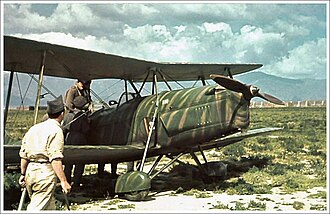
The Ca.164’s story is unusual because the aircraft did not perform as well in its intended training role as its designers and operators had hoped. Flight testing revealed handling characteristics that made it unsuitable for some of the tasks for which it had been designed, and the Italian air force consequently employed many examples in liaison, communication, and other secondary roles. It was also used for limited reconnaissance duties during the Second World War, while its history included an export connection with France. Although it was never as famous as Italy’s combat aircraft, the Ca.164 provides an interesting look at the practical side of military aviation: the aircraft that carried messages, supported units, and served behind the front line while faster and more heavily armed machines dominated public attention.
The Historical Background of the Caproni Ca.164
Italy’s need for a new training aircraft
During the 1930s, the Italian military was expanding and reorganizing its aviation forces. The development of modern fighters and bombers attracted considerable attention, but an effective air force also required a dependable system for training pilots. Future military aviators needed to learn basic aircraft handling, take-offs and landings, coordinated turns, navigation, formation flying, and the procedures that would prepare them for more advanced aircraft. These skills could not be acquired efficiently without suitable training machines, and the aircraft used for elementary instruction had to be economical to operate, sufficiently robust for repeated flights, and forgiving enough to support inexperienced pilots.
The Caproni Ca.100 had served as an important Italian training aircraft, but the continuing evolution of aviation created pressure to replace older types with improved designs. A new trainer had to fit the practical requirements of flying schools while remaining compatible with the financial and industrial limitations of the period. It needed enough power for normal training operations, a layout that allowed an instructor to supervise a student, and straightforward systems that ground crews could maintain without excessive difficulty. These requirements could sound modest compared with those of a bomber, but a trainer’s handling qualities were especially important because it would be flown by inexperienced pilots who were still learning to recognize and correct mistakes.
The Ca.164 was developed within this context. Rather than pursuing a radical departure from the established trainer configuration, Caproni adopted a familiar biplane arrangement with two seats and a single engine. The concept offered a straightforward route toward a new aircraft based on the general principles of earlier Italian trainers. However, familiarity of appearance did not necessarily translate into suitability for the training role. A trainer had to respond predictably to control inputs, recover from common student errors in a manageable way, and provide consistent behavior across a wide range of flight conditions. The Ca.164 would demonstrate that satisfying the basic design brief was not enough if the aircraft’s handling characteristics did not match the needs of a flying school.
Caproni and designer Raffaele Conflenti
The Ca.164 was associated with Raffaele Conflenti, an Italian aircraft designer whose work formed part of the wider engineering activity of the Caproni organization. Caproni was one of Italy’s most established aircraft manufacturers, with a history that included civil aircraft, military machines, and numerous experimental projects. By the late 1930s, the company was operating in a competitive aviation market in which manufacturers had to respond to military requirements while managing the practical demands of production, material supply, and technical development.
Conflenti’s Ca.164 followed a conventional approach that was well suited to the general appearance of contemporary elementary aircraft. The biplane layout provided a relatively large lifting surface for the aircraft’s size, while the fixed landing gear simplified the basic arrangement and avoided the additional mechanisms associated with retractable gear. The two-seat configuration enabled a student and instructor to fly together, allowing lessons to be conducted directly in the aircraft rather than relying entirely on ground instruction. Separate cockpits were typical of many trainers of the period and gave each occupant a defined position from which to operate the aircraft.
The aircraft was developed at a time when manufacturers were often asked to produce new designs on tight schedules. Military aviation was growing quickly, and the pressure to modernize encouraged the development of multiple aircraft types for different roles. The Ca.164 was part of this broad movement, but its eventual history shows that a familiar design formula still required careful testing and refinement. Its shortcomings in the training role did not erase its value as an example of the engineering priorities of the period; rather, they demonstrate why flight testing was essential before a new aircraft could be considered suitable for widespread use by inexperienced pilots.
Development and First Flight
From the Ca.163 prototype to the Ca.164
The development history of the Ca.164 includes an important distinction between the prototype and the production aircraft. The prototype was designated Caproni Ca.163 and made its first flight on 17 November 1938, according to commonly cited historical accounts. It was built by Caproni at Taliedo and served as the basis for the aircraft that would enter production under the Ca.164 designation. This difference in designation is worth noting because some short summaries refer broadly to the Ca.164 program when describing the prototype’s first flight, while more detailed accounts identify the experimental aircraft as the Ca.163.
The prototype used a mixed construction method that combined a welded steel-tube fuselage with wooden wings and fabric covering. This approach was common among light aircraft of the era because it allowed manufacturers to combine a relatively strong central structure with lightweight lifting surfaces. Fabric covering helped keep the aircraft’s weight manageable and could be repaired using established workshop techniques. The design was not intended to withstand the stresses associated with high-speed combat or heavy weapons loads; instead, it was intended to support the repeated take-offs, landings, and routine manoeuvres of a training aircraft.
The prototype’s flight testing, however, exposed shortcomings in its handling. The aircraft did not prove sufficiently suitable for the intended elementary training mission, and this affected the way the production model was ultimately used. A training aircraft needed to be predictable and manageable, particularly during slow-speed flight and the manoeuvres that inexperienced pilots commonly performed. If an aircraft behaved in ways that made instruction unnecessarily difficult or increased the likelihood of student error, it could lose its value even if its basic construction and performance were otherwise acceptable.
Despite these concerns, the Ca.164 went into production. The decision reflected the operational pressures of the period and the possibility that the aircraft could still serve in other capacities. Military aircraft frequently acquired secondary roles when their original purpose became less practical, and the Ca.164 would become a clear example of this process. Its subsequent service in liaison and support duties gave the type a useful place in the Italian aviation system, even though it did not fulfil its original training ambition as successfully as intended.
Production and entry into service
Production of the Ca.164 began in 1939, with aircraft reaching Italian flying schools during the autumn of that year. Commonly cited production figures give approximately 280 production aircraft plus one prototype, although totals differ across historical summaries because some sources count only completed production examples while others include prototypes, conversions, or aircraft produced for export. The Italian Air Force’s official historical account notes that 252 Ca.164s were on hand in 1942, indicating that the type was present in significant numbers despite its difficulties as a primary trainer.
The Ca.164’s introduction coincided with the beginning of the Second World War in Europe. Although Italy did not enter the conflict until June 1940, the wider European situation had already transformed the demands placed on military aviation. Training systems needed to produce pilots and aircrew, while operational units required a wide variety of support aircraft to handle communications, transport personnel, and perform tasks that did not justify the use of more advanced combat machines. An aircraft such as the Ca.164 could therefore remain useful even if it was not ideal for its original assignment.
Its service history demonstrates the difference between an aircraft’s intended role and the tasks it eventually performed. The Ca.164 was designed primarily as a training and touring biplane, but its handling problems encouraged the Italian military to employ it in secondary duties. Rather than becoming a standard aircraft for all elementary training establishments, it appeared in smaller and more specialized units, including liaison elements associated with larger formations. The aircraft’s career was shaped less by a dramatic technical breakthrough than by the practical need to make use of available airframes during a period of growing military pressure.
Design and Construction of the Caproni Ca.164
The inverted sesquiplane wing arrangement
One of the Ca.164’s most distinctive features was its inverted sesquiplane configuration. Like a conventional biplane, it had two sets of wings, one above the other, but the upper wing was shorter than the lower wing. This arrangement differed from the more familiar sesquiplane layout in which the lower wing is the smaller one. The Ca.164’s configuration reflected the influence of earlier Caproni designs, particularly the Ca.100, and helped preserve a traditional appearance at a time when monoplanes were becoming increasingly common in military aviation.
Biplanes had several practical advantages for light aircraft. Two wings could provide substantial lifting area within a relatively compact span, and their structure could be made sufficiently robust for routine flying operations without relying on the same design methods used for heavier combat aircraft. The arrangement was especially familiar to instructors and pilots who had learned to fly on earlier-generation aircraft. At the same time, the additional wing and its supporting structure increased aerodynamic drag compared with many contemporary monoplanes. As aircraft engines and construction methods improved, this disadvantage became more significant, particularly for designs intended to achieve higher speeds.
The Ca.164 was not designed to compete with modern fighters in speed or altitude. Its intended purpose was to provide a manageable aircraft for training and general aviation duties, so the biplane arrangement was not inherently inappropriate. However, a trainer’s value depends on more than lift and basic structural strength. The aircraft must also respond consistently to changes in pitch, roll, and yaw, and it must give a student enough warning of approaching aerodynamic limits. The Ca.164’s handling difficulties meant that its traditional wing layout did not deliver the complete combination of characteristics required for the intended role.
The inverted sesquiplane arrangement nevertheless makes the Ca.164 interesting from an engineering perspective. It represents a design tradition that remained in use alongside the emergence of increasingly streamlined monoplanes. During the late 1930s, both configurations could still be found in aviation, but the advantages of monoplanes were becoming harder to ignore. The Ca.164 therefore belongs to a transitional period in which established biplane concepts remained practical for some duties even as the broader direction of aircraft development moved toward more streamlined designs.
Fuselage, wings, and covering
The Ca.164 used a mixed-construction airframe. Its fuselage was based on a welded steel-tube framework covered with fabric, while its wings were primarily wooden structures with fabric covering. This approach was well established in light aircraft production and made it possible to construct an airframe that was relatively light while retaining the strength needed for normal flight operations. The steel-tube framework formed the central structural skeleton, supporting the cockpit area, engine installation, tail surfaces, and other major components. The wooden wings provided the lifting surfaces, while the fabric covering helped maintain a smooth external shape without adding the weight of a fully metal skin.
Mixed construction also reflected the industrial realities of the period. Not every manufacturer or production facility had adopted the same level of all-metal construction used in more advanced combat aircraft. Wood, steel tubing, and fabric could be worked using established processes, and their use could make a light aircraft less demanding to manufacture than a complex metal monoplane. Repairs could also be undertaken by suitably equipped workshops familiar with these materials, although the exact procedures depended on the damage and the condition of the structure.
Fabric-covered aircraft required regular inspection. The covering had to remain properly tensioned and attached, and exposed surfaces could deteriorate through weathering, moisture, and prolonged use. Damage to the fabric might appear minor, but any problem that affected the shape or integrity of a lifting surface needed attention before the aircraft returned to flight. The underlying wooden and steel structures also required checks for wear, damage, corrosion, or deterioration. The Ca.164’s construction was appropriate for a light utility aircraft of its period, but it still depended on routine maintenance and careful handling.
The aircraft’s structure was designed for the relatively modest loads associated with training and liaison work. It did not need the extensive protection, heavy weapon installations, or bomb-carrying provisions found on combat aircraft. Its simplicity was therefore a practical advantage in the roles it eventually performed. Although the Ca.164 did not achieve the success originally expected of it as a trainer, its construction allowed it to remain useful for the less demanding tasks of communication, local movement, and support work.
Cockpits, landing gear, and flight controls
The Ca.164 accommodated two people, generally described as a pilot and instructor in its intended training configuration. The separate cockpits provided individual seating positions and basic controls, following a familiar arrangement for elementary aircraft of the period. Visibility and cockpit access were important considerations for a trainer, since instructors needed to observe the student’s actions and students needed to learn how to manage the aircraft’s controls and instruments while maintaining awareness of the surrounding airspace. In liaison service, the same two-seat layout was convenient for carrying a pilot and a passenger or observer.
The landing gear was fixed rather than retractable, reducing mechanical complexity and simplifying inspections. Fixed landing gear was widely used on trainers and light utility aircraft because it was durable and relatively easy to maintain. Although the exposed wheels and supporting structure increased aerodynamic drag, the penalty was acceptable for an aircraft whose primary purpose was not high-speed flight. The landing gear also had to withstand repeated training circuits, including the occasional firm landing that could occur when inexperienced pilots were learning to judge height and speed.
The flight-control system followed the conventional arrangement of ailerons, elevators, and rudder, allowing the pilot to control roll, pitch, and yaw. These controls were fundamental to basic flight instruction, but their effectiveness depended on the aircraft’s overall aerodynamic behavior. A trainer needed to provide a clear and manageable response to the pilot’s inputs, especially at lower speeds and during turns or recovery from unusual attitudes. The Ca.164’s poor handling characteristics showed that conventional controls and a familiar cockpit layout could not, by themselves, ensure that the aircraft was suitable for beginners.
The aircraft’s relatively modest dimensions and fixed landing gear were well suited to the routine work of a light military aircraft. It could operate without the complexity associated with advanced combat machines, and its cockpit arrangement allowed it to carry out tasks involving an additional crew member. These features helped preserve its usefulness after it was reassigned from its intended primary training role.
Engine and Flight Performance
The Alfa Romeo 115 engine
The Caproni Ca.164 was powered by a single Alfa Romeo 115-I six-cylinder, air-cooled inline piston engine, commonly rated at approximately 185 horsepower. This engine provided power for the aircraft’s two-bladed propeller and was suitable in principle for a light biplane intended for training and general-purpose flying. The inline configuration gave the aircraft a relatively narrow forward profile compared with some radial-engine installations, while air cooling avoided the need for a liquid-cooling radiator and its associated plumbing.
The engine’s output was modest by the standards of contemporary bombers and fighters, but the Ca.164 was a much lighter aircraft and did not require the power needed to carry heavy weapons or fly at high combat speeds. Its engine was expected to support normal training manoeuvres, climbing, cruising, and short-distance travel. The effectiveness of this installation, however, depended on the aircraft’s weight, drag, propeller efficiency, and the engine’s condition. A nominal power rating alone cannot establish whether an aircraft will perform well in every operating situation.
The air-cooled design offered practical advantages for a light utility aircraft. Without a liquid-cooling system, there was no radiator or coolant circuit to maintain, although the engine still required careful attention to lubrication, temperature, ignition, fuel delivery, and general mechanical condition. Ground crews had to keep the powerplant in reliable working order, particularly when the aircraft was used frequently for training or liaison missions. As with other piston-engine aircraft, the performance of an individual Ca.164 depended partly on how well it had been maintained and the conditions in which it was flown.
The Ca.164’s powerplant was adequate for its basic performance class, but the engine could not compensate for unsatisfactory handling characteristics. In a trainer, the central requirement was not simply to reach a particular maximum speed; it was to provide an aircraft that students could learn to fly safely and instructors could use confidently. The Ca.164’s history underlines the importance of evaluating the whole aircraft rather than judging it solely by its engine output or published performance figures.
Speed, range, and service ceiling
Published performance figures for the Ca.164 vary somewhat across references. The Italian Air Force’s historical summary lists a maximum speed of 217 km/h and a maximum range of approximately 550 km, while other aviation references quote a maximum speed closer to 230 km/h and a cruising speed around 185 km/h. These differences may reflect different test conditions, configurations, or specification conventions. For a historical aircraft, it is more accurate to acknowledge these variations than to suggest that a single number applied to every airframe under all circumstances.
The Ca.164’s range made it suitable for local and regional tasks rather than long-distance transport. A flight of several hundred kilometres could be useful for carrying a message, moving a liaison officer, or connecting airfields and military headquarters. The actual distance available on a particular flight depended on fuel capacity, engine condition, wind, altitude, and operating speed. A pilot also needed to retain a sensible reserve rather than planning to use every unit of fuel carried, especially when weather or navigation uncertainty could complicate the journey.
The service ceiling is commonly reported at approximately 4,200–4,250 metres, placing the aircraft within the performance range expected of a light trainer and liaison machine. Its climb performance was sufficient for ordinary flying duties, but it was not intended to compete with combat aircraft designed to operate at much greater altitudes. In practical terms, the Ca.164 was built around the needs of low- and medium-altitude flight, where it could support instruction, communications, and local observation rather than high-altitude interception or strategic bombing.
These figures help explain why the Ca.164 could remain useful despite its limitations. A liaison aircraft did not need the speed of a fighter or the range of a heavy bomber; it needed to carry its crew, reach the destination reliably, and operate from the airfields available to its unit. The Ca.164 could provide those capabilities in appropriate circumstances, although its training shortcomings limited the extent to which it could fulfil the original purpose of the design.
Why handling mattered more than maximum speed
For an elementary trainer, handling characteristics were not a secondary concern. Student pilots had to learn how the aircraft responded to control inputs, how to coordinate turns, how to manage speed during approach, and how to recognize the warning signs of a stall or other dangerous condition. A good trainer generally needed predictable behavior and a manageable response when the pilot made an error. These characteristics allowed instructors to build confidence progressively, while giving students an opportunity to learn the relationship between control inputs and aircraft movement.
The Ca.164’s testing revealed that it was not sufficiently well suited to this purpose. Historical summaries describe its handling as poor enough to make it unsuitable for its intended training role, leading to its reassignment to other duties. The precise behavior that caused concern is not described consistently in all short accounts, so it would be misleading to attribute the aircraft’s difficulties to one specific aerodynamic fault without a detailed technical source. The broader conclusion, however, is clear: the aircraft did not offer the overall handling qualities required for widespread elementary instruction.
This outcome highlights a central principle of aircraft design. A machine can be structurally sound, reasonably powered, and capable of meeting basic performance figures, yet still be unsuccessful if its behavior does not match the mission for which it was developed. For a trainer, easy and consistent handling can be more valuable than a small increase in maximum speed or range. The Ca.164’s reassignment was therefore not simply an administrative decision; it reflected the practical importance of matching an aircraft’s flight characteristics to the needs of its intended users.
The Caproni Ca.164 in Military Service
Liaison and communications duties
After its limitations as a primary trainer became apparent, the Ca.164 found a more suitable place in liaison and communications work. Liaison aircraft served a different purpose from fighters and bombers: they connected headquarters with subordinate units, carried officers and dispatches, and helped commanders maintain contact across areas where road or rail travel might be slow, difficult, or vulnerable. In a military organization that depended increasingly on air operations, the ability to move information quickly could be valuable even when the aircraft involved was unarmed and relatively slow.
The Ca.164’s two-seat layout and modest operating requirements made it appropriate for many of these tasks. A pilot could carry an observer or passenger, while the aircraft’s range allowed it to travel between nearby airfields and operational positions. Its fixed landing gear and straightforward construction were also useful features for routine flying. Unlike a frontline bomber, it did not need to carry a large payload or defend itself with a complex arrangement of guns. Its practical value came from availability, ease of use, and the ability to perform short missions when a larger aircraft would have been unnecessary.
Liaison work could still involve risk. Military aircraft operating near a front line might encounter enemy fighters, ground fire, poor weather, or unfamiliar landing areas. Pilots often had to navigate without the sophisticated systems available on larger aircraft, and the aircraft’s limited speed could make it vulnerable if it entered hostile airspace. Nevertheless, liaison duties were generally less demanding than the combat missions flown by bombers and fighters, allowing the Ca.164 to contribute in a role more closely aligned with its capabilities.
The Italian Air Force’s official historical account notes that the type was widely present among minor and peripheral units. That description captures the kind of service in which the Ca.164 became useful: it was not the centerpiece of a major air campaign, but a supporting aircraft distributed among units that needed local transport and communication capabilities. Its story is a reminder that an air force relies on many different types of aircraft, including machines whose contribution is measured in messages delivered, personnel moved, and routine tasks completed rather than victories in aerial combat.
Reconnaissance during the Croatian campaign
The Ca.164 also performed limited tactical reconnaissance and observation duties during the Italian campaign in Croatia. In 1942, at least one aircraft was used for short-range reconnaissance and liaison work associated with operations in the region. Such missions differed considerably from the high-altitude or long-range reconnaissance tasks carried out by more specialized aircraft. A light biplane could be used to observe activity in a local area, carry information between units, or provide a commander with a quick view of a route or position.
Short-range reconnaissance required good visibility, the ability to fly slowly enough to observe the ground, and the capacity to operate from available airfields. A light aircraft could be useful in these circumstances because it did not need the infrastructure or operating resources associated with larger machines. However, it also had serious limitations. It lacked the speed, protection, and equipment of specialized reconnaissance aircraft, and its crew could be vulnerable if the mission brought it into contact with hostile forces. The Ca.164 was therefore better suited to local observation and communication than to reconnaissance in heavily defended airspace.
The aircraft’s use in Croatia illustrates how military units often adapted whatever equipment was available to meet immediate operational needs. The distinction between a trainer, a liaison aircraft, and a light reconnaissance machine was not always absolute in wartime, particularly when a unit needed an aircraft for a specific short mission and lacked a purpose-built alternative. An aircraft that was unsuitable for one task might still be valuable in another, provided the mission did not exceed its practical capabilities.
The Ca.164 did not become a famous reconnaissance aircraft, and its contribution in this role was limited. Yet this small episode adds an important dimension to its history. It shows that the aircraft was not simply withdrawn from use after failing to meet its original purpose; instead, it was adapted to support the everyday work of military units during a complicated campaign.
Night-flying training, armed conversions, and target towing
The Ca.164’s service did not end with liaison duties. Italian sources also record proposals and modifications for additional specialized roles during the war, illustrating the effort to make use of an existing fleet as operational requirements changed. In 1941, the aircraft was considered for night-flying instruction for prospective fighter pilots. Night training required pilots to develop different habits from those used in daylight, including more careful instrument monitoring, disciplined navigation, and the ability to maintain control when visual references were limited. A relatively simple two-seat aircraft could be useful for introducing these skills, provided its handling and equipment were appropriate for the task.
In 1942, an armed version was reconsidered, and a number of Ca.164 aircraft were reportedly modified to carry a machine gun. The exact configuration and operational use varied, and the aircraft should not be confused with a purpose-built combat biplane. Adding a gun could offer limited defensive or training value, but it did not give the Ca.164 the speed, protection, or payload of a dedicated attack aircraft. The modification is better understood as part of the wider effort to adapt existing airframes to changing military needs than as evidence that the Ca.164 became an effective frontline combat type.
In February 1943, a group of Ca.164 aircraft was also modified for target-towing duties, according to Italian historical summaries. Target towing supported air-to-air gunnery training by allowing a suitably equipped aircraft to tow a target behind it while other pilots practiced tracking and firing under controlled conditions. Such work demanded dependable flight at predictable speeds and the ability to maintain a steady course while carrying the towing equipment. Although target towing was a specialized task, it offered another way to use older aircraft after their original role had diminished.
These secondary assignments show that the Ca.164 remained relevant through adaptation rather than through major technical advancement. An aircraft did not have to be a first-rate trainer or combat machine to serve a purpose within a military organization. If its airframe remained serviceable and its performance suited a particular task, it could continue to support the broader aviation system. The Ca.164’s later roles are therefore an important part of its history, revealing how military forces managed their aircraft inventories during a period when replacing every unsuitable type with a completely new design was not always practical.
International Use and the French Connection
The Ca.164 and the Armée de l’Air
The Ca.164’s history extended beyond Italy through its connection with France. Historical summaries report that the French Air Force, the Armée de l’Air, acquired Ca.164 aircraft in the period immediately before the fall of France in 1940. Some references describe an order or purchase of approximately 100 aircraft, although details about production, delivery, and the number that actually entered French service should be treated cautiously because published accounts do not always distinguish clearly between aircraft ordered, built, and delivered.
The French interest in the aircraft reflected the practical pressures faced by air forces during the late 1930s. France, like Italy, required training aircraft and other light machines to support its aviation organization. Military expansion created demand for a range of aircraft, and foreign purchases could supplement domestic production when a service needed additional airframes. The Ca.164’s conventional configuration and two-seat layout made it recognizable as a light trainer, even though its handling characteristics had limited its success in the role for which it was originally intended.
The circumstances of 1940 complicated the French aircraft procurement picture. The German offensive in Western Europe led to the rapid collapse of organized French resistance and disrupted military training, equipment delivery, and the operation of air units. As a result, it is difficult to treat the reported French acquisition as evidence of a long or extensive operational career for the Ca.164 in French hands. The available information supports the aircraft’s French connection, but not a claim that it became a major element of the Armée de l’Air’s wartime operations.
This international aspect nevertheless demonstrates that interwar aircraft markets were not defined solely by national design programs. Countries sometimes purchased aircraft abroad to meet immediate needs, and manufacturers sought customers outside their home markets. The Ca.164’s export history was limited and affected by the events of the Second World War, but it shows how a relatively modest Italian biplane became part of a wider European effort to equip and train military air forces.
Why export numbers require caution
Aircraft production totals can be surprisingly difficult to establish, particularly for types that were manufactured in more than one facility or delivered under contracts disrupted by war. The Ca.164 is a good example. Several commonly cited summaries give a total of around 280 production aircraft plus the Ca.163 prototype, while other sources present different totals or mention approximately 100 aircraft associated with the French order. These numbers should not automatically be added together, because an export order may already be included in an overall production total, and some accounts may refer to an order rather than completed aircraft.
Differences can also arise from the way historians classify modified aircraft. A prototype may be listed separately from production, while converted airframes may be counted under their original designation even after receiving new equipment. Wartime records may be incomplete, and aircraft may be lost, transferred, or abandoned before they appear in a complete service inventory. These factors can produce apparently conflicting figures even when sources are discussing the same basic aircraft.
For a blog article, the most responsible approach is to use an approximate production total and explain that published counts vary. The key historical point is not whether every reference agrees on the final number, but that the Ca.164 was built in sufficient quantity to serve across numerous Italian units. The Italian Air Force’s record of 252 aircraft in inventory in 1942 reinforces the fact that the type was present in substantial numbers at that stage of the war, even if its role was more limited than originally planned.
The Ca.164 Compared with Other Italian Trainers
Relationship with the Caproni Ca.100
The Caproni Ca.100 was an important predecessor in the Italian training system, and the Ca.164 was developed with the intention of replacing it. Both aircraft belonged to the broader family of light biplanes that were used for elementary training and general aviation work. Their conventional construction and two-seat arrangements reflected the needs of flying schools that required aircraft suitable for repeated practice rather than high-performance military operations.
The Ca.100 had established itself as a familiar training machine, but replacing an existing aircraft was not simply a matter of creating a newer version with similar dimensions. A successor needed to preserve useful characteristics while improving areas such as performance, reliability, maintainability, and student handling. The Ca.164’s development shows how difficult this could be. It retained a traditional biplane layout, but flight testing raised concerns about its suitability for the very role it was expected to assume.
The contrast between the two aircraft illustrates an important point in aviation history: a newer design is not automatically a better training aircraft. The value of a trainer depends on the way its handling qualities support instruction, and an older machine with predictable behavior can remain useful even if it is slower or less modern in appearance. The Ca.164’s reassignment away from primary training duties reflects this reality and helps explain why its intended replacement role was not fully realized.
Biplanes in an era of monoplanes
By the late 1930s, monoplane designs were becoming increasingly important across military aviation. Their single-wing arrangement generally offered lower aerodynamic drag than a comparable biplane, allowing designers to pursue higher speeds and more efficient performance. Improved engines, structural techniques, and aerodynamic knowledge made it possible to develop monoplanes that combined useful strength with more streamlined shapes. For combat aircraft, these advantages were especially significant as fighters and bombers became faster and more heavily equipped.
Biplanes still had a place in light aviation, however. They could offer useful lifting characteristics at relatively low speeds and were familiar to manufacturers and operators. Their structure could be straightforward, and the aircraft could be designed for basic flying rather than high-speed missions. These characteristics meant that a biplane was not necessarily obsolete simply because monoplanes were advancing; the question was whether its particular strengths matched the work it was expected to perform.
The Ca.164 was caught between these two trends. Its general configuration reflected a long-established design tradition, but the requirements of military aviation were changing quickly. As a training and utility aircraft, it could still perform a number of useful tasks, yet its unsatisfactory handling made it less effective as a primary trainer. The aircraft’s history therefore cannot be explained solely by the fact that it was a biplane. Its limitations were more specific: the design did not provide the overall flight characteristics required for the role that had originally motivated its development.
Strengths and Limitations of the Caproni Ca.164
The Ca.164’s main strengths were its conventional construction, two-seat layout, and ability to perform routine support missions. Its single engine and fixed landing gear avoided the complexity of larger military aircraft, while the steel-tube fuselage and wooden wings reflected established construction methods. It could be used for liaison, communications, local observation, and other tasks that did not require a high-performance aircraft. Its presence among Italian units in 1942 suggests that the type retained practical value even after its original training purpose had been curtailed.
Its most important limitation was the handling problem identified during flight testing. For a primary trainer, predictable behavior was fundamental, and an aircraft that proved unsuitable for student instruction could not easily fulfil the role for which it had been ordered. The Ca.164’s performance was also modest compared with the more advanced monoplanes that were transforming aviation, although speed was less important for its intended utility duties than for frontline combat. The type was not a purpose-built reconnaissance aircraft or combat machine, and its secondary military assignments should not obscure its fundamental limitations.
The Ca.164 also illustrates the compromises involved in wartime aircraft management. A military service might possess a large number of airframes that were not ideal for their original task, yet replacing them immediately could be expensive or impossible. Reassigning aircraft to communications, target towing, or other specialized roles allowed their remaining value to be used. This did not turn the Ca.164 into a successful primary trainer, but it did help the aircraft remain relevant to the broader military organization.
Its historical importance lies in this distinction between original purpose and practical service. The Ca.164 was not a celebrated combat aircraft, nor was it an unqualified success as a trainer. It was a modest light aircraft that found ways to contribute after its initial role proved unsuitable. That makes it a useful example of the many less famous machines that supported military aviation during the Second World War.
Surviving Aircraft and Historical Preservation
One of the most interesting details associated with the Ca.164 is the survival of its prototype predecessor, the Caproni Ca.163. Historical accounts identify the Ca.163 prototype as preserved at the Gianni Caproni Museum of Aeronautics near Trento Airport in northern Italy. This distinction matters: the preserved aircraft is the prototype associated with the development program, not a surviving production Ca.164. Published references generally report that no original Ca.164 examples survive today, making the Ca.163 an important physical link to the aircraft’s development history.
Aircraft preservation helps explain designs that can otherwise seem remote or abstract. A surviving airframe allows visitors to examine the proportions of the wings, the arrangement of the cockpit, the relationship between the fuselage and landing gear, and the construction methods used by the manufacturer. Even where a prototype differs from the production model, it can reveal the engineering traditions and manufacturing techniques that shaped the aircraft family. In the case of the Ca.163, the preserved prototype offers a tangible connection to the period when Caproni was developing a new light aircraft for Italy’s expanding aviation system.
The absence of surviving production Ca.164 aircraft also reflects the challenges of preserving relatively ordinary military machines. Famous fighters and bombers are more likely to attract attention from museums and collectors, while trainers and liaison aircraft may be discarded when they become obsolete. Wooden components and fabric covering require ongoing maintenance, and a steel-tube structure can deteriorate if it is not stored and preserved correctly. Once an aircraft has been dismantled or scrapped, reconstructing it from photographs and technical drawings can be a costly undertaking.
Although the Ca.164 is not represented by a surviving production example, its place in aviation history remains worth documenting. It represents the less glamorous but essential side of military flying: instruction, communication, observation, and support. Its story also demonstrates that the historical value of an aircraft does not depend entirely on combat achievements or technological breakthroughs. Sometimes the most revealing aircraft are those that show how military organizations adapted their equipment when original plans did not work as expected.
Caproni Ca.164 Technical Specifications
The following table summarizes commonly cited specifications for the Caproni Ca.164. Some references give different figures for dimensions, weight, maximum speed, and production totals. The table uses the Italian Air Force’s published figures where available and notes commonly reported alternatives where useful. Performance can vary with aircraft configuration, engine condition, altitude, and the source’s measurement conventions.
| Specification | Details |
|---|---|
| Aircraft name | Caproni Ca.164 |
| Country of origin | Italy |
| Manufacturer | Caproni |
| Designer | Raffaele Conflenti |
| Aircraft category | Two-seat training and liaison aircraft |
| Configuration | Single-engine biplane; inverted sesquiplane |
| Prototype designation | Caproni Ca.163 |
| First flight | 17 November 1938 (prototype) |
| Introduction | 1939 |
| Primary operator | Regia Aeronautica |
| Other reported operator | French Armée de l’Air |
| Crew | 2 |
| Construction | Welded steel-tube fuselage, wooden wings, fabric covering |
| Length | 7.74 m |
| Wingspan | 9.45 m |
| Height | 3.00 m |
| Wing area | 22.4 m² |
| Empty weight | 780 kg (official Italian Air Force figure) |
| Maximum loaded weight | 1,040 kg (official Italian Air Force figure) |
| Powerplant | 1 × Alfa Romeo 115-I six-cylinder inline piston engine |
| Engine power | Approximately 185 hp (138 kW) |
| Propeller | Two-bladed wooden fixed-pitch propeller, commonly reported |
| Maximum speed | 217 km/h; some references quote approximately 230 km/h |
| Cruising speed | Approximately 184–185 km/h |
| Range | Approximately 550 km |
| Service ceiling | Approximately 4,200–4,250 m |
| Armament | Generally unarmed; some aircraft reportedly modified to carry a machine gun |
| Primary roles | Training, liaison, communications, local observation |
| Additional roles | Night-flying instruction and target towing in modified aircraft |
| Production | Commonly reported as approximately 280 production aircraft plus one Ca.163 prototype; totals vary by source |
Conclusion
The Caproni Ca.164 was a modest Italian biplane whose career reveals much about the practical challenges of aircraft development in the years immediately before and during the Second World War. Conceived as a successor to the Ca.100, it offered a conventional two-seat layout, mixed construction, and a relatively simple engine installation. Yet testing exposed handling characteristics that made it unsuitable for its intended primary training role, demonstrating that a familiar design and reasonable performance figures were not enough to make an aircraft effective for inexperienced pilots.
The Ca.164 nevertheless found useful work in liaison, communication, local reconnaissance, and other support duties. Its service with the Regia Aeronautica and its reported connection with French aviation place it within the broader story of military expansion and aircraft procurement during the late 1930s. Later proposals for night-flying instruction, armed conversions, and target towing further demonstrate how existing airframes could be adapted to meet changing requirements when replacing them was not always practical.
Today, the Ca.164 remains a relatively obscure aircraft, overshadowed by the fighters and bombers that defined Italy’s wartime aviation history. Its significance, however, lies in its less spectacular but important supporting role. The aircraft illustrates the difference between a design’s original intention and its real-world usefulness, while its development history provides a reminder that successful aviation depends on handling, reliability, and suitability for the mission just as much as it depends on speed or engine power.
