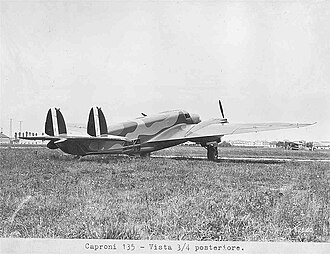
Although the Ca.135 never achieved the reputation of more successful Italian aircraft such as the Savoia-Marchetti SM.79, it remains an interesting part of interwar aviation history. Its story extends beyond Italy, with export versions serving in Peru and Hungary and related aircraft being considered for other countries. The bomber’s evolution—from its original powerplant to more heavily revised versions with different engines, redesigned forward fuselages, and improved defensive arrangements—reveals how rapidly military aircraft design was changing during the late 1930s. Its operational record was uneven, but the Ca.135 offers a valuable case study in the challenges faced by air forces and manufacturers trying to modernize quickly under political, industrial, and strategic pressure.
The Origins of the Caproni Ca.135
Italy’s drive to modernize its bomber force
During the early and middle 1930s, Italian military aviation underwent a major modernization effort. Aircraft that had appeared advanced only a few years earlier were rapidly becoming outdated as improvements in engine output, aerodynamic design, metal construction, navigation equipment, and defensive armament transformed the capabilities expected of a modern bomber. Italian leaders wanted an air force large enough to project national power, support military operations overseas, and compete with the growing air forces of other European states. The modernization program associated with General Giuseppe Valle, commonly referred to as the “R-plan,” encouraged the development and procurement of new aircraft types, including several medium bombers intended to replace older designs.
A competition held in the mid-1930s called for aircraft with ambitious performance targets. The requirements emphasized high speed, a useful bomb load, a substantial operating radius, and the ability to reach operational altitudes that could make interception more difficult. These goals were challenging for an aircraft that also had to carry fuel, crew, defensive guns, communications equipment, and a structurally adequate bomb bay. Designers were therefore forced to balance competing demands: increasing engine power could improve speed and climb, but larger engines added weight and could increase drag; carrying more fuel improved range, but reduced the weight available for bombs; and adding defensive positions improved protection at the cost of complexity and aerodynamic efficiency.
The Ca.135 emerged from this environment of rapid development and institutional ambition. It was one of several designs considered as part of the broader effort to modernize Italy’s bomber force. Other aircraft from the same general period included the Fiat BR.20 and the Savoia-Marchetti SM.79, each of which followed a different design philosophy and ultimately experienced a different operational trajectory. The Ca.135’s development was therefore not an isolated engineering project, but part of a larger competition in which manufacturers sought military contracts while the air force attempted to identify aircraft that could meet increasingly demanding requirements.
Cesare Pallavicino and the Caproni design team
The Ca.135 was designed under the direction of Cesare Pallavicino, an aviation engineer associated with Caproni’s Bergamo-based design organization, Caproni Aeronautica Bergamasca. Although the aircraft carried the familiar Caproni designation, its development was closely connected with the engineering work carried out at this branch of the company. Caproni had built a broad reputation through a variety of aircraft projects, ranging from civil transports to military machines, and the company was seeking to maintain its place in an increasingly competitive aviation industry.
Pallavicino’s design had to address the practical realities of producing a medium bomber that could be manufactured in quantity and adapted to different military requirements. The resulting aircraft used a conventional twin-engine layout, with an enclosed fuselage, a relatively broad wing, and defensive positions arranged to protect it from attack. Its general configuration was not radically experimental; instead, the designers aimed to develop a modern, practical bomber within the engineering and industrial capabilities available at the time. This conventional approach could make an aircraft easier to understand and maintain in principle, but it could not guarantee success if the engines, weight distribution, or aerodynamic characteristics failed to deliver the performance expected by its operators.
The prototype was completed after a development period that began in the middle of the decade and made its first flight on 1 April 1935, according to commonly cited aircraft histories. Other summaries give differing dates or distinguish between the prototype’s early testing and the later introduction of production aircraft, so the first-flight and service dates should not be treated as interchangeable. The aircraft entered the wider military picture during the latter half of the 1930s, but its subsequent development proved more complicated than the initial concept had suggested.
Design and Construction
A conventional twin-engine bomber layout
The Caproni Ca.135 was a twin-engine, low-wing monoplane designed for medium-bomber duties. Its configuration reflected the broad direction of military aviation during the 1930s, when monoplane designs were replacing older biplanes and increasingly sophisticated aircraft were being developed for operations at higher speeds and longer ranges. The Ca.135’s fuselage housed the crew, equipment, defensive positions, and bomb-carrying arrangements, while the two engines were mounted in nacelles on the wings. This arrangement allowed the aircraft to carry its powerplants outside the central fuselage, leaving the body available for crew stations and payload.
The aircraft’s overall shape was relatively substantial, with a rounded forward fuselage and a wing designed to support the weight of the aircraft, fuel, crew, and bombs. However, a bomber’s dimensions alone say little about its practical effectiveness. Its performance depended on the relationship between structural weight, engine output, propeller efficiency, aerodynamic drag, and the load carried on a particular mission. The Ca.135’s history demonstrated this clearly: changes in powerplant and external configuration could produce meaningful differences in speed and payload, but those improvements had to be considered alongside reliability, take-off performance, and maintenance demands.
The aircraft’s construction belonged to a transitional period in which metal structures and more modern aerodynamic forms were becoming increasingly important. Compared with earlier aircraft designs, a contemporary medium bomber had to accommodate heavier equipment and more complex systems while remaining strong enough to withstand the stresses of take-off, landing, turbulence, and operational service. It also had to be sufficiently accessible for ground crews to inspect and repair its engines, landing gear, fuel systems, and defensive equipment. For the Ca.135, the goal was a capable and adaptable military aircraft, but the actual experience of its users showed that a sound general configuration was only one part of the equation.
Crew accommodation and defensive positions
A medium bomber needed more than a pilot and an engine operator. Depending on the configuration and mission, the Ca.135 carried a crew of approximately four or five, including personnel responsible for flying the aircraft, navigating, operating the bombing equipment, and manning defensive weapons. Crew members had to coordinate their work within a confined environment, often in cold, noisy, and physically demanding conditions. Long flights required careful fuel management and navigation, while combat missions added the risk of enemy fighters, ground-based anti-aircraft fire, and damage to the aircraft’s engines or control systems.
Defensive armament varied between versions. Later Ca.135 P.XI specifications commonly list three 12.7 mm Breda-SAFAT machine guns, while other configurations and earlier aircraft differed in their arrangements and weapons. The purpose of these guns was to give the bomber some ability to resist fighter attacks from vulnerable directions, particularly from the rear and above or below, depending on the position of each weapon. Such armament was not a substitute for fighter escort or speed, however. A bomber’s defensive guns were useful only if the crew could bring them to bear, and their effectiveness depended on fields of fire, visibility, ammunition supply, and the ability of the aircraft to withstand an attack long enough for the gunners to respond.
The Ca.135’s defensive arrangements also reveal a wider problem faced by bombers of the period. Adding gun positions and their associated equipment increased weight and could add aerodynamic drag, while the bomber’s relatively limited power margin made every additional kilogram significant. The aircraft needed enough protection to survive in contested airspace, but it also needed to remain fast enough to reach its target and return. As fighter aircraft improved rapidly during the late 1930s, the balance became increasingly difficult to maintain, and designs that had seemed promising on paper could quickly become less competitive.
Engines and Performance
The original Isotta Fraschini powerplants
One of the Ca.135’s most important challenges was its engine installation. The prototype used two Isotta Fraschini Asso XI-series engines, powerful liquid-cooled V-type powerplants that were intended to provide the performance required of a modern medium bomber. The original engine arrangement was part of the aircraft’s early identity, but the combination of airframe weight, aerodynamic resistance, and available power proved less satisfactory in service than the designers had hoped. The aircraft’s performance could vary substantially depending on the specific version, the engine fitted, the altitude, and the load being carried, which makes it important to distinguish prototype figures from those of later production models.
The early Ca.135 was expected to meet demanding speed and range targets while carrying a substantial bomb load. In practice, the available power did not always provide sufficient margin for the aircraft’s weight, particularly during take-off and climb. These shortcomings were especially serious for a bomber because its operating weight changed considerably between missions. An aircraft carrying a full fuel load and a large bomb load could be far more difficult to operate than one flying a short training sortie with reduced fuel and no bombs. If the power available was inadequate, the crew could be forced to compromise between payload, fuel, and operational safety.
This was not a problem unique to Caproni. Aviation manufacturers across Europe were struggling to reconcile the growing weight of military equipment with the demands for higher speeds and longer ranges. However, the Ca.135’s repeated engine changes suggest that its original installation did not provide the combination of reliability and performance required for the aircraft to become a successful frontline bomber in Italian service. The airframe could be improved, but its usefulness remained tied to the capabilities of its powerplants and to the practical work needed to keep those engines operating consistently.
The move to Piaggio radial engines
One major development was the introduction of the Piaggio P.XI R.C.40 radial engine on the Ca.135 P.XI and related revised aircraft. These engines were rated at approximately 1,000 horsepower each, offering a different approach to the problems experienced with the earlier powerplants. The radial configuration had its own aerodynamic and installation considerations, but it was widely used in military aviation during this period and could offer a useful combination of power and practical operating characteristics. The engine change was accompanied by other refinements, including changes to the nose and engine nacelles on the Ca.135 Bis.
The revised versions are commonly associated with a maximum speed of roughly 365 km/h (227 mph) at altitude, although figures differ among published accounts and should be understood as version-specific performance estimates rather than universal numbers for every Ca.135. Some sources quote different speeds for other engine installations, and the prototype, early production aircraft, export versions, and later modifications did not all share the same capabilities. In the case of the P.XI-powered aircraft, the improvement in speed did not automatically eliminate the broader operational difficulties associated with the design.
The aircraft’s range and bomb-carrying ability also depended on the mission profile. A bomber could travel farther with a lighter payload, while carrying additional bombs increased take-off weight and fuel consumption. Published specifications for the P.XI version commonly give a range of about 2,000 kilometres, a service ceiling of around 6,500 metres, and a bomb load of up to approximately 1,474 kilograms under specified conditions. Such figures should not be read as a guarantee that the aircraft could carry its maximum bomb load and full fuel capacity on every sortie. Operational performance depended on the combination of fuel, weapons, crew, equipment, weather, airfield conditions, and engine condition.
The gap between published performance and operational usefulness
A specification sheet can make an aircraft look more capable than it proved to be in everyday service. Maximum speed is generally measured under particular conditions, often at a specified altitude and with the aircraft in a relatively clean configuration. It does not by itself reveal how quickly the aircraft could climb with a combat load, how safely it could take off from a short or poorly prepared airfield, how frequently its engines required maintenance, or how much time it spent unavailable for operations. For a military bomber, those practical considerations could be just as important as headline performance.
The Ca.135’s early history was marked by dissatisfaction with its performance and the need for modifications. The aircraft’s weight and power balance were particular concerns, and the demands of military operation exposed weaknesses that were less obvious during initial design and testing. Even when an engine change improved speed, it could not necessarily resolve every problem involving handling, landing gear, serviceability, or payload. The aircraft also had to compete with other Italian bombers that were being developed at the same time, some of which were better suited to the requirements of the air force.
The distinction between technical potential and operational value is central to understanding the Ca.135. It was not an aircraft that remained unchanged from prototype to final production; it was a family of related configurations that reflected an ongoing attempt to make the original concept more useful. Its later export service would demonstrate that the aircraft could have a place in a different operational setting, but its difficulties in Italian service limited its contribution at a critical time in the development of the country’s air force.
Variants and Development
Caproni Ca.135: The initial production version
The first production Ca.135 aircraft retained the original design concept and the early Isotta Fraschini engine installation. These aircraft were produced for the Regia Aeronautica, but their operational careers were affected by technical difficulties and the need for changes. Early production totals are often given as 32 aircraft, though the exact way individual aircraft were counted can vary when conversions and later modifications are included. The initial version helped establish the Ca.135 as a real production type, but it also exposed the shortcomings that prompted further development.
Early aircraft were not simply discarded as soon as the improved versions appeared. Some were modified, while others were reassigned to training or support duties. This was a common practice in military aviation, where an aircraft that no longer met frontline requirements might still be useful for instruction, familiarization, or secondary work. Nevertheless, the Ca.135’s limited success in Italian service meant that the type did not become one of the Regia Aeronautica’s most important operational bombers.
Ca.135 Tipo Spagna
The Ca.135 Tipo Spagna was a modified version associated with the use of Fiat A.80 R.C.41 engines. The designation is linked to plans and service connected with Spain, and sources commonly describe a small group of aircraft receiving this engine installation. The modifications reflected the continuing search for a more effective powerplant and the wider interest in adapting the bomber to different requirements. As with many interwar aircraft, engine substitution was not a minor change: it could affect performance, weight distribution, maintenance procedures, and the aircraft’s overall operating characteristics.
The Tipo Spagna illustrates how aircraft development could become fragmented when a basic design was adapted for different users or technical demands. Rather than a single standardized model, the Ca.135 family included aircraft with distinct engines and equipment, making it necessary to identify the variant when discussing performance. Details about the number of aircraft converted and the extent of their operational use differ between summaries, so the designation is best understood as one stage in the type’s broader development rather than a wholly separate aircraft.
Ca.135 Mod.
The Ca.135 Mod. designation is associated with aircraft re-engined with Piaggio P.XI R.C.40 radial engines. These engines offered approximately 1,000 horsepower each and represented an important attempt to improve the aircraft’s power and performance. The modification did not transform the Ca.135 into an entirely new design, but it changed one of the most important factors affecting its usefulness: the relationship between engine output and loaded weight.
Re-engining a bomber was a substantial engineering task. The new engines had to be integrated with the nacelles, cooling arrangements, fuel and oil systems, controls, propellers, and maintenance access. Even where the installation produced better performance, the resulting aircraft could still retain weaknesses inherited from the original airframe. The Ca.135 Mod. therefore represents an incremental improvement rather than an unqualified success, and it formed part of the transition toward the more extensively revised Ca.135 Bis.
Ca.135 Bis
The Ca.135 Bis was one of the most significant production developments. It combined the Piaggio P.XI radial engines with changes to the forward fuselage and engine nacelles intended to improve the aircraft’s overall configuration. The nose was redesigned, giving the aircraft a different appearance from the earlier version, while the engine installation and associated details reflected the effort to make the bomber more effective. The revised model is often listed with a length of about 17.7 metres in some summaries, although published dimensions can vary between sources and configurations; other specification references give a shorter overall length for the P.XI version. Such differences are a reminder that variant identification is essential when comparing the Ca.135’s dimensions and performance.
The Ca.135 Bis was produced in greater numbers than some of the earlier versions, and it became especially important in the aircraft’s export story. Nevertheless, the aircraft’s problems were not entirely eliminated. Italian service assessments remained disappointing, and the type did not establish itself as a dependable first-line bomber in the Regia Aeronautica. Some aircraft were sent to training establishments or otherwise removed from frontline duties, while a substantial number were transferred or sold abroad. The Bis was therefore an important technical development, but not a decisive answer to the Ca.135’s underlying difficulties.
Ca.135 Tipo Peru
The Ca.135 Tipo Peru was an export configuration developed for the Peruvian Aviation Corps. It was equipped with Isotta Fraschini Asso XI R.C.40 Spinto engines, rated in commonly cited references at around 900 horsepower each at altitude, and included changes to the engine cowlings and defensive armament. The Peruvian version was adapted to meet the customer’s requirements, illustrating how export orders could give an aircraft a second opportunity even when its home air force was dissatisfied with the original design.
Six aircraft were completed for Peru and shipped across the Atlantic, where they were reassembled and entered service with the Peruvian Aviation Corps in 1937. The export version’s improved power and revised equipment were intended to make the aircraft more competitive, and some accounts credit it with a greater potential bomb load than early Italian examples. However, the small size of the Peruvian order meant that the type’s service there remained limited in scale compared with the large bomber fleets being operated by major European powers.
The Peruvian order is nevertheless significant because it demonstrates that the Ca.135 was not universally rejected. An export aircraft could be tailored to a particular customer, and a small air force might value a type differently from a large service with numerous competing designs. The Peruvian Ca.135 was one of the aircraft that helped establish the bomber’s international history, although it did not lead to broad export success.
Ca.135 bis/Alfa and the Ca.325 proposal
Caproni also explored more radical improvements. One aircraft was modified with Alfa Romeo 135 R.C.32 Tornado radial engines, each rated at approximately 1,400 horsepower, and changes that included a revised tail arrangement. This experimental aircraft is described in sources under related designations such as Ca.135 bis/Alfa or Ca.169, depending on the account. The much more powerful engines offered the prospect of substantially higher speed, with some summaries reporting performance exceeding 480 km/h. That figure belongs to the heavily modified experimental aircraft, not to the standard Ca.135, and should not be used as the typical performance figure for the production bomber.
A further development, the Ca.325, was proposed with more powerful Isotta Fraschini engines. It did not progress into full production and is generally described as reaching only the mock-up stage. The project reflected a familiar problem in military aircraft development: the original airframe could be improved only so far before a more extensive redesign became necessary. Increasing engine power might improve speed, but a successful next-generation bomber would also need a suitable structure, efficient aerodynamics, adequate payload capacity, and reliable systems.
These proposals reveal that Caproni’s designers continued looking for ways to extract more performance from the Ca.135 concept. However, experimental promise did not automatically translate into a viable production aircraft. By the late 1930s, military aviation was changing quickly, and the need for a dependable, standardized bomber was becoming more urgent than the ability to demonstrate impressive results with a single modified machine.
Operational History of the Caproni Ca.135
Service with the Italian Regia Aeronautica
The Ca.135 entered Italian military service during a period of rapid change, when the Regia Aeronautica was attempting to expand its capabilities while simultaneously introducing numerous new aircraft types. The bomber was initially expected to contribute to the modernization of Italy’s medium-bomber force, but technical difficulties limited its usefulness. The early aircraft required attention to their engines and other systems, and the operational availability of the fleet became a concern. In an air force preparing for possible large-scale conflict, an aircraft that spent too much time undergoing maintenance could not deliver the sortie rate that commanders required.
The Ca.135’s difficulties were especially damaging because it was competing with other Italian designs that were more promising for frontline service. The Savoia-Marchetti SM.79, for example, became famous for its operational flexibility and later for its role as a torpedo bomber, while the Fiat BR.20 served as a conventional medium bomber. The Ca.135 was part of the same broader modernization effort, but it did not achieve comparable operational importance within the Italian service. Instead, aircraft were increasingly directed toward secondary duties, training, or modification, while the search for more effective bomber types continued.
Accounts of the Ca.135’s Italian career commonly emphasize that it did not establish a meaningful combat record for the Regia Aeronautica. Although the aircraft was produced and accepted into service, the type’s shortcomings prevented it from becoming a dependable frontline instrument during the period when Italy was preparing for war. This distinction is important: production and formal introduction do not necessarily mean that an aircraft was available in sufficient numbers, sufficiently reliable, or sufficiently capable to carry out the missions for which it had been designed.
The Spanish connection
The Ca.135’s development took place against the background of the Spanish Civil War, which became a major testing ground for aircraft, weapons, and military doctrine during the 1930s. Italy supported the Nationalist side in the conflict and sent aircraft and personnel to Spain, making the war an important influence on Italian military aviation. The Ca.135 family included aircraft associated with the designation Tipo Spagna, reflecting the period’s efforts to adapt aircraft to particular requirements and potential service environments.
The aircraft’s Spanish connection should not be confused with proof of extensive combat use by the type. The Ca.135 did not become a major battlefield presence comparable to some of the other Italian aircraft deployed during the conflict, and accounts of its history indicate that the aircraft’s operational contribution was limited. Its association with Spain is more useful as evidence of the wider context in which Italian aircraft were being evaluated, modified, and prepared for military service than as a story of sustained combat success.
The Spanish Civil War nevertheless helped demonstrate how quickly the environment for military aircraft was changing. Bombers faced increasingly capable fighters, ground fire, and the demands of operating from airfields that could be far from ideal. An aircraft’s reliability, take-off performance, defensive coverage, and ability to carry a useful payload under real conditions mattered at least as much as its maximum speed in a test flight. Those were precisely the areas in which a bomber such as the Ca.135 needed to demonstrate consistent performance if it was to become a successful frontline type.
Hungarian service and the Eastern Front
The Ca.135 found a more important operational role with the Royal Hungarian Air Force, which acquired the aircraft from Italy. Hungary needed to modernize its military aviation and build a more capable bomber force, and the Ca.135 provided a means of increasing its available aircraft numbers while it pursued broader rearmament. Hungarian service became the most prominent chapter in the bomber’s operational history, particularly during the early years of the Second World War.
Hungarian Ca.135s were used on the Eastern Front after Hungary joined the war against the Soviet Union in 1941. The aircraft carried out bombing missions in a demanding operational environment, where distances, weather, airfield conditions, and enemy activity imposed heavy demands on crews and ground personnel. The Ca.135 offered Hungary a twin-engine bomber with a useful payload and respectable performance for its time, although its technical shortcomings remained a concern. Accounts of Hungarian service describe problems involving maintenance, landing gear, and the proportion of the fleet that could be kept ready for operations.
The Hungarian experience also demonstrates that an aircraft’s reputation can differ depending on the service operating it. A type that proved disappointing in one air force could still fill an important capability gap in another, particularly if the receiving country had fewer alternatives. Hungarian crews employed the Ca.135 in combat, and the aircraft contributed to the country’s bomber operations during the early Eastern Front campaign. It was not without limitations, but it had a more substantial combat role in Hungarian hands than it had achieved in the Italian service for which it had originally been developed.
As the war progressed, the Hungarian Air Force moved toward more modern German aircraft, including the Junkers Ju 88. The arrival of newer bombers and the Ca.135’s continuing technical limitations reduced its value, and the type was gradually phased out of frontline duties. Its Hungarian career is therefore best understood as a period of useful but constrained service rather than an example of a bomber that remained competitive throughout the war.
Service in Peru
Peru’s acquisition of six Ca.135 Tipo Peru aircraft gave the bomber a smaller but historically important export career. The aircraft were delivered in 1937 and operated by the Peruvian Aviation Corps. The purchase reflected Peru’s effort to develop its military aviation capabilities and acquire modern equipment from abroad. At the time, a twin-engine bomber represented a substantial investment for a smaller air force, providing a combination of range, payload, and defensive armament that could be useful for training and national defense.
The Peruvian variant differed from the earliest Italian aircraft in its engine installation and equipment. The stronger Asso XI R.C.40 Spinto engines and revised defensive arrangements were intended to improve its usefulness, while changes to the engine cowlings reflected the requirements of the modified installation. These adjustments show how manufacturers attempted to tailor aircraft to individual customers rather than treating export versions as identical to the machines operated at home.
The small Peruvian fleet did not make the Ca.135 an internationally dominant bomber, but the order was an important part of its story. It shows that aircraft exports depended on more than an aircraft’s reputation within its country of origin. Cost, availability, diplomatic relationships, local requirements, and the lack of suitable alternatives all influenced procurement decisions. Peru’s use of the Ca.135 also meant that the design’s history extended beyond Europe, giving the aircraft a place in the development of South American military aviation during the interwar years.
Armament and Bomb-Carrying Capability
Defensive weapons
The Ca.135’s defensive armament varied by version, but later P.XI-powered specifications commonly identify three 12.7 mm Breda-SAFAT machine guns. These weapons were intended to provide protection against attacking fighters, with guns distributed among defensive positions to cover vulnerable directions. A medium bomber could not depend solely on speed to avoid interception, so defensive guns were an important element of its design, particularly when missions took the aircraft beyond the protection of friendly fighters.
Even so, defensive armament had practical limitations. Machine guns and ammunition added weight, and a gunner needed sufficient visibility and a clear field of fire to engage an attacker effectively. The aircraft’s defensive positions also had to be integrated into the fuselage without creating excessive drag or interfering with the crew’s work. On the Ca.135, as on other bombers of its generation, the balance between protection and performance was a constant compromise.
The development of more capable fighters made that compromise increasingly difficult. By the beginning of the Second World War, fighter aircraft were faster and more heavily armed than many of the aircraft that had been designed just a few years earlier. Defensive guns could make an attack more dangerous for an enemy pilot, but they could not guarantee survival. The Ca.135’s limited operational success was therefore connected not just to its defensive armament, but to the broader question of whether the aircraft could fly, climb, carry its weapons, and return reliably in the conditions of modern warfare.
Bomb load and mission planning
The Ca.135 was designed to carry bombs internally, allowing it to perform the conventional medium-bomber role for which it had been developed. The precise bomb load varied by version and operating conditions. Published specifications for the P.XI-powered aircraft commonly list a maximum bomb load of approximately 1,474 kilograms, while other accounts give different figures for modified export aircraft or describe higher potential loads under particular conditions. These figures should be treated as variant-specific limits rather than an amount that every Ca.135 could routinely carry on every mission.
A bomber’s maximum payload was only one part of its practical capability. The crew had to consider the distance to the target, the fuel needed for the outward and return journeys, the weight of defensive ammunition and other equipment, and the airfield conditions at departure. Carrying more bombs could reduce fuel capacity or require the aircraft to operate at a higher weight, which could affect take-off distance, climb, and overall safety. A mission with a moderate bomb load and sufficient fuel might therefore be more useful than a nominally heavier attack that left too little margin for changing weather or unexpected delays.
This relationship between payload and range helps explain why the Ca.135’s published specifications need to be read carefully. A quoted range of around 2,000 kilometres does not mean the aircraft could fly that distance with its maximum bomb load and still retain a comfortable operational reserve. Military range figures generally depend on assumptions about fuel, speed, altitude, and payload. The real usefulness of the bomber depended on how effectively its crews and commanders could combine those variables for a specific mission.
Strengths and Weaknesses of the Caproni Ca.135
The Ca.135 had several characteristics that made it attractive on paper. It was a twin-engine monoplane designed for the medium-bomber role, with an enclosed crew compartment, internal bomb-carrying capacity, and the potential for meaningful range. The development program also showed a willingness to improve the aircraft through new engines and revised configurations. Its export variants demonstrate that the basic design could be adapted to different customer requirements, and Hungarian service proved that it could carry out combat missions when the necessary aircraft, crews, and maintenance support were available.
Its principal weaknesses, however, were difficult to ignore. The original aircraft struggled to deliver the expected performance, and the need for re-engining and other modifications complicated its development. A series of variants can indicate a successful design being progressively refined, but it can also reveal that the original aircraft did not satisfy the operational requirements placed upon it. In the Ca.135’s case, the continuing changes did not make it a leading bomber in Italian service, and the type remained burdened by concerns about serviceability, payload, and general operational effectiveness.
Another weakness was timing. Military aircraft developed during the middle of the 1930s could become outdated quickly as engine power, fighter performance, and combat expectations advanced. A bomber that was adequate when the design process began might already be struggling to remain competitive by the time it entered service. The Ca.135 was caught in this transition: its designers were trying to meet ambitious requirements with a design that needed significant improvement, while competing aircraft and emerging operational experience were changing what air forces expected from a medium bomber.
Ultimately, the Ca.135 was neither a complete technical failure nor a major success. It was a design with useful underlying features that struggled to turn its potential into consistent frontline effectiveness. Its service in Hungary and Peru gives it a broader history than its disappointing Italian career alone might suggest, while its numerous engine and airframe developments reveal the engineering effort invested in improving it. The aircraft’s record is a reminder that a bomber’s value depended not only on its specifications, but also on reliability, maintainability, production consistency, and its ability to perform missions under real operational conditions.
The Legacy of the Caproni Ca.135
The Caproni Ca.135 occupies a modest but revealing place in the history of Italian aviation. It emerged from an ambitious program to modernize the Regia Aeronautica, and its development involved several attempts to improve performance through new engines and revised configurations. Despite those efforts, it did not become one of Italy’s principal combat bombers, and its frontline contribution in Italian service remained limited. The aircraft’s story illustrates how the rapid pace of aviation development could expose weaknesses before a design had fully matured, especially when military procurement demanded that new aircraft satisfy increasingly ambitious requirements.
Its later use abroad gives the type a more complex legacy. Peru operated a small export fleet, while Hungary used the bomber in combat on the Eastern Front. These careers demonstrate that an aircraft’s usefulness was shaped by the needs and resources of the country operating it. A bomber that was not ideal for a major air force with several competing designs might still provide a valuable capability to a smaller service seeking to expand its fleet. At the same time, the Ca.135’s maintenance and performance problems meant that its potential was never fully realized.
Today, the Ca.135 is best remembered as an example of the difficult transition from interwar aircraft design to the demands of the Second World War. Its conventional twin-engine layout, multiple powerplant changes, export variants, and uneven service record make it an instructive subject for anyone interested in military aviation history. The aircraft was overshadowed by more successful Italian bombers, but it remains important as part of the broader story of how air forces attempted to modernize—and how technical ambition did not always translate into battlefield effectiveness.
Caproni Ca.135 Technical Specifications
The table below summarizes commonly cited specifications for the Caproni Ca.135 P.XI, one of the principal revised production versions. Figures can vary across historical references because the Ca.135 existed in several configurations, including early aircraft with different engines and export versions. Dimensions, payload, and performance should therefore not be assumed to apply equally to every variant.
| Specification | Caproni Ca.135 P.XI |
|---|---|
| Aircraft type | Twin-engine medium bomber |
| Country of origin | Italy |
| Manufacturer | Caproni |
| Design organization | Caproni Aeronautica Bergamasca |
| Designer | Cesare Pallavicino |
| First flight | 1 April 1935 (commonly cited) |
| Introduction | 1937–1938, depending on operator and definition |
| Primary operator | Regia Aeronautica; later Royal Hungarian Air Force |
| Other operator | Peruvian Aviation Corps |
| Crew | 4–5 |
| Configuration | Low-wing monoplane, twin-engine |
| Length | Approx. 14.38 m; dimensions vary by variant and source |
| Wingspan | Approx. 18.80 m |
| Height | Approx. 3.40 m |
| Wing area | Approx. 60 m² |
| Empty weight | Approx. 6,051 kg |
| Maximum/gross weight | Approx. 9,548 kg |
| Engines | 2 × Piaggio P.XI R.C.40, 14-cylinder air-cooled radial engines |
| Power | Approx. 1,000 hp (746 kW) per engine |
| Maximum speed | Approx. 365 km/h (227 mph) at altitude |
| Cruise speed | Approx. 349 km/h (217 mph) |
| Range | Approx. 2,000 km, depending on load and conditions |
| Service ceiling | Approx. 6,500 m (21,300 ft) |
| Rate of climb | Approx. 5.6 m/s |
| Defensive armament | Commonly listed as 3 × 12.7 mm Breda-SAFAT machine guns on the P.XI version |
| Maximum bomb load | Commonly listed at approximately 1,474 kg; variant and mission dependent |
| Production | Several versions; totals vary among historical accounts |
Conclusion
The Caproni Ca.135 was an ambitious Italian medium bomber whose history was shaped by the difficulties of developing an effective military aircraft during a period of rapid technological change. Designed to help modernize the Regia Aeronautica, it required repeated changes to its engines and configuration, yet still struggled to establish itself as a dependable frontline bomber in Italian service. Its more substantial use by Hungary, together with the small Peruvian export fleet, shows that the aircraft retained some practical value even though it failed to become one of the most successful bombers of its generation.
The Ca.135’s lasting significance lies in what it reveals about aircraft development between the world wars. Speed, range, and bomb load were important goals, but none could compensate entirely for poor serviceability or an unsatisfactory balance between power and weight. The aircraft’s varied versions and uneven operational record make it a useful reminder that military aviation history is not simply a story of famous victories and celebrated machines; it is also a story of designs that were modified, reassigned, exported, and eventually overtaken by more effective aircraft.
