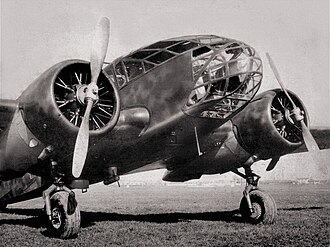
The Caproni Ca.311 was an Italian twin-engine military aircraft developed during the late 1930s, a period when European air forces were rapidly transforming their doctrines, equipment, and operational capabilities in anticipation of another major conflict. Designed by the Italian aircraft manufacturer Caproni, the Ca.311 belonged to a generation of machines intended to perform several important battlefield roles, including tactical reconnaissance, artillery observation, light bombing, and cooperation with ground forces. Its distinctive configuration, relatively compact dimensions, and twin-engine layout reflected the practical requirements of an air force that needed aircraft capable of operating across a variety of landscapes, from mountainous terrain and rugged countryside to the open plains and coastal regions of the Mediterranean. Although it did not achieve the international recognition enjoyed by some of the more famous aircraft of the Second World War, the Ca.311 provides a valuable insight into the strengths, compromises, and technological limitations of Italian military aviation during one of its most consequential periods.
The story of the Ca.311 is also a story about the changing nature of aerial warfare. During the interwar years, reconnaissance aircraft were expected to do far more than simply observe enemy movements from a safe distance. They were increasingly required to communicate information to commanders, locate artillery positions, photograph strategic targets, assist friendly ground troops, and sometimes attack targets of opportunity with bombs or machine guns. These demands encouraged the development of versatile aircraft that could carry observers and cameras while maintaining sufficient speed, endurance, and maneuverability to operate near contested territory. The Ca.311 emerged from this environment as an aircraft designed around operational flexibility rather than specialization in a single mission. However, the rapid evolution of fighter aircraft, radar, antiaircraft weapons, and tactical doctrine meant that the qualities that made such aircraft useful in the late 1930s could become liabilities once they encountered the increasingly dangerous skies of the Second World War.
Understanding the Caproni Ca.311 therefore requires more than a description of its engines, dimensions, and armament. Its development illustrates the industrial ambitions of Italy’s aviation sector, the organizational priorities of the Regia Aeronautica, and the difficulties experienced by military planners who attempted to reconcile reconnaissance, ground support, and light attack within a single airframe. Its service history also demonstrates how aircraft designed for observation and battlefield cooperation could be pushed into dangerous environments as operational demands increased and more capable replacements became necessary. While the Ca.311 was not a decisive weapon in the strategic sense, it formed part of the broader network of aircraft, pilots, observers, mechanics, and ground personnel whose daily work sustained military operations across several theaters of the war.
Historical Background: Italian Military Aviation Before the Ca.311
The development of Italy’s military aircraft industry
Italy entered the interwar period with a strong aviation tradition and considerable ambitions for its domestic aircraft industry. Italian designers and manufacturers had earned international attention during the First World War and the years that followed, while the country’s military aviation organizations sought to establish themselves as important instruments of national power. Aircraft were viewed not only as battlefield tools but also as demonstrations of technological achievement, industrial competence, and modernity. Manufacturers such as Caproni developed a wide variety of designs, ranging from large multiengine aircraft to smaller military and civilian machines, and the resulting industrial environment encouraged experimentation with different configurations, propulsion systems, and operational concepts. Nevertheless, Italy’s aviation sector faced the same fundamental challenge as other national industries: technological progress had to be translated into affordable, reliable aircraft that could be manufactured in sufficient numbers, maintained under field conditions, and adapted to the rapidly changing requirements of military service.
During the 1920s and 1930s, military aircraft design developed at an extraordinary pace. Wooden structures and fabric coverings remained common on many aircraft even as metal construction became increasingly important, while improvements in engines, propellers, instruments, and aerodynamics steadily increased performance. Military authorities also began to recognize that different missions demanded different aircraft characteristics. Fighters required speed and maneuverability, bombers needed payload and range, and reconnaissance machines required visibility, endurance, stable flight characteristics, and enough defensive capability to survive in contested airspace. The boundaries between these categories were not always clearly defined, especially in countries where industrial resources were limited and military procurement programs emphasized multipurpose designs. Italian aircraft development reflected this complicated balance between ambition, practicality, and available resources, creating the conditions in which aircraft such as the Ca.311 could emerge.
The importance of reconnaissance and army cooperation
Aerial reconnaissance became increasingly valuable after the First World War because military commanders had learned that information about enemy movements could be as important as the direct application of firepower. Ground forces needed to know where opposing units were positioned, whether roads and bridges remained usable, where artillery batteries had been deployed, and how defensive lines were changing. Aircraft could gather this information more quickly than many ground-based observation systems, while aerial photography made it possible to examine terrain and military installations in greater detail. In addition to strategic reconnaissance, which focused on large areas and distant targets, armies required tactical observation close to the front, where information might become outdated within hours or even minutes. This requirement placed special emphasis on aircraft that could operate from relatively modest airfields, remain over a particular area for useful periods, and communicate observations to commanders through the available radio and reporting systems.
The concept of army cooperation also encouraged aircraft to undertake missions that went beyond observation. Pilots and observers might identify targets for artillery, monitor friendly advances, attack lightly defended positions, or deliver small bomb loads against concentrations of troops and vehicles. Such missions made reconnaissance aircraft valuable to commanders but exposed them to serious dangers. Flying low improved visibility and made ground targets easier to identify, yet it also brought aircraft within range of rifle fire, machine guns, and light antiaircraft weapons. Operating at greater altitudes could reduce some of these risks but make visual identification more difficult, particularly when weather conditions were poor or camouflage concealed military installations. The aircraft therefore needed to balance visibility, performance, endurance, and survivability, a combination that became increasingly difficult to achieve as fighter aircraft grew faster and ground defenses became more effective.
Development of the Caproni Ca.311
From earlier Caproni designs to a dedicated reconnaissance aircraft
The Ca.311 developed within a broader family of Italian reconnaissance and army-cooperation aircraft associated with Caproni’s military production. Its immediate design lineage is commonly connected with the Caproni Ca.310 and Ca.310bis, earlier twin-engine aircraft that helped establish the configuration and practical design principles from which the later machine evolved. These earlier designs reflected the growing demand for aircraft capable of performing reconnaissance and light attack missions while remaining suitable for production within Italy’s existing industrial framework. Rather than representing a complete departure from established practice, the Ca.311 was a development of ideas already being explored by Caproni, with changes intended to improve its suitability for military observation and operational use. The result was an aircraft that retained a recognizable family resemblance to its predecessors while incorporating a more purposeful arrangement of its forward fuselage and crew accommodation.
One of the most visually distinctive characteristics of the Ca.311 was its revised nose configuration. Compared with earlier members of the family, the aircraft featured a glazed forward section that provided the crew with improved visibility, an important consideration for observation, reconnaissance photography, and the identification of ground targets. The nose was not simply an aesthetic feature; it reflected the operational importance of seeing the terrain below and ahead of the aircraft, particularly when flying at low altitude over unfamiliar territory. Its twin-engine arrangement also offered practical advantages, including the possibility of continuing flight after the loss of one engine under suitable conditions, although a single-engine emergency could still be extremely hazardous depending on aircraft weight, altitude, weather, and the condition of the remaining engine. The overall design demonstrated how seemingly modest modifications to an existing airframe could alter the usefulness of an aircraft for a particular category of military work.
Design philosophy and production priorities
The Ca.311 was developed at a time when Italy’s military aviation planners needed aircraft that could be introduced into service without requiring an entirely new industrial infrastructure. Reusing elements of established designs could reduce development costs, simplify manufacturing, and make it easier for maintenance personnel to draw upon existing experience with engines, components, and operating procedures. Such continuity was especially important for aircraft intended to equip frontline units in significant numbers, because operational availability depended on more than the performance of individual machines. A successful military aircraft program also required spare parts, trained technicians, dependable engines, appropriate tools, replacement assemblies, and a supply network capable of supporting units far from major factories. By building on the established Caproni design family, the Ca.311 benefited from a development approach that emphasized practical evolution rather than a wholly new technical concept.
At the same time, evolutionary design carried limitations. An aircraft whose basic layout originated in an earlier period could struggle to keep pace with the rapid improvements being made to fighters and dedicated bombers. Increasing engine power might improve climb and payload performance, but additional weight could affect range and handling. Strengthening the structure could improve durability while reducing useful payload, and fitting extra defensive weapons could increase drag without offering enough protection against modern fighters. The Ca.311 embodied this broader problem of interwar military aircraft development: designers had to make a series of compromises that appeared reasonable when the aircraft was conceived but became harder to justify as wartime conditions changed. Its design should consequently be understood in the context of the requirements and expectations of the late 1930s rather than judged solely against the most advanced aircraft that appeared later in the conflict.
Technical Design and Construction
Airframe configuration and external appearance
The Caproni Ca.311 was a compact twin-engine aircraft with a low-mounted wing, conventional tail surfaces, and two engine nacelles positioned on the wings. Its relatively short, purposeful fuselage and distinctive glazed nose gave it an appearance that differed from many contemporary aircraft designed primarily for bombing or fighter combat. The forward glazing helped the crew observe the ground, while the cockpit and other crew stations were arranged to accommodate the different responsibilities involved in flying and reconnaissance. The twin-engine layout also gave the aircraft a balanced, symmetrical appearance, with its propulsion system distributed across the wings rather than concentrated in a single engine at the nose. Although the aircraft was not particularly large by the standards of multiengine military aviation, its configuration was suited to carrying the equipment and personnel necessary for observation, navigation, communications, and limited offensive operations.
The Ca.311’s construction reflected the mixed-material techniques common to many aircraft of its generation, combining structural elements and covering materials selected to balance weight, strength, manufacturing requirements, and cost. Such construction methods were well established in the 1930s, when aircraft manufacturers were gradually transitioning toward more extensive use of metal structures but continued to rely on traditional materials where they remained practical. The precise composition of different structural elements could vary across aircraft families and production details, so broad descriptions should not be mistaken for a claim that every component used the same material. What matters from an operational perspective is that the airframe was designed for a specific combination of payload, range, and flight performance, rather than the extreme speed, armor protection, or heavy bomb load associated with other military aircraft categories.
Engines and propulsion system
The Ca.311 was powered by two Piaggio P.VII C.16 radial engines, a configuration that placed it within the established Italian tradition of using air-cooled radial powerplants in military aircraft. Radial engines were attractive for many applications because their air-cooled arrangement avoided the additional radiators, coolant plumbing, and associated vulnerabilities of liquid-cooled systems. Their compact installation and relatively straightforward cooling arrangements could be beneficial for aircraft operating from dispersed airfields or in climates where maintenance and logistics presented constant challenges. However, the advantages of radial engines did not eliminate the technical demands of operating a twin-engine aircraft. Each powerplant required regular inspection, careful attention to lubrication and temperature, correct propeller operation, and a reliable supply of components. An aircraft with two engines also required crews and maintenance units to keep both systems in suitable condition, and a fault in either engine could significantly affect the aircraft’s performance.
Published specifications commonly associate the Ca.311 with a maximum output of approximately 470 horsepower per engine, although figures can vary depending on the precise rating and reference used. Engine output was only one factor determining the aircraft’s performance, since propeller efficiency, aircraft weight, altitude, atmospheric conditions, and maintenance quality all affected the power actually available during flight. The twin-engine configuration provided useful redundancy, but it should not be interpreted as a guarantee of safe operation after an engine failure. An aircraft flying close to its maximum weight, particularly at low altitude or in unfavorable weather, might have limited ability to maintain height or reach a suitable airfield following a powerplant failure. For crews engaged in low-level reconnaissance, where terrain and obstacles could leave little room for recovery, the condition of both engines was therefore a matter of considerable operational importance.
Crew accommodation and visibility
The Ca.311’s crew arrangement reflected its role as a reconnaissance and army-cooperation aircraft, where observation was a shared responsibility rather than a task performed entirely by the pilot. Depending on the mission and equipment fit, the crew could include a pilot, a second crew member or observer, and a further specialist responsible for communications, observation, or defensive armament. The observer’s duties could involve identifying military positions, recording information, operating reconnaissance equipment, assisting navigation, and communicating with friendly units. These responsibilities demanded sustained concentration, particularly during low-level flights over terrain where landmarks could be difficult to recognize and enemy activity might change quickly. In such circumstances, good visibility was not merely a convenience but an important feature affecting the quality of the information an aircraft could deliver.
The glazed nose was especially relevant to forward and downward observation, giving the Ca.311 a recognizable profile and distinguishing it from aircraft with more conventional solid noses. However, glazing alone could not solve the practical difficulties of aerial reconnaissance. Reflections, shadows, cloud cover, haze, camouflage, and the changing angle of the sun could all interfere with the identification of ground targets. Crew members also had to interpret what they saw, distinguish military activity from civilian movement, and communicate useful information under operational pressure. Even an aircraft with excellent visibility could produce limited intelligence if the crew lacked suitable maps, reliable navigation aids, effective communications, or enough time to examine an area properly. The Ca.311 therefore depended on the combined performance of its airframe, crew training, equipment, and supporting command structure.
Defensive armament and light attack capability
Like many reconnaissance aircraft of its period, the Ca.311 could carry defensive machine guns and a limited bomb load for light attack missions. Its armament was intended to provide some means of resisting enemy aircraft and engaging suitable ground targets, rather than to transform it into a dedicated bomber or fighter. The exact configuration could depend on the production standard and operational fit, and descriptions of its weapons should therefore be treated with care when sources do not distinguish between variants or field modifications. In general terms, the aircraft’s weapons reflected the multifunctional character of its role: reconnaissance remained central, but the ability to deliver a small attack could make it more useful to units operating in situations where dedicated strike aircraft were unavailable or unnecessary.
The weakness of this arrangement became increasingly apparent as the Second World War progressed. Defensive machine guns could discourage an inexperienced or poorly positioned attacker, but they offered little guarantee of survival against a faster fighter with more powerful weapons and better maneuverability. A limited bomb load could damage exposed vehicles, field positions, or other lightly protected targets, yet it could not provide the destructive power of a medium bomber carrying a much larger payload. Furthermore, carrying bombs and defensive equipment increased aircraft weight and could reduce performance, while attacking ground targets often forced the aircraft to fly low enough to become vulnerable to small-arms fire. The Ca.311’s armament consequently made it a flexible support aircraft within its intended operational environment, but it did not remove the fundamental vulnerability associated with performing observation and attack missions near enemy forces.
Technical Specifications of the Caproni Ca.311
Dimensions, weight, and flight performance
The Caproni Ca.311 belonged to the light twin-engine category, and its published dimensions illustrate a design intended to accommodate several crew members and mission equipment without becoming a large, heavy bomber. Reference works generally give a wingspan of approximately 16.2 metres and a length of around 11.7 metres, although small differences may appear among published measurements. Such discrepancies are not unusual in historical aircraft documentation, where sources may round values differently or refer to different variants, configurations, or measurement conventions. For a historical overview, rounded figures are useful provided they are clearly identified as approximate rather than presented as immutable measurements applying to every aircraft.
The aircraft’s maximum speed is commonly reported at approximately 365 kilometres per hour, with a cruising speed around 300 kilometres per hour. Its operational range is often listed at roughly 1,600 kilometres, although actual mission radius depended on fuel reserves, payload, weather, flight altitude, and the need to return to a suitable base. Maximum range should not be confused with the distance an aircraft could safely travel on a combat mission, because crews needed fuel for takeoff, climb, navigation, possible diversions, and the return journey. Service ceiling figures are commonly given at approximately 7,700 metres, but practical operating altitudes varied with aircraft condition, weight, engine performance, and the nature of the mission. These specifications placed the Ca.311 within the performance envelope of a light reconnaissance aircraft of its period, but they did not make it competitive with the most advanced fighters that appeared during the war.
How its performance compared with operational requirements
On paper, the Ca.311 offered a reasonable combination of speed, endurance, and payload for an aircraft intended to cooperate with ground forces. Its twin engines supported the desired level of performance, while its relatively compact size and observation-oriented design helped it fulfill missions that demanded access to a broad area of terrain. Yet specifications alone provide only a partial picture of its usefulness. A reconnaissance aircraft might spend considerable time orbiting a target, flying at a low altitude, or maneuvering to obtain a clearer view, all of which differed from a straight-line maximum-speed test. Fuel consumption increased under some operating conditions, payload affected climb performance, and the need to avoid enemy fighters or antiaircraft fire could force crews to alter their intended routes. The Ca.311’s practical value therefore depended on how well its capabilities matched the mission and the level of opposition encountered.
By the early 1940s, the distinction between acceptable performance in peacetime exercises and acceptable performance in combat had become increasingly important. Faster fighters could intercept reconnaissance aircraft more easily, and improved weapons made it dangerous to rely on defensive guns or the hope that an attacker would be unable to position itself effectively. Even when the Ca.311 could reach its destination, the crew might have to choose between flying at an altitude that improved observation and flying higher to reduce exposure to ground fire. These competing requirements limited the aircraft’s effectiveness in heavily defended areas. The Ca.311’s specifications are consequently most revealing when interpreted alongside its intended missions, rather than treated as isolated numbers that determine its overall quality.
Operational Service During the Second World War
Entry into service and early wartime employment
The Ca.311 entered Italian military service around the beginning of the Second World War, at a time when the Regia Aeronautica was attempting to maintain a broad inventory of aircraft for reconnaissance, bombing, fighter defense, and support of ground operations. Italy’s military commitments extended across a large geographical area, and its aircraft frequently had to operate in conditions that differed significantly from one theater to another. Units might face hot, dusty airfields, mountainous terrain, limited maintenance facilities, or long supply routes, each of which affected operational availability. Aircraft such as the Ca.311 were useful because they could undertake multiple forms of observation and support work without requiring the resources associated with larger bombers. Nevertheless, the usefulness of the design depended on the ability of individual units to keep their aircraft serviceable and to employ them in circumstances suited to their capabilities.
During early wartime operations, reconnaissance aircraft were expected to support commanders by locating enemy forces, observing roads and defensive positions, and reporting developments that might influence the movement of friendly troops. The Ca.311’s combination of twin engines and a glazed observation area suited these general tasks, particularly where the opposing air force could not maintain continuous fighter coverage. Its secondary attack capability could also provide a means of engaging lightly defended targets when circumstances permitted. However, it is important not to assume that every aircraft carried out every possible mission, or that all units operated the same way. Operational tasking depended on local conditions, available equipment, command priorities, and the presence of more specialized aircraft. The Ca.311 should therefore be understood as one element within a wider system of reconnaissance and tactical aviation rather than as an aircraft whose service can be summarized by a single standardized mission profile.
Operations in the Mediterranean and North African environment
The Mediterranean theater presented Italian aircraft with a complex combination of operational demands, including long distances between bases, changing weather, intense sunlight, dust, and the challenges of supporting ground forces over varied terrain. In North Africa, flat desert areas could provide long sightlines, but the absence of prominent landmarks sometimes made navigation difficult, while dust and heat placed additional demands on engines and ground crews. In mountainous or coastal regions, the terrain introduced other complications, including restricted approach paths, changing wind conditions, and the need to navigate around elevated ground. Reconnaissance aircraft operating in these environments had to deliver useful observations while managing the practical risks of heat, visibility, fuel consumption, and limited emergency landing options. The Ca.311’s twin-engine arrangement and observation-oriented design were relevant to these challenges, although they could not eliminate the difficulties inherent in operating a relatively vulnerable aircraft near a battlefield.
As Allied air power expanded, the environment became more dangerous for Italian reconnaissance aircraft. Enemy fighters could attack aircraft that had limited speed and defensive armament, while ground forces increasingly possessed weapons capable of threatening aircraft flying at low altitude. Even when a reconnaissance sortie did not result in an engagement, the possibility of interception could influence how crews approached a target, how long they remained in an observation area, and whether they attempted to photograph or inspect a position closely. In such conditions, mission success could not be measured solely by whether an aircraft returned to base. The quality of the information gathered, the time required to obtain it, the risk accepted by the crew, and the operational cost of losing a trained aircraft and its personnel all formed part of the calculation. The Ca.311’s wartime experience reflects the wider predicament of tactical reconnaissance aircraft as the balance of air power shifted.
Service in the Balkans and other theaters
Italian military operations in the Balkans and the wider southeastern European region created a different set of challenges for reconnaissance aircraft. Mountain ranges, narrow valleys, irregular road networks, changing weather, and the presence of dispersed ground forces complicated both navigation and target identification. Aerial observation could be particularly valuable in such circumstances because ground commanders often had incomplete information about enemy positions beyond the immediate area of contact. Aircraft could help identify troop movements, observe routes through difficult terrain, and report on positions that were difficult to examine from the ground. Yet mountainous terrain also restricted low-level maneuvering and could make emergency landings hazardous, while cloud and poor visibility could reduce the effectiveness of visual reconnaissance. Such conditions demanded disciplined crews and careful planning, especially when aircraft were required to operate at relatively low speeds or altitudes to obtain meaningful observations.
The Ca.311 belonged to the broader category of Italian aircraft used to support army operations during this period, but its contribution should not be exaggerated into a claim that it independently shaped the course of campaigns. The influence of reconnaissance depended on the entire chain between the aircraft and the commander who received its report. Observations had to be recorded accurately, transmitted through available communications systems, interpreted in context, and acted upon quickly enough to remain relevant. If communications failed or reports arrived too late, even a successful flight might produce little immediate advantage. Conversely, accurate information could help commanders make better decisions about troop movements, defensive preparations, and the allocation of limited resources. The aircraft was therefore most effective when integrated into a functioning intelligence and command system, rather than employed as an isolated instrument of observation.
The risks of low-level reconnaissance
Low-level reconnaissance was among the most demanding tasks assigned to aircraft such as the Ca.311 because it forced crews to operate close to the very forces they were observing. Flying low could improve the visibility of vehicles, field fortifications, road traffic, and smaller ground installations, but it also reduced the time available to react to unexpected obstacles, enemy fire, or sudden changes in terrain. Pilots had to maintain situational awareness while following navigation instructions, avoiding hazards, and maneuvering to give the observer a suitable view. The observer, meanwhile, had to distinguish meaningful details from ordinary landscape features, record information, and communicate with the pilot and any supporting units. These simultaneous responsibilities made reconnaissance a demanding combination of flying skill, attention, and rapid interpretation.
The tactical danger increased as ground forces became more experienced in defending themselves against aircraft. Machine guns and light antiaircraft weapons could threaten slow or predictable targets, while enemy fighters could exploit their superior speed and maneuverability to attack from advantageous positions. The Ca.311’s defensive armament offered only limited protection, and its aircraft structure was not designed to absorb the punishment associated with heavily armored attack aircraft. This did not make reconnaissance impossible, but it forced commanders and crews to consider whether the expected intelligence justified the risk. Alternative approaches might include flying at different altitudes, changing routes, relying on reports from other units, or scheduling missions when enemy opposition was expected to be weaker. The tension between gathering detailed information and preserving aircraft and crews remained a central problem for battlefield aviation throughout the war.
Strengths and Weaknesses of the Ca.311
The advantages of a twin-engine reconnaissance platform
One of the Ca.311’s principal advantages was its twin-engine configuration, which provided a useful balance between performance and operational flexibility for a light military aircraft of its generation. Two engines could deliver the power needed to carry crew members, reconnaissance equipment, fuel, and a limited offensive load, while the arrangement also offered a degree of redundancy if one engine failed. The aircraft’s observation-oriented forward fuselage was another important feature, helping crews examine terrain and identify targets during missions in which visual information was central. In addition, the design’s relationship to earlier Caproni aircraft supported a relatively evolutionary development process, which could be beneficial when manufacturers and military authorities were attempting to expand production while controlling costs and avoiding unnecessary disruption to established maintenance practices.
Its multipurpose character also offered practical advantages. An aircraft capable of observation, photographic reconnaissance, and limited attack could serve several functions within a unit, particularly when the availability of more specialized aircraft was restricted. This flexibility did not mean that the Ca.311 was equally effective at every task, but it did provide commanders with an additional tool for meeting operational requirements. Aircraft of this type were often valuable not because they could defeat the enemy in direct combat, but because they could gather information, maintain contact with ground forces, and perform supporting missions that larger or more specialized aircraft might not be available to undertake. In this respect, the Ca.311 illustrates the importance of utility and adaptability in military aviation, particularly for an air force operating across multiple theaters with finite industrial and logistical resources.
Performance limitations and declining battlefield relevance
The Ca.311’s principal weaknesses emerged from the same compromises that had made it a practical aircraft in the first place. Its size, weight, engine power, and armament had been balanced around reconnaissance and light support missions, but this combination did not provide the speed or protection needed to survive comfortably in an increasingly contested air environment. As the war progressed, enemy fighters became more capable, defensive weapons became more dangerous, and tactical operations often demanded performance that earlier reconnaissance designs could not provide. The Ca.311 could still be useful in situations where opposition was limited or where the mission did not require prolonged exposure to hostile aircraft, but its survivability declined when crews were required to operate against better-equipped opponents.
Its limited offensive capability created another constraint. Although a small bomb load could be useful against exposed targets, it did not offer the destructive power necessary for many heavily defended or strategically significant objectives. Carrying additional weapons could reduce available fuel or adversely affect flight performance, while the aircraft’s observation role continued to require space for crew members and specialist equipment. The Ca.311 consequently occupied a difficult middle ground: it was more versatile than a purely observational platform in some circumstances, but it lacked the specialization and performance of dedicated aircraft designed for high-speed reconnaissance, close air support, or bombing. This limitation was not unique to the Ca.311; it affected many multipurpose aircraft designed before the demands of modern air warfare became fully apparent.
Reliability, maintenance, and logistical demands
Combat effectiveness depended on much more than maximum speed or published range. The Ca.311 required serviceable engines, correctly maintained propellers, functioning instruments, suitable tires and brakes, and the many other components necessary to keep an aircraft ready for flight. A twin-engine design also required the maintenance system to support two powerplants, increasing the number of components and inspections associated with routine servicing. In operational units, mechanics had to work within the constraints of available tools, spare parts, transport, and time. Dust, temperature extremes, heavy use, and the distance between airfields and supply centers could all influence the rate at which aircraft became unavailable. A machine that performed well in a test flight was of limited military value if it could not be kept in service consistently under frontline conditions.
This broader logistical context helps explain why the usefulness of any military aircraft cannot be assessed solely by comparing specifications. A slightly slower aircraft might remain valuable if it were easier to repair and had access to reliable supplies, while a theoretically superior aircraft could be of limited use if engines, specialist components, or trained personnel were unavailable. The Ca.311’s place in Italian aviation must therefore be considered alongside the industrial and organizational challenges facing the Regia Aeronautica. Italy operated a varied collection of aircraft and faced competing demands for production capacity, engine supplies, maintenance resources, and trained crews. These pressures affected the practical value of reconnaissance aircraft as much as their performance in the air, particularly as wartime losses and wear increased the burden on units responsible for maintaining operational readiness.
The Ca.311 in the Wider Evolution of Military Reconnaissance
From visual observation to specialized aerial intelligence
The development of military reconnaissance during the Second World War gradually exposed the limitations of aircraft designed primarily around direct visual observation. Cameras became increasingly important for documenting enemy installations, roads, airfields, and defensive positions, while advances in communications helped connect aerial observations with the needs of operational commanders. Dedicated reconnaissance aircraft could be optimized for speed, altitude, endurance, or specialized sensors, depending on the intelligence requirements of the mission. By contrast, a multipurpose aircraft such as the Ca.311 had to accommodate several competing tasks within one design. Its forward glazing and crew arrangement made sense for an era when direct observation remained fundamental, but the wider development of aerial intelligence increasingly favored specialized platforms and more sophisticated equipment.
Nevertheless, the transition to specialized reconnaissance was neither immediate nor universal. Military organizations continued to use older aircraft when they were available, when their missions were considered relatively safe, or when the cost of replacement was too high. Reconnaissance requirements also varied considerably between theaters, and not every mission required the capabilities of an advanced high-speed aircraft. Visual observation remained valuable for many tactical tasks, particularly when commanders needed a rapid assessment of nearby terrain or enemy activity. The Ca.311 therefore represents a transitional stage in the evolution of reconnaissance aviation: a design that retained the practical characteristics of the interwar period while operating in a conflict that increasingly rewarded speed, specialization, improved communications, and greater survivability.
Comparison with other Italian reconnaissance aircraft
The Ca.311 is best understood as part of a broader Italian effort to provide military units with aircraft capable of reconnaissance and army cooperation. Its predecessors, including the Ca.310 family, helped establish the design lineage, while other Italian types fulfilled overlapping or more specialized roles as operational requirements changed. One of the better-known Italian aircraft in this general category was the IMAM Ro.37, a biplane reconnaissance and army-cooperation aircraft that had already served during the interwar years and continued to be used in the early part of the Second World War. The contrast between the older Ro.37 and the newer Ca.311 illustrates the transition from earlier reconnaissance concepts toward more modern twin-engine designs, although a direct comparison must account for differences in performance, mission equipment, production history, and the operational conditions in which each aircraft was used.
Other Italian aircraft, including later Caproni reconnaissance developments, also reflected the search for better performance and more effective battlefield cooperation. However, the development of a successor did not automatically mean that earlier aircraft disappeared immediately from operational service. Military inventories often contained several generations of aircraft at the same time, and the retirement of a type depended on production schedules, losses, maintenance requirements, and the availability of replacement machines. Consequently, the Ca.311’s significance lies partly in the way it illustrates the difficulties of replacing older aircraft while the demands of war were increasing. It belonged to a period when the Italian aviation industry was attempting to modernize its forces, but industrial capacity and rapidly changing combat requirements made that process uneven.
Production, Variants, and the Limits of the Historical Record
Production history and aircraft variants
The Caproni Ca.311 was produced in a period when the Italian aircraft industry was attempting to supply multiple military requirements while dealing with the limitations of available resources and the increasing urgency of wartime procurement. The type is generally associated with production in the hundreds rather than with the much larger totals achieved by some of the most widely manufactured aircraft of the war. Published totals are commonly reported at approximately 335 aircraft, although historical references may differ according to whether they count completed production machines, particular subvariants, or aircraft assigned to closely related designations. This is an important distinction in aviation history because production totals can be affected by incomplete records, changes in designation, and the way authors define a particular model. A responsible summary should therefore identify the figure as approximate rather than suggesting that every historical source agrees on an exact total.
As with many military aircraft, equipment and armament could vary according to production standard, operational requirements, and modifications introduced during service. Differences in communication equipment, defensive armament, internal fittings, and other details might influence the way a particular aircraft was employed without necessarily creating a completely separate aircraft type. Historical descriptions sometimes combine information from multiple variants or repeat specifications without identifying the particular configuration to which they apply. For this reason, detailed technical comparisons should rely on sources that explicitly distinguish the Ca.311 from its predecessors and related Caproni models. This is especially important when discussing weapons, engine ratings, or performance figures, since values from a closely related aircraft can easily be attributed to the wrong designation when information is summarized too broadly.
Why historical specifications sometimes differ
Historical aircraft specifications often contain small but meaningful discrepancies because manufacturers, military authorities, and later reference authors did not always use identical methods of measurement or reporting. Maximum speed could be recorded at a particular altitude or under specific test conditions, while cruising speed could refer to an economical setting rather than a single standardized figure. Engine power could be quoted as a nominal rating, a takeoff rating, or a value associated with a particular operating condition. Weight figures might refer to an empty aircraft, a normal operational load, or a maximum takeoff configuration. The same issue applies to range, which could be calculated using a specific fuel load and flight profile rather than the full variety of conditions encountered in combat.
The Ca.311 should be approached with this broader historical context in mind. Figures such as its approximately 16.2-metre wingspan, 11.7-metre length, 365-kilometre-per-hour maximum speed, and twin Piaggio radial engines are useful for understanding the general character of the aircraft. However, such values should not be interpreted as guarantees of identical performance for every airframe in every operational situation. Aircraft wear, engine condition, equipment installation, payload, weather, and altitude could all influence the figures achieved in practice. A technically responsible article distinguishes between the general specifications associated with a type and the real-world performance of an individual aircraft during a particular mission.
Historical Significance and Legacy
What the Ca.311 reveals about Italian air power
The Ca.311 provides a useful example of the priorities that shaped Italian military aviation during the late 1930s and the opening years of the Second World War. Its design combined a familiar twin-engine arrangement with observation-oriented features and a limited capacity for offensive action, reflecting the belief that a single aircraft could perform several supporting tasks. This approach made sense in a military environment where procurement costs, industrial capacity, and the need to equip numerous operational units all influenced design decisions. The aircraft’s development also demonstrates the importance of evolutionary engineering, in which existing designs were adapted to meet new requirements without abandoning the manufacturing knowledge and maintenance experience already available. Such decisions could help an air force expand its inventory, but they could also make it harder to achieve the substantial performance improvements demanded by a rapidly changing conflict.
The Ca.311 also illustrates the distinction between technological modernization and operational effectiveness. A more modern-looking aircraft did not necessarily possess the speed, protection, communications equipment, or mission specialization needed to remain effective throughout a prolonged war. The value of reconnaissance aircraft increasingly depended on their ability to operate in contested airspace and deliver information quickly enough to influence decisions on the ground. As enemy fighters and air defenses improved, the limitations of earlier multipurpose designs became more apparent. The Ca.311 was part of this transition, demonstrating both the usefulness of reconnaissance aircraft and the difficulty of preserving their effectiveness as the technological balance shifted. Its history therefore contributes to a broader understanding of how air forces adapted, often imperfectly, to the changing demands of modern warfare.
Why the aircraft remains worth studying
Although the Ca.311 is not among the most famous aircraft of the Second World War, it remains a worthwhile subject for historians, aviation enthusiasts, and readers interested in the practical realities of military aviation. Its story highlights the importance of aircraft that performed essential but comparatively unglamorous tasks, including observation, navigation, communication, and support for ground forces. These activities rarely attract the same attention as fighter combat or strategic bombing, yet military operations often depended on the information gathered by reconnaissance crews and the ability of air units to maintain contact with forces on the ground. Examining an aircraft such as the Ca.311 helps broaden the history of aviation beyond celebrated aces and headline-grabbing battles, drawing attention to the complicated relationship between industrial production, aircraft design, logistics, and battlefield intelligence.
The Ca.311 is also a reminder that military aircraft should be judged within the context of the requirements for which they were developed. Its characteristics were shaped by the technological possibilities and operational expectations of the late 1930s, while its wartime experience was influenced by developments that no design could fully control. The appearance of faster fighters, more effective antiaircraft weapons, and increasingly specialized reconnaissance aircraft altered the environment in which the Ca.311 operated. These changes did not erase the importance of the aircraft’s earlier design goals, but they exposed the limitations of trying to combine observation, light attack, and general support within a single airframe. The resulting history is less a story of an unsuccessful design than an illustration of how quickly the requirements of warfare can outgrow the assumptions behind an aircraft.
Conclusion: An Important Example of Interwar Military Aviation
The Caproni Ca.311 occupies a modest but revealing place in the history of Italian aviation. Developed from an existing family of Caproni twin-engine aircraft, it was designed to provide reconnaissance, observation, and limited offensive support for military operations. Its twin Piaggio radial engines, glazed forward fuselage, and multipurpose configuration reflected the practical requirements of an era in which air forces needed aircraft capable of fulfilling several duties with the industrial resources available to them. In its intended role, the Ca.311 represented an attempt to combine visibility, endurance, and operational flexibility within a relatively compact platform. Its service history, however, also demonstrated the vulnerabilities that confronted reconnaissance aircraft as the Second World War accelerated the development of fighter performance and ground-based air defenses.
Ultimately, the Ca.311’s significance lies not in a claim that it transformed aerial warfare, but in the way it illustrates the evolution of military aircraft design and the everyday challenges of operational aviation. Reconnaissance depended on the interaction of aircraft performance, crew skill, communications, maintenance, and the ability of commanders to act upon the information they received. A machine could be technically capable yet operationally constrained by its vulnerability, its supply requirements, or the changing nature of the battlefield. The Caproni Ca.311 stands as an example of this complex relationship between engineering and warfare, offering a valuable perspective on the efforts of Italian aviation to modernize during a period of rapid technological change. For anyone exploring the lesser-known aircraft of the Second World War, it is a reminder that the history of military aviation includes not only the machines that achieved lasting fame, but also the reconnaissance aircraft that helped armies observe, navigate, and understand the battlefields on which they fought.
Summary Table: Caproni Ca.311 Technical Specifications
| Specification | Details |
|---|---|
| Aircraft designation | Caproni Ca.311 |
| Country of origin | Italy |
| Manufacturer | Caproni |
| Aircraft category | Twin-engine reconnaissance and army-cooperation aircraft |
| First flight | 1938 |
| Introduction into service | Around 1940 |
| Primary operators | Regia Aeronautica (Italian Royal Air Force) |
| Crew | Typically 3 |
| Powerplant | 2 × Piaggio P.VII C.16 air-cooled radial engines |
| Power output | Approximately 470 hp per engine |
| Wingspan | Approximately 16.2 m |
| Length | Approximately 11.7 m |
| Height | Approximately 3.7 m |
| Wing area | Approximately 38 m² |
| Maximum speed | Approximately 365 km/h |
| Cruising speed | Approximately 300 km/h |
| Range | Approximately 1,600 km |
| Service ceiling | Approximately 7,700 m |
| Armament | Defensive machine guns; provision for a limited bomb load |
| Construction | Mixed structural materials, consistent with contemporary aircraft practice |
| Production | Commonly reported at approximately 335 aircraft |
| Main missions | Tactical reconnaissance, aerial observation, artillery cooperation, and light attack |
| Historical period | Late 1930s and Second World War |
