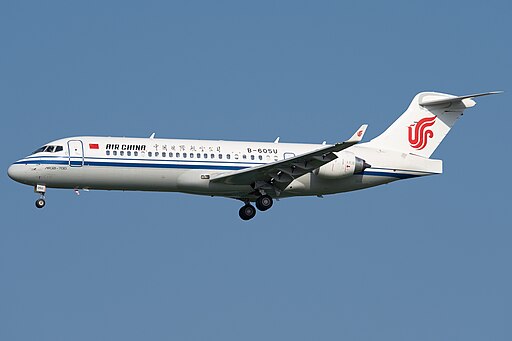
The COMAC C909 is a twin-engine regional jet developed by China’s Commercial Aircraft Corporation of China (COMAC). Initially introduced as the ARJ21, it was rebranded as the C909 in late 2024 to align with COMAC’s naming scheme alongside its C919 and C929 aircraft. The C909 is designed to serve short- to medium‐haul routes, typically in the 70- to 105-seat class, and targets both domestic Chinese airlines and emerging international markets.
It is significant for being one of China’s first domestically produced passenger jets in commercial service, marking China’s bid to reduce dependence on Western airframe manufacturers.
Development and Design Philosophy
COMAC began work on the ARJ21 programme (which later became the C909) in the early 2000s. The aircraft was built to meet the needs of regional and feeder services in China, where smaller cities and less-equipped airports require aircraft capable of operating from shorter runways and handling more challenging environments (such as high temperatures, high altitudes or smaller infrastructure).
The rebranding to “C909” was officially announced in November 2024, signalling COMAC’s desire to unify its product line branding and enhance export appeal. The aircraft has been improved incrementally in areas such as weight, aerodynamic resistance, noise reduction and operating cost efficiency as part of the marketing repositioning.
Airframe and Aerodynamics
Fuselage & Structure
The C909 uses a conventional narrow-body monoplane layout. The fuselage is constructed from aluminum alloys and incorporates high-strength structure elements to ensure durability and longevity. The cabin cross-section is approximately 3.14 m wide and about 2.03 m high, providing adequate comfort for a regional jet.
Door and cargo apertures are designed to support multiple layouts: passenger, VIP/business, or freight conversions.
The landing gear is retractable, designed for regional operations including airports with less optimal runway conditions.
Wing and Tailplane
The wing features a supercritical airfoil shape and is swept about 25° at the quarter-chord, enhancing cruise efficiency while preserving good low-speed behaviour. Wing area is approximately 79.9 m² in the standard variant. The wings are equipped with leading-edge slats and trailing-edge Fowler flaps to boost lift during take-off and landing, allowing operation from shorter runways. The tailplane is of conventional configuration, with horizontal stabilizer mounted low on the vertical fin, providing stable control and good handling across the flight envelope.
Propulsion and Performance Systems
The standard C909 is powered by two General Electric CF34-10A turbofan engines, each producing around 17,000 lbf (approximately 75.6 kN) of thrust. These engines are relatively mature and provide a balance of reliability and efficiency for the regional-jet role.
Fuel capacity is sufficient to provide a standard range of about 2,225 km in the baseline version, with an extended range variant (ER) capable of up to roughly 3,700 km.
The aircraft is fitted with modern systems including integrated monitoring of engine and airframe health, and redundancy built into hydraulics, electrics and flight controls consistent with commercial certification standards.
Cabin, Cockpit and Avionics
Passenger Cabin
The C909 accommodates 78 passengers in a two-class configuration or up to 90 in an all-economy layout in the standard version. High-density layouts can push capacity up to roughly 95 or 97 seats depending on interior specification. VIP and business jet (CBJ) variants are also offered, with luxurious interiors and fewer seats.
Versions configured for freight (CCF) or convertible mixed‐freight-passenger layouts are part of the product family, with reinforced floors and larger cargo doors.
Cabin systems are designed for ease of maintenance and rapid reconfiguration between roles.
Cockpit and Avionics
The flight deck features a modern “glass cockpit” environment with large multifunction displays, enabling pilots to manage navigation, engine systems, flight management and safety systems effectively. Fly-by-wire control augmentation may be present or planned in upgraded variants. Navigation systems include GPS/INS, weather radar, TCAS, ADS-B and satellite communications as options. The avionics suite is designed to support operations into smaller airports with limited ground infrastructure, offering reduced-minimum performance capabilities and short-field performance support.
Technical Specifications (Standard and ER Variants)
Below are key specification figures for the C909 in its standard and extended-range (ER) versions:
| Parameter | Standard (STD) | Extended Range (ER) |
|---|---|---|
| Crew | 2 pilots | 2 pilots |
| Passenger Capacity | 78–90 (standard) | 78–90 (optionally higher) |
| Length | ~ 33.46 m | ~ (slightly higher in some sources) |
| Wingspan | ~ 27.28 m | ~ 27.28 m |
| Height | ~ 8.44 m | same |
| Wing Area | ~ 79.9 m² | ~ 79.9 m² |
| Empty Weight | ~ 24,955 kg | ~ ~25,000 kg to ~26,270 kg (depending source) |
| Maximum Take-off Weight (MTOW) | ~ 40,500 kg | ~ 43,500 kg or more |
| Maximum Payload | ~ 8,935 kg | ~ 11,246 kg in larger variant |
| Maximum Speed (vₘₐₓ) | Mach 0.82 (~870 km/h) | same |
| Normal Cruise Speed | Mach 0.78 (~828 km/h) | same |
| Service Ceiling | ~ 11,900 m | similar |
| Range | ~ 2,225 km (STD) | up to ~ 3,700 km (ER) |
| Runway Take-off Distance (MTOW) | ~ 1,700 m (STD) | ~ 1,900 m (ER) |
Note: Some published figures vary slightly depending on source and configuration.
Operational Roles and Variants
The C909 family is offered in several configurations tailored to different use-cases:
-
STD (Standard Range): For typical regional operations, seating 78-90 passengers.
-
ER (Extended Range): Enhanced fuel capacity and structural allowances for longer regional missions, up to ~3,700 km.
-
CBJ (Commercial Business Jet): VIP configuration with fewer seats, luxurious furnishings, potential for corporate or government transport.
-
CCF (Converted Freighter): Freight version with reinforced floor, large cargo door, suitable for palletised freight or lower-density passenger/freight mix.
The aircraft is suited for operations into smaller or remote airports due to its relatively short take-off distance and good field performance, making it attractive for markets with less-developed infrastructure.
Market Position and Strategic Implications
The C909 sits in the regional‐jet category competing with legacy models like Embraer E-series or older regional jets, aimed primarily at feeders and smaller routes rather than large trunk mainline operations. For COMAC and China’s aviation strategy, the C909 marks an important stepping stone: it demonstrates the ability to design, certify and deliver a jet airliner under domestic control, which underpins more ambitious programmes such as the C919 narrow-body.
However, achieving broad international certification (such as by EASA or FAA) remains a challenge, and export penetration is still limited. The delivery of the first C909 to an operator outside China, Lao Airlines in March 2025, represents an important milestone in internationalisation of the aircraft.
Summary
The COMAC C909 is a significant regional jet programme developed in China, offering a 78-to-90 seat capability with a twin-engine configuration, modern aerodynamics, and a flexible variant line-up for passenger, VIP and freight roles. Its technical specifications place it competitively within the regional-jet segment, while its operational adaptability—from primary airports to smaller feeder fields—gives it appeal in developing and emerging markets. As COMAC gains experience, the C909 serves as a platform for broader ambitions in Commercial aviation, even as it navigates certification, support and global operator acceptance challenges.
.jpg)