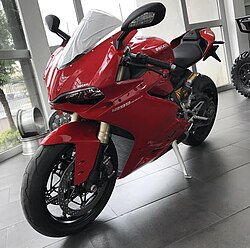
Ducati 1299 Panigale: The Last Great V-Twin Superbike
The Ducati 1299 Panigale occupies a special place in modern superbike history. It was not simply an evolution of Ducati’s celebrated 1199 Panigale; it represented the final, highly developed expression of the company’s large-displacement V-twin superbike philosophy before Ducati moved its flagship road-going performance machines to the V4 configuration. Introduced for the 2015 model year, the 1299 combined a larger 1,285 cc Superquadro engine with an advanced electronic package, radical aerodynamics, a lightweight monocoque chassis and the unmistakable styling that made the Panigale family one of the most recognizable motorcycles of its generation. Contemporary testing highlighted its claimed 205 horsepower and 106.7 lb-ft of torque, figures that put it firmly among the most powerful production motorcycles of its era.
What makes the 1299 particularly interesting today is the way it sits between two eras. On one side was Ducati’s traditional V-twin superbike heritage, stretching back through legendary models such as the 916, 999 and 1198. On the other was the V4 revolution that would arrive with the Panigale V4. The 1299 therefore became something of a technological and emotional finale: a motorcycle that retained the distinctive pulse, character and engine architecture of Ducati’s twin-cylinder superbikes while incorporating sophisticated electronics capable of making its enormous performance considerably more manageable. For enthusiasts, that combination gives the 1299 a significance that goes well beyond its specification sheet.
The Evolution of the Panigale
From the 1199 to the 1299
The 1199 Panigale had already transformed Ducati’s superbike formula. Its monocoque aluminum chassis, compact Superquadro engine and unconventional engineering represented a major departure from the tubular trellis-frame approach associated with earlier Ducati superbikes. When Ducati developed the 1299, however, the company did not simply increase engine displacement and leave the rest of the motorcycle untouched. The larger engine was accompanied by chassis refinements and a substantially more sophisticated electronic control system.
The key change was the engine. Ducati retained the 60.8 mm stroke of the 1199 but increased bore to an extraordinary 116 mm, producing a displacement of 1,285 cc. This approach allowed engineers to increase capacity without significantly changing the engine’s fundamental external dimensions. The result was an engine capable of producing a claimed 205 hp at 10,500 rpm and 106.7 lb-ft of torque at 8,750 rpm. Cycle World’s technical examination noted that Ducati’s strategy also brought a substantial increase in midrange torque, helping make the 1299 more flexible than the model it replaced.
More Than Just Bigger
The significance of the 1299 was not simply that Ducati had created a 200-horsepower-plus V-twin. The company also worked to make the performance more accessible. The 1199 could be demanding because of the way its power arrived, particularly for riders attempting to exploit its capabilities on the road or track. The 1299’s additional displacement produced stronger torque lower in the rev range, while revised electronics helped manage acceleration, braking and chassis behavior.
This was one of the motorcycle’s greatest strengths. Modern superbike performance is not defined solely by horsepower; it is also about how effectively a rider can use that power. Ducati equipped the 1299 with systems including Ducati Traction Control, Ducati Wheelie Control, Engine Brake Control, Ducati Quick Shift and cornering ABS, all working with information from an inertial measurement unit. The result was a motorcycle that could remain ferocious while giving the rider substantially more control over its behavior.
The 1,285 cc Superquadro Engine
A Huge-Bore V-Twin
At the heart of the Ducati 1299 is its 90-degree liquid-cooled Superquadro V-twin. The 116 mm bore is one of the defining characteristics of the engine, while the 60.8 mm stroke contributes to its extremely oversquare design. Four desmodromically actuated valves are used per cylinder, and electronic fuel injection works with ride-by-wire throttle control.
The engine’s personality is fundamentally different from that of a conventional four-cylinder superbike. There is an unmistakable sense of mechanical character and immediacy when the throttle is opened, combined with a forceful surge of torque as the revs build. Ducati’s claimed figures are impressive even by modern standards, but the numbers do not fully explain the experience. The appeal lies in the combination of pulse, intake noise, exhaust character and the rapid escalation of acceleration as the engine approaches its upper reaches.
The 1299 also demonstrated why Ducati had continued developing its V-twin concept despite the increasingly fierce competition from four-cylinder machines. The enormous bore allowed Ducati to achieve its desired displacement while maintaining the engine’s compact architecture. Cycle World described the 1299 as the most extreme version of the Superquadro engine at the time, emphasizing the engineering significance of its 116 mm pistons.
Performance That Demands Respect
A motorcycle producing more than 200 claimed horsepower in a lightweight superbike chassis is never going to be an entirely casual machine. The 1299 rewards a rider who is smooth and precise, particularly when using its performance on a circuit. Its electronics reduce the consequences of mistakes, but they do not eliminate the physical demands associated with riding a powerful superbike.
Contemporary reviews generally praised the improved linearity of the engine compared with the 1199. MCN specifically noted that the additional torque arrived lower in the rev range and made the power delivery more progressive. That improvement is important because it transformed the motorcycle from an intimidating machine into something that could be exploited more effectively by experienced riders.
Chassis, Suspension and Braking
The Monocoque Philosophy
One of the most distinctive engineering decisions behind the Panigale family was Ducati’s aluminum monocoque chassis. Instead of using a conventional frame surrounding the engine, the architecture integrates the engine into the motorcycle’s structural concept. The arrangement contributes to the Panigale’s compact appearance and helps keep weight centralized.
The 1299 also uses a single-sided aluminum swingarm, adding another unmistakable Ducati design element. With a 1,437 mm wheelbase and a 24-degree steering-head angle, the geometry was developed around sharp handling and high-speed stability. The motorcycle’s dimensions underline its purpose: this is fundamentally a supersport machine designed to attack corners rather than a touring motorcycle adapted for occasional sporting use.
Suspension and Brakes
The standard 1299 Panigale used fully adjustable 50 mm Marzocchi front forks and a Sachs rear shock, while the higher-spec 1299 Panigale S received electronically controlled Öhlins suspension. The S model therefore offered a substantial upgrade for riders who wanted to use the motorcycle extensively on track or who simply wanted the additional adjustability and sophistication of Ducati’s premium package.
Braking performance was equally serious. The motorcycle was equipped with twin 330 mm front discs and radially mounted four-piston Brembo monobloc calipers, accompanied by a 245 mm rear disc. Cornering ABS was part of the electronics package, allowing braking assistance to take lean angle into account rather than functioning only as a conventional straight-line ABS system.
Electronics: The Hidden Strength of the 1299
Rider Modes and Electronic Assistance
The electronics are arguably what made the 1299 so significant. A motorcycle with 205 horsepower can easily overwhelm its rear tire, particularly when the road surface is imperfect or the rider opens the throttle aggressively while leaned over. Ducati’s electronic systems were designed to manage these situations without stripping away the character of the machine.
Ducati Traction Control helps regulate rear-wheel slip, while Ducati Wheelie Control manages excessive front-wheel lift during hard acceleration. Engine Brake Control helps control the behavior of the motorcycle during aggressive downshifts and deceleration. Ducati Quick Shift allows rapid gear changes with reduced interruption to acceleration, and the ride-by-wire throttle gives the electronics much finer control over engine response.
The 1299 S
For riders seeking an even more sophisticated version, the 1299 S added electronically controlled Öhlins suspension and lighter forged wheels. The semi-active suspension could alter damping characteristics according to riding conditions and selected mode, providing another layer of adaptability. Cycle World’s testing of the S highlighted its Öhlins NIX30 fork and TTX36 rear shock, both featuring electronic compression and rebound adjustment.
What the Ducati 1299 Is Like to Ride
On the road, the 1299 presents an interesting contradiction. It is more approachable than its predecessor in important ways, yet it remains unmistakably a full-blooded superbike. The riding position, heat generation, engine noise and aggressive chassis are reminders that this motorcycle was created primarily for performance.
On a fast, flowing road, however, the package starts to make sense. The strong midrange means the rider does not need to constantly chase the top of the rev range to experience serious acceleration. The chassis provides substantial confidence, while the brakes offer the stopping power expected from a machine in this class. MCN’s long-term experience with the Panigale 1299 S found that the motorcycle could be remarkably effective on track while remaining usable on the road.
The compromises become clearer in everyday riding. The clutch can feel heavy, the engine can be noisy at low speeds, and the motorcycle generates considerable heat. The riding position is also designed around performance rather than relaxed commuting. These are not necessarily flaws; they are reminders that the 1299 belongs to a category where practicality comes second to speed, handling and emotional appeal.
Design That Has Aged Remarkably Well
The Panigale 1299 remains one of the most visually distinctive motorcycles of its generation. Ducati managed to create an aggressive silhouette without relying on excessive visual clutter. The compact bodywork, sharp front end, exposed mechanical details and single-sided swingarm give the bike an unmistakable presence.
This design is particularly important to the 1299’s long-term appeal because the motorcycle looks purposeful even when standing still. Unlike some superbikes whose styling is heavily tied to a particular fashion trend, the Panigale’s basic proportions remain contemporary. The bike communicates speed through its shape rather than through unnecessary decoration.
The 1299 also benefited from Ducati’s attention to detail. High-quality Brembo braking components, sophisticated suspension on the S version, forged wheels and the extensive electronics package reinforced the impression that this was Ducati’s flagship V-twin road superbike.
Ducati 1299 vs. the V4 Era
The End of an Era
Perhaps the most important fact about the 1299 is that it was the end of a lineage. Ducati eventually replaced its flagship V-twin superbike with the Panigale V4, marking a major change in engine architecture. That transition made the 1299 more than another model-year Ducati; it turned it into the culmination of decades of V-twin superbike development.
The 1299 therefore occupies an unusual position in the used-motorcycle market and among collectors. It offers the character of a large-displacement Ducati twin but incorporates technology that was sophisticated enough to remain relevant long after the model ceased production. Contemporary sources identify the 1299 as the final road-going flagship V-twin before Ducati’s transition to the V4 platform.
Standard, S and Special Editions
The standard 1299 was arguably the most straightforward version of the family, while the 1299 S added electronically controlled Öhlins suspension and other premium components. Ducati also produced special versions, including the limited-production 1299 Panigale S Anniversario and the later 1299 Panigale R Final Edition. The Anniversario was limited to 500 numbered motorcycles, giving it an additional layer of exclusivity.
Is the Ducati 1299 Still Worth Considering?
For an enthusiast searching for a modern classic superbike, the Ducati 1299 makes an unusually compelling case. It combines a spectacular engine, sophisticated electronics, exceptional braking, distinctive styling and genuine historical importance. It is also sufficiently old to have established a reputation among owners and reviewers while still feeling technically advanced.
However, potential buyers should approach ownership with realistic expectations. This is not a cheap commuter motorcycle, and specialist maintenance, tires, brakes and other consumables can become expensive. Used examples should be evaluated carefully, with particular attention paid to maintenance history and evidence of proper servicing. Contemporary owner feedback and reviews also indicate that running costs can be significant.
For primarily road-based riding, the standard model may make more sense than paying a premium for an S or special edition. For frequent track use or for collectors who value the most sophisticated specification, the S and limited editions are considerably more attractive. Ultimately, condition and documented maintenance are more important than simply choosing the most expensive version.
Ducati 1299 Technical Specifications
The following figures summarize the principal specifications of the standard Ducati 1299 Panigale. Published figures can vary slightly by market, model year, measurement method and whether weight is quoted dry or with operating fluids. The core engine and chassis figures are consistent across major contemporary specification sources.
| Specification | Ducati 1299 Panigale |
|---|---|
| Engine | Liquid-cooled 90° V-twin Superquadro |
| Valve system | Desmodromic, 4 valves per cylinder |
| Displacement | 1,285 cc |
| Bore × stroke | 116 × 60.8 mm |
| Compression ratio | 12.6:1 |
| Maximum power | 205 hp @ 10,500 rpm |
| Maximum torque | 106.7 lb-ft @ 8,750 rpm |
| Fuel system | Electronic fuel injection, ride-by-wire |
| Transmission | 6-speed |
| Clutch | Wet multiplate slipper clutch |
| Frame | Aluminum monocoque |
| Front suspension | Fully adjustable 50 mm Marzocchi fork |
| Rear suspension | Fully adjustable Sachs shock |
| Front brakes | Twin 330 mm discs, Brembo 4-piston monobloc calipers |
| Rear brake | 245 mm disc, 2-piston caliper |
| ABS | Cornering ABS |
| Front tire | 120/70 ZR17 |
| Rear tire | 200/55 ZR17 |
| Wheelbase | 1,437 mm |
| Rake | 24° |
| Seat height | 830 mm |
| Fuel capacity | 17 litres |
| Dry weight | Approximately 166.5 kg |
| Wet/kerb weight | Approximately 190–191 kg |
| Electronics | DTC, DWC, DQS, EBC, riding modes, ride-by-wire, cornering ABS |
Final Verdict
The Ducati 1299 Panigale is much more than a motorcycle with an impressive horsepower figure. It represents the culmination of Ducati’s large-capacity V-twin superbike philosophy at a moment when the company was pushing that architecture to its technological limits. The 1,285 cc Superquadro engine delivers huge performance, while the monocoque chassis, Brembo brakes, sophisticated electronics and optional Öhlins suspension create a package capable of genuine superbike-level performance.
Its greatest appeal, however, is its character. The 1299 feels like the product of an era in which Ducati was willing to build a motorcycle that was uncompromisingly focused on speed while still using electronics to make that performance accessible. It is fast, dramatic, demanding and unmistakably Italian.
The arrival of the Panigale V4 eventually changed Ducati’s superbike story, but it did not make the 1299 irrelevant. Instead, it gave the motorcycle a place in history. As the final development of Ducati’s flagship V-twin road superbike, the 1299 Panigale stands as a fitting farewell to one of the most distinctive engine configurations ever used in high-performance motorcycles. For riders who value mechanical character as much as outright numbers, that may ultimately be what makes the Ducati 1299 so memorable.
