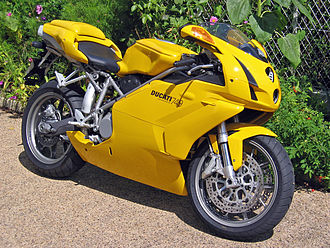
Ducati 749: The Italian Supersport That Refused to Live in the Shadow of the 999
The Ducati 749 is one of the most interesting motorcycles in Ducati’s modern history because it arrived at a complicated moment for the Italian manufacturer. It succeeded the celebrated 748, shared its fundamental engine architecture with the larger 999, and introduced the controversial but technically ambitious styling language created by designer Pierre Terblanche. Produced from 2003 through the middle of the decade, the 749 was a genuine middleweight superbike rather than simply a smaller machine intended for beginners. Its 748 cc liquid-cooled 90-degree L-twin, desmodromic four-valve heads, tubular steel trellis frame, fully adjustable suspension, powerful Brembo brakes, six-speed transmission, and single-sided swingarm created a motorcycle that was thoroughly serious about performance. Available in standard, Dark, S, and race-focused R forms, the 749 combined Ducati’s traditional mechanical character with a much more modern approach to chassis adjustment, instrumentation, aerodynamics, and rider ergonomics.
The Birth of the Ducati 749
The 749 arrived as the successor to the Ducati 748 and was closely related to the new Ducati 999. The relationship between the two motorcycles was obvious: both were part of Ducati’s new superbike generation, both used the company’s characteristic 90-degree L-twin configuration and desmodromic valve actuation, and both employed a tubular steel trellis chassis. Yet the 749 was not merely a 999 with smaller cylinders. Its 748 cc engine gave it a different performance character, while its smaller rear tire and more compact engine dimensions contributed to a riding experience of its own. Ducati produced the 749 alongside the 999 during a period when the company was moving away from the styling established by the 916, 996, and 998 and toward a more technical, angular design philosophy.
The standard 749 used a 90 mm bore and 58.8 mm stroke to produce 748 cc. According to Ducati’s technical documentation for the model, the engine developed approximately 103 horsepower at 10,000 rpm and 77 Nm of torque at 8,500 rpm in the earlier standard specification, with the 749S producing approximately 110 horsepower at 10,500 rpm. Later workshop documentation shows that Ducati subsequently revised the stated test-bench output figures, illustrating why published specifications can vary according to model year and measurement standard.
Pierre Terblanche’s Controversial Design
A New Direction for Ducati
Few motorcycles demonstrate how dramatically motorcycle styling can divide opinion quite like the Ducati 749. The earlier 916 family had established a near-universal visual formula for the Italian superbike: smooth surfaces, elegant curves, narrow proportions, twin headlights, and a tail section that appeared almost impossibly compact. The 749 moved in a different direction. Pierre Terblanche’s design emphasized technical surfaces, sharper transitions, a more substantial front fairing, and an unmistakably modern appearance.
When the motorcycle was new, some Ducati enthusiasts struggled with this change because the 749 did not attempt to imitate its famous predecessor. With hindsight, however, the design has become increasingly interesting. It represents a particular moment in motorcycle history when manufacturers were experimenting with computer-assisted development, aerodynamic efficiency, advanced instrumentation, and radically different interpretations of sport-bike ergonomics. The 749 therefore has an identity that is independent of the 748 rather than simply being a visual continuation of it.
Form and Function
The unusual appearance was not purely an exercise in styling. The fairing, air intakes, lighting arrangement, rider position, and chassis packaging were all designed around the requirements of a modern high-performance motorcycle. The narrow waist and exposed trellis frame maintained recognizable Ducati characteristics, while the under-seat exhausts and single-sided swingarm preserved visual connections with the company’s superbike tradition.
The result was a motorcycle that could look surprisingly compact from certain angles while appearing broad and technical from others. Its proportions were dictated by the engine, frame, cooling system, and aerodynamic requirements rather than by an attempt to reproduce the aesthetic formula of the 1990s.
The Desmodromic 748 cc V-Twin
At the center of the 749 was Ducati’s liquid-cooled, four-stroke 90-degree L-twin. The engine used four valves per cylinder and Ducati’s desmodromic valve actuation, with separate opening and closing rockers controlling the valves. Two overhead camshafts per cylinder head were driven by toothed belts, while electronic fuel injection supplied the engine through 54 mm throttle bodies.
The 90 × 58.8 mm bore and stroke combination gave the engine its 748 cc displacement. The relatively short stroke allowed the motor to operate at high engine speeds, with the early 749 specification permitting a maximum of approximately 11,500 rpm. This was an important part of the motorcycle’s personality: unlike a large-displacement twin that could produce overwhelming torque with very little throttle input, the 749 encouraged the rider to work through the six-speed gearbox and keep the engine in its stronger rev range.
The standard 749’s compression ratio was approximately 11.7:1, while the 749S used a higher 12.3:1 ratio. Ducati’s official workshop documentation for later standard and Dark versions also lists revised maximum test-bench output of around 108 hp, while the later 749S is listed at approximately 116 hp under the relevant test standard. Such figures demonstrate how the engine evolved during production and why specifications should always be tied to a particular model year.
Transmission and Mechanical Character
Six Speeds and a Dry Clutch
The Ducati 749 used a six-speed constant-mesh gearbox with a dry multi-plate clutch operated hydraulically. Final drive was by chain. The primary drive used straight-cut gears, while the standard 749 and Dark generally used a 14-tooth front sprocket and 39-tooth rear sprocket; the 749S used a 14/38 combination in later factory documentation.
The dry clutch was one of the motorcycle’s most distinctive mechanical features. To modern riders accustomed to wet clutches, the noise of a Ducati dry clutch can sound unusual, but for enthusiasts it became part of the experience. It contributed to the unmistakable mechanical personality of Ducati’s superbikes and was also closely associated with the company’s racing machinery.
The gearbox complemented the engine’s character. A 749 rider could not simply rely on displacement to generate acceleration everywhere in the rev range. Strong performance demanded appropriate gear selection, throttle control, and an understanding of how the L-twin delivered its power. This made the motorcycle engaging even when ridden at speeds that did not approach its theoretical maximum.
The Trellis Chassis
Built Around the Rider
Ducati retained its famous tubular steel trellis frame for the 749, but the chassis was considerably more adjustable than that of many earlier motorcycles. The standard machine used a 43 mm upside-down Showa fork with adjustment for rebound, compression, and spring preload. At the rear, a progressive linkage connected the swingarm to an adjustable monoshock, with settings for rebound, compression, and spring preload. Front wheel travel was approximately 125 mm and rear wheel travel approximately 128 mm.
The chassis geometry was equally serious. The wheelbase was approximately 1,420 mm, while rake could vary depending on specification. This was not a motorcycle designed around soft suspension or forgiving commuter behavior. It was designed to provide a stable platform at high speed while still allowing the rider to exploit the motorcycle’s relatively compact dimensions through corners.
The adjustable steering geometry and suspension were particularly important on the more sporting versions. Rather than providing a single compromise setup, Ducati gave owners the ability to adapt the motorcycle to road conditions, rider preference, tire choice, and circuit use.
The Single-Sided Swingarm
The single-sided aluminum swingarm remained one of the most recognizable Ducati features. It provided the practical advantage of simplifying rear-wheel removal while also giving the motorcycle a distinctive appearance. The exposed rear wheel and carefully shaped exhaust system made the 749 instantly identifiable from the side.
The standard rear tire was a 180/55 ZR17, narrower than the 190-section tire used by the 999. That choice was significant because it contributed to the 749’s handling character. The motorcycle could feel relatively agile and willing to change direction, reinforcing its position as a middleweight alternative rather than a scaled-down version of the larger machine.
Brembo Brakes and Sporting Hardware
The 749 was equipped with substantial Brembo braking hardware. The standard specification used twin semi-floating 320 mm front discs with four-piston calipers, while the rear used a 240 mm drilled disc with a two-piston caliper.
These components gave the motorcycle the braking authority expected from a genuine superbike. The brakes were supported by the adjustable front suspension and rigid chassis, allowing riders to brake hard before corners and then transition smoothly into the turn. On a motorcycle like the 749, braking performance cannot be considered independently of the chassis: the ability to exploit powerful brakes depends on suspension control, tire grip, steering geometry, and rider confidence.
The combination was especially impressive on the 749S and 749R. Higher-specification versions received increasingly sophisticated components, with the R eventually moving to radial front calipers and Öhlins suspension.
Ducati 749 Model Variants
Ducati 749 and 749 Dark
The standard 749 was the foundation of the range. It offered the full Ducati superbike formula without the additional expense and specialization of the higher-performance versions. With roughly 103 horsepower in its earlier factory specification and a claimed maximum speed of around 240 km/h, it was already an extremely capable road motorcycle.
The 749 Dark provided a visually more understated alternative. Its darker finish and simplified presentation gave it a different personality without changing the essential mechanical architecture. For riders who appreciated the 749’s engineering and unusual styling but wanted something less visually traditional, the Dark was an appealing option.
Ducati 749S
The 749S moved the motorcycle toward the performance end of the spectrum. Its compression ratio rose to 12.3:1, output increased to approximately 110 horsepower in the original specification, and the suspension received upgraded components. The fork featured a titanium-nitride surface treatment, giving it a distinctive appearance while supporting the motorcycle’s sporting credentials.
Later technical documentation lists still higher test-bench figures for the 749S, reflecting development over the production run. The S therefore represents an important sweet spot in the family: it delivered more performance and equipment than the standard motorcycle while remaining substantially less specialized than the R.
Ducati 749R
The 749R was the most exotic member of the family. Developed with racing homologation in mind, it received a significantly revised engine with a 94 mm bore and 54 mm stroke, raising displacement to 749 cc while allowing a more aggressive internal configuration. The compression ratio rose to 12.7:1, and the engine incorporated specialist components including titanium connecting rods.
The chassis was similarly upgraded. The 749R became associated with Öhlins suspension and radial front brake calipers, while extensive use of lightweight materials helped distinguish it from the ordinary road versions. Contemporary specifications put output at roughly 117 horsepower, although exact figures vary by market and measurement method.
The R demonstrates the philosophy behind Ducati’s homologation motorcycles: instead of creating a cosmetic special edition, Ducati developed a machine whose specifications were driven by competition requirements. Consequently, the 749R has become particularly interesting to collectors and enthusiasts who appreciate the technical evolution of Ducati’s middleweight superbike.
Riding the Ducati 749
The character of the 749 is fundamentally different from that of a modern electronic superbike. There is no need to select riding modes, configure traction-control maps, or study a large color display before riding away. Instead, the relationship between rider and motorcycle is predominantly mechanical.
The relatively compact 748 cc engine encourages momentum and precision. The rider has to choose the correct gear, manage the throttle carefully, and use the engine’s rev range intelligently. On a winding road, this can make the motorcycle feel more rewarding than its peak power figure might suggest. The chassis provides confidence, while the narrow rear tire contributes to an agile feeling that helps the bike change direction without requiring excessive effort.
At the same time, the 749 is not a soft or casual motorcycle. The riding position is unmistakably sporting, and the engine’s performance is concentrated toward the upper part of the rev range. This is a machine designed to be ridden actively. Its greatest appeal comes when the rider becomes part of the mechanical process rather than treating the motorcycle simply as transportation.
Racing Heritage and the 749R
The 749’s connection to racing was fundamental to its development. Ducati produced specialized racing versions and used the platform in supersport competition, with the 749R serving as the homologation-oriented road model. Its specialized engine dimensions, high-performance suspension, braking equipment, and lightweight components made it particularly well suited to the demands of circuit racing.
This competition focus also helps explain why the 749 feels so technically purposeful. The adjustable chassis, six-speed transmission, high-revving engine, powerful brakes, and sophisticated suspension were not isolated features. They formed an integrated system intended to allow the rider to extract consistent performance from the motorcycle.
Why the Ducati 749 Still Matters
The Ducati 749 occupies an unusual position in the used-bike and collector world. It was overshadowed for years by the beauty and historical importance of the 916 generation, while its own successor, the 848, eventually became one of Ducati’s most popular middleweight sport motorcycles. Yet the 749 has increasingly gained recognition as a motorcycle with a strong identity of its own.
Part of its appeal is its rarity of character. Modern motorcycles are extraordinarily capable, but many have converged around similar aerodynamic shapes, electronic systems, and performance targets. The 749 belongs to a period when manufacturers were still willing to take significant risks with styling and mechanical presentation. Its design may have been controversial when new, but it has aged into something distinctive.
It is also an important motorcycle for understanding Ducati’s transition from the 1990s superbike era to the technology-driven machines that followed. The 749 retained the desmodromic L-twin, dry clutch, trellis frame, and single-sided swingarm associated with traditional Ducati engineering while introducing a much more modern chassis and ergonomic philosophy.
Ducati 749 Technical Specifications
The table below summarizes representative factory specifications for the standard Ducati 749, with the most important differences for the 749S and 749R noted separately. Exact figures can vary according to production year, market, and measurement standard, so a specific motorcycle should always be checked against its factory documentation. Ducati itself maintains a library of owner’s manuals for model-specific information.
| Specification | Ducati 749 | Ducati 749S | Ducati 749R |
|---|---|---|---|
| Production period | 2003–2006 | 2003–2006 | 2004–2006 |
| Engine | 90° L-twin, 4-stroke | 90° L-twin, 4-stroke | 90° L-twin, 4-stroke |
| Cooling | Liquid | Liquid | Liquid |
| Displacement | 748 cc | 748 cc | 749 cc |
| Bore × stroke | 90 × 58.8 mm | 90 × 58.8 mm | 94 × 54.0 mm |
| Valves | 4 per cylinder | 4 per cylinder | 4 per cylinder |
| Valve actuation | Desmodromic DOHC | Desmodromic DOHC | Desmodromic DOHC |
| Compression ratio | 11.7:1 | 12.3:1 | 12.7:1 |
| Peak power, early factory specification | 103 hp @ 10,000 rpm | 110 hp @ 10,500 rpm | Approx. 117 hp |
| Peak torque | 77 Nm @ 8,500 rpm | 78 Nm @ 8,500 rpm | Approx. 81 Nm |
| Maximum engine speed | Approx. 11,500 rpm | Approx. 11,500 rpm | Higher-specification race-oriented tune |
| Fuel system | Electronic injection, 54 mm throttle bodies | Electronic injection | Electronic injection |
| Transmission | 6-speed | 6-speed | 6-speed |
| Clutch | Dry multi-plate, hydraulic | Dry multi-plate, hydraulic | Dry multi-plate |
| Final drive | Chain | Chain | Chain |
| Frame | Tubular steel trellis | Tubular steel trellis | Tubular steel trellis |
| Front suspension | 43 mm fully adjustable Showa USD fork | Upgraded Showa USD, TiN-coated | Öhlins on later specification |
| Rear suspension | Progressive linkage, adjustable monoshock | Upgraded adjustable monoshock | Öhlins, adjustable |
| Front brakes | Twin 320 mm discs, 4-piston Brembo | Twin 320 mm discs | Radial Brembo specification |
| Rear brake | 240 mm disc, 2-piston Brembo | 240 mm disc | 240 mm disc |
| Front tire | 120/70 ZR17 | 120/70 ZR17 | 120/70 ZR17 |
| Rear tire | 180/55 ZR17 | 180/55 ZR17 | 180/55 ZR17 |
| Wheelbase | Approx. 1,420 mm | Approx. 1,420 mm | Approx. 1,420 mm |
| Seat height | Approx. 780 mm | Approx. 780 mm | Varies by equipment |
| Fuel capacity | Approx. 15.5 L | Approx. 15.5 L | Approx. 18.3 L |
| Dry weight | Approx. 199 kg | Around 195–198 kg depending on year | Approximately 192 kg, depending on specification |
| Claimed top speed | Approx. 240 km/h | Approx. 250 km/h | Approximately 260 km/h |
A Ducati Worth Remembering
The Ducati 749 is ultimately a motorcycle about transition. It sits between two important generations of Ducati superbikes: the legendary 748/916/996/998 family and the later 848/1098/1198 era. Its engine retained the mechanical identity that Ducati enthusiasts loved, while its chassis, styling, instrumentation, and adjustability pointed toward a more modern future.
Its greatest achievement may be that it remained recognizably Ducati while refusing to repeat the past. The 749 did not try to be another 916. It was sharper, more technical, more angular, and in many ways more experimental. That made it controversial when new, but it also gave the motorcycle a character that has become easier to appreciate with age.
The standard 749 was already a formidable sporting motorcycle, the 749S added a meaningful layer of performance equipment, and the 749R demonstrated just how far Ducati could push the 748 cc platform when racing requirements became the priority. Across the range, the same fundamental qualities remained: a high-revving desmodromic V-twin, a six-speed gearbox, a dry clutch, a trellis frame, sophisticated suspension, powerful Brembo brakes, and a design unlike almost anything else on the road.
For enthusiasts today, the Ducati 749 therefore deserves to be judged on its own terms. It is not simply the smaller 999, nor is it merely the successor to the 748. It is a fascinating snapshot of Ducati engineering at the beginning of the 21st century—a motorcycle that combined traditional Italian mechanical character with a willingness to challenge established ideas about what a Ducati superbike should look like and how it should perform.
