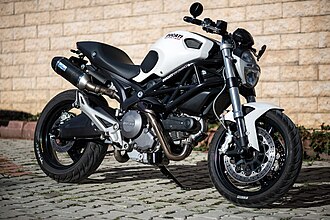
Ducati Monster 696: The Italian Naked Bike That Made Desmodromic Performance Accessible
The Ducati Monster 696 occupies an important place in the history of modern naked motorcycles. Introduced for the 2008 model year as the successor to the Monster 695, it represented a substantial evolution of Ducati’s famous streetfighter formula while deliberately preserving the silhouette and personality that had made the original Monster such an icon. With its exposed trellis frame, compact proportions, muscular fuel tank and unmistakable 90-degree L-twin engine, the Monster 696 looked unmistakably like a Ducati, but underneath the familiar styling was a lighter, sharper and more sophisticated motorcycle. Ducati produced the 696 from 2008 through 2014, with the model eventually succeeded by the Monster 797.
The importance of the Ducati Monster 696 goes beyond its specifications. It was designed at a time when naked motorcycles were becoming increasingly popular with riders who wanted the excitement of a sportbike without the extreme riding position and full fairing. The Monster formula was already well established, having originated in the early 1990s, but the 696 demonstrated how effectively Ducati could modernize that formula without destroying its identity. The result was a motorcycle that was approachable enough for newer riders, entertaining enough for experienced enthusiasts and visually distinctive enough to remain desirable years after its production ended.
The Evolution of the Monster
From the Monster 695 to the 696
The Ducati Monster 696 was unveiled in late 2007 and reached dealers in 2008. Although its name suggested only a modest increase over the outgoing Monster 695, the changes were considerably more substantial than the extra cubic centimeter might imply. Ducati reworked the engine, revised the chassis and improved the ergonomics, while simultaneously reducing weight. Contemporary testing described it as a major improvement over the previous generation, particularly in handling and rider comfort.
Ducati’s challenge was particularly difficult because the Monster had become one of the company’s defining motorcycles. The original Monster, designed around the concept of taking a sporting motorcycle and stripping away its fairing, had established a visual formula that customers immediately associated with Ducati. A completely new design risked alienating existing Monster enthusiasts, while a minor update would have left the motorcycle struggling against increasingly sophisticated competitors.
The 696 therefore followed an interesting middle path. From a distance it retained the recognizable Monster profile, but almost every important mechanical area received attention. Ducati also lowered the seat and altered the relationship between the rider and handlebars, making the new motorcycle easier to live with on the street. The company reportedly reduced the weight by around 5 kg compared with the 695, an important improvement for a motorcycle whose appeal depended heavily on agility.
A Design That Stayed Faithful to the Monster
The Classic Trellis Frame and Modern Details
The Ducati Monster 696 immediately communicates its identity through its steel tubular trellis frame. Rather than hiding the structural components behind bodywork, Ducati made the frame a central visual feature. The exposed mechanical architecture became one of the Monster family’s signatures, giving the motorcycle a purposeful appearance without requiring excessive bodywork.
The fuel tank, compact headlight area and short tail create a visual balance that makes the motorcycle appear smaller than many conventional middleweight machines. This is one reason the 696 feels approachable even before the engine is started. Its seat height of approximately 770 mm is relatively accessible, while the upright handlebars provide substantial leverage and make low-speed maneuvering straightforward. Contemporary reviewers noted the revised ergonomics, including a shorter reach to the handlebars and a more comfortable riding position than some earlier Monsters.
The details also show how Ducati tried to bring the Monster into the modern era. The instrument cluster was cleaner and more sophisticated than the rather cluttered arrangement on earlier versions, while the motorcycle gained features associated with Ducati’s more performance-oriented models. The overall design was therefore familiar without being old-fashioned.
The Monster 696 was also available in the 696+ configuration, which added a small bikini fairing around the instruments and a color-matched seat cowl. This version gave buyers a slightly more distinctive appearance while retaining the same fundamental mechanical package. Later in the model’s life, Ducati also offered ABS-equipped versions and special editions, including a 20th Anniversary model.
The 696 cc Ducati L-Twin
Desmodromic Character in a Compact Package
The engine is arguably the defining component of the Ducati Monster 696. It is a 696 cc, 90-degree L-twin with Ducati’s distinctive desmodromic valve-control system and two valves per cylinder. Unlike many modern liquid-cooled performance motorcycles, the 696 uses air cooling, reinforcing its connection with Ducati’s traditional engine architecture. Fuel delivery is handled electronically, with a Siemens injection system and a 45 mm throttle body.
The bore and stroke measure approximately 88 x 57.2 mm, giving the engine a relatively short-stroke configuration. Early production specifications commonly quote around 80 horsepower at 9,000 rpm and 69 Nm of torque at approximately 7,500–7,750 rpm, although some published sources give lower output figures depending on the market, measurement standard or model year. The 80-horsepower figure is the commonly cited factory specification for the 2008-generation motorcycle.
What makes the engine interesting is not simply its peak output but its delivery. The Monster 696 is not a motorcycle that requires enormous speeds to become entertaining. Its relatively low mass means the rider can exploit a large portion of the available performance on ordinary roads. The engine also has the mechanical sound and pulse that riders associate with a Ducati V-twin, giving the motorcycle an identity that a specification sheet cannot fully communicate.
Contemporary testing found that the engine was relatively calm at lower revs before becoming more lively higher in the rev range. One review noted that the character became particularly pronounced from around 6,000 rpm, accompanied by the distinctive induction and mechanical soundtrack of the Ducati twin.
The six-speed transmission works with a chain final drive, while the motorcycle uses Ducati’s APTC wet multi-plate clutch with hydraulic operation. The light clutch action was one of the practical improvements that made the 696 more approachable than some earlier Ducati models.
Lightweight Performance and Handling
A Chassis Built for Real Roads
One of the greatest strengths of the Monster 696 is its balance. The motorcycle is neither excessively powerful nor excessively heavy, and that makes it particularly effective on winding roads. The steel trellis frame works with a 43 mm upside-down front fork and a Sachs rear monoshock mounted through progressive linkage. The rear shock provides preload and rebound adjustment, while the front fork is generally non-adjustable on standard versions.
The front braking system is another area where the 696 punches above what its engine capacity might suggest. It uses twin 320 mm front discs with four-piston Brembo calipers, while the rear wheel is equipped with a 245 mm disc and two-piston caliper. The radial-mounted front calipers provide strong stopping performance without making the motorcycle difficult to control, an important characteristic for a machine aimed at a broad range of riders.
The 17-inch wheels use a 120/60 front tire and 160/60 rear tire, dimensions that contribute to predictable handling and a large selection of replacement rubber. With a wheelbase of roughly 1,450 mm and a dry weight around 161–163 kg depending on the specification source and version, the 696 has the physical characteristics of a genuinely agile naked motorcycle.
This combination becomes particularly enjoyable on twisty roads. The wide handlebar gives the rider plenty of leverage, allowing quick changes of direction without requiring significant physical effort. The Monster does not have the outright engine performance of larger Ducati models, but that can actually be an advantage on public roads. Instead of constantly managing excessive acceleration, the rider can concentrate on corner entry, braking and maintaining momentum.
Everyday Riding and Comfort
More Than Just a Weekend Toy
The Monster 696 is often remembered for its sporty appearance, but it is surprisingly practical for everyday use. The relatively low seat, upright riding position and light weight make it suitable for urban riding, while the 15-liter fuel tank gives it enough range for longer rides. Contemporary testing described the motorcycle as easy to maneuver in traffic and sufficiently punchy to avoid feeling overwhelmed in city conditions.
The lack of a full fairing obviously means wind protection is limited. At highway speeds, the rider is exposed to the airflow, and this becomes part of the motorcycle’s character. The Monster is at its best when treated as a compact road motorcycle rather than a high-speed touring machine.
The relatively low seat height is another significant advantage. At approximately 770 mm, it helped broaden the motorcycle’s appeal to riders who might find larger naked motorcycles intimidating. This accessibility was an important part of Ducati’s strategy with the 696, particularly as the company sought to make the Monster attractive to a new generation of riders.
Ducati Monster 696 and the Rider
A Motorcycle That Rewards Smoothness
The Monster 696 is not a motorcycle that demands expert technique before it becomes enjoyable. Its relatively modest weight, strong brakes and manageable power make it forgiving, but it also provides enough feedback to reward a rider who wants to improve. This makes it an interesting choice for someone moving beyond a smaller beginner motorcycle without immediately stepping into the performance levels of a large superbike.
The engine’s character encourages the rider to use the gearbox and keep the motor in its stronger rev range. Because the 696 does not produce enormous amounts of torque everywhere in the rev range, smooth throttle control and appropriate gear selection are more important than simply opening the throttle. In the right hands, this creates an engaging riding experience in which momentum becomes more important than brute force.
The handling is similarly communicative. The motorcycle is light enough to change direction quickly, yet its chassis is stable enough to inspire confidence. Contemporary reviews praised its improved ground clearance and handling compared with previous Monster generations, highlighting the transformation Ducati had made beneath the familiar styling.
Reliability and Ownership Considerations
What Makes a Used Monster 696 Attractive
The Monster 696 has become an interesting option on the used motorcycle market because it combines Ducati’s distinctive character with relatively simple mechanical architecture. The air-cooled two-valve engine is less complex than the high-performance liquid-cooled engines found in Ducati’s larger superbikes, and the motorcycle’s relatively straightforward design makes it appealing to enthusiasts who want Italian character without moving into the most extreme ownership territory.
However, prospective owners should remember that the motorcycle remains a Ducati and therefore deserves disciplined maintenance. The desmodromic valve system and belt-driven valve timing require proper servicing, and the condition of an individual used motorcycle is ultimately more important than the model’s reputation. Service records, evidence of correct belt and valve maintenance, brake condition, suspension condition and general electrical health are all worth examining before purchasing.
Later ABS versions can be particularly attractive to riders who value additional braking assistance, while earlier non-ABS examples can appeal to purists seeking the simplest expression of the 696. Because specifications changed during the model’s production run, buyers should verify the exact year and equipment of an individual motorcycle rather than assuming every 696 is mechanically identical.
Why the Monster 696 Still Matters
The Ducati Monster 696 succeeded because it understood what made the Monster concept special. It did not attempt to turn the motorcycle into a miniature superbike with an enormous engine. Instead, Ducati concentrated on balance, character, accessible ergonomics and visual identity. The result was a motorcycle that could be enjoyed by a new rider while still giving an experienced rider plenty of reasons to take it out on a winding road.
Its historical importance is also worth recognizing. The Monster helped establish the naked motorcycle as a major category, and the 696 demonstrated that the formula remained relevant more than a decade after the original Monster appeared. By 2008, the competition had become much stronger, yet Ducati’s solution was not to abandon the original concept. It refined it.
That philosophy explains why the Monster 696 still attracts attention. Its specifications are no longer extraordinary by modern standards, but motorcycles are not remembered solely by horsepower figures. The 696 has the kind of mechanical personality that makes an owner feel connected to the machine. The exposed frame, air-cooled L-twin, desmodromic valve gear, Brembo brakes and unmistakable Italian styling create an experience that is difficult to replicate with a modern motorcycle designed entirely around efficiency.
Final Thoughts
The Ducati Monster 696 is one of the most successful evolutions of the original Monster idea. It took the essential ingredients of Ducati’s iconic naked motorcycle and updated almost every practical element without losing the character that made the name special. The result was a lightweight, agile and visually distinctive motorcycle with enough performance to be genuinely exciting but without becoming unnecessarily intimidating.
Its 696 cc air-cooled L-twin may not compete with today’s high-output performance engines, but that misses the point. The Monster 696 was designed around usable performance and rider involvement. Its low weight, strong Brembo brakes, responsive chassis and accessible ergonomics allow the rider to enjoy the motorcycle at realistic road speeds. Meanwhile, the desmodromic Ducati engine supplies the mechanical personality that makes the bike feel special every time it is started.
More than a decade after production began, the Monster 696 remains a compelling example of how good motorcycle design does not necessarily require enormous power or complex technology. It demonstrates that a well-balanced chassis, charismatic engine and unmistakable visual identity can create a motorcycle that remains desirable long after its original showroom debut. For riders who want an approachable Ducati with genuine Italian character, the Monster 696 remains one of the most interesting motorcycles in the Monster family’s long history.
Ducati Monster 696 Technical Specifications
| Specification | Ducati Monster 696 |
|---|---|
| Manufacturer | Ducati |
| Model | Monster 696 |
| Production | 2008–2014 |
| Category | Naked motorcycle |
| Engine | 90° L-twin, 4-stroke |
| Valve system | Desmodromic, 2 valves per cylinder |
| Cooling | Air cooled / air-oil cooled |
| Displacement | 696 cc |
| Bore × stroke | 88 × 57.2 mm |
| Compression ratio | Approximately 10.5–10.7:1 |
| Fuel system | Siemens electronic fuel injection |
| Throttle body | 45 mm |
| Maximum power | Approximately 80 hp (58.8 kW) @ 9,000 rpm |
| Maximum torque | Approximately 69 Nm @ 7,500–7,750 rpm |
| Transmission | 6-speed |
| Clutch | APTC wet multi-plate, hydraulic |
| Final drive | Chain |
| Frame | Tubular steel trellis |
| Front suspension | 43 mm upside-down fork |
| Rear suspension | Sachs monoshock with progressive linkage |
| Front brakes | Twin 320 mm discs, four-piston calipers |
| Rear brake | 245 mm disc, two-piston caliper |
| Front tire | 120/60 ZR17 |
| Rear tire | 160/60 ZR17 |
| Wheelbase | Approximately 1,450–1,452 mm |
| Seat height | 770 mm |
| Fuel capacity | 15 litres |
| Claimed dry weight | Approximately 161–163 kg |
| ABS | Available on later versions |
| Top speed | Approximately 205–207 km/h, depending on source |
Specifications can vary by model year, market and version, particularly power figures, weight and ABS equipment. Contemporary and manufacturer-derived sources list slightly different figures, so the table should be treated as a general reference rather than a substitute for the specifications of a particular motorcycle.
