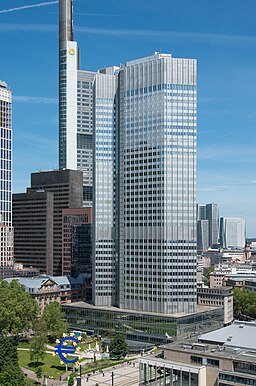
Eurotower
The Eurotower stands as a monumental landmark in Frankfurt, Germany, epitomizing the city’s role as a leading financial hub in Europe. Located in the central business district, this iconic skyscraper rises to a height of 148 meters, making it a significant feature of Frankfurt’s distinctive skyline. Constructed in the 1970s, the Eurotower initially served as the headquarters for the European Central Bank (ECB), symbolizing Europe’s economic unity and financial prowess. Its presence in Frankfurt underscores the city’s importance in the global financial system and its role in shaping monetary policy across the Eurozone.
Architecturally, the Eurotower reflects a blend of modernist design and functional elegance. Its clean lines, extensive use of glass, and symmetrical form create a visually striking silhouette against the backdrop of Frankfurt’s urban landscape. The building comprises 40 floors, each designed to accommodate the needs of financial institutions, with state-of-the-art office spaces, conference rooms, and technological infrastructure. The Eurotower’s design not only prioritizes efficiency and functionality but also incorporates sustainable practices, making it a model of modern architectural standards.
Beyond its structural and functional attributes, the Eurotower holds significant cultural and symbolic value for Frankfurt and the broader European community. As the former home of the ECB, it played a pivotal role in shaping the economic policies that impact millions of people across Europe. Today, while the ECB has moved to a new headquarters, the Eurotower continues to be a hub of financial activity and innovation. Its enduring presence in Frankfurt serves as a reminder of the city’s legacy in banking and finance, while also pointing to its future as a center of economic leadership and growth.
Using Eurotower
The Eurotower, located in the heart of Frankfurt’s financial district, stands as an enduring symbol of European economic strength and unity. Soaring to a height of 148 meters, this prominent skyscraper was constructed in the 1970s and became renowned as the initial headquarters of the European Central Bank (ECB). The building’s stature and significance are reflective of Frankfurt’s pivotal role as a leading financial center not only in Germany but across the entire Eurozone. The Eurotower’s towering presence underscores the city’s importance in the global financial landscape, hosting institutions that drive Europe’s economic policies and financial stability.
Architecturally, the Eurotower showcases the clean lines and functional elegance typical of modernist design. Its glass facade and symmetrical structure create a commanding presence amidst Frankfurt’s bustling urban environment. Inside, the tower’s 40 floors are equipped with advanced office spaces, conference rooms, and the latest technological infrastructure, designed to meet the high demands of financial institutions. Sustainability is also a key feature of the Eurotower’s design, aligning with contemporary standards of environmental responsibility and energy efficiency. This blend of aesthetics and functionality makes the Eurotower a model of modern architectural achievement.
Beyond its architectural prowess and functional capabilities, the Eurotower holds deep cultural and symbolic significance. As the former seat of the ECB, the tower was at the heart of crucial economic decision-making processes that affected millions across Europe. Even after the ECB relocated to its new headquarters, the Eurotower remains a vital hub of financial activity, housing various financial firms and continuing to influence economic discourse. Its lasting presence in Frankfurt not only commemorates the city’s historical role in European finance but also highlights its ongoing contributions to global economic leadership and innovation.
Parameters Eurotower
Here is a list of parameters or characteristics of the Eurotower in Frankfurt, Germany:
- Location: Situated in the central business district of Frankfurt, Germany, specifically in the Bankenviertel (Banking District).
- Height: Stands at approximately 148 meters tall, making it a prominent feature of Frankfurt’s skyline.
- Construction Period: Built in the 1970s, marking it as a significant development during that era of modernist architectural expansion.
- Architectural Style: Exhibits a modernist design with clean lines, extensive use of glass, and a symmetrical form, reflecting the architectural trends of its time.
- Number of Floors: Comprises 40 floors, each designed to accommodate various needs of financial institutions.
- Original Function: Initially served as the headquarters for the European Central Bank (ECB), symbolizing European economic unity and financial authority.
- Current Use: Continues to be a hub for financial activity, housing various financial firms and institutions even after the ECB moved to its new headquarters.
- Materials: Predominantly constructed with steel and glass, aligning with modernist architectural practices and providing durability and aesthetic appeal.
- Amenities: Equipped with state-of-the-art office spaces, conference rooms, and technological infrastructure to support the operations of financial institutions.
- Sustainability: Incorporates sustainable design practices and energy-efficient technologies, reflecting contemporary standards of environmental responsibility.
- Cultural Significance: Holds symbolic value as a former seat of the ECB and as a key player in the financial history and economic policy-making of the Eurozone.
- Community Impact: Acts as a central figure in Frankfurt’s financial district, contributing to the city’s identity as a global financial center and supporting economic activity and innovation.
- Accessibility: Located with convenient access to public transportation, major roadways, and amenities within Frankfurt, facilitating easy connectivity for workers and visitors.
