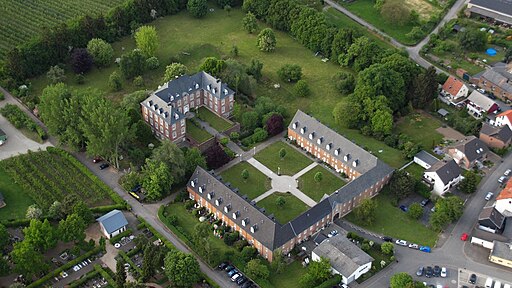
Schloss Gelsdorf, a lesser-known yet historically significant manor in the Rhineland, embodies the quiet elegance and deep-rooted history characteristic of Germany’s noble estates. Located in the village of Gelsdorf, near Grafschaft in the district of Ahrweiler, Rhineland-Palatinate, this stately property combines centuries of architectural evolution with a tranquil rural setting. Though not as grand as the famous Rhine castles, Schloss Gelsdorf represents an important example of the transformation of medieval noble holdings into refined Baroque and classical residences. Its long history of ownership, adaptation, and preservation offers insight into the cultural and social evolution of the Rhineland aristocracy.
Historical Origins
The history of Schloss Gelsdorf reaches back to the Middle Ages. The earliest fortifications in the area are believed to have been built between the 13th and 14th centuries, during a period when the Rhineland was dotted with fortified estates belonging to local lords and ministerial families. These early structures were typically designed for both defense and administration, serving as the seat of local power within the feudal hierarchy of the Electorate of Cologne.
The medieval Gelsdorf estate likely began as a fortified manor, surrounded by agricultural land and small settlements under the protection of its lord. Over time, the feudal emphasis on defense diminished, and the estate gradually transformed into a more comfortable and representative noble residence.
By the 17th and 18th centuries, the Gelsdorf property had evolved into a moated manor house — the precursor of today’s Schloss Gelsdorf — reflecting the growing wealth and cultural aspirations of its owners.
The Noble Families of Gelsdorf
Throughout its history, Schloss Gelsdorf has been associated with several noble families who shaped its development and maintained its standing in the region. Among these, the von Gelsdorf and later von Metternich families played pivotal roles in the estate’s history.
The von Gelsdorf family, from whom the estate takes its name, were originally knights in the service of the Archbishop of Cologne. They held administrative and military responsibilities, overseeing local lands and collecting revenues for the ecclesiastical authorities. As their influence grew, they established Gelsdorf as their ancestral seat.
In the early modern period, the estate came into the possession of the von Metternich family, one of the most prominent noble houses of the Rhineland. This family, known for their political influence and architectural patronage, transformed many of their rural properties into elegant residences that reflected Baroque and Rococo sensibilities. Under their ownership, Schloss Gelsdorf was redesigned and expanded into a more stately manor house, emphasizing symmetry, style, and landscape integration rather than defense.
Architectural Evolution
The current form of Schloss Gelsdorf is the result of centuries of architectural adaptation. While little of the medieval fortress remains, traces of the earlier structure can still be found in the thick foundations and the remnants of a moat that once surrounded the property.
The main building, constructed in the 18th century, follows the traditional layout of a three-winged Baroque manor. The central wing, used as the primary residence, faces a formal courtyard, while two side wings extend at right angles, enclosing the space and creating a sense of grandeur and balance. The façade, built from local stone and plastered in a soft ochre tone, features evenly spaced windows, decorative cornices, and a modest central pediment that adds classical dignity without ostentation.
The roofline is steep and slate-covered, typical of the Rhineland region, and punctuated by dormer windows that illuminate the attic rooms. The main entrance, accessed by a short staircase, opens into a grand hall that served both as a reception area and a symbol of the family’s prestige.
Inside, the rooms were arranged symmetrically along a central corridor, with high ceilings, ornate fireplaces, and stuccoed decorations. Some original elements, such as carved doorframes and tiled stoves, survive from the 18th century, offering glimpses into the refined domestic life of the period.
The estate also includes several auxiliary buildings, including a carriage house, stables, and agricultural structures that supported the manor’s operations. These outbuildings, though functional, were designed in architectural harmony with the main house, contributing to the estate’s cohesive appearance.
The Moat and Grounds
Like many aristocratic estates of the Rhineland, Schloss Gelsdorf was originally surrounded by a water-filled moat, a remnant of its medieval defensive design. Over time, the moat became more ornamental, forming part of a landscaped park that reflected the ideals of Baroque garden design.
The surrounding grounds were laid out with formal paths, tree-lined avenues, and carefully tended lawns, emphasizing symmetry and order. In the 19th century, during the Romantic period, portions of the park were redesigned in a more naturalistic English style, with winding paths and open vistas that framed views of the castle.
Even today, the gentle slopes and greenery of the Gelsdorf estate evoke a serene and timeless atmosphere. The moat has largely silted up but remains visible in parts, a quiet reminder of the castle’s medieval past.
Role in Regional History
Schloss Gelsdorf played a modest yet consistent role in the local history of the Rhineland. As a noble estate, it served as the administrative and economic center of its surrounding lands, overseeing agriculture, forestry, and trade. During the feudal and early modern periods, the owners of Schloss Gelsdorf exerted considerable influence over the local community, employing laborers, hosting seasonal markets, and contributing to parish affairs.
In the 18th and 19th centuries, the castle mirrored the shifting fortunes of the Rhineland nobility. The French Revolutionary and Napoleonic wars disrupted feudal landownership, and many estates faced confiscation or decline. However, Schloss Gelsdorf survived largely intact, thanks to prudent management and adaptation to new political realities.
By the 19th century, as industrialization spread through the Rhineland, the estate’s function transitioned from a feudal manor to a modern agricultural property. The noble family continued to reside in the castle, balancing their traditional social roles with the practical demands of land management in a changing world.
Schloss Gelsdorf in the Modern Era
In the 20th century, Schloss Gelsdorf faced new challenges but retained its integrity as a historical landmark. Unlike many castles in the region, it escaped destruction during both World Wars, though the surrounding area saw military activity.
Following the war, the estate remained privately owned and underwent several phases of restoration. Efforts were made to preserve its Baroque architectural character while adapting the interior for modern living. Today, Schloss Gelsdorf continues to serve as a private residence, though parts of the estate have been used for cultural and community events, including local exhibitions and guided tours.
The castle and its park are listed under heritage protection, recognizing their historical and architectural value to the region. Preservation work focuses on maintaining the building’s structural integrity, restoring original decorative elements, and conserving the surrounding landscape.
Cultural and Architectural Significance
While Schloss Gelsdorf is not among the most famous castles in Germany, it holds significant cultural value as a representative example of a Rhineland moated manor house that evolved organically from medieval to Baroque architecture. Its story reflects the broader transformation of the German aristocracy — from feudal knights to cultivated landowners — and the accompanying shift in architectural priorities from defense to beauty and comfort.
The estate also exemplifies the enduring relationship between architecture and landscape in the Rhineland. The interplay of water, stone, and greenery at Schloss Gelsdorf creates a harmonious ensemble that embodies the regional ideal of a noble rural residence.
Visiting Schloss Gelsdorf
Because Schloss Gelsdorf is privately owned, it is not open to the public on a regular basis. However, the exterior can be admired from nearby paths and roads, and its silhouette remains a defining feature of the Gelsdorf village landscape. On special heritage days and cultural occasions, guided tours may be organized to offer visitors a closer look at the architecture and history of the property.
The surrounding region, rich in vineyards, rolling hills, and historical towns, provides a perfect setting for exploring the legacy of Rhineland castles and manors. Schloss Gelsdorf, with its understated beauty and deep historical roots, fits seamlessly into this cultural landscape.
Conclusion
Schloss Gelsdorf stands as a quiet testament to the layered history of the Rhineland — a place where medieval foundations, Baroque refinement, and modern preservation coexist in harmony. Its centuries-long evolution from a fortified manor to a stately residence mirrors the broader story of Germany’s noble estates, where the pursuit of power gradually gave way to the appreciation of art, architecture, and nature.
