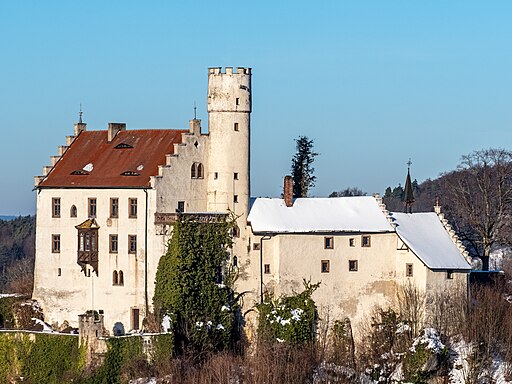
High above the market town of Gößweinstein in Upper Franconia rises Burg Gößweinstein, a commanding medieval fortress that defines the skyline of the region. Situated within the dramatic limestone formations of the Franconian Switzerland landscape, the castle crowns a steep hill that overlooks the Wiesent Valley. Its towers and walls appear as a natural extension of the rugged rock beneath them, creating a striking fusion of architecture and geology that has captivated visitors for centuries.
The surrounding region is known for its caves, forests, and winding rivers, and Burg Gößweinstein occupies one of the most prominent vantage points within this terrain. From its heights, expansive views stretch across rolling hills and patchwork fields, offering not only scenic beauty but also insight into why such a location was strategically invaluable during the Middle Ages. The castle’s position allowed for surveillance of trade routes and rapid communication across neighboring territories, reinforcing its importance within the defensive network of Franconia.
Medieval Foundations and Strategic Purpose
The origins of Burg Gößweinstein date back to the High Middle Ages, when regional powers sought to secure their influence through fortified strongholds. The castle was constructed as a protective and administrative center, serving both military and political functions. Its thick walls, elevated position, and carefully designed access points were deliberate responses to the realities of medieval conflict.
Throughout its early history, the fortress became intertwined with the authority of regional rulers and ecclesiastical powers, particularly those connected to Bamberg. Control of such a prominent stronghold signified not only military capability but also jurisdiction over surrounding lands and settlements. Within its walls, decisions were made that shaped agricultural production, trade oversight, and local governance. The castle was not an isolated bastion but a dynamic hub within a broader feudal system.
Life inside Burg Gößweinstein would have been structured yet demanding. Knights, guards, administrators, and servants all played roles in maintaining daily operations. Supplies had to be transported up the steep approach, wells maintained, and defenses kept in readiness. Even during times of relative peace, the potential for conflict shaped the rhythm of castle life.
Architectural Character and Defensive Design
The architecture of Burg Gößweinstein reflects both practicality and symbolic authority. The core structure includes imposing curtain walls that follow the contours of the rocky summit, maximizing defensive strength while minimizing vulnerability. Towers punctuate the walls at strategic points, offering vantage positions for observation and protection. The gate area, traditionally the most vulnerable part of any fortress, was carefully fortified to prevent easy access.
As centuries passed and immediate military threats receded, the castle underwent changes that softened its purely defensive character. Residential quarters were expanded and refined, creating spaces more suited to comfort and representation. Windows grew larger, interior rooms were adapted, and courtyards evolved into more versatile communal areas. The balance between fortress and residence became increasingly evident, illustrating how architecture adapts alongside shifting political realities.
The materials themselves contribute significantly to the castle’s character. Built primarily from local limestone, the walls echo the pale hues of the surrounding cliffs. Weathering over hundreds of years has textured the surfaces, giving the stone a sense of age and permanence. This visual continuity between natural rock and constructed wall enhances the impression that Burg Gößweinstein is inseparable from its setting.
Periods of Turbulence and Preservation
Like many castles in Central Europe, Burg Gößweinstein experienced phases of decline and restoration. Conflicts, economic changes, and evolving warfare technologies reduced the defensive necessity of hilltop fortresses. At times, the castle faced neglect or partial ruin, its stones subject to the wear of weather and shifting priorities.
However, its commanding presence and historical significance ensured that it would not vanish from the landscape. Efforts to preserve and restore the structure gained momentum in later centuries, particularly as appreciation for medieval heritage grew. Rather than dismantling the fortress for building material or abandoning it entirely, caretakers chose to safeguard its legacy.
These restoration initiatives sought to stabilize the castle while respecting its historical fabric. The result is a structure that retains its medieval atmosphere while remaining accessible and functional in the modern era. The preservation of Burg Gößweinstein stands as a testament to regional commitment to cultural continuity and architectural heritage.
A Symbol of Franconian Identity
Today, Burg Gößweinstein serves not only as a historical monument but also as a symbol of Franconian identity. The town below, known for its pilgrimage traditions and scenic charm, finds in the castle a powerful visual anchor. Together with nearby religious landmarks, the fortress contributes to a distinctive cultural landscape that blends spirituality, history, and natural beauty.
Visitors who ascend to the castle encounter more than stone walls and panoramic views. They engage with a narrative that spans centuries, connecting medieval governance, regional resilience, and modern appreciation of heritage. The castle’s elevated terraces offer sweeping vistas across Franconian Switzerland, reinforcing a sense of continuity between past and present.
Events and tourism further integrate Burg Gößweinstein into contemporary life. While its original function was defense, its current role emphasizes education, exploration, and cultural exchange. The transformation reflects a broader European pattern in which historic fortifications become spaces for shared memory rather than instruments of power.
The Enduring Experience of Height and Stone
To stand within Burg Gößweinstein is to feel the interplay of elevation and enclosure. The ascent itself prepares visitors for a shift in perspective, both physically and symbolically. At the summit, the wind moves freely across battlements once guarded by watchful sentries. The thick masonry conveys solidity, yet the open views create a sense of expansive freedom.
The castle’s endurance speaks to the resilience of both material and memory. Generations have altered, defended, restored, and admired this structure, each leaving subtle traces of their presence. Despite the passage of time, Burg Gößweinstein remains a focal point in the Franconian landscape, bridging medieval origins with modern engagement.
