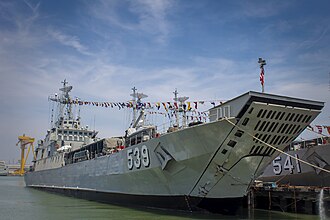
KRI Teluk Jakarta (541): History, Design, Technical Specifications and the 2020 Sinking
KRI Teluk Jakarta (541) was an Indonesian Navy landing ship whose career linked the naval history of Cold War-era East Germany with the maritime requirements of the Indonesian archipelago. Originally commissioned as Eisenhüttenstadt in the East German Volksmarine, the vessel was transferred to Indonesia in the 1990s and became part of a fleet of former East German amphibious ships used to transport military personnel, vehicles, equipment and supplies. It belonged to the Frosch I family, a class designed around practical amphibious logistics rather than the high speed or advanced weapons systems associated with modern front-line combatants.
For more than two decades, the ship contributed to Indonesia’s ability to move military cargo between islands and support operations in coastal areas. Its career ended abruptly on 14 July 2020, when it sank in rough seas northeast of Kangean Island while carrying logistics supplies bound for eastern Indonesia. All 55 personnel aboard survived, making the incident a story not only about the loss of an ageing naval vessel but also about the successful rescue of its crew. The history of KRI Teluk Jakarta offers a valuable look at the importance of landing ships, the long-term use of second-hand naval equipment and the challenges of operating large vessels across Indonesia’s demanding maritime environment.
Overview of KRI Teluk Jakarta (541)
KRI Teluk Jakarta was a medium landing ship operated by the Indonesian Navy, officially known as Tentara Nasional Indonesia Angkatan Laut (TNI AL). It was part of the Frosch-class family of landing ships developed in East Germany and was commonly associated with the Indonesian Navy’s Teluk Gilimanuk-class group of vessels. Its principal function was to transport military vehicles, troops and supplies, allowing the navy to move heavy cargo between ports and deliver equipment in support of amphibious and logistical operations.
The vessel was originally named Eisenhüttenstadt and served with the East German Volksmarine under pennant number 615. It was constructed at VEB Peenewerft in Wolgast, launched in March 1978 and commissioned into East German service in January 1979. After the end of the Cold War and the dissolution of the East German Navy, the ship became available for transfer. Indonesia acquired it in 1993, and it entered Indonesian Navy service as KRI Teluk Jakarta (541) in September 1994. Its new name referred to Jakarta Bay, one of the most recognisable geographical features of Indonesia’s capital region.
The ship’s Indonesian career lasted until 14 July 2020. On that day, while sailing in the waters northeast of Kangean Island, it suffered a leak after encountering high waves and eventually sank. Contemporary reports stated that the vessel went down in water approximately 90 metres deep. All 55 crew members were rescued by nearby commercial vessels and subsequently transferred to another Indonesian Navy ship. The loss of KRI Teluk Jakarta was a significant event for the TNI AL, both because it removed a transport vessel from the fleet and because it prompted renewed attention to the condition and age of other ships in service.
Historical Background and Construction
Construction in East Germany
The origins of KRI Teluk Jakarta can be traced to the shipbuilding industry of the former German Democratic Republic. During the Cold War, East Germany maintained a naval force known as the Volksmarine, which required vessels for coastal defence, transport, patrol and amphibious support. Landing ships were an important part of this structure because they could carry vehicles and supplies while operating in coastal waters and supporting the movement of military units between locations.
The ship was built by VEB Peenewerft, a shipyard located in Wolgast on the Baltic coast. The yard was involved in the construction of naval and other vessels for East German requirements, and it produced a number of ships belonging to the Frosch family. KRI Teluk Jakarta was assigned yard number 341. Its keel was laid on 18 August 1977, it was launched on 8 March 1978, and it entered East German naval service on 4 January 1979 under the name Eisenhüttenstadt. These dates place the vessel among the later examples of the Frosch I design.
The Frosch I concept reflected the military requirements of a period in which the movement of ground forces and equipment across coastal areas was an important part of naval planning. Rather than building a specialised vessel around a large missile arsenal or advanced anti-submarine systems, the designers focused on cargo capacity, vehicle transport and the ability to support landing operations. The result was a relatively large landing ship with a straightforward diesel propulsion system and a hull arrangement suited to carrying heavy loads.
Service as Eisenhüttenstadt
As Eisenhüttenstadt, the ship served the East German Navy during the final years of the Cold War. Its role was associated with amphibious transport and the movement of military equipment. Like other vessels of its class, it was intended to provide the navy with a practical means of delivering vehicles, personnel and supplies to coastal locations, helping support the movement of military forces beyond established port facilities.
The vessel’s East German service ended during the political and military changes that followed German reunification. The Volksmarine was dissolved, and its ships were assessed for disposal, transfer or possible incorporation into the newly unified German Navy. A number of former East German vessels were not retained, creating an opportunity for other countries to acquire ships that still had useful military functions. Eisenhüttenstadt was among the vessels that did not continue into the unified German naval structure and was eventually sold to Indonesia.
Transfer to the Indonesian Navy
Indonesia’s Acquisition of Former East German Warships
Indonesia acquired a number of former East German naval vessels during the 1990s as part of a wider programme to strengthen the TNI AL. The acquisition was associated with an effort to increase the navy’s capabilities by obtaining available ships that could fulfil practical operational needs. For an archipelagic country, transport and amphibious vessels are particularly important because they enable military forces to move personnel, vehicles and equipment between islands without relying entirely on commercial shipping.
KRI Teluk Jakarta was acquired on 25 August 1993. Before beginning its Indonesian career, the ship underwent preparation and refit work in Germany. It was subsequently transferred to Indonesia and commissioned as KRI Teluk Jakarta (541) on 19 September 1994, according to the commonly cited service chronology. The change of name replaced the original German geographical reference with one drawn from Indonesia’s own landscape. The pennant number 541 identified the ship within the Indonesian fleet.
The vessel joined a wider group of former East German Frosch landing ships that received Indonesian names associated with bays and coastal locations. This group included ships such as KRI Teluk Gilimanuk, KRI Teluk Celukan Bawang, KRI Teluk Cendrawasih, KRI Teluk Berau, KRI Teluk Peleng, KRI Teluk Sibolga, KRI Teluk Manado, KRI Teluk Hading, KRI Teluk Parigi and KRI Teluk Lampung. Together, these ships helped expand the navy’s amphibious transport capacity during a period when acquiring entirely new vessels for every requirement would have been a more expensive undertaking.
The Meaning of the Name Teluk Jakarta
The name Teluk Jakarta translates into English as Jakarta Bay. This geographical feature lies on the northern coast of Java and forms part of the maritime environment surrounding Indonesia’s capital. Naming a naval vessel after a bay or other coastal feature is consistent with a broader Indonesian naval tradition in which ships are named after places, islands, geographical landmarks and elements of the national landscape.
The name also gave the ship a distinct Indonesian identity after its transfer from East Germany. Although its hull and original design belonged to a European naval tradition, its new service role was shaped by the geography and requirements of Indonesia. It became one of the vessels expected to support military mobility across a country where the sea is not simply a boundary between land areas but a major route connecting communities, ports, bases and strategic locations.
Design and Construction Characteristics
The Frosch I Landing Ship Concept
KRI Teluk Jakarta belonged to the Frosch I design family, also identified with the East German Project 108 designation. In Indonesian service, ships of this type were generally used as medium landing ships or tank landing ships. Their primary purpose was to carry heavy cargo, including military vehicles, and transport it to locations where it could be unloaded in support of ground forces. This role required a different set of design priorities from those of a conventional frigate or patrol vessel.
A landing ship must provide sufficient internal space and structural strength for heavy loads, while also maintaining the stability and seaworthiness required for operations at sea. The design must accommodate cargo that can be bulky, heavy or difficult to handle, and it must allow that cargo to be moved efficiently during loading and unloading. For military applications, this often means carrying vehicles, engineering equipment, ammunition, food, fuel and other supplies needed by deployed units.
The Frosch I design offered a practical balance between transport capacity and the ability to operate in coastal environments. Commonly published specifications list a length of approximately 98 metres, a beam of 11.1 metres and a draught of around 2.8 metres. These dimensions gave the vessel a relatively long hull and useful cargo volume while retaining a draught suitable for a range of coastal and harbour operations. The ship was not designed to land on every type of beach or operate in all sea conditions, but its general configuration supported the amphibious transport mission.
Hull and Cargo Arrangement
The hull of a landing ship is central to its operational purpose. A conventional cargo vessel may be designed primarily around the efficient carriage of freight between established ports, whereas a military landing ship must be able to carry vehicles and supplies in a manner suited to tactical transport. Cargo weight, vehicle dimensions, loading arrangements and the ship’s stability all influence how much equipment can be carried on a particular voyage.
Published descriptions of the Frosch I class commonly state a capacity of up to 11 amphibious tanks or approximately 400 to 600 tonnes of cargo. These figures provide a useful indication of the ship’s intended role, although the exact practical load would vary according to the nature of the cargo and the conditions of the voyage. A load of vehicles, for example, would have different weight distribution and handling requirements from a cargo consisting mainly of packaged supplies or engineering equipment.
The ability to carry heavy vehicles made the ship useful for supporting amphibious forces. Tanks and other armoured vehicles provide ground units with mobility, protection and firepower after reaching shore. A landing ship can transport such vehicles by sea and deliver them closer to their intended operating area, reducing the need for multiple transport stages. This capability is especially relevant in an archipelagic country, where military units may need to move between islands separated by long stretches of water.
Dimensions and Displacement
The commonly cited full-load displacement of KRI Teluk Jakarta is approximately 1,950 long tons, or about 1,980 metric tonnes. Displacement represents the weight of the vessel and everything aboard at a particular loading condition, including fuel, crew, equipment and cargo. For a transport ship, displacement changes according to how much cargo and fuel it is carrying, so a published figure should always be understood in the context of the specified loading condition.
Its reported length of 98 metres and beam of 11.1 metres gave the vessel the proportions expected of a medium landing ship. The draught of approximately 2.8 metres was relatively shallow compared with many larger combatants and commercial ships. This characteristic could be useful when approaching suitable coastal areas or operating in shallower waters, although actual access always depends on local bathymetry, tides, sea state and seabed conditions.
Propulsion and Performance
Diesel Engines and Twin-Shaft Propulsion
KRI Teluk Jakarta was powered by a conventional diesel propulsion system. Commonly published specifications for the Frosch I design identify two diesel engines driving two propeller shafts, with total installed power of approximately 5,000 horsepower, or 3.7 megawatts. This arrangement was suited to a vessel whose main responsibility was moving cargo and personnel over operational distances rather than conducting high-speed combat manoeuvres.
Diesel engines are widely used in transport and auxiliary ships because they can provide sustained propulsion and are generally appropriate for vessels that spend long periods travelling between ports, bases and operating areas. A twin-shaft arrangement also provides a practical propulsion layout for a medium landing ship of this size. The propulsion system was not intended to make KRI Teluk Jakarta a fast attack platform; instead, it provided the power needed to move a heavy hull and its cargo at a useful cruising speed.
Maximum Speed and Operational Mobility
The commonly reported maximum speed of the Frosch I class is approximately 18 knots, equivalent to around 33 kilometres per hour. This was adequate for a landing ship designed to transport military cargo, although it was slower than many modern frigates, corvettes and fast patrol vessels. Speed was only one part of the ship’s usefulness. Its cargo capacity, ability to move vehicles and suitability for coastal transport were more important to its principal mission.
In an archipelagic environment, a vessel such as KRI Teluk Jakarta could support military mobility by transporting equipment between naval bases, ports and remote operating areas. The ship could carry supplies for forces stationed away from major logistics centres, move vehicles to support exercises or help deliver heavy equipment to locations where road transport was unavailable. The value of this capability depended not just on speed, but also on the vessel’s reliability, fuel endurance, loading arrangements and the availability of safe ports or landing locations.
Military Role and Operational Capabilities
Transporting Troops and Marines
One of the main functions of KRI Teluk Jakarta was to transport military personnel. Published class descriptions commonly associate the Frosch I with the ability to carry approximately one company of Marines, although the exact number of personnel embarked on a particular mission would depend on the amount of equipment, supplies and other cargo being carried. Troop transport requires more than simply providing space for people: personnel need accommodation, food, water, sanitation, safety equipment and room for their individual gear.
The ability to move Marines by sea is particularly relevant to Indonesia, where military operations may involve islands with limited road connections or modest port infrastructure. A landing ship can transport a unit and its equipment together, allowing the force to arrive with much of the material needed for its mission. This can be useful during amphibious exercises, deployments, reinforcement operations and other activities requiring the movement of ground forces across maritime distances.
Transporting Amphibious Vehicles and Heavy Equipment
The Frosch I design was intended to carry military vehicles, including amphibious tanks, as well as other heavy equipment. The commonly cited capacity of up to 11 amphibious tanks demonstrates the scale of the vessel’s intended transport role. Vehicles are among the most demanding forms of military cargo because they are heavy, occupy substantial space and must be secured properly during a voyage. Their loading and unloading also require suitable access arrangements and careful attention to the ship’s stability.
Transporting vehicles by sea allows military units to deploy with equipment that would be difficult or impossible to move by air in large quantities. A landing ship can carry armoured vehicles, engineering machinery, trucks and other equipment that may be needed after personnel reach their destination. This makes the ship a valuable support asset even when it is not involved in a direct amphibious assault. In many situations, the most important task is simply getting the right equipment to the right island at the right time.
Logistics Across the Indonesian Archipelago
The Indonesian Navy operates in a maritime environment characterised by long distances, numerous islands and a wide range of port facilities. Not every island has the infrastructure needed to receive large commercial cargo ships, and some military locations may depend on sea transport for regular resupply. A landing ship can help bridge this gap by moving supplies, equipment and personnel between naval bases and areas where other transport options are limited.
KRI Teluk Jakarta’s role as a logistics vessel is especially relevant to understanding its final voyage. On 14 July 2020, it was carrying supplies bound for eastern Indonesia when it encountered severe sea conditions northeast of Kangean Island. This was not a combat deployment but a transport mission, demonstrating how landing ships could be used for routine military logistics as well as amphibious operations. The vessel’s loss therefore affected a practical support function within the navy, rather than simply removing another armed ship from the order of battle.
Armament and Defensive Equipment
Reported Gun Systems
Although KRI Teluk Jakarta was primarily a transport vessel, published Frosch I class specifications list several gun systems for self-defence. The commonly reported Indonesian configuration included one single Bofors 40 mm L/60 gun, one twin V-11 37 mm L/63 mount and two twin 2M-3 25 mm mounts. These weapons provided a degree of defensive capability against nearby surface and aerial threats, but they did not transform the vessel into a dedicated surface combatant.
The 40 mm Bofors gun was a widely used naval weapon that had served in many navies over several decades. The 37 mm and 25 mm mounts added further short-range gun capability. Such weapons were consistent with the defensive requirements of a transport ship operating in coastal waters, where a vessel might need protection against small surface craft or certain close-range threats. Their presence should not be confused with the advanced air-defence and anti-ship systems carried by modern frigates and corvettes.
Radar and Navigation Equipment
Commonly published technical listings associate the Frosch I design with a TSR-333 I-band navigation radar and an MR-302 Strut Curve F-band air/surface search radar. Navigation radar helps a ship detect coastlines, vessels and other objects in its vicinity, supporting safe movement through busy waterways and coastal environments. A search radar can contribute to a broader picture of the surrounding maritime environment by detecting surface contacts and, depending on system configuration, relevant aerial targets.
Radar equipment is particularly important for a vessel that operates around ports, islands and shipping routes. Indonesia’s waters contain commercial traffic, fishing vessels, naval units and many navigational hazards. A landing ship must maintain awareness of its surroundings even when its mission is focused on cargo delivery rather than combat. As with the weapon listings, however, the class-level radar specifications should be treated as reported historical equipment, not as a guarantee that every system remained unchanged and operational throughout the ship’s Indonesian service.
Electronic Countermeasures
Some published specifications also list two PK-16 chaff launchers. Chaff is a defensive countermeasure that releases radar-reflective material to create misleading radar returns and potentially distract or confuse certain radar-guided threats. Such equipment can form part of a ship’s defensive suite, although its effectiveness depends on the threat, the engagement conditions and the wider defensive systems available to the vessel.
For a landing ship, defensive systems are supplementary to its principal mission. Its survival in a high-threat environment would normally depend on operational planning, situational awareness and protection from other naval units, rather than on its own armament alone. KRI Teluk Jakarta was built to move cargo and personnel, and its weapons were intended to provide limited self-protection rather than sustained combat capability.
The Sinking of KRI Teluk Jakarta on 14 July 2020
The Voyage Near Kangean Island
The most defining event in the history of KRI Teluk Jakarta occurred on 14 July 2020, when the vessel sank in waters northeast of Kangean Island, in the area east of Java. The ship was carrying logistics supplies bound for eastern Indonesia when it encountered difficult sea conditions. Reports described waves reaching approximately 2.5 to 4 metres, and the vessel subsequently suffered a leak that led to its sinking. The ship reportedly went down at around 09:00 local time in water approximately 90 metres deep.
The incident was a serious loss for the Indonesian Navy because the vessel was performing a practical transport mission rather than operating in a combat environment. Landing ships are designed to carry heavy loads, but they must still contend with the forces imposed by waves, wind and changing sea conditions. When a vessel begins taking on water, the situation can deteriorate quickly if flooding cannot be contained. The combination of an ageing hull, rough weather and a developing leak can create a dangerous emergency, although the precise technical sequence of the incident should be distinguished from the initial information released publicly.
The Crew Rescue
The most important aspect of the sinking was that all 55 personnel aboard survived. Contemporary reports stated that 54 crew members were rescued by the commercial vessel KM Tanto Sejahtera, while the remaining crew member was picked up by KM Dobonsolo. The rescued personnel were subsequently transferred to the Indonesian Navy frigate KRI Raden Eddy Martadinata (331), which helped complete the response and return arrangements.
The rescue demonstrated the importance of maritime cooperation and the role that commercial shipping can play during emergencies at sea. Ships travelling through busy sea lanes may be able to provide immediate assistance when a nearby vessel is in distress, particularly when they have sufficient space and equipment to take people aboard. In this incident, the assistance of passing commercial vessels was crucial in ensuring that the crew could be evacuated safely after their own ship was lost.
The Reported Cause and Official Assessment
Initial reports attributed the sinking to a leak after the ship encountered high waves. Indonesian Navy Chief of Staff Admiral Yudo Margono was quoted by ANTARA as saying that KRI Teluk Jakarta had been considered seaworthy and had completed the navy’s required procedures before sailing. The ship had reportedly undergone docking in April 2020 and had passed the relevant technical and readiness checks described by the Navy. He also said that the vessel had encountered large waves northeast of Kangean Island and subsequently suffered a leak.
These statements are important because they show the distinction between a ship’s assessed readiness before departure and the hazards it may encounter at sea. A vessel can pass inspections and still suffer an emergency under difficult conditions. At the same time, the ship’s age prompted the Navy to conduct a broader evaluation of the condition of its other vessels. The loss therefore became part of a wider discussion about ageing ships, maintenance, seaworthiness and the need to assess older units across the fleet.
Impact on the Indonesian Navy
The sinking removed a medium landing ship from the TNI AL’s transport inventory. The loss was significant because the vessel had been part of a group of former East German landing ships used to support amphibious and logistical operations. The Jakarta Post noted in its 2020 reporting that several Frosch-class ships had already been lost or withdrawn for different reasons, placing the loss of KRI Teluk Jakarta within a broader pattern of attrition among the older vessels acquired from East Germany.
The incident also prompted attention to the condition of other ageing Indonesian naval ships. According to ANTARA, the Navy leadership instructed a comprehensive evaluation of ships in service, including vessels of the same class and other older types. Such an assessment is important because a fleet’s readiness depends not only on the condition of individual ships but also on the quality of inspection procedures, maintenance planning, crew training and the availability of replacement parts. The sinking of KRI Teluk Jakarta became a reminder that fleet modernisation must include the replacement or life-extension of support vessels, not just the acquisition of new combat ships.
The Importance of Landing Ships to Indonesia
Supporting a Maritime Nation
Indonesia’s geography makes naval transport a central part of national defence. Its islands are separated by seas that serve as transportation routes, economic corridors and strategic waterways. Military forces stationed on remote islands may need regular supplies, while units preparing for exercises or deployments must be able to move personnel and equipment over substantial distances. Landing ships help provide this mobility by carrying cargo that may be difficult to transport using aircraft or smaller vessels.
A ship such as KRI Teluk Jakarta could move vehicles, engineering equipment, food, fuel and other supplies in quantities that would be impractical for many smaller naval platforms. Its cargo capacity gave it a role in sustaining military operations and supporting the movement of forces across the archipelago. Although the ship was not designed for the most demanding modern combat environments, its transport function remained relevant to the everyday requirements of the Indonesian Navy.
Amphibious Transport and Operational Flexibility
Amphibious capability is often associated with large-scale assaults, but the underlying requirement is broader: forces must be able to move between sea and land when ordinary transport routes are unavailable or unsuitable. This can involve deploying Marines, transporting vehicles, delivering supplies, supporting exercises or reinforcing isolated locations. Landing ships contribute to this flexibility by combining a sea-going transport platform with the ability to operate closer to suitable shore areas than many conventional cargo vessels.
The Frosch I design provided Indonesia with a practical form of this capability. It did not offer the aviation facilities or advanced command systems of a modern amphibious assault ship, but it could carry a useful quantity of vehicles and cargo. For a navy managing a large archipelago, that kind of straightforward transport capability can be valuable even when the vessel is not among the most technologically advanced ships in the fleet.
Lessons from the Former East German Fleet
The Indonesian acquisition of former East German vessels during the 1990s demonstrates both the advantages and limitations of second-hand naval procurement. Purchasing ships that have already been built can provide a country with additional capabilities more quickly and at a lower initial cost than ordering a completely new fleet. However, the long-term value of such acquisitions depends on the condition of the ships, the availability of spare parts, the compatibility of their equipment and the cost of maintaining them over many years.
KRI Teluk Jakarta served Indonesia for approximately 26 years after its commissioning in 1994. That represents a substantial period of service for a vessel that had originally entered East German service in 1979. Yet its loss in 2020 also highlighted the reality that even a ship which has passed readiness checks remains subject to the risks of age, mechanical failure and severe weather. The history of the vessel is therefore relevant not only as a record of naval service but also as an example of the complex decisions involved in maintaining an ageing fleet.
Legacy of KRI Teluk Jakarta (541)
KRI Teluk Jakarta’s legacy rests primarily on its contribution to the Indonesian Navy’s transport and amphibious logistics capabilities. Originally built for a European Cold War navy, it was transferred to Indonesia at a time when the country was expanding its fleet using a combination of new and second-hand vessels. Its service as a landing ship reflected the practical needs of a country whose military forces must be able to move across a vast maritime area.
The vessel’s sinking in July 2020 was a tragic end to its operational career, but the successful rescue of all 55 personnel remains the most important human aspect of the incident. The loss also encouraged a wider review of older naval ships and highlighted the importance of maintaining safe operating conditions across the fleet. KRI Teluk Jakarta was not a high-profile missile combatant or a symbol of advanced naval technology. It was a working transport ship, and its history demonstrates how essential such vessels can be to the daily functioning of a maritime force.
Technical Specifications of KRI Teluk Jakarta (541)
The following table summarises the commonly reported technical characteristics of KRI Teluk Jakarta. Most of the performance and equipment figures are associated with the Frosch I class and should be treated as reference specifications. They do not necessarily confirm the exact condition or configuration of every system at the time the vessel sank in 2020.
| Category | Specification |
|---|---|
| Name | KRI Teluk Jakarta |
| Pennant number | 541 |
| Original name | Eisenhüttenstadt |
| Original pennant number | 615 |
| Original operator | East German Volksmarine |
| Indonesian operator | Indonesian Navy (TNI AL) |
| Ship type | Medium landing ship / tank landing ship |
| Class | Frosch I |
| Project designation | Project 108 |
| Builder | VEB Peenewerft, Wolgast, East Germany |
| Shipyard number | 341 |
| Keel laid | 18 August 1977 |
| Launched | 8 March 1978 |
| Commissioned in East Germany | 4 January 1979 |
| Acquired by Indonesia | 25 August 1993 |
| Commissioned in Indonesia | 19 September 1994 |
| Final operational date | 14 July 2020 |
| Final fate | Sank after taking on water in rough seas |
| Displacement | Approximately 1,950 long tons / 1,980 tonnes |
| Length | 98 metres |
| Beam | 11.1 metres |
| Draught | 2.8 metres |
| Propulsion | Two diesel engines |
| Propeller shafts | Two |
| Installed power | Approximately 5,000 hp / 3.7 MW |
| Maximum speed | Approximately 18 knots |
| Cargo capacity | Approximately 400–600 tonnes |
| Vehicle capacity | Up to 11 amphibious tanks, as commonly reported |
| Troop capacity | Approximately one company of Marines |
| Standard complement | Approximately 46 (published class figure) |
| Crew aboard during sinking | 55 personnel |
| Navigation radar | TSR-333 I-band, reported |
| Air/surface search radar | MR-302 Strut Curve F-band, reported |
| Defensive countermeasures | Two PK-16 chaff launchers, reported |
| Main gun | One Bofors 40 mm L/60, reported |
| Secondary armament | One twin 37 mm mount and two twin 25 mm mounts, reported |
Conclusion
KRI Teluk Jakarta (541) was an important example of the Indonesian Navy’s use of former East German landing ships to strengthen its amphibious transport and logistical capabilities. Built as Eisenhüttenstadt for the Volksmarine, it entered Indonesian service in 1994 and spent more than two decades supporting the movement of military personnel, vehicles and supplies. Its Frosch I design offered a practical combination of cargo capacity, diesel propulsion and coastal operating capability, making it useful for a navy responsible for an extensive archipelago.
The ship’s sinking on 14 July 2020 brought its career to an unexpected end. The loss highlighted the difficulties of operating ageing naval vessels, particularly in challenging sea conditions, while the successful rescue of all 55 personnel demonstrated the importance of emergency response and cooperation between ships at sea. Although KRI Teluk Jakarta is no longer part of the Indonesian fleet, its history remains relevant to understanding Indonesia’s amphibious logistics, naval procurement decisions and the continuing importance of transport vessels in maritime defence.
