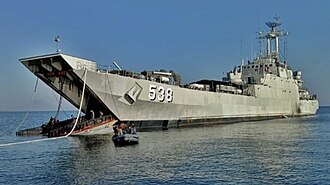
KRI Teluk Hading (538): History, Design, Specifications and Final Chapter of an Indonesian Navy Landing Ship
KRI Teluk Hading (538) was one of the Indonesian Navy’s former East German-built landing ships, serving for decades as a transport platform for troops, military vehicles, equipment and supplies. Designed around the practical demands of amphibious operations rather than the heavy firepower of a front-line combatant, the vessel belonged to the Frosch I family of medium landing ships. Its career connected two very different naval histories: its original service with the East German Volksmarine and its later role in the Indonesian Navy, where the ship supported military mobility across the country’s extensive island geography.
The vessel’s story is also a reminder that the usefulness of a naval ship cannot be measured by weapons or speed alone. Landing ships provide the physical link between ports, ships and shorelines, allowing personnel and equipment to reach places where conventional transport infrastructure may be limited. KRI Teluk Hading performed this kind of supporting role for many years, but its later history was marked by a serious fire in 2023, formal retirement from active service in 2024 and, according to reports published in 2026, its eventual use as a missile target. Its career therefore offers an interesting case study in naval procurement, amphibious logistics, ship ageing and the changing requirements of maritime forces.
Overview of KRI Teluk Hading (538)
KRI Teluk Hading was a medium landing ship operated by the Indonesian Navy, known locally as Tentara Nasional Indonesia Angkatan Laut, or TNI AL. It was part of the Frosch-class family, a group of amphibious transport vessels developed for the East German Navy during the Cold War. The ship was originally built as Cottbus and entered East German service in 1978. Following the end of the Cold War and the dissolution of the East German naval structure, it became available for transfer and was subsequently acquired by Indonesia as part of a broader programme to obtain former East German naval equipment.
After arriving in Indonesian service, the vessel received the name Teluk Hading and the pennant number 538. Its principal purpose was to transport military cargo and support amphibious operations, including the movement of Marine Corps personnel and vehicles. Its design gave it a useful combination of cargo capacity, landing capability and modest defensive armament. Rather than being intended to fight enemy warships independently, it was designed to move the resources needed by other naval and ground forces.
The Indonesian Navy officially announced the ship’s retirement on 31 October 2024. This followed a major fire at sea in June 2023, when all personnel aboard were evacuated safely. Later reporting stated that the retired vessel was sunk during a naval exercise on 23 April 2026 after being struck by an Exocet anti-ship missile. These events form an important part of the ship’s history and distinguish its final years from the much longer period in which it served as a transport and landing platform.
Historical Background and Construction
Origins in the East German Navy
The history of KRI Teluk Hading began in East Germany, where the ship was constructed for the Volksmarine, the naval force of the German Democratic Republic. During the Cold War, East Germany required naval vessels capable of supporting coastal defence, transporting military units and moving equipment between ports and landing areas. Amphibious transport ships were valuable because they could carry vehicles and supplies while operating in waters where larger commercial vessels or conventional cargo ships might not be suitable.
The vessel was built by VEB Peenewerft in Wolgast, a shipbuilding facility that produced vessels for East German naval and commercial requirements. Construction records commonly identify the ship as yard number 338. Its keel was laid in November 1976, it was launched in June 1977, and it entered East German service on 26 May 1978 under the name Cottbus. In that navy, it carried pennant numbers associated with its original service, including 634 and 614 in different records. The ship was part of the Frosch I, or Project 108, design family, which was developed to provide a practical amphibious transport capability.
The Frosch I design reflected the operational priorities of its era. It was not intended to be a sophisticated missile combatant or a high-speed escort ship. Instead, its value came from its ability to carry a substantial load of vehicles, troops and equipment and to deliver those resources close to shore. Such vessels were particularly useful for forces that needed to reinforce coastal positions, move supplies between separated locations or conduct amphibious landings in support of wider military operations.
Transfer to Indonesia
The end of the Cold War brought major changes to the armed forces of the former East German state. Following German reunification, the Volksmarine ceased to exist as an independent national navy, and many of its vessels were withdrawn from service or made available for disposal. Indonesia took advantage of this situation through a procurement programme that brought a number of former East German naval vessels into the TNI AL inventory.
KRI Teluk Hading was acquired by Indonesia on 25 August 1993 and subsequently entered Indonesian Navy service on 12 July 1994. The ship was renamed after Hading Bay, a geographical feature associated with East Flores Regency in East Nusa Tenggara. The new name reflected the Indonesian Navy’s practice of naming many vessels after locations, islands, bays and other features of the national archipelago. Its pennant number became 538, under which it was known during its Indonesian career.
The transfer was part of a wider effort to strengthen Indonesia’s naval capabilities using available second-hand vessels. For an archipelagic country with thousands of islands, the ability to transport troops, vehicles and supplies by sea is essential. Acquiring landing ships offered a relatively direct way to increase the navy’s ability to move military resources between islands without relying entirely on civilian shipping or developed port facilities.
Design and Construction Characteristics
Frosch I Landing Ship Design
KRI Teluk Hading belonged to the Frosch I family, also associated with the designation Project 108. This type of vessel was designed around the requirements of amphibious transport. Its hull and internal arrangement were intended to accommodate vehicles and cargo, while its landing-ship configuration allowed the delivery of those loads to suitable shore areas. In comparison with a conventional cargo ship, a landing ship places greater emphasis on the relationship between its cargo spaces, vehicle movement arrangements and ability to operate close to land.
The ship’s dimensions gave it the proportions of a medium landing vessel. Published reference specifications commonly list a length of approximately 98 metres, a beam of 11.1 metres and a draught of around 2.8 metres. These dimensions provided a relatively long hull for carrying vehicles and stores while keeping the vessel shallow enough to approach suitable landing areas. The design was intended to balance cargo volume, stability, seaworthiness and the ability to operate in coastal environments.
There are differences between published specifications for the ship and its class. Some Indonesian media reports give shorter dimensions and different displacement or engine-power figures, while other reference listings use the broader Frosch-class figures. For that reason, the figures in the technical table below should be treated as commonly published class or reference specifications, rather than as a definitive engineering record of the individual ship in every stage of its career.
Hull Arrangement and Amphibious Function
The most important feature of a landing ship is not its external appearance but the way its hull supports the movement of cargo from ship to shore. Unlike a vessel designed mainly for passengers or container freight, an amphibious transport ship must be able to carry military vehicles and heavy equipment in a configuration that allows them to be unloaded efficiently. This requirement influences the arrangement of cargo spaces, access routes and landing facilities.
KRI Teluk Hading was intended to carry amphibious vehicles, military stores and other heavy cargo. Class-level descriptions commonly state a capacity of up to 11 amphibious tanks or approximately 400 to 600 tonnes of cargo, depending on the type and configuration of the load. These figures illustrate the ship’s role as a transport platform, although the actual load that could be carried on a particular voyage would depend on weight distribution, stability, weather, fuel requirements and operational restrictions.
The ship’s relatively shallow draught was also relevant to its amphibious mission. Landing ships are expected to operate in coastal waters and approach suitable shorelines or landing facilities. This does not mean that they can safely beach on every coastline: local depth, seabed conditions, surf, tides and weather all affect whether a landing can be conducted. The vessel’s design nevertheless provided greater flexibility for coastal logistics than would be available from many deep-draught commercial cargo ships.
Propulsion and Mobility
Diesel Propulsion System
KRI Teluk Hading was powered by a diesel propulsion arrangement. Commonly published Frosch-class specifications describe two diesel engines driving two propeller shafts. This configuration was suited to a ship whose main purpose was the transportation of cargo and personnel rather than high-speed manoeuvring. Diesel propulsion is widely used in naval auxiliary and amphibious vessels because it can provide sustained power for long periods and is compatible with the operational demands of ships that spend much of their time travelling between ports and operating areas.
Reference specifications frequently list installed power at approximately 5,000 horsepower, or about 3.7 megawatts. Some secondary reports provide a higher power figure, so the precise engine rating should be treated cautiously unless confirmed by an original technical manual or an official Indonesian Navy record. The commonly quoted maximum speed for the class is around 18 knots, equivalent to approximately 33 kilometres per hour.
Operational Speed and Range
A maximum speed of about 18 knots placed KRI Teluk Hading in the category of a moderately paced transport vessel. It was not designed to keep pace with fast attack craft or modern high-speed frigates, but that was not its primary purpose. Its operational value depended more on the amount of cargo it could carry, the reliability of its machinery and its ability to complete transport missions than on achieving high speeds.
For an island nation, a ship capable of moving vehicles and personnel between separated ports and coastal locations can make a significant contribution to military readiness. A landing ship can help move supplies to a remote area, reinforce a garrison, transport engineering equipment or support the deployment of Marine Corps units. Its speed is only one factor in that mission; reliability, loading arrangements, fuel endurance and the availability of suitable landing areas are equally important.
Military Role and Operational Capabilities
Transporting Troops and Military Vehicles
The principal role of KRI Teluk Hading was to transport military personnel, vehicles and supplies. Class descriptions commonly associate the vessel with the capacity to carry one company of Marines, although the number of personnel that could be embarked would depend on the mission and the amount of equipment being carried. Troops require accommodation, food, water, safety equipment and space for their personal gear, so the maximum practical troop load cannot be considered separately from the vessel’s cargo requirements.
The ability to transport amphibious tanks and other military vehicles was a particularly important feature. Vehicles are essential to many military operations because they provide mobility, protection, communications and logistical support once personnel reach shore. A landing ship allows those vehicles to be moved by sea and delivered closer to the area where they are required. This can reduce the need for multiple stages of transport and give commanders more flexibility when planning deployments across an archipelago.
Logistics and Inter-Island Support
In addition to amphibious operations, KRI Teluk Hading could perform a broad range of naval logistics tasks. Transport ships are often used to move food, fuel, spare parts, construction materials and other supplies between naval bases and operational locations. These tasks may not attract the same attention as combat operations, but they are fundamental to sustaining a military presence over a large maritime area.
Indonesia’s geography makes this role especially important. Many islands are separated by significant stretches of sea, and some locations have limited port infrastructure. A military landing ship can provide a means of moving equipment and supplies where conventional transport options are restricted. It can also support the movement of personnel during exercises, deployments and other naval activities. The ship’s utility therefore extended beyond a narrow definition of amphibious assault: it was also a practical tool for maintaining the mobility of the Indonesian armed forces.
Support for Amphibious Operations
Amphibious operations involve the movement of forces from the sea to land, often under conditions that require careful coordination between naval and ground units. A landing ship contributes by transporting the people, vehicles and supplies needed for the operation. It is one component of a wider system that may include escort ships, landing craft, helicopters, command elements, reconnaissance units and shore-based support.
KRI Teluk Hading was not a modern amphibious assault ship equipped with a large flight deck or extensive aviation facilities. Its value lay in its conventional landing-ship capabilities: carrying a useful quantity of cargo and delivering that cargo in support of forces operating ashore. This made it relevant to the practical transport needs of the Indonesian Navy and Marine Corps, particularly in exercises and operations involving dispersed island locations.
Armament and Defensive Systems
Gun Armament
Although KRI Teluk Hading was primarily a transport and landing vessel, published class specifications list several gun systems for self-defence. These commonly include a Bofors 40 mm gun, a twin 37 mm mount and two twin 25 mm mounts. The precise configuration and serviceability of these weapons at different points in the ship’s Indonesian career should not be assumed without an official refit or maintenance record.
The presence of these weapons reflected the operational environment in which the ship was designed. Amphibious transport vessels may be exposed to threats while approaching a landing area or operating near a coast. Defensive guns can provide a limited ability to engage nearby surface or aerial threats, but they do not make a landing ship equivalent to a dedicated air-defence frigate or missile-armed combatant. The ship would normally depend on wider naval protection and operational planning when deployed in a contested environment.
Radar and Electronic Equipment
Published Frosch-class reference data also associates the ships with navigation and air/surface search radar equipment, including systems identified as TSR-333 and MR-302 Strut Curve. Such sensors help a vessel maintain navigational awareness and detect objects in its surrounding maritime environment. Radar is important for safe navigation, particularly when operating in busy sea lanes, coastal waters or reduced visibility.
Some reference descriptions also list PK-16 chaff launchers as part of the class’s defensive equipment. Chaff is designed to create radar-reflective interference that may confuse or distract certain radar-guided threats. As with the guns and radar systems, these listings should be understood as reported configuration information, not proof that every system remained installed, operational or unchanged throughout the ship’s Indonesian service. Older ships may undergo modifications, equipment removals and changes in operational fit over a career lasting several decades.
The 2023 Fire in the Waters off South Sulawesi
The Incident on 3 June 2023
One of the most serious events in the later history of KRI Teluk Hading occurred on 3 June 2023, when the ship caught fire while operating in the waters near the Selayar Strait and the coast of South Sulawesi. According to the Indonesian Navy’s official announcement, the vessel was conducting a routine naval operation when the fire broke out. The incident was reported to the local search-and-rescue authorities, and the ship’s personnel had to be evacuated as the emergency developed.
The Indonesian Navy reported that 119 personnel were aboard at the time of the incident and that all were evacuated safely. They were taken aboard the passing tugboat Bahtera Zalfa. The Navy’s initial statement said that the cause of the fire had not yet been established. This distinction is important: while the incident was widely reported, the publicly available initial announcement did not establish a definitive technical cause, and it would be inaccurate to attribute the fire to a particular engine, electrical fault or other failure without reliable investigative findings.
The successful evacuation was the most important outcome of the emergency. Fires aboard ships can become especially dangerous because enclosed spaces, fuel systems, machinery compartments and stored materials can allow flames and smoke to spread quickly. At sea, the crew must manage the emergency while also dealing with the vessel’s movement, limited access to shore-based firefighting resources and the need to protect everyone aboard. The fact that all 119 personnel were rescued safely was therefore a significant result of the response.
Consequences for the Ship
Although the crew survived, the fire had lasting consequences for the vessel. KRI Teluk Hading was an ageing ship by the time of the incident, having originally entered East German service in 1978. It had already spent many years operating in Indonesian waters, and the damage caused by the fire became a major factor in the final stage of its career. A ship can sometimes be repaired after a serious onboard fire, but the decision depends on the extent of structural, mechanical and electrical damage, the availability of spare parts, the cost of restoration and the remaining useful life of the hull.
The incident also highlighted the maintenance challenges associated with older naval vessels. A ship’s ability to remain operational depends on more than its original design specifications. Machinery condition, corrosion control, electrical systems, firefighting equipment, crew training and access to replacement components all influence long-term reliability. For a vessel built decades earlier in another country, maintaining its systems can become increasingly demanding as original equipment ages and specialist parts become harder to obtain.
Retirement from the Indonesian Navy
Formal Decommissioning in October 2024
The Indonesian Navy formally ended KRI Teluk Hading’s active service on 31 October 2024. The decommissioning ceremony took place at the Layang Pier of the Makassar Naval Main Base, Lantamal VI. The ceremony included the lowering of the naval ensign and the formal release of the ship from active duty. The event was reported by Kolinlamil, the Indonesian Navy’s Military Sealift Command, which identified the vessel as a Frosch-type ship built in 1977 by VEB Peenewerft in Wolgast, East Germany.
The official announcement also noted that the ship had entered the Indonesian Navy inventory in 1994 and had served actively from 1996 as a Frosch tank transport ship under Kolinlamil’s supervision. This provides an important distinction between its formal entry into the fleet and the start of its active operational assignment. The vessel had therefore been associated with Indonesian naval service for roughly three decades before its retirement, and its working career included a substantial period dedicated to military transport duties.
Its retirement was not simply the removal of an old name from the fleet list. It marked the end of a long period in which the Indonesian Navy had used a former East German landing ship to support the movement of troops, vehicles and supplies across the archipelago. The decision also reflected the practical limits of keeping older vessels in service, particularly after a major casualty that may affect their structural integrity and economic viability.
What Decommissioning Means
Decommissioning is the formal process through which a naval vessel is withdrawn from active service. It generally involves ending its operational assignment, removing it from the active fleet structure and completing the administrative and technical steps associated with retirement. The ship may subsequently be placed in reserve, sold, dismantled, converted for another purpose or retained for use in training exercises.
In the case of KRI Teluk Hading, later reports indicate that the ship did not remain simply as a retired hull. Its final reported use was as a target during a naval exercise in April 2026. This is a different stage from decommissioning: a vessel can be retired from service and then retained temporarily for a controlled training purpose before its disposal.
Final Fate: Sunk During a Naval Exercise in 2026
Reports published after the event state that KRI Teluk Hading was sunk on 23 April 2026 during an Indonesian Navy exercise in the Java Sea. According to those reports, the former landing ship was struck by an Exocet MM40 Block 3 anti-ship missile launched from the frigate KRI I Gusti Ngurah Rai (332). The exercise provided an opportunity to demonstrate the use of a modern anti-ship missile against a surface target, while the retired landing ship served as the target vessel.
The reported sinking brought the ship’s history to a physical end. Instead of being returned to operational service or converted into another role, its hull was used in a live-fire training scenario. Such exercises can help naval forces assess weapon performance and practise the procedures involved in detecting, tracking and engaging surface targets. The use of a decommissioned vessel as a target also provides a realistic surface object for training, although the exact details of the exercise and its assessment should be drawn from official reporting where available.
The event is a striking contrast with the ship’s original purpose. KRI Teluk Hading had been built to transport troops, vehicles and equipment, but its final reported role was to provide a target for a modern guided missile. The transition from Cold War-era landing ship to a target in a contemporary naval exercise illustrates how military equipment can take on very different functions as technology, force structures and operational priorities change.
Significance of KRI Teluk Hading in Indonesian Naval History
A Practical Contribution to an Archipelagic Navy
Indonesia’s maritime geography creates a demanding environment for naval logistics. The country consists of thousands of islands spread across a large area, with major population centres, military facilities and strategic waterways separated by sea. Maintaining a credible military presence across this geography requires more than combat ships. It also requires vessels that can transport personnel, equipment, supplies and vehicles to locations where they are needed.
KRI Teluk Hading contributed to this supporting capability. Its cargo capacity and landing-ship design made it useful for the movement of heavy equipment and military personnel. A transport ship may not attract the attention given to a frigate or submarine, but it can be essential to the success of operations conducted by those platforms and the forces they support. Without a dependable logistics network, combat units cannot remain deployed, and forces operating on remote islands may be difficult to reinforce.
The Legacy of Former East German Vessels
The ship also represents a particular chapter in Indonesia’s naval modernisation: the acquisition of former East German vessels during the 1990s. These purchases helped expand the Indonesian Navy’s inventory at a time when obtaining new-build ships for every requirement would have been a more demanding undertaking. The vessels brought useful capabilities into the fleet, but they also carried the technical characteristics and age profile of ships designed during an earlier period.
Operating second-hand naval vessels involves trade-offs. The purchase price may be lower than that of a new ship, and the vessel may provide an immediate capability. However, maintenance, training, spare parts, upgrades and eventual replacement must all be considered over the long term. KRI Teluk Hading’s decades of service demonstrate the potential value of such acquisitions, while its age and eventual retirement illustrate why fleet renewal remains an important issue for any navy.
A Reminder of the Importance of Naval Logistics
The history of KRI Teluk Hading shows that a navy’s effectiveness depends on a balanced fleet. Warships designed for air defence, anti-submarine warfare and surface combat are important, but they cannot independently perform every task required across a large maritime region. Landing ships, tank transporters, replenishment vessels, repair ships and other support platforms help sustain the wider fleet and extend the reach of military forces.
For Indonesia, the ability to move Marines, vehicles and supplies between islands is a practical requirement rather than a secondary consideration. KRI Teluk Hading fulfilled that kind of role for many years. Although it is no longer an active naval vessel, its career remains a useful example of the contribution made by amphibious logistics ships to an archipelagic defence strategy.
Technical Specifications of KRI Teluk Hading (538)
The following table summarises commonly published specifications associated with KRI Teluk Hading and the Frosch I design. Because some secondary sources report different dimensions, displacement, engine power and crew figures, these values should be regarded as reference figures rather than a fully verified record of the ship’s configuration at every point in its service. The armament and sensor entries describe reported equipment and should not be interpreted as confirmation that every system remained installed or operational until retirement.
| Category | Specification |
|---|---|
| Ship name | KRI Teluk Hading |
| Pennant number | 538 |
| Original name | Cottbus |
| Original operator | East German Volksmarine |
| Indonesian operator | Indonesian Navy (TNI AL) |
| Ship type | Medium landing ship / tank landing ship |
| Class | Frosch I |
| Project designation | Project 108 |
| Builder | VEB Peenewerft, Wolgast, East Germany |
| Yard number | 338 |
| Keel laid | 22 November 1976 |
| Launched | 10 June 1977 |
| Commissioned in East Germany | 26 May 1978 |
| Acquired by Indonesia | 25 August 1993 |
| Commissioned in Indonesia | 12 July 1994 |
| Retired from active service | 31 October 2024 |
| Reported final fate | Sunk as a target during a naval exercise, 23 April 2026 |
| Full-load displacement | Approximately 1,950 long tons / 1,980 tonnes |
| Length | Approximately 98 metres |
| Beam | Approximately 11.1 metres |
| Draught | Approximately 2.8 metres |
| Propulsion | Two diesel engines |
| Propeller shafts | Two |
| Installed power | Approximately 5,000 hp / 3.7 MW (commonly published class figure) |
| Maximum speed | Approximately 18 knots |
| Cargo capacity | Approximately 400–600 tonnes |
| Vehicle capacity | Commonly listed as up to 11 amphibious tanks |
| Troop capacity | Approximately one company of Marines |
| Complement | Approximately 46 in commonly published class data |
| Navigation radar | TSR-333, reported |
| Air/surface search radar | MR-302 Strut Curve, reported |
| Defensive countermeasures | Two PK-16 chaff launchers, reported |
| Main gun | One Bofors 40 mm gun, reported |
| Secondary guns | One twin 37 mm mount and two twin 25 mm mounts, reported |
| Primary mission | Amphibious transport, vehicle movement and military logistics |
Conclusion
KRI Teluk Hading (538) occupied a useful place in the Indonesian Navy as a medium landing ship dedicated to transporting troops, vehicles and military supplies. Built in East Germany as Cottbus, it passed into Indonesian hands during the 1990s and became part of the navy’s efforts to strengthen its amphibious and inter-island logistics capabilities. Its Frosch I design was based on practical requirements: carrying substantial loads, approaching coastal operating areas and supporting the movement of military forces across maritime distances.
Its career included decades of service, a serious onboard fire in 2023, formal decommissioning in October 2024 and a reported final sinking during a missile exercise in April 2026. While the vessel was not a major surface combatant, its contribution illustrates why transport and landing ships are important to a navy operating across a vast archipelago. KRI Teluk Hading’s story is ultimately one of practical military service, changing technology and the gradual retirement of a Cold War-era vessel from a modernising fleet.
