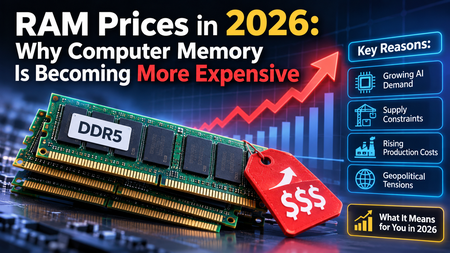
For years, computer memory was one of the most affordable components of a PC upgrade. Whether you wanted to increase your system’s performance, build a gaming computer, or upgrade an aging laptop, buying additional RAM was usually a relatively inexpensive investment. However, 2026 has brought a significant change to the memory market.
RAM prices have been climbing rapidly, making memory upgrades considerably more expensive for gamers, PC enthusiasts, businesses, and everyday computer users. Both DDR4 and DDR5 memory have been affected, and the situation is creating new challenges for people planning to build or upgrade their computers.
So, what is behind these rising prices? Is artificial intelligence responsible for the memory shortage? And, most importantly, should consumers buy RAM now or wait for prices to fall?
Let’s take a closer look at why computer memory is becoming more expensive in 2026 and what the situation means for PC users.
1. Artificial Intelligence Is Driving Demand for Memory
One of the biggest reasons behind rising RAM prices is the rapid expansion of artificial intelligence.
Companies such as Microsoft, Google, Amazon, and Meta are investing billions of dollars in AI infrastructure. These investments involve building massive data centers equipped with powerful processors, graphics accelerators, and enormous amounts of memory.
AI systems require significantly more memory than traditional consumer applications. Training large language models, processing complex datasets, and running AI inference workloads all require substantial memory capacity and bandwidth.
This has created unprecedented demand for specialized memory products, particularly High Bandwidth Memory (HBM).
Unlike conventional DDR4 and DDR5 RAM used in desktop computers and laptops, HBM is designed to deliver extremely high memory bandwidth for AI accelerators and advanced computing systems.
As AI companies continue expanding their infrastructure, memory manufacturers are increasingly prioritizing these lucrative products over traditional consumer memory.
The result is a market where demand is growing faster than available manufacturing capacity.
2. Memory Manufacturers Are Prioritizing More Profitable Products
The global memory industry is dominated by three major manufacturers:
- Samsung Electronics
- SK hynix
- Micron Technology
These companies produce a large proportion of the world’s DRAM chips, which are used in everything from desktop computers and laptops to smartphones and servers.
However, manufacturers must make strategic decisions about how to allocate their production capacity.
HBM and enterprise memory products can offer attractive profit margins because demand from AI infrastructure companies is exceptionally strong. Consequently, manufacturers have strong financial incentives to prioritize these products.
This creates a problem for the traditional PC market.
When manufacturers dedicate more resources to producing HBM and high-capacity server memory, less manufacturing capacity may be available for conventional DRAM.
According to S&P Global, this shift toward high-bandwidth memory is tightening supplies of conventional DRAM and contributing to higher prices.
In other words, even if you are shopping for an ordinary 16GB or 32GB DDR5 memory kit, you are competing indirectly with some of the world’s largest technology companies for limited semiconductor manufacturing resources.
3. The Global Memory Supply Is Struggling to Keep Up
Increasing semiconductor production is not something manufacturers can accomplish overnight.
Building a modern semiconductor fabrication facility requires enormous financial investment, specialized equipment, highly trained employees, and years of development.
Even when manufacturers announce new production facilities or expand existing operations, additional memory supplies may take several years to reach the market.
Deloitte’s July 2026 analysis suggests that the current memory shortage could continue until 2029 or 2030, despite significant investments in additional manufacturing capacity.
This is particularly important because AI infrastructure development is continuing at an extraordinary pace.
Data center operators are competing for available memory supplies, while manufacturers are trying to balance production between conventional DRAM, HBM, and other specialized memory technologies.
Until production capacity increases sufficiently, consumers may continue experiencing higher prices and limited availability.
4. DDR5 RAM Is Becoming More Expensive
DDR5 has become the standard memory technology for modern desktop platforms and many newer laptops.
It offers higher bandwidth, improved efficiency, and greater memory capacities compared with previous generations.
However, DDR5 prices have been significantly affected by the current supply shortage.
PC builders who previously considered 32GB of DDR5 a relatively affordable upgrade may now face considerably higher costs.
Some market reports have highlighted particularly dramatic increases in retail prices. Tom’s Hardware reported in July 2026 that certain 32GB DDR5 memory kits had become substantially more expensive compared with their prices a year earlier.
The problem is not limited to high-performance gaming memory. Standard DDR5 modules are also affected by the broader DRAM supply situation.
For consumers, this means that choosing faster memory, larger capacities, or premium products can make an already expensive PC upgrade even more costly.
5. DDR4 RAM Is Also Affected by Rising Prices
Some users might assume that switching to older DDR4 memory is an easy way to avoid expensive DDR5 modules.
Unfortunately, that is not necessarily the case.
DDR4 memory is also experiencing supply pressure.
As manufacturers concentrate on newer and more profitable memory products, production resources for older technologies can become increasingly limited.
This creates an unusual situation: even though DDR4 is an older technology, its prices may increase rather than decrease.
For people maintaining older desktop computers, this can be particularly frustrating.
A computer that originally cost very little to upgrade may suddenly require a surprisingly large investment just to increase its memory capacity.
However, DDR4 can still make financial sense for users who already own a compatible motherboard. Buying an entirely new DDR5 platform simply to access newer memory is not necessarily a cost-effective decision.
6. The Price Increases Are Affecting More Than Desktop Computers
Although desktop RAM attracts considerable attention among PC enthusiasts, the memory shortage has consequences throughout the technology industry.
Several product categories are affected:
Laptops: Manufacturers face higher memory procurement costs, potentially resulting in more expensive laptops or reduced memory configurations in budget models.
Smartphones: Modern smartphones rely on LPDDR memory. Higher component costs can make it more difficult for manufacturers to maintain competitive device prices.
Gaming PCs: Prebuilt gaming computers may become more expensive as manufacturers pass increased memory costs on to customers.
Servers: Enterprise servers require substantial amounts of memory, and rising DRAM prices can significantly increase infrastructure costs.
Graphics cards: Graphics memory is another part of the semiconductor memory market. Changes in supply and manufacturing priorities can also influence the cost of graphics hardware.
Ultimately, the memory shortage is becoming a broader technology industry problem rather than simply an inconvenience for people building desktop computers.
7. Will RAM Prices Go Down in 2027?
This is probably the most important question for consumers.
Unfortunately, predicting the exact direction of memory prices is difficult because the semiconductor industry is highly cyclical.
Historically, memory prices have experienced periods of oversupply followed by shortages. When manufacturers produce more memory than the market requires, prices can fall dramatically. When demand exceeds production capacity, prices move in the opposite direction.
The current situation is particularly challenging because AI infrastructure is creating a new source of long-term demand.
Deloitte expects the supply imbalance to remain a significant issue for several years, while other industry forecasts also point to continued pressure into 2027.
There are several factors that could eventually help stabilize prices:
- New semiconductor manufacturing capacity coming online.
- Improved production efficiency at existing facilities.
- A slowdown in AI infrastructure investments.
- Reduced demand from data center operators.
- Better balance between HBM and conventional DRAM production.
However, none of these developments guarantees an immediate return to the low memory prices consumers enjoyed in previous years.
Even if prices stabilize, that does not necessarily mean they will return to their previous levels.
8. Should You Buy RAM Now or Wait?
With memory prices rising, deciding when to upgrade your computer has become more important.
The best approach depends on your current hardware and how much memory you actually need.
If you are building a new PC: Calculate your memory requirements before purchasing components. Avoid spending unnecessarily on oversized memory configurations if you do not need them.
If you already have 16GB of RAM: Consider whether your everyday applications, games, or professional workloads genuinely require an upgrade. If your system performs well, there may be no immediate reason to spend more money.
If you need 32GB or 64GB: Compare prices across several retailers and manufacturers. Pay attention to memory speed, latency, compatibility, and warranty coverage rather than focusing exclusively on capacity.
If you own an older DDR4 system: Check the cost of compatible DDR4 modules before considering a complete platform upgrade. Keeping your existing motherboard and processor may still be the more economical option.
Most importantly, avoid panic buying. Although memory prices can increase further, purchasing expensive components without considering your actual requirements is rarely a good investment.
9. What Does the Future of the RAM Market Look Like?
The memory market is undergoing a major transformation.
For decades, conventional DRAM production was closely connected to demand from personal computers, smartphones, and traditional servers. Today, artificial intelligence is changing the industry’s priorities.
High-performance AI systems require enormous amounts of specialized memory, and technology companies are willing to pay substantial amounts to secure reliable supplies.
This creates a new competitive environment in which consumer electronics manufacturers and data center operators are competing for the same limited semiconductor resources.
Memory manufacturers are responding by investing heavily in production capacity and focusing on more profitable technologies.
However, these changes will take time to influence the wider market.
For consumers, the most realistic expectation is that RAM prices may remain relatively high and unpredictable throughout the near future. A meaningful improvement will depend on how quickly manufacturing capacity expands and whether AI-related demand continues growing at its current pace.
Final Thoughts: RAM Is No Longer a Cheap PC Upgrade
The rising cost of computer memory in 2026 is the result of several connected factors. The rapid expansion of artificial intelligence, growing demand from data centers, limited semiconductor manufacturing capacity, and manufacturers prioritizing more profitable memory products have all contributed to the current situation.
Unfortunately, ordinary PC users are feeling the consequences.
Whether you are upgrading a gaming computer, purchasing a new laptop, or building a workstation, memory costs deserve more attention than they did just a few years ago.
The good news is that the semiconductor industry is investing in additional production capacity. However, the benefits of these investments will not appear immediately.
Until supply catches up with demand, consumers should carefully evaluate their memory requirements, compare available products, and avoid unnecessary upgrades.
One thing is becoming increasingly clear: in the age of artificial intelligence, even a seemingly ordinary component like RAM can become one of the most expensive parts of a computer.