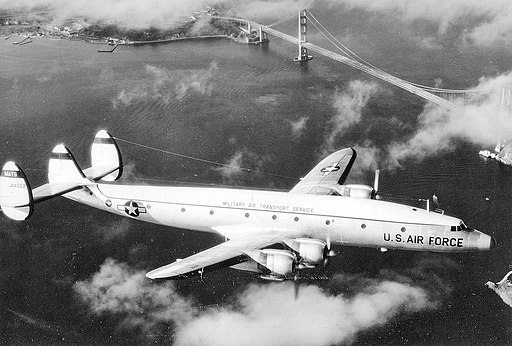
Lockheed C-121 Constellation
The Lockheed C-121 Constellation, born from the distinguished lineage of the civilian Constellation airliner, served as a stalwart military transport aircraft with enduring contributions to mid-20th-century aviation. A modified version of the iconic Constellation, the C-121 featured strengthened components to meet military demands, playing a vital role in post-World War II and Cold War operations. With a length of 95 feet and a wingspan of 123 feet, the C-121 could carry up to 6,000 pounds of cargo or accommodate 44 passengers. Powered by four Wright R-3350 Duplex-Cyclone radial engines, it boasted a maximum speed of approximately 330 miles per hour and a range of around 3,400 miles.
The C-121 Constellation served various roles, including troop transport, medical evacuation, and reconnaissance, contributing significantly to the logistical and strategic needs of the U.S. military during a transformative period in global history. Its legacy endures as a testament to the adaptability and utility of Lockheed’s innovative design.
Lockheed C-121 Constellation parameters
The Lockheed C-121 Constellation, a military transport version derived from the civilian Lockheed Constellation, had several variants with varying specifications. Below are the parameters for one of the common military versions, the C-121C:
- Crew: 5-6 (pilot, co-pilot, navigator, flight engineer, radio operator, and loadmaster)
- Length: 95 feet 2 inches (29.01 meters)
- Wingspan: 123 feet (37.49 meters)
- Height: 23 feet 8 inches (7.21 meters)
- Empty Weight: Approximately 60,000 pounds (27,216 kilograms)
- Max Takeoff Weight: Approximately 107,000 pounds (48,534 kilograms)
- Payload Capacity: Up to 6,000 pounds (2,722 kilograms) of cargo or 44 passengers
- Engines: Four Wright R-3350 Duplex-Cyclone radial engines
- Maximum Speed: Approximately 330 miles per hour (531 kilometers per hour)
- Cruise Speed: Approximately 250 miles per hour (402 kilometers per hour)
- Range: Approximately 3,400 miles (5,472 kilometers)
- Service Ceiling: 23,000 feet (7,010 meters)
- First Flight: April 1949 (for C-121C variant)
- Number Built: Various, including civilian and military versions
These parameters highlight the versatility of the Lockheed C-121 Constellation as a military transport aircraft, showcasing its capacity for carrying both cargo and passengers over medium to long distances. The aircraft played a crucial role in military logistics and transportation during the post-World War II and Cold War periods.
History of the Lockheed C-121 Constellation
The Lockheed C-121 Constellation, derived from the iconic civilian Lockheed Constellation airliner, played a significant role as a military transport aircraft in the mid-20th century. In the aftermath of World War II, the U.S. military sought a reliable and versatile transport plane, leading to the adaptation of the Constellation for military use. The C-121 featured a strengthened fuselage, reinforced landing gear, and other modifications to meet military requirements. Initially designated as the C-69 and later redesignated as the C-121, these aircraft served in various roles, including troop and cargo transport, medical evacuation, and reconnaissance.
The C-121 Constellation became a workhorse for the U.S. Air Force and other military branches during the 1940s and 1950s, contributing to the logistical needs of the Cold War era. It also played a vital role in humanitarian missions and supported the United Nations during the Korean War. The Constellation series, both in civilian and military variants, remains an enduring symbol of aviation elegance and utility in the mid-20th century.
