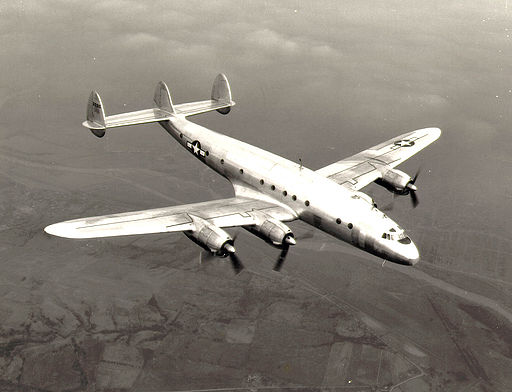
Lockheed C-69 Constellation
The Lockheed C-69 Constellation marked a pioneering era in aviation as an early long-range military transport aircraft developed during World War II. Derived from the successful Lockheed L-049 Constellation airliner, the C-69 was adapted for military use with modifications that included a strengthened airframe, additional windows, and military avionics. It featured a pressurized cabin, allowing for higher altitudes and improved comfort for the crew and passengers. The C-69 Constellation had a length of 95 feet and a wingspan of 123 feet, powered by four Wright R-3350 radial engines. It could accommodate up to 64 fully equipped troops or a combination of passengers and cargo.
Although the C-69 saw limited military service, its legacy lived on in the post-war Constellation variants, such as the C-121, which played crucial roles in military and civilian applications. The Lockheed C-69 Constellation remains a significant milestone in aviation history, reflecting the transition from wartime development to the post-war era’s burgeoning civil and military aviation sectors.
parameters of the Lockheed C-69 Constellation
The Lockheed C-69 Constellation, developed during World War II, served as an early long-range military transport aircraft. Here are some key parameters for the C-69:
- Crew: 5-7 (pilot, co-pilot, navigator, radio operator, and one or two flight engineers)
- Length: 95 feet 2 inches (29.01 meters)
- Wingspan: 123 feet (37.49 meters)
- Height: 23 feet 8 inches (7.21 meters)
- Empty Weight: Approximately 54,000 pounds (24,494 kilograms)
- Max Takeoff Weight: Approximately 86,250 pounds (39,135 kilograms)
- Payload Capacity: Up to 14,000 pounds (6,350 kilograms) of cargo or 62 fully equipped troops
- Engines: Four Wright R-3350 Duplex-Cyclone radial engines
- Maximum Speed: Approximately 345 miles per hour (555 kilometers per hour)
- Cruise Speed: Approximately 270 miles per hour (435 kilometers per hour)
- Range: Approximately 3,200 miles (5,150 kilometers)
- Service Ceiling: 24,000 feet (7,315 meters)
- First Flight: January 9, 1943
- Number Built: 22 C-69s, including prototypes and production variants
These parameters illustrate the C-69 Constellation’s capabilities as a long-range transport aircraft, emphasizing its versatility in carrying both cargo and troops. The C-69 played a crucial role during the war and laid the foundation for the iconic Constellation series that followed in the post-war period.
History of the Lockheed C-69 Constellation
The Lockheed C-69 Constellation emerged as a significant development during World War II, showcasing Lockheed’s commitment to pushing the boundaries of aviation technology. First taking flight on January 9, 1943, the C-69 was born out of the need for a long-range transport aircraft capable of carrying cargo and troops across vast distances. Derived from the successful L-049 Constellation airliner, the C-69 featured modifications to suit military requirements, including a strengthened airframe, additional windows, and pressurization for improved performance at higher altitudes.
Though initially designed as a transport, the C-69 primarily served as a VIP transport aircraft during the war, carrying high-ranking military and political figures. Its legacy extended beyond its wartime duties, as the lessons learned from the C-69 contributed to the development of subsequent Constellation variants, such as the widely successful C-121. The Lockheed C-69 Constellation stands as a testament to the adaptability of aviation technology during a pivotal era in history, bridging the gap between military and civilian applications.
