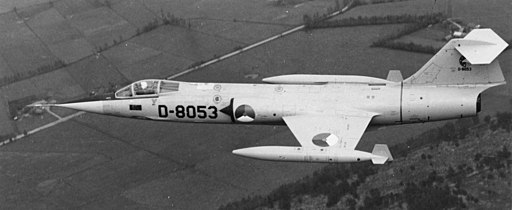
Lockheed F-104 Starfighter
The Lockheed F-104 Starfighter, a renowned supersonic jet aircraft, stands as a symbol of technological innovation and high-performance aviation during the mid-20th century. Designed to meet the demands of the Cold War era, the F-104 represented a paradigm shift in fighter aircraft design, featuring a sleek, streamlined fuselage, thin wings, and a powerful turbojet engine that propelled it to unprecedented speeds. Its distinctive appearance earned it the nickname “The Missile with a Man in It,” highlighting its resemblance to a missile with a cockpit.
Introduced in the late 1950s, the F-104 quickly garnered attention for its exceptional speed and altitude capabilities, setting numerous world records for altitude and speed during its operational service. Equipped with a powerful afterburning turbojet engine, the F-104 could achieve speeds exceeding Mach 2 and altitudes surpassing 80,000 feet, making it one of the fastest and highest-flying production aircraft of its time. Its agility and maneuverability also made it a popular choice for air forces around the world, with over a dozen nations adopting the F-104 into their fleets.
Despite its impressive performance, the F-104 gained notoriety for its challenging flight characteristics, earning it the nickname “Widowmaker” due to its high accident rate, particularly during takeoff and landing. The aircraft’s short wings and high landing speed contributed to its reputation for being difficult to fly, leading to a significant number of accidents, especially among less-experienced pilots. Despite these challenges, the F-104 served with distinction in various roles, including air defense, reconnaissance, and ground attack, leaving a lasting legacy as one of the most iconic jet fighters of the Cold War era.
Armament Lockheed F-104 Starfighter
The armament of the Lockheed F-104 Starfighter, a supersonic interceptor and fighter-bomber aircraft, typically included a combination of air-to-air and air-to-ground weapons. While specific configurations varied depending on mission requirements and operational theaters, the F-104 Starfighter was typically armed with:
- Air-to-Air Missiles (AAMs): The F-104 could be equipped with AIM-9 Sidewinder infrared-guided missiles for engaging enemy aircraft in aerial combat. These short-range missiles were mounted on wingtip pylons and provided the F-104 with a defensive capability against enemy fighters.
- Air-to-Ground Munitions: For ground attack missions, the F-104 could carry a variety of bombs and rockets to engage ground targets. This included unguided bombs such as Mk 82 and Mk 83 general-purpose bombs, as well as rockets like the 2.75-inch FFAR (Folding-Fin Aerial Rocket) or the LAU-3/A rocket launcher.
- Gun: The F-104 was typically armed with an internally mounted M61 Vulcan rotary cannon, which was capable of firing 20mm ammunition at a high rate of fire. The cannon was primarily used for strafing ground targets or engaging enemy aircraft at close range.
- Additional Weapons: Depending on the mission requirements, the F-104 could also be equipped with additional weapons such as cluster bombs, napalm canisters, or external fuel tanks for extended range or loitering time over the target area.
Overall, the armament of the Lockheed F-104 Starfighter was tailored to its role as a multirole combat aircraft, providing it with the capability to engage both air and ground targets effectively in a variety of mission scenarios.
Dimensions of the Lockheed F-104 Starfighter
The Lockheed F-104 Starfighter, a supersonic interceptor and fighter-bomber aircraft, has the following approximate dimensions:
- Length: Approximately 16.66 meters (54 feet 8 inches) for the F-104G variant.
- Wingspan: Approximately 6.36 meters (20 feet 10 inches) for the F-104G variant.
- Height: Approximately 4.09 meters (13 feet 5 inches) for the F-104G variant.
These dimensions may vary slightly depending on the specific variant and configuration of the F-104 Starfighter.
