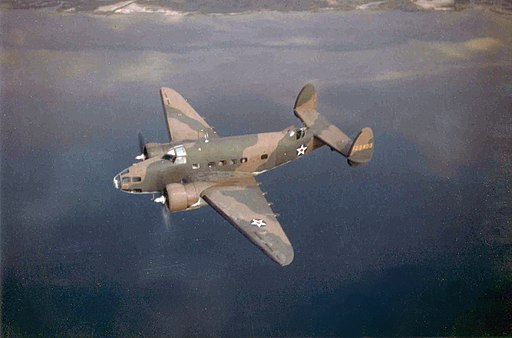
Lockheed Hudson
The Lockheed Hudson, a versatile light bomber and reconnaissance aircraft, played a significant role during World War II, particularly in maritime operations. Developed by Lockheed Corporation, the Hudson was derived from the civilian Lockheed Model 14 Super Electra airliner, modified to meet military requirements. Initially designed for reconnaissance and anti-submarine warfare (ASW) roles, the Hudson proved to be adaptable for a variety of missions, including patrol, convoy escort, and bombing raids.
One of the Hudson’s most notable contributions was its role in ASW operations, where it played a vital role in protecting Allied shipping from enemy submarines. Equipped with depth charges, sonobuoys, and radar, the Hudson hunted down and neutralized German U-boats, significantly contributing to the Allied victory in the Battle of the Atlantic. Its ability to operate from land bases, as well as from aircraft carriers and other naval vessels, gave Allied commanders flexibility in deploying this versatile aircraft wherever it was needed most.
Throughout its operational service, the Lockheed Hudson underwent several variants and modifications to enhance its capabilities and adapt to evolving operational requirements. These upgrades included improvements to its avionics, defensive armament, and sensor suites, ensuring that it remained effective in the face of changing threats. Despite being overshadowed by other aircraft in the post-war era, the legacy of the Lockheed Hudson endures, with several examples preserved in museums and private collections, serving as a reminder of its invaluable contribution to military aviation history.
Armament Lockheed Hudson
The armament of the Lockheed Hudson, a versatile light bomber and reconnaissance aircraft, typically included a variety of weapons suitable for multiple roles, including anti-submarine warfare (ASW), reconnaissance, and strike missions. While specific configurations may have varied depending on mission requirements and operational theaters, the Lockheed Hudson was typically equipped with:
- Machine Guns: The Hudson was often armed with multiple machine guns for defensive purposes. These could include .303 caliber or .50 caliber machine guns mounted in nose, dorsal, and tail gun positions to defend against enemy fighters and surface threats.
- Bombs: As a bomber, the Hudson could carry a variety of bombs for attacking ground targets, enemy shipping, and installations. These could range from small fragmentation bombs to larger conventional bombs, such as 250-pound or 500-pound bombs, depending on the mission requirements.
- Depth Charges: In its ASW role, the Hudson could carry depth charges for attacking enemy submarines. Depth charges were typically dropped from the aircraft’s bomb bays or released from underwing pylons and detonated at a predetermined depth to damage or destroy submerged threats.
- Torpedoes: Some variants of the Hudson were equipped with torpedo racks and could carry torpedoes for attacking enemy shipping. These torpedoes provided the aircraft with a stand-off capability to engage surface targets at extended ranges.
Overall, the armament of the Lockheed Hudson was tailored to its multi-role capabilities, providing it with the flexibility to engage a wide range of targets in various operational environments.
Dimensions of the Lockheed Hudson
The Lockheed Hudson, a versatile light bomber and reconnaissance aircraft, had the following dimensions:
- Length: Approximately 14.3 meters (47 feet).
- Wingspan: Approximately 19.8 meters (65 feet).
- Height: Approximately 3.6 meters (12 feet).
These dimensions provided the Lockheed Hudson with the necessary size and wingspan to accommodate its payload of bombs, depth charges, and other mission equipment, while also allowing it to operate effectively in various operational environments
