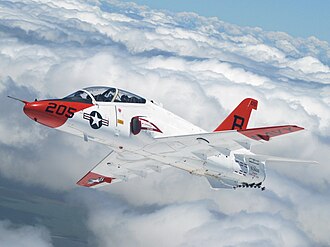
McDonnell Douglas T-45 Goshawk: The Carrier-Based Jet Trainer That Shapes Naval Aviators
The McDonnell Douglas T-45 Goshawk is one of the most recognizable aircraft in modern American naval aviation training. Designed to prepare future U.S. Navy and Marine Corps pilots for the demanding environment of carrier aviation, this compact, single-engine jet trainer combines the proven aerodynamic qualities of the British Aerospace Hawk with a range of modifications developed specifically for aircraft carrier operations. Its tandem-seat arrangement, robust landing gear, arresting hook, strengthened structure, and specialized low-speed handling characteristics make it far more than a conventional training aircraft. The Goshawk is an essential bridge between the fundamentals of military flight training and the complex realities of operating high-performance combat aircraft from an aircraft carrier.
Although its origins lie in a British training aircraft developed during the 1970s, the T-45 has become deeply associated with the United States Navy’s pilot-training system. Over several decades, it has introduced thousands of student aviators to advanced jet handling, instrument flying, formation work, tactical maneuvering, and the precise approaches required for carrier landings. Its development also illustrates how an established aircraft design can be transformed through international cooperation into a specialized platform for a very different operating environment. The story of the T-45 Goshawk is therefore one of engineering adaptation, naval aviation tradition, technological modernization, and the continuing importance of disciplined flight training.
The Origins of the T-45 Goshawk
From the British Aerospace Hawk to an American Naval Trainer
The T-45 Goshawk is derived from the British Aerospace Hawk, a jet trainer originally developed for the Royal Air Force. The Hawk emerged from a requirement for a modern aircraft capable of providing advanced jet training while also offering useful performance for tactical weapons instruction. Hawker Siddeley began design studies in the late 1960s, and the company’s proposal eventually developed into an aircraft that would become one of the most successful jet trainers of its generation.
The first Hawk prototype flew on 21 August 1974, and the type entered Royal Air Force service during the second half of the decade. The aircraft featured a compact design, a tandem cockpit, swept wings, and a Rolls-Royce/Turbomeca Adour turbofan engine. Its handling qualities, relatively economical operation, and ability to support a range of training activities made it attractive to air forces around the world. The Hawk was also exported in several versions, demonstrating that its basic design could be adapted to different national requirements.
The United States Navy became interested in the Hawk as it considered replacing two important training aircraft: the North American T-2 Buckeye and the Douglas TA-4J Skyhawk. These aircraft had played major roles in preparing naval aviators, but the Navy wanted a newer platform that could combine intermediate and advanced jet training within a more integrated system. The British Hawk offered a promising starting point, but it was not designed for the severe demands of carrier operations. A conventional land-based trainer would require substantial modifications before it could safely and reliably launch from and recover aboard an aircraft carrier.
The VTXTS Competition and International Cooperation
In 1978, the U.S. Navy initiated the VTXTS, or trainer experimental tactical training system, program to identify a replacement for its aging jet trainers. McDonnell Douglas and British Aerospace joined forces to propose a navalized version of the Hawk. The partnership combined British Aerospace’s experience with the original aircraft and McDonnell Douglas’s expertise in American military aircraft, production, and naval aviation requirements.
The team’s proposal was selected in 1981, with McDonnell Douglas serving as the prime contractor. The aircraft was designated the T-45 and later received the name Goshawk, a name that had previously been associated with a U.S. Navy fighter aircraft. The program called for a two-seat jet trainer that could operate from aircraft carriers while also performing the demanding training missions required at land-based naval air stations.
The first T-45 prototype flew on 16 April 1988. This milestone was followed by extensive testing to evaluate the aircraft’s flight characteristics, structural strength, carrier suitability, and training capabilities. The T-45A became operational in 1991, beginning a new era in U.S. Navy and Marine Corps jet pilot instruction. The program eventually evolved into the T-45C, which incorporated a digital cockpit and became the principal configuration used for modern naval aviation training.
Design Features and Naval Modifications
A Hawk Adapted for Aircraft Carrier Operations
At first glance, the T-45 Goshawk resembles the British Aerospace Hawk on which it is based. It retains the compact, swept-wing configuration and tandem cockpit layout that made the Hawk such an effective training aircraft. However, the differences between the standard Hawk and the T-45 are substantial. Carrier operations impose unique demands on an aircraft, particularly during takeoff, landing, taxiing, and operation in the confined environment of a flight deck.
One of the most important modifications was the installation of a strengthened landing gear system. Aircraft carrier landings subject an airframe to forces that are significantly different from those experienced during ordinary runway operations. A naval trainer must be capable of touching down accurately on a short landing area while descending at a relatively high rate and then engaging an arresting wire. The T-45 was designed to withstand these demands repeatedly throughout its service life.
The aircraft also received an arresting hook beneath the rear fuselage. This hook is essential for carrier recoveries because it catches one of the arresting wires stretched across the flight deck. When the hook engages a wire, the aircraft’s forward motion is rapidly reduced, allowing it to stop within a limited distance. Successful carrier landings require exceptional precision, and the T-45’s design gives student pilots the opportunity to develop these skills before progressing to frontline naval aircraft.
The Goshawk was also equipped with features intended to improve its handling at low speeds and during flight-deck operations. These included leading-edge wing slats, revised control surfaces, a strengthened airframe, and high-gain nose-wheel steering. The steering system was particularly valuable during taxiing, where precise maneuvering is necessary around parked aircraft, deck equipment, and other hazards.
Cockpit Arrangement and Visibility
The T-45 uses a tandem-seat cockpit, with the student pilot seated in front and the instructor behind. This arrangement is common among advanced military trainers because it allows the student to experience the aircraft from the normal pilot position while the instructor maintains a clear view of the student’s actions and the surrounding flight environment.
The rear cockpit is raised relative to the front cockpit, improving the instructor’s forward visibility. Both crew members sit beneath a large canopy designed to provide useful visibility during flight, formation work, approach procedures, and carrier operations. Clear visibility is especially important in training aircraft because instructors must monitor not only the aircraft’s flight path but also the student’s instrument interpretation, control inputs, and situational awareness.
The original T-45A featured an analog-style cockpit, reflecting the technology available when the aircraft entered service. As military aircraft increasingly adopted digital displays and computerized mission systems, the Navy sought to modernize the Goshawk’s cockpit so that students could develop skills more relevant to the aircraft they would eventually fly in operational squadrons.
The T-45A and T-45C Variants
The Original T-45A
The T-45A was the first production version of the Goshawk and entered operational service in 1991. Its primary role was to provide intermediate and advanced jet training for Navy and Marine Corps pilots preparing for carrier aviation and tactical strike missions. The aircraft replaced the T-2C Buckeye and TA-4J Skyhawk in the training pipeline, helping to consolidate instruction around a more modern platform.
The T-45A’s analog cockpit was suitable for the training requirements of its era. Students learned the fundamentals of jet aircraft operation, instrument flying, navigation, formation flying, and carrier approaches. The aircraft’s handling qualities were intended to make it an effective instructional platform while still exposing pilots to the discipline and precision required in naval aviation.
The T-45A was not intended to be a combat aircraft. It was designed as a dedicated training platform, and its value lay in preparing pilots to operate more advanced aircraft safely and effectively. By giving students experience with carrier-compatible systems and procedures, the T-45A helped bridge the gap between land-based flight training and the operational demands of naval aviation.
The Digitally Equipped T-45C
The T-45C represented a major modernization of the Goshawk. The first T-45C aircraft began delivery in December 1997, and the variant introduced a digital “glass cockpit” known as Cockpit-21. Instead of relying primarily on traditional analog instruments, the T-45C incorporated multifunction displays that presented information in a more flexible and integrated format.
The digital cockpit was designed to prepare students for the increasingly computerized cockpits of modern fleet aircraft. The displays could provide navigation, aircraft performance, communications, and other flight information. This made the training environment more representative of the systems students would encounter in aircraft such as the F/A-18 Hornet and other carrier-based platforms.
The transition to the T-45C was more than a cosmetic change. Digital displays altered the way pilots interacted with aircraft systems, interpreted information, and managed workload. Introducing these concepts during training helped the Navy maintain a closer connection between the equipment used by student aviators and the technology found in operational aircraft.
Over time, T-45A aircraft underwent the Required Avionics Modernization Program, or RAMP, which brought them to a T-45C-equivalent cockpit configuration. As a result, the distinction between the two versions became less significant from an operational training perspective. The modernized fleet could provide a more consistent instructional environment across naval training units.
The Goshawk in the U.S. Navy Training System
More Than Just an Aircraft
The T-45 Goshawk is best understood as one component of a larger integrated training system. The Navy’s approach combines aircraft operations with academic instruction, simulators, flight-training management, and other educational resources. This arrangement allows students to study procedures and concepts on the ground before practicing them in the air.
Flight simulators play an important role in this process. They can expose students to instrument procedures, emergency situations, navigation exercises, and other scenarios without the risks and costs associated with actual flight. Simulators also allow instructors to repeat difficult exercises and evaluate student performance in a controlled environment.
The aircraft itself provides the physical experience that simulation cannot completely reproduce. Students must learn how a jet responds to control inputs, how energy is managed during an approach, how to maintain precise airspeed and altitude, and how to coordinate the many tasks involved in a carrier landing. The T-45’s design makes it a useful platform for combining these practical skills with the theoretical knowledge taught in classrooms and simulators.
The integrated system also supports the Navy’s emphasis on standardization. Student pilots progress through structured stages of training, gradually developing the capabilities required to operate more complex aircraft. The T-45 is an important part of that progression, especially for pilots preparing to fly high-performance carrier-based aircraft.
Training Missions and Skills
The Goshawk is used for the intermediate and advanced stages of naval jet pilot training. Students typically arrive at this stage with experience in earlier training aircraft and a foundation in basic aviation skills. The T-45 then introduces them to more demanding jet operations, including advanced instrument flying, formation work, aerobatic maneuvers, tactical navigation, and carrier-specific procedures.
Carrier qualification is one of the aircraft’s most important missions. Landing on an aircraft carrier is among the most challenging tasks in military aviation because the runway is short, the landing area is moving, and the pilot must maintain an exact approach path. The arresting hook must engage a wire, and there is little room for error. The T-45 allows students to practice these skills under the supervision of experienced instructors before they move on to operational aircraft.
The aircraft also supports training for Naval Flight Officers through associated systems and modified training arrangements. The broader T-45 training infrastructure has been used to support instruction in navigation, radar-related skills, and other areas relevant to naval aviation. This demonstrates that the Goshawk is part of a larger educational framework rather than simply a vehicle for learning how to fly a jet.
Performance and Technical Characteristics
Speed, Altitude, and Range
The T-45 Goshawk is a compact aircraft, measuring approximately 39 feet 4 inches in length and 30 feet 10 inches across the wings. Its relatively small size contributes to its suitability for training operations and makes it easier to accommodate within the constraints of naval aviation infrastructure.
The aircraft is powered by a single Rolls-Royce F405-RR-401 turbofan engine, a naval designation for the Adour engine family. The engine produces approximately 5,527 pounds of thrust, providing the performance necessary for advanced jet training, high-energy maneuvering, and carrier operations.
Official U.S. Navy specifications commonly list a maximum speed of approximately 645 miles per hour, a service ceiling of about 42,500 feet, and a range of approximately 700 nautical miles. These figures describe the aircraft’s general performance envelope, although actual flight performance varies with fuel load, payload, weather, configuration, and the particular mission being flown.
The Goshawk’s performance is deliberately balanced against its training role. It is fast enough to introduce students to the handling characteristics of a modern jet, but it is not designed to replicate every capability of a frontline fighter. Its purpose is to provide a manageable and effective environment in which pilots can build the skills, judgment, and discipline needed for more advanced aircraft.
Carrier Suitability and Low-Speed Handling
A major engineering achievement of the T-45 program was adapting the Hawk’s aerodynamic design for carrier operations. Aircraft carriers require trainers to approach at carefully controlled speeds and descent rates, often while maintaining a precise flight path toward a moving landing area. The aircraft must remain controllable at low speed and respond predictably to small control inputs.
The T-45’s leading-edge slats improve low-speed aerodynamic performance by helping the wings generate lift at higher angles of attack. Its strengthened landing gear and arresting hook support repeated carrier recoveries, while its specialized steering system helps pilots maneuver the aircraft on the flight deck.
The Goshawk has also been described by Boeing as capable of routine landings at sink rates greater than 700 feet per minute, a characteristic that reflects the demanding requirements of carrier approaches. This capability is central to its instructional role. Students must learn to maintain the correct approach attitude, airspeed, glide path, and power setting while preparing for an arrestment.
Production, Service, and Modernization
Manufacturing Partnership
The T-45 program was an international manufacturing effort. British Aerospace produced major components, including the wings and rear and center fuselage sections, while McDonnell Douglas was responsible for other structural elements, final assembly, and testing. Production activity was initially associated with facilities in California before the program moved to St. Louis, Missouri, in 1989.
This partnership demonstrated the value of combining established aircraft design expertise with the industrial and operational knowledge needed to meet American naval requirements. The T-45 was not simply imported from Britain; it was extensively redesigned and manufactured as a purpose-built U.S. Navy training aircraft.
Following the merger of McDonnell Douglas with Boeing, the T-45 program continued under the Boeing name. Boeing became responsible for ongoing production, engineering support, logistics, and modernization activities. BAE Systems, the successor to British Aerospace, remained an important industrial partner.
Long-Term Fleet Service
Boeing delivered the 221st and final T-45 training aircraft to the U.S. Navy in November 2009. By that point, the Goshawk had become a central element of naval aviation training, with a large fleet operating from major training locations in the United States.
The aircraft achieved significant operational milestones during its service. In 2010, the Navy and Boeing recognized the completion of one million T-45 flight hours within the Naval Air Training Command. Such milestones reflected the aircraft’s central role in preparing successive generations of naval aviators.
The Goshawk has also undergone continuing upgrades to avionics, training systems, and support infrastructure. These improvements help extend the useful life of the aircraft and keep its training environment relevant as operational aircraft become more sophisticated. Maintaining an older training fleet requires careful attention to spare parts, maintenance, structural inspections, software, and instructional requirements, making long-term support an important part of the program.
The Legacy of the McDonnell Douglas T-45 Goshawk
The T-45 Goshawk is an example of how a successful aircraft design can be transformed to meet a specialized military mission. The original British Aerospace Hawk was created as a land-based jet trainer, but the Goshawk incorporated the structural, aerodynamic, and systems changes necessary to operate from aircraft carriers. The result was a distinctive aircraft that combined relatively simple single-engine propulsion with the demanding requirements of naval aviation.
Its greatest contribution is not measured solely by speed, range, or engine power. The T-45 has played a critical role in developing the skills and habits of Navy and Marine Corps pilots. By the time a student completes Goshawk training, they have been exposed to many of the procedures and challenges associated with carrier aviation, including precise approaches, advanced jet handling, instrument operations, and flight-deck discipline.
The aircraft also represents an important transition in cockpit technology. The move from the analog T-45A to the digital T-45C reflects the broader transformation of military aviation toward computerized flight decks, multifunction displays, and integrated information systems. This modernization ensured that the Goshawk remained relevant as the aircraft flown by naval aviators continued to evolve.
Conclusion
The McDonnell Douglas T-45 Goshawk is far more than a derivative of the British Aerospace Hawk. It is a carefully adapted naval training aircraft designed to introduce pilots to the unique challenges of carrier aviation. Its strengthened structure, arresting hook, specialized landing gear, low-speed handling improvements, and tandem-seat cockpit make it an effective platform for advanced flight instruction.
From its origins in the VTXTS program to the introduction of the digital T-45C, the Goshawk has demonstrated the importance of innovation, international cooperation, and long-term modernization. Its operational record and central role in the U.S. Navy’s integrated training system have established it as one of the most important jet trainers in American naval aviation.
While the aircraft lacks the combat role and headline performance of a frontline fighter, its contribution is arguably just as significant. Every naval aviator must first learn the fundamentals of safe, precise, and disciplined flight. For generations of Navy and Marine Corps pilots, the T-45 Goshawk has provided the demanding but essential foundation upon which those operational careers are built.
Technical Specifications of the McDonnell Douglas T-45 Goshawk
The following table summarizes commonly published specifications for the T-45 Goshawk. Figures are based primarily on U.S. Navy and Boeing reference material and may vary slightly depending on the aircraft configuration, source, and measurement conventions.
| Specification | McDonnell Douglas T-45 Goshawk |
|---|---|
| Aircraft type | Tandem-seat, single-engine carrier-capable jet trainer |
| Primary role | Intermediate and advanced naval jet pilot training |
| Manufacturer | McDonnell Douglas, in partnership with British Aerospace |
| Current program contractor | Boeing |
| Country of origin | United States / United Kingdom collaborative program |
| Development program | VTXTS |
| First flight | 16 April 1988 |
| Operational introduction | 1991 |
| Main variants | T-45A and T-45C |
| T-45C introduction | 1997 |
| Production total | 221 aircraft delivered |
| Crew | 2 — instructor pilot and student pilot |
| Length | 39 ft 4 in / 11.98 m |
| Wingspan | 30 ft 10 in / 9.39 m |
| Height | 13 ft 6 in / 4.11 m |
| Empty weight | 9,394 lb / 4,261 kg |
| Maximum takeoff weight | 13,500 lb / 6,075 kg |
| Power plant | 1 × Rolls-Royce F405-RR-401 turbofan |
| Engine thrust | Approximately 5,527 lbf / 24.6 kN |
| Maximum speed | Approximately 645 mph / 1,038 km/h |
| Service ceiling | Approximately 42,500 ft / 12,954 m |
| Published range | Approximately 700 nautical miles / 1,288 km |
| Cockpit | Tandem seating; analog T-45A, digital T-45C |
| Landing gear | Retractable, strengthened tricycle landing gear |
| Carrier equipment | Arresting hook and carrier-compatible systems |
| Armament | None in its primary training configuration |
| Typical operating bases | Naval Air Station Meridian, Mississippi; Naval Air Station Kingsville, Texas |
| Primary users | U.S. Navy and U.S. Marine Corps |
| Training system | Aircraft, simulators, academics, and integrated training management |
