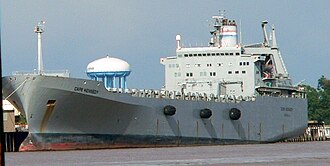
Among the many ships that support the military capabilities of the United States, some operate far from public attention despite playing a role that is every bit as important as frontline combat vessels. Aircraft carriers, destroyers, submarines, and amphibious assault ships often receive widespread recognition because they represent visible expressions of military power. Yet the ability of those forces to operate overseas depends heavily on a much less glamorous but absolutely essential component of national defense: strategic sealift. At the heart of this logistical network are cargo vessels capable of transporting enormous quantities of equipment, vehicles, ammunition, and supplies across vast oceans. One such ship is the MV Cape Kennedy (T-AKR 5083), a vessel whose contribution to military readiness and global mobility has made it a critical asset within the United States Ready Reserve Force.
The Cape Kennedy is not a warship in the traditional sense. It carries no missiles, possesses no sophisticated radar systems designed for combat, and lacks the armament associated with naval combatants. Instead, its mission revolves around transportation and logistics. The vessel exists to ensure that military forces can deploy rapidly to distant regions of the world whenever circumstances require. Whether supporting military operations, humanitarian missions, disaster relief efforts, or large-scale training exercises, the Cape Kennedy serves as a bridge between strategic planning and operational capability.
Like many vessels within the Ready Reserve Force, the Cape Kennedy began life in commercial service before transitioning into government ownership. Its transformation from merchant vessel to strategic transportation asset reflects broader developments in maritime commerce, defense policy, and military logistics during the late twentieth century. Over several decades, the ship has evolved into a floating warehouse capable of transporting thousands of tons of military cargo while remaining ready for activation on relatively short notice.
The story of the Cape Kennedy offers a fascinating look into the world of strategic sealift. It demonstrates how cargo ships, despite rarely appearing in headlines, form one of the foundational pillars of modern military power. Understanding the vessel’s history, design, and role provides valuable insight into how nations maintain the ability to project force and respond to crises across the globe.
The Critical Role of Strategic Sealift
Why Military Logistics Matters
Throughout history, military success has depended as much upon logistics as upon battlefield performance. Commanders from ancient times to the modern era have recognized that armies cannot operate effectively without reliable systems for transporting food, fuel, weapons, equipment, and personnel. As military technology has advanced, logistical requirements have become increasingly complex and demanding.
Modern armed forces rely heavily on mechanized systems. Tanks, armored vehicles, helicopters, engineering machinery, support trucks, fuel carriers, and maintenance equipment all require transportation. Moving such assets across continents presents a major challenge. While aircraft can transport certain types of cargo quickly, they cannot economically move the enormous quantities of heavy equipment required for sustained military operations.
Sealift solves this problem.
Ships provide unmatched cargo capacity and efficiency. A single strategic sealift vessel can transport equipment that would require hundreds of aircraft sorties to move. As a result, maritime transportation remains the backbone of large-scale military deployments.
The Cape Kennedy exemplifies this reality. Its purpose is not to engage enemy forces directly but to ensure that those forces have the resources needed to operate effectively.
The Evolution of America’s Sealift Strategy
The United States has long recognized the importance of strategic mobility. During the Cold War, defense planners anticipated the possibility of deploying forces rapidly to distant theaters. Achieving such deployments required transportation assets capable of moving heavy equipment quickly and efficiently.
Experiences during conflicts such as the Korean War, Vietnam War, and later operations in the Persian Gulf reinforced the importance of maintaining a capable sealift fleet. These lessons contributed to the development of the Ready Reserve Force, which was designed to provide surge transportation capacity during emergencies.
The Cape Kennedy became part of this broader strategy, joining a fleet of vessels maintained specifically to support national defense requirements.
Origins of the Cape Kennedy
Construction and Commercial Beginnings
The vessel that would eventually become Cape Kennedy was originally built as a commercial cargo ship during an era of rapid expansion in global maritime trade. The 1970s and early 1980s witnessed significant changes in shipping technology, including larger vessels, improved cargo-handling systems, and increased emphasis on transportation efficiency.
Constructed in Germany by the renowned shipbuilder AG Weser Seebeckwerft, the ship entered service under the name MV Gopher State. It was one of a series of large cargo vessels designed to transport substantial loads while maintaining efficient operating costs and dependable performance.
At the time of its construction, global trade networks were becoming increasingly interconnected. Shipping companies sought vessels capable of handling large volumes of cargo while adapting to evolving transportation demands. The future Cape Kennedy emerged from this environment, benefiting from contemporary engineering standards and modern cargo ship design principles.
Its early years in commercial service provided valuable operational experience while demonstrating the reliability that would later make it attractive to government planners.
Characteristics That Attracted Government Interest
Several factors contributed to the vessel’s eventual acquisition by the United States government.
First, its large cargo capacity made it well suited for transporting heavy equipment. Second, its robust construction ensured long-term durability. Third, the vessel’s design offered flexibility, allowing it to accommodate a wide range of cargo types.
Defense planners frequently evaluate commercial vessels as potential sealift assets because building entirely new ships can be costly and time-consuming. Ships that demonstrate strong performance in commercial service often provide excellent foundations for military support roles.
The future Cape Kennedy met these criteria exceptionally well.
Entry into Government Service
Acquisition by the Maritime Administration
As strategic sealift requirements expanded, the Maritime Administration (MARAD) acquired numerous commercial vessels suitable for military transportation missions. The future Cape Kennedy was among those selected.
Following acquisition, the vessel was assigned the name Cape Kennedy and designated T-AKR 5083. This transition marked a significant change in its mission and operational focus.
Rather than transporting commercial cargo for private customers, the vessel became part of a strategic transportation reserve intended to support military operations and national emergencies.
The ship joined the Ready Reserve Force, a fleet specifically designed to provide rapid-response sealift capability whenever needed.
Becoming Part of the Ready Reserve Force
The Ready Reserve Force occupies a unique position within American defense planning.
Unlike active commercial ships, RRF vessels spend much of their time in reduced operating status. They are maintained carefully, undergo routine inspections, and remain available for activation within designated readiness timelines.
This approach provides a cost-effective method of preserving transportation capacity without incurring the expense of continuous operation.
For the Cape Kennedy, inclusion in the RRF meant entering a long-term role as a strategic asset capable of supporting military deployments around the world.
Design and Engineering Excellence
General Dimensions and Structure
The Cape Kennedy belongs to a category of vessels designed for heavy cargo transportation. Its large dimensions provide substantial internal volume, enabling it to transport extensive quantities of vehicles, equipment, and supplies.
The vessel measures approximately 946 feet (288 meters) in length, making it one of the larger ships within the strategic sealift fleet. Its beam exceeds 105 feet, while its displacement and cargo capacity allow it to accommodate significant military loads.
These dimensions reflect a design philosophy centered on efficiency and flexibility. Every aspect of the ship’s structure was intended to maximize transportation capability while maintaining seaworthiness and operational reliability.
The result is a vessel capable of supporting complex logistical missions across vast distances.
Roll-On/Roll-Off Cargo Operations
One of the most important features of the Cape Kennedy is its roll-on/roll-off capability.
Traditional cargo ships often rely heavily on cranes for loading and unloading operations. While effective, this approach can be time-consuming and labor-intensive.
Roll-on/roll-off ships simplify the process dramatically.
Vehicles enter the vessel through large ramps and are driven directly into cargo spaces. Tanks, trucks, trailers, engineering equipment, and support vehicles can be loaded rapidly without requiring extensive cargo-handling infrastructure.
For military operations, this capability is invaluable. Rapid loading and unloading reduce deployment timelines and improve logistical efficiency.
The Cape Kennedy’s extensive vehicle decks and cargo handling systems enable it to transport large quantities of wheeled and tracked equipment while maintaining operational flexibility.
Propulsion Systems
The vessel employs powerful diesel propulsion systems designed to support long-range operations.
Strategic sealift missions frequently involve transoceanic voyages covering thousands of nautical miles. Reliability is therefore essential.
The Cape Kennedy’s engineering systems emphasize durability, fuel efficiency, and sustained performance. Its propulsion arrangement allows the ship to maintain speeds suitable for rapid deployment while carrying substantial cargo loads.
Although newer technologies continue to emerge within commercial shipping, the vessel’s propulsion systems remain highly effective for its intended mission.
Operational Service and Strategic Contributions
Supporting Military Deployments
The primary mission of the Cape Kennedy is supporting military deployments.
When activated, the ship can transport vehicles, equipment, and supplies needed by military forces operating overseas. This capability allows units to deploy with the resources necessary to perform their missions effectively.
Military deployments often require moving thousands of vehicles and millions of pounds of cargo. Ships such as the Cape Kennedy provide the capacity needed to accomplish these tasks efficiently.
Without strategic sealift vessels, large-scale overseas operations would be far more difficult and expensive.
Humanitarian Assistance and Disaster Relief
Although military transportation remains its primary role, the Cape Kennedy can also support humanitarian operations.
Natural disasters frequently create urgent transportation requirements. Earthquakes, hurricanes, tsunamis, and other catastrophic events may damage infrastructure and disrupt supply chains.
In such situations, strategic sealift vessels can transport emergency supplies, construction equipment, generators, medical resources, and relief materials.
The Cape Kennedy’s cargo capacity makes it a valuable asset during disaster response efforts, demonstrating the versatility of sealift capabilities.
Exercises and Readiness Operations
Maintaining readiness requires continuous preparation.
The Cape Kennedy periodically participates in activation exercises designed to test its ability to return to operational status quickly. These exercises involve engineering checks, crew mobilization, cargo system evaluations, and operational planning activities.
Such exercises ensure that the vessel remains capable of fulfilling its mission whenever needed.
Readiness, rather than constant deployment, defines the ship’s operational philosophy.
Life Aboard the Cape Kennedy
Civilian Mariners and Sealift Operations
Unlike naval combatants operated by uniformed sailors, Ready Reserve Force vessels are generally crewed by civilian mariners.
These professionals bring extensive maritime expertise to their roles. Engineers maintain propulsion systems, deck officers oversee navigation, cargo specialists manage loading operations, and support personnel ensure safe vessel operation.
The work requires technical knowledge, discipline, and adaptability.
Civilian mariners form the backbone of strategic sealift operations, ensuring that ships like the Cape Kennedy remain ready for service.
Maintenance and Preservation
Because reserve vessels spend extended periods inactive, maintenance plays a critical role in preserving readiness.
Mechanical systems require regular inspections. Corrosion prevention measures must be applied consistently. Electrical equipment needs testing and servicing. Safety systems must remain fully operational.
These activities occur continuously, even when the ship is not deployed.
The objective is straightforward: ensure that the vessel can return to service rapidly whenever activation orders arrive.
Why the Cape Kennedy Remains Relevant
The Enduring Need for Sealift
Despite advances in aviation, strategic sealift remains indispensable.
Aircraft offer speed but limited capacity. Ships provide the ability to transport enormous quantities of equipment economically and efficiently.
As long as military forces rely on heavy vehicles, engineering machinery, and large logistical inventories, sealift will remain essential.
The Cape Kennedy continues to fulfill this requirement.
Strategic Flexibility in an Uncertain World
The international security environment remains unpredictable.
Military crises, humanitarian emergencies, and natural disasters can emerge with little warning. Maintaining reserve transportation assets provides flexibility and resilience.
The Cape Kennedy represents a form of strategic insurance, ensuring that transportation capacity exists when needed.
Its value lies not merely in how often it sails but in the capability it provides when circumstances demand action.
Legacy of a Strategic Workhorse
The history of the Cape Kennedy demonstrates the importance of logistics within national defense. While combat systems often dominate public discussions of military power, transportation assets enable those systems to reach operational theaters in the first place.
From its origins as a commercial cargo vessel to its role within the Ready Reserve Force, the ship has adapted successfully to changing requirements. Its large cargo capacity, efficient loading systems, dependable engineering, and operational flexibility have ensured its continued relevance.
The vessel also illustrates the close relationship between commercial shipping and military logistics. Many strategic sealift assets began their careers in private service before transitioning into government roles. This connection highlights the broader importance of maritime transportation infrastructure to national security.
Conclusion
The MV Cape Kennedy (T-AKR 5083) stands as one of the most important yet least visible assets within America’s strategic transportation network. Although it lacks the glamour associated with combat vessels, its role is fundamental to military readiness and global mobility.
By transporting vehicles, equipment, and supplies across oceans, the Cape Kennedy helps transform strategic plans into operational capability. It enables military deployments, supports humanitarian missions, and contributes to national resilience during emergencies.
Its story is a reminder that military power depends not only on weapons but also on logistics. Ships like the Cape Kennedy ensure that forces can move where they are needed and arrive equipped to succeed.
As long as nations require the ability to project power and respond to crises across the globe, strategic sealift vessels will remain indispensable. The Cape Kennedy continues to embody that mission, serving quietly but effectively as a cornerstone of America’s maritime logistics capability.
Technical Parameters of MV Cape Kennedy (T-AKR 5083)
| Parameter | Specification |
|---|---|
| Name | MV Cape Kennedy |
| Hull Designation | T-AKR 5083 |
| Type | Roll-on/Roll-off Cargo Ship |
| Fleet | Ready Reserve Force (RRF) |
| Owner | U.S. Maritime Administration (MARAD) |
| Operator | Ready Reserve Force Management |
| Original Name | MV Gopher State |
| Builder | AG Weser Seebeckwerft, Bremerhaven, Germany |
| Year Built | 1971 |
| Acquisition by U.S. Government | 1980s |
| Length Overall | 946 ft (288.4 m) |
| Beam | 105 ft (32 m) |
| Draft | Approximately 34 ft (10.4 m) |
| Gross Tonnage | Approximately 55,000 GT |
| Deadweight Tonnage | Approximately 26,000–30,000 DWT |
| Full Load Displacement | Approximately 52,000+ tons |
| Propulsion | Diesel engines |
| Propeller Configuration | Single screw |
| Maximum Speed | Approximately 18–20 knots |
| Range | Intercontinental deployment capability |
| Cargo Handling | Roll-on/Roll-off (Ro-Ro) |
| Vehicle Capacity | Hundreds of military vehicles |
| Cargo Decks | Multiple enclosed decks |
| Crew (Activated) | Merchant Marine personnel |
| Crew (Reserve Status) | Reduced maintenance crew |
| Primary Mission | Strategic military sealift |
| Humanitarian Mission Capability | Yes |
| Aviation Facilities | Limited helicopter support capability |
| Armament | None |
| Current Status | Ready Reserve Force asset |
| Activation Status | Maintained for rapid deployment |
