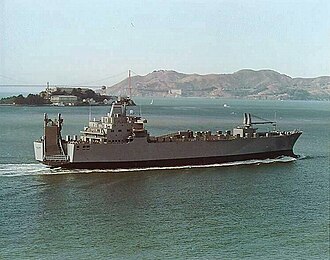
When people think about naval power, their minds typically turn toward aircraft carriers launching fighter jets, guided missile destroyers patrolling contested waters, or nuclear submarines operating beneath the ocean’s surface. These vessels represent the visible face of military strength, appearing in news reports, documentaries, and defense analyses around the world. Yet behind every successful military deployment lies an enormous logistical system that receives far less public attention. Within this network of transportation assets, cargo vessels play a role that is every bit as important as combat ships. Among these unsung workhorses is the SS Cape Island (AKR-10), a vessel whose mission has been centered not on fighting wars directly but on ensuring that military forces have the equipment, vehicles, and supplies needed to carry out their operations.
The Cape Island occupies a unique place within America’s strategic sealift capability. Originally constructed as a commercial vessel during the late 1970s, the ship eventually became part of the Maritime Administration’s Ready Reserve Force, where it has remained available for rapid activation during military crises, major deployments, and national emergencies. Although it spends much of its time in reserve status, the vessel represents an important component of a broader transportation network that allows the United States to project power across the globe. Without ships such as the Cape Island, modern military operations would face enormous logistical challenges, regardless of how advanced their weapons systems might be.
The story of the Cape Island is also a story about the evolution of maritime transportation. It reflects the changing nature of global commerce, the growing importance of roll-on/roll-off cargo operations, and the recognition by defense planners that strategic mobility depends upon reliable sealift capabilities. Over several decades, the vessel has transitioned from commercial service to military support operations while maintaining a reputation for versatility and readiness.
Today, the Cape Island remains one of the less-publicized but highly significant assets within America’s strategic transportation fleet. Its history offers valuable insight into the world of military logistics and demonstrates why cargo ships continue to play an indispensable role in modern defense planning.
The Historical Importance of Strategic Sealift
Logistics as the Foundation of Military Power
Military history repeatedly demonstrates that success on the battlefield depends heavily upon logistics. Armies can only operate effectively when they receive a continuous flow of supplies, fuel, equipment, ammunition, and replacement parts. Throughout history, commanders who mastered logistics often gained decisive advantages over opponents who failed to sustain their forces.
In the modern era, logistical demands have expanded dramatically. Mechanized armies rely upon tanks, armored vehicles, engineering equipment, and support systems that weigh thousands of tons. Air transport provides speed but cannot economically move the enormous quantities of heavy equipment required for large-scale operations. Consequently, sealift remains the most efficient method for transporting military cargo across long distances.
Ships such as the Cape Island serve as floating logistics platforms capable of carrying entire unit equipment sets. They enable military forces to deploy quickly while ensuring that essential resources arrive where they are needed. Without sealift, modern expeditionary operations would be virtually impossible.
The Emergence of Reserve Sealift Fleets
Following the experiences of major twentieth-century conflicts, defense planners increasingly recognized the value of maintaining reserve transportation assets. Instead of relying solely on commercial shipping during emergencies, governments sought to establish dedicated fleets that could be activated rapidly when military requirements arose.
The United States responded by developing the National Defense Reserve Fleet and later the Ready Reserve Force. These programs ensured that suitable ships would remain available for activation during crises, allowing military forces to deploy equipment without depending entirely on commercial operators.
The Cape Island eventually became part of this system, joining a fleet designed to provide strategic transportation capacity whenever national interests required it.
Origins as SS Illinois
Construction at Bath Iron Works
The vessel that would eventually become Cape Island began its life under a different name. Originally launched as SS Illinois, the ship was constructed at Bath Iron Works in Bath, Maine, one of the most respected shipbuilding facilities in the United States. Construction began on 16 February 1976, and the vessel was launched later that year on 21 December before entering service in 1977.
The ship was built as a Maritime Administration Type C7-S-95a vessel, a design intended to meet the needs of modern cargo transportation. During the 1970s, shipping companies increasingly sought larger and more efficient vessels capable of handling diverse cargoes while reducing operating costs. The C7 design represented a significant advancement in cargo ship development, combining substantial carrying capacity with high operating speeds and flexible cargo arrangements.
Bath Iron Works applied decades of shipbuilding expertise to the project. Although the yard is often associated with naval warships, it also produced commercial vessels that met demanding operational standards. The future Cape Island emerged from this environment of engineering excellence and maritime innovation.
Commercial Service with States Lines
Following completion, the vessel entered commercial service with States Lines, one of the major American shipping companies of the era. During this phase of its career, the ship operated within international trade networks, transporting cargo across major ocean routes.
Commercial service provided valuable operational experience while demonstrating the ship’s reliability and efficiency. Long voyages, demanding schedules, and diverse cargo requirements tested both the vessel and its crews. These years established the ship’s reputation as a dependable transportation asset capable of handling complex logistical tasks.
At the time, few observers would have predicted that the vessel would eventually become part of a military transportation fleet. Nevertheless, the qualities that made it successful in commercial service would later prove equally valuable in support of national defense.
Becoming USNS Mercury
Transition to Military Sealift Command
A significant turning point in the ship’s history occurred when it was transferred to government service. After its commercial period, the vessel entered the Military Sealift Command framework and was renamed USNS Mercury (T-AKR-10). This transition reflected a broader effort by the United States government to strengthen strategic transportation capabilities.
Military Sealift Command occupies a unique position within the defense structure. Unlike combat fleets, its mission focuses on transportation, replenishment, and logistical support. MSC vessels ensure that military forces receive the resources necessary to sustain operations around the world.
As USNS Mercury, the ship transported vehicles, military cargo, and support equipment. Although it remained fundamentally a cargo vessel, its role became increasingly tied to defense planning and military readiness.
Supporting Strategic Mobility
The transition to Military Sealift Command highlighted the growing importance of strategic mobility. During the Cold War, planners recognized that military forces might need to deploy rapidly to distant regions. Achieving such deployments required transportation assets capable of moving large quantities of equipment efficiently.
USNS Mercury contributed to this objective by providing substantial cargo capacity and operational flexibility. The vessel could transport wheeled vehicles, heavy machinery, and various forms of military cargo while maintaining the reliability expected of strategic transportation assets.
Its service during this period laid the foundation for its eventual role within the Ready Reserve Force.
Transformation into Cape Island
Joining the Ready Reserve Force
On 22 November 1993, the vessel underwent another important transition. It was assigned to the Maritime Administration’s Ready Reserve Force and received the name SS Cape Island (AKR-10). This new identity aligned the ship with other members of the Cape-class strategic sealift fleet.
The Ready Reserve Force serves as a crucial component of America’s strategic transportation infrastructure. Unlike continuously active vessels, RRF ships remain in reduced operating status while undergoing maintenance and preservation activities. They are designed to be activated rapidly whenever military or national requirements arise.
The Cape Island’s assignment to the RRF reflected confidence in its capabilities and long-term value. Rather than being retired, the vessel was preserved as a strategic asset capable of supporting future operations.
Tacoma and Reserve Operations
In its reserve role, the Cape Island became associated with Tacoma, Washington, where it has spent much of its time moored alongside other reserve vessels. The location provides access to Pacific transportation routes while supporting maintenance and readiness activities.
Although reserve ships may appear inactive to casual observers, substantial effort goes into maintaining readiness. Mechanical systems require regular inspections, preservation procedures must be performed consistently, and crews conduct exercises designed to ensure rapid activation capability.
This continuous attention allows ships such as the Cape Island to transition quickly from reserve status to operational service when circumstances demand.
Design and Engineering Features
The C7-S-95a Design
One of the most distinctive aspects of the Cape Island is its Type C7-S-95a design. Developed during an era of rapid innovation in cargo transportation, the design emphasized efficiency, cargo flexibility, and operational speed.
The vessel measures approximately 685 feet (209 meters) in length with a beam of about 102 feet (31 meters). These dimensions provide substantial internal volume while maintaining favorable handling characteristics at sea.
Its large hull allows for extensive cargo storage areas capable of accommodating vehicles, equipment, and support materials. The design also supports efficient loading and unloading operations, an essential feature for military logistics.
Roll-On/Roll-Off Capability
The Cape Island belongs to a category of ships known as roll-on/roll-off cargo vessels. This concept revolutionized vehicle transportation by allowing cargo to be driven directly aboard rather than lifted individually by cranes.
For military operations, this capability provides enormous advantages. Tanks, trucks, engineering vehicles, trailers, and support equipment can be loaded quickly and efficiently. Upon arrival, the same vehicles can be driven directly off the ship, reducing port congestion and accelerating deployment schedules.
This operational flexibility is one of the primary reasons why vessels like the Cape Island remain valuable strategic assets decades after their construction.
Propulsion and Performance
The ship employs steam turbine propulsion, a common technology among large cargo vessels built during the 1970s. Powered by twin steam turbines driving two propellers, the vessel was designed to achieve relatively high speeds for a cargo ship of its size. Its maximum speed of approximately 23 knots allows it to respond quickly when activated for transportation missions.
The propulsion system reflects an era when speed and reliability were considered essential characteristics for strategic cargo vessels. Even today, the ship’s performance remains suitable for many transportation missions.
Gulf War Service and Operational Contributions
Activation During Operation Desert Shield and Desert Storm
One of the most notable chapters in the Cape Island’s history occurred during the Gulf War. During the buildup to Operations Desert Shield and Desert Storm, strategic sealift assets played a critical role in transporting military equipment to the Middle East.
The ship, then operating as USNS Mercury, participated in these efforts by helping move vehicles and supplies necessary for coalition operations. Strategic sealift vessels transported enormous quantities of cargo, enabling military forces to establish and sustain combat capability far from home bases.
This service demonstrated the practical importance of maintaining a capable sealift fleet. The ability to move heavy equipment efficiently contributed directly to operational success.
Recognition and Awards
The vessel’s service record includes several awards associated with its operational contributions. These honors reflect participation in significant military support activities and underscore the importance of logistics in achieving strategic objectives.
While cargo ships rarely receive the public recognition afforded to combat vessels, their contributions remain indispensable.
Life Inside the Ready Reserve Force
Readiness as a Mission
The primary mission of the Cape Island today is readiness. Every maintenance procedure, inspection, and preservation effort serves the objective of ensuring the ship can be activated rapidly.
Unlike commercial ships that operate continuously, reserve vessels must balance inactivity with preparedness. Systems must remain functional despite long periods without deployment. Achieving this balance requires careful planning and disciplined maintenance practices.
Activation Exercises
To ensure readiness, reserve ships periodically participate in activation exercises. These events test the ability of crews and support organizations to bring vessels back into operational service within designated timelines.
Exercises may involve engineering checks, navigation preparations, cargo system testing, and crew mobilization. Such activities confirm that the vessel remains capable of fulfilling its mission when called upon.
The Cape Island’s continued participation in readiness programs demonstrates its enduring relevance.
Why Ships Like Cape Island Still Matter
The Enduring Value of Sealift
Despite advances in aviation and military technology, sealift remains irreplaceable. Aircraft provide speed, but ships provide capacity. Large-scale military operations require transportation assets capable of moving thousands of vehicles and millions of pounds of equipment.
The Cape Island represents this enduring reality. Its role illustrates how transportation infrastructure supports every aspect of military power.
Strategic Insurance for the Future
Reserve ships function as a form of national insurance. Their value is measured not only by how often they are activated but by the capability they provide when needed.
In an unpredictable world, maintaining transportation assets such as the Cape Island ensures that strategic mobility remains available. Whether supporting military operations, humanitarian missions, or emergency response efforts, these ships provide flexibility and resilience.
Conclusion
The SS Cape Island (AKR-10) stands as an excellent example of how logistics and transportation underpin modern military capability. From its origins as the commercial vessel SS Illinois to its service as USNS Mercury and ultimately its role within the Ready Reserve Force, the ship has adapted continuously to changing national requirements.
Although it lacks the visibility of frontline combat vessels, its importance cannot be overstated. The ability to transport vehicles, equipment, and supplies across oceans remains essential to military readiness and global response capability. The Cape Island fulfills this mission quietly but effectively, embodying the principle that logistics is the foundation upon which operational success is built.
As long as nations require the ability to move forces rapidly across the globe, ships like the Cape Island will continue to play a vital role. Their contributions may occur behind the scenes, but their impact reaches every corner of military planning and strategic mobility.
Technical Parameters of SS Cape Island (AKR-10)
| Parameter | Specification |
|---|---|
| Name | SS Cape Island |
| Hull Designation | AKR-10 / T-AKR-10 |
| Original Name | SS Illinois |
| Intermediate Name | USNS Mercury |
| Class | Cape I-class Roll-on/Roll-off Cargo Ship |
| Design Type | C7-S-95a |
| Builder | Bath Iron Works, Bath, Maine, USA |
| Yard Number | 369 |
| Laid Down | 16 February 1976 |
| Launched | 21 December 1976 |
| Entered Service | 2 June 1977 |
| Renamed Cape Island | 22 November 1993 |
| Owner | U.S. Maritime Administration (MARAD) |
| Fleet Assignment | Ready Reserve Force (RRF) |
| Current Status | Reserve / Reduced Operating Status |
| Home Berth | Tacoma, Washington |
| IMO Number | 7390131 |
| MMSI | 366779000 |
| Callsign | WZSZ |
| Length Overall | 685 ft (208.7 m) |
| Beam | 102 ft (31.1 m) |
| Draft | 32 ft (9.8 m) |
| Displacement (Light) | Approx. 15,000 tons |
| Displacement (Full Load) | Approx. 33,900 tons |
| Gross Tonnage | 30,483 GT |
| Deadweight Tonnage | 20,473 DWT |
| Propulsion | Two steam turbines, twin-screw configuration |
| Propellers | 2 |
| Maximum Speed | 23 knots |
| Operational Range | Approx. 12,600 nautical miles |
| Crew (Activated) | 31 personnel |
| Crew (Reserve Status) | 9 personnel |
| Cargo Type | Roll-on/Roll-off vehicle and cargo transport |
| Primary Mission | Strategic military sealift |
| Armament | None |
| Notable Service | Gulf War logistics support, Ready Reserve Force operations |
