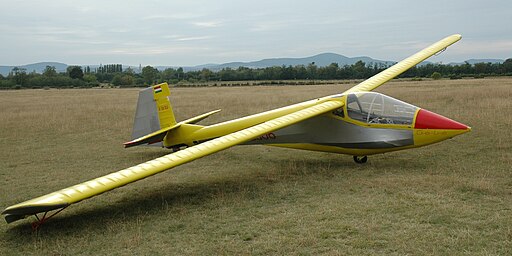
The Rubik R-26 Góbé is a Hungarian two-seat glider designed and manufactured in the 1960s. It was developed primarily for training and recreational soaring, with an emphasis on stability, durability, and ease of handling. Named “Góbé,” which translates to “clever” or “resourceful,” the aircraft quickly became a popular choice in gliding clubs across Eastern Europe due to its forgiving flight characteristics, simple construction, and suitability for early-stage pilot training.
Development and Design
The R-26 Góbé was conceived as a successor to earlier Rubik gliders, aiming to provide better performance and increased reliability for flight schools. The design featured a conventional high-wing monoplane configuration with a cantilever wing, providing stability and excellent visibility for the student and instructor seated in tandem. The airframe was primarily constructed from wood and fabric, a common and cost-effective approach for gliders of that era, while the fuselage utilized a semi-monocoque structure to ensure rigidity and light weight.
The glider incorporated fixed landing gear, with a monowheel complemented by small nose and tail skids. This configuration reduced complexity, maintenance needs, and weight, while allowing operations from grass airstrips commonly found in gliding clubs. The cockpit accommodated two occupants in tandem, with dual controls to facilitate instruction and pilot transition.
Aerodynamic Features
The Rubik R-26 Góbé was designed for stable and predictable flight characteristics. The high-wing design, combined with moderate dihedral and a conventional tail unit, provided excellent lateral and longitudinal stability. The wing employed a NACA airfoil profile optimized for low-speed lift and good glide performance, making it ideal for thermalling and extended flight durations.
The ailerons, rudder, and elevator were fully controllable with mechanical linkages, ensuring smooth response and simplicity of maintenance. The control surfaces were covered with fabric, reducing weight and enhancing the glider’s responsiveness. Airbrakes were integrated into the wings to allow controlled descents and precise landings, particularly important for training purposes.
Performance Characteristics
The Rubik R-26 Góbé is characterized by moderate performance metrics suitable for training and recreational use. Its glide ratio is approximately 28:1 at optimal speed, providing ample opportunity for thermalling and local soaring flights. The stall speed is low, around 40 kilometers per hour, which contributes to forgiving takeoff and landing characteristics for student pilots.
The maximum permissible flight speed is approximately 180 kilometers per hour, ensuring structural integrity during maneuvers while providing sufficient envelope for intermediate and advanced pilot training. The aircraft can handle light aerobatic maneuvers, though it is primarily intended for standard soaring and cross-country training.
Cockpit and Instrumentation
The cockpit of the R-26 Góbé is simple and functional, optimized for training and dual-control operations. Standard instrumentation includes an airspeed indicator, variometer, altimeter, and compass. Some gliders are equipped with optional flight computers or radio communication devices for cross-country training and competition flights.
The tandem seating arrangement allows the instructor to have an unobstructed view of the student, enabling effective monitoring of control inputs and flight performance. Large canopy glazing ensures excellent visibility, essential for thermal detection and collision avoidance during group gliding operations.
Landing Gear and Ground Handling
The glider’s fixed monowheel landing gear is complemented by small nose and tail skids. This arrangement provides simple and lightweight ground handling while allowing operations on grass airfields without extensive infrastructure. The monowheel is typically fitted with a shock absorber to reduce impact forces during landing. Ground handling is straightforward, and the glider can be easily maneuvered by a small crew or even manually in some cases.
Operational Roles and Uses
The Rubik R-26 Góbé has served primarily as a training glider in Hungarian and Eastern European gliding clubs. Its stable handling and forgiving flight characteristics make it ideal for novice pilots, while its reasonable performance allows more experienced pilots to practice cross-country flights. The glider has also been used in recreational soaring, gliding competitions, and flight demonstrations, demonstrating its versatility and reliability.
Dimensions and Technical Parameters
-
Wingspan: 16.0 meters
-
Length: 7.2 meters
-
Height: 1.35 meters
-
Wing area: 17.6 square meters
-
Aspect ratio: 14.5
-
Empty weight: 320 kilograms
-
Maximum takeoff weight: 500 kilograms
-
Wing loading: 28 kg/m²
-
Glide ratio: 28:1
-
Minimum sink rate: 0.7 m/s
-
Stall speed: 40 km/h
-
Maximum permissible speed: 180 km/h
-
Maximum allowable load factor: +4.0 / -2.0 g
-
Landing gear: fixed monowheel with nose and tail skids
-
Control surfaces: ailerons, elevator, rudder, and wing-mounted airbrakes
Safety and Maintenance
The R-26 Góbé’s wooden and fabric construction allows for simple maintenance and repair with conventional materials and techniques. Routine inspections include checking for fabric integrity, wood joint condition, and control surface linkages. Its forgiving flight characteristics contribute to safety, particularly for beginner pilots. The glider’s low stall speed and stable behavior reduce the likelihood of accidents during takeoff, thermalling, and landing.
Legacy and Conclusion
The Rubik R-26 Góbé remains an iconic example of mid-20th-century Hungarian glider design. Its combination of stable flight characteristics, ease of maintenance, and suitability for both training and recreational soaring has earned it a lasting reputation among gliding enthusiasts. Even decades after its introduction, many R-26 Góbé gliders remain in use, serving as a testament to the design’s robustness and thoughtful engineering. The glider continues to be celebrated for its contribution to pilot training and the promotion of recreational aviation in Hungary and beyond.
