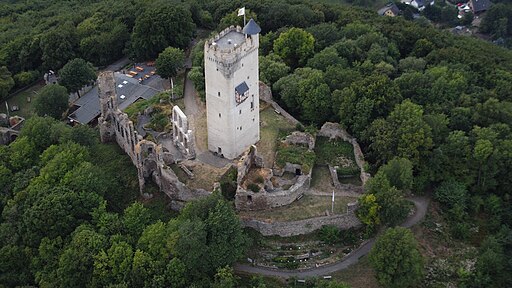
Burg Olbrück is a prominent hilltop castle ruin located in the eastern Eifel region of Rhineland-Palatinate, Germany. Standing high above the Brohltal valley near Niederdürenbach, it is one of the oldest fortifications in the wider Eifel area and an unmistakable landmark that dominates the surrounding volcanic landscape. The site’s elevated position on a basalt cone provides sweeping panoramas of the Eifel highlands, illustrating why medieval builders chose this strategic and symbolic location. Although largely in ruins today, Burg Olbrück has been partially restored and continues to attract visitors who are intrigued by its ancient origins, dramatic setting, and atmospheric remains.
Early History and Construction
The origins of Burg Olbrück reach back to the eleventh century, with construction typically dated to around 1050. It was likely established by the Counts of Wied or noble families closely associated with the Archbishopric of Cologne, which exerted significant influence in the region during that period. The castle’s early Romanesque design reflected the architectural norms of the time, with a compact layout centered on a fortified keep and essential defensive structures. These early phases of construction focused primarily on military strength, ensuring the hilltop fortress could withstand regional conflicts, territorial disputes, and the shifting political alliances of the medieval Rhineland.
Development Through the Middle Ages
Over the following centuries, Burg Olbrück expanded and adapted to the evolving needs of its inhabitants. Additional curtain walls, residential buildings, and defensive outworks were constructed, particularly during the high and late Middle Ages. The castle gradually developed into a more complex fortified residence, accommodating not only soldiers but also administrators and servants in the service of its ruling lords. Because the Eifel region often found itself at the crossroads of competing noble interests, Burg Olbrück played a role as a local stronghold during both minor feuds and larger regional conflicts. Its architecture reflects these demands, combining living quarters with robust military features that attest to the turbulent history of the medieval Rhine territories.
Destruction and Decline
Like many castles in the Rhineland, Burg Olbrück met its downfall during the seventeenth century. The turmoil of the Thirty Years’ War weakened many fortifications, and in the decades that followed, French troops under Louis XIV targeted numerous German castles to break regional resistance. Burg Olbrück was heavily damaged and subsequently abandoned, leaving it to decay. Over time, storms, vegetation, and the natural erosion of its volcanic rock foundation contributed to its ruinous state. By the eighteenth and nineteenth centuries, the site had become a picturesque ruin often sketched or written about by travelers who were inspired by the romantic appeal of its crumbling walls and dramatic setting.
Modern Restoration and Preservation
In the twentieth century, efforts were made to stabilize and preserve Burg Olbrück, recognizing both its cultural value and its significance as a regional landmark. Restoration work focused on securing the remaining walls and reconstructing the tower to a safe and accessible state. This restored tower now serves as a lookout platform, offering expansive views over the volcanic Eifel landscape, including the Laacher See area and numerous extinct volcanic cones. Modern preservation emphasizes both safety and authenticity, ensuring visitors can explore the site while still experiencing the atmosphere of an ancient fortress shaped by centuries of history.
Architecture and Site Layout
Visitors to Burg Olbrück today encounter a fascinating mix of ruined masonry, reconstructed elements, and clearly visible medieval structural forms. The dominant feature is the tall tower, which stands on the foundations of the original keep and provides insight into the vertical defensive strategy common in eleventh-century castles. Remnants of the ring walls, segments of the inner courtyard, and outlines of former halls and residential buildings allow one to imagine the castle’s medieval layout. The basalt hill on which Burg Olbrück stands also plays a significant role in defining its architecture, as the irregular volcanic terrain dictated the orientation and development of the fortress over many centuries.
Cultural Significance and Tourism
Burg Olbrück has become an integral part of the cultural and natural heritage of the Eifel region. Its commanding silhouette is visible for miles, contributing to the identity of the Brohltal and serving as a symbol of the region’s medieval past. The castle is included in regional hiking networks, including routes associated with the Vulkanpark, which highlights the geological history of the Eifel volcanic field. Educational signs and guided tours help visitors understand both the historical evolution of the castle and the unique volcanic landscape that surrounds it. Events such as medieval markets, cultural performances, and themed tours bring additional life to the ancient ruins and reinforce their role as a living monument.
Visiting Burg Olbrück Today
A visit to Burg Olbrück offers a combination of historical exploration, scenic vistas, and immersion in the natural beauty of the Eifel. The ascent to the hilltop rewards hikers with a sense of stepping back in time, and the restored tower provides an exceptional panoramic viewpoint. While much of the castle remains in ruin, the careful preservation work ensures that visitors can safely navigate the site and appreciate its architectural and historical significance. Whether one approaches it as a history enthusiast, a hiking visitor, or someone drawn to picturesque ruins, Burg Olbrück offers a rich and memorable experience.
