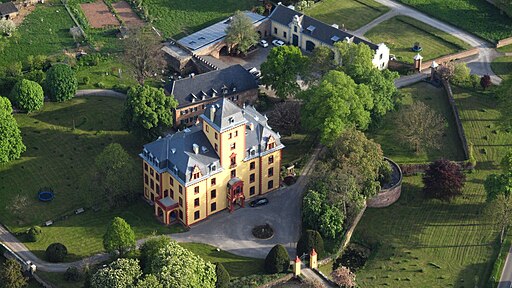
Schloss Wachendorf is located in the Eifel region of western Germany, an area characterized by rolling hills, forests, and a long tradition of rural settlement shaped by agriculture and small-scale industry. The surrounding landscape plays an essential role in understanding the castle’s significance, as it reflects the close relationship between aristocratic residences and the land they governed. The estate developed within a cultural landscape that balanced productivity and representation, where noble families demonstrated their status not only through architecture but also through the careful organization of fields, gardens, and access roads. Schloss Wachendorf stands as a prominent landmark within this setting, visually anchoring the village and reinforcing its historical role as a center of local authority.
Historical Origins and Noble Lineage
The origins of Schloss Wachendorf can be traced to the medieval period, when the site functioned as the seat of a local noble family responsible for administering land and maintaining regional order. Early structures were likely modest and practical, designed to combine residential comfort with defensive capability. Over time, as feudal conflicts diminished and political conditions stabilized, the castle developed into a more refined noble residence. Successive owners expanded and reshaped the complex, responding to shifts in wealth, alliances, and social expectations. Through inheritance, marriage, and changing political affiliations, Schloss Wachendorf became part of a broader network of noble estates that linked the Eifel region to wider developments within the Rhineland.
Architectural Development and Design Features
Architecturally, Schloss Wachendorf reflects centuries of adaptation rather than a single, unified design concept. Medieval foundations and compact building forms coexist with later additions that emphasize symmetry, larger windows, and more comfortable interior spaces. The architectural evolution of the castle illustrates how noble residences transitioned from fortified strongholds to representative country estates. Defensive elements gradually lost their importance, while aesthetic considerations and domestic functionality gained prominence. The overall layout suggests careful planning, with the main residential structures complemented by auxiliary buildings that supported estate management. This layered architectural character gives Schloss Wachendorf its distinctive identity, revealing how each historical period left a visible imprint on the structure.
Social and Economic Role in the Region
Schloss Wachendorf was not merely a private residence but also a key institution within the local social and economic system. As the administrative heart of an estate, it played a central role in organizing agricultural production, collecting rents, and overseeing legal matters. The castle’s presence shaped the development of the surrounding village, influencing settlement patterns and employment opportunities. Local inhabitants depended on the estate for work and protection, while the castle’s owners relied on the productivity of the land and the loyalty of their tenants. This interdependent relationship highlights the broader function of noble estates in rural German society, where power, responsibility, and economic survival were closely intertwined.
Transformation and Preservation in Modern Times
In the modern era, Schloss Wachendorf has undergone significant transformation as traditional aristocratic structures gave way to new social and economic realities. Like many historic estates, it faced periods of decline, changing ownership, and the challenge of maintaining an aging structure. Preservation efforts have focused on safeguarding the architectural integrity of the castle while allowing it to adapt to contemporary uses. Today, Schloss Wachendorf is valued as a cultural and historical monument that offers insight into the region’s past. Its continued preservation underscores the importance of protecting such sites, as they serve as tangible reminders of how history, architecture, and landscape are deeply connected over time.
