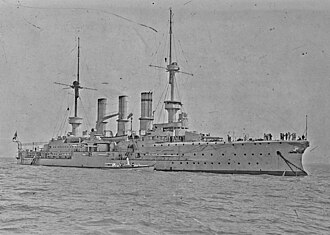
The SMS Friedrich Carl (1902) was an armored cruiser of the Imperial German Navy, a powerful and versatile warship designed during a period when Germany was rapidly expanding its naval strength and challenging the established maritime powers of Europe. Commissioned in December 1903, she represented a generation of vessels that combined substantial gun armament, protective armor, and the range needed to operate far from home waters. At just over 126 meters long, with a displacement of more than 9,000 metric tons and a top speed of approximately 20 knots, Friedrich Carl was built to serve as a fleet scout, a formidable opponent for enemy cruisers, and a visible instrument of German maritime power. Her career, however, unfolded during a time of rapid technological change. The armored cruiser had once offered an attractive compromise between the heavy battleship and the lighter protected cruiser, but the arrival of more powerful guns, improved submarines, and increasingly sophisticated naval mines was changing the nature of sea warfare. Friedrich Carl served during the final years of peace, when naval exercises and international cruises reflected the prestige of the German Empire, before returning to active duty during the First World War. Her wartime career was tragically short: in November 1914, while sailing toward the Russian-held port of Libau in the Baltic Sea, she struck two naval mines and sank, with most of her crew rescued but several sailors lost. Her story is therefore more than a record of a ship’s construction, armament, and final voyage; it is also a reminder of how quickly the strategic assumptions behind a modern warship could be overturned by the changing weapons of industrial warfare.
The Origins of the Prinz Adalbert Class
Germany’s Expanding Naval Ambitions
Friedrich Carl was the second and final ship of the Prinz Adalbert class, developed as part of Germany’s broader effort to establish a modern navy capable of protecting overseas interests and supporting operations in European waters. Around the turn of the twentieth century, German naval policy was increasingly shaped by the belief that maritime power was essential to the country’s international standing, commercial security, and strategic independence. The Naval Laws championed under Kaiser Wilhelm II and Grand Admiral Alfred von Tirpitz provided a framework for expanding the fleet, while industrial growth enabled German shipyards to construct increasingly sophisticated warships. The armored cruiser occupied a useful position within this strategy because it could perform several missions without requiring the resources of a full battleship. It could scout ahead of the main fleet, patrol trade routes, reinforce distant stations, and confront enemy cruisers that might threaten German commerce or colonial possessions. Yet the type also reflected a compromise: Germany needed ships capable of performing numerous duties, but budgets and force-planning priorities made it difficult to build separate specialized vessels for every task. The Prinz Adalbert class consequently combined long-range cruising ability with enough armor and firepower to fight opponents of similar size, making it suitable for a navy that wanted flexibility both at home and overseas.
The Development of a More Capable Armored Cruiser
The Prinz Adalbert class developed from earlier German armored cruisers, incorporating improvements intended to make the ships more balanced fighting units. Friedrich Carl’s design retained the basic concept of a heavily armed cruiser protected by an armored belt, but it carried a main battery of four 21-centimeter guns and a substantial secondary battery of 15-centimeter weapons. This arrangement gave the ship the ability to engage an enemy cruiser with heavy shells while using her numerous medium-caliber guns to maintain a rapid volume of fire. Her armor was concentrated around the vital parts of the hull and armament rather than spread evenly across every surface, a practical compromise that helped keep displacement within acceptable limits. The design also reflected the expectations of a period when naval battles were still often imagined as exchanges of gunfire between ships visible on the horizon, with speed, gunnery, armor, and tactical maneuver playing central roles. The later development of dreadnought battleships and battlecruisers would make many existing armored cruisers less competitive in a direct confrontation with the newest capital ships, but this did not immediately make them obsolete. In 1903, when Friedrich Carl entered service, she was a modern and useful asset, particularly for reconnaissance, independent patrols, and operations in which the navy needed a ship more capable than a light cruiser but less costly than a battleship.
Construction and Commissioning
Built at Blohm & Voss in Hamburg
Friedrich Carl was constructed by the Blohm & Voss shipyard in Hamburg, one of the major German industrial centers involved in the expansion of the Imperial Navy. Her keel was laid in 1901, and she was launched on 21 June 1902, allowing the hull to enter the fitting-out stage before commissioning on 12 December 1903. Launching was an important milestone, but it did not mean the ship was ready for combat: engines, boilers, electrical systems, gun mountings, armor fittings, communications equipment, and numerous other systems still had to be installed, tested, and integrated before the vessel could join the fleet. Building a warship of this size required the coordinated work of shipwrights, engineers, metalworkers, machinery specialists, and weapons technicians, along with a complex supply chain that delivered armor plate, guns, ammunition, and propulsion equipment. The finished vessel was more than a steel hull carrying artillery; she was a floating industrial system whose effectiveness depended on the reliable interaction of hundreds of mechanical and human processes. When Friedrich Carl finally entered service, she joined a navy that was investing heavily in standardized training, fleet organization, and increasingly ambitious exercises designed to prepare its ships for operations in the North Sea, the Baltic, and beyond.
A Name Rooted in Prussian History
The ship’s name connected her to the Prussian military tradition that played such an important role in the identity of the German Empire. German naval vessels were often named after monarchs, military figures, provinces, or other symbols of national history, allowing the expanding fleet to project continuity with the traditions of the state. The name Friedrich Carl recalled a Prussian royal and military figure, fitting the naming culture of a navy that sought both to modernize its technology and to establish a distinctive national heritage. In practice, however, a ship’s identity was defined as much by the people who served aboard her as by the name painted on her stern. Officers managed navigation, engineering, gunnery, and discipline, while hundreds of enlisted sailors maintained the boilers, handled ammunition, operated weapons, and performed the routine work required to keep the cruiser ready for sea. Life aboard a large armored cruiser involved demanding watches, maintenance in confined machinery spaces, repeated gunnery drills, and the constant challenge of managing heat, smoke, vibration, and noise. The ship’s eventual loss would therefore affect not only an item of naval equipment but also a tightly organized community of sailors whose daily lives revolved around the vessel.
Design and Physical Characteristics
Dimensions, Hull, and Seakeeping
Friedrich Carl measured approximately 126.5 meters overall, with a beam of 19.6 meters and a forward draft of about 7.43 meters. Her normal displacement was approximately 9,087 metric tons, rising to roughly 9,875 metric tons at full load. These dimensions gave her the volume needed to accommodate heavy artillery, armor, machinery, coal bunkers, ammunition magazines, accommodation spaces, and the stores required for extended operations. Her long steel hull was divided into compartments to help contain flooding, while internal structural arrangements supported the weight of the armor and the stresses produced by the ship’s machinery and guns. As with other warships of her generation, the designers had to balance competing demands: a broad enough hull to support stability and protection, sufficient internal space for propulsion and ammunition, and a shape capable of moving efficiently through the water at cruising and combat speeds. The ship’s three large funnels and substantial masts gave her the recognizable profile of an early twentieth-century armored cruiser. Her appearance also reflected the practical requirements of a coal-fired steam warship, because the boilers needed a dependable supply of air and a way to discharge exhaust while the crew required access to observation points and signaling equipment. In peacetime, these features helped make Friedrich Carl an impressive symbol of naval power; in wartime, they formed part of a working vessel that had to navigate unfamiliar waters, respond to orders, and remain operational under increasingly dangerous conditions.
Armor Protection
The cruiser was protected by Krupp armor, a form of hardened steel associated with the increasingly sophisticated armor technology of the late nineteenth and early twentieth centuries. Her main armored belt was approximately 100 millimeters thick amidships, where the most important machinery and internal spaces required protection, and thinner toward the ends of the ship, where the need to save weight was greater. The main gun turrets had armor up to about 150 millimeters thick, while the forward conning tower also received protection of approximately 150 millimeters. The casemate-mounted secondary guns were shielded by armor around 100 millimeters thick, and deck protection varied according to location and design, commonly reported within a range of roughly 40 to 80 millimeters. This protective arrangement was intended to improve the ship’s chances of surviving shellfire from other cruisers, especially at ranges where the trajectory and penetration of incoming projectiles made belt and turret armor decisive. Armor could not, however, make a vessel invulnerable. Its value depended on the angle and type of incoming fire, the location of an impact, the integrity of internal compartments, and the ability of damage-control teams to control flooding and fires. Mines presented a different kind of danger: an underwater explosion could damage the hull below the armored belt, rupture compartments, and compromise the ship’s buoyancy without first penetrating a heavily protected turret or conning tower. Friedrich Carl’s loss in 1914 would demonstrate this fundamental limitation with terrible clarity.
Propulsion and Performance
Triple-Expansion Steam Engines
Friedrich Carl was powered by three vertical triple-expansion steam engines, each driving one of the ship’s three screw propellers. Steam came from fourteen coal-fired Dürr water-tube boilers, which supplied the energy required to move the vessel and operate her machinery. The engines used successive stages of expansion to extract work from steam, a mature and widely adopted technology that had enabled the construction of large ocean-going warships before steam turbines became dominant in many new naval designs. The ship’s machinery was rated at approximately 17,000 metric horsepower, and her designed speed was around 20 knots, although trial figures could be somewhat higher depending on the conditions and the measurement used. Three propellers offered substantial propulsion power and helped distribute the demands of a large vessel across several shafts, but the entire system depended on intensive labor. Boiler rooms required stokers to move coal into the furnaces, maintain combustion, and remove ash, while engineers monitored steam pressure, lubrication, temperatures, and the performance of moving components. The heat and physical effort involved made engineering spaces among the most demanding workplaces aboard the cruiser. At sea, the reliability of the engines and boilers was essential to tactical freedom: a ship that could not maintain speed might lose contact with a formation, fail to reach a patrol area on schedule, or be unable to disengage from an enemy.
Range, Coal Consumption, and Operational Reach
The cruiser carried up to approximately 1,630 metric tons of coal, providing a reported range of around 5,080 nautical miles at a cruising speed of 12 knots. This endurance was particularly important for a vessel expected to operate away from its main base, although the theoretical range was never an absolute guarantee of operational reach. Actual coal consumption varied with speed, sea conditions, machinery condition, weather, and the use of onboard equipment, while combat operations and prolonged high-speed steaming could reduce the distance that remained possible before refueling. Coaling itself was a demanding process, involving the transfer of large quantities of fuel into bunkers and the movement of coal through the ship’s internal spaces. The fuel burden also illustrates one of the great limitations of early twentieth-century naval technology: the cruiser required a substantial logistics network to support even a relatively short period of intense activity. A commander planning a patrol had to consider not only the location of enemy forces but also the availability of friendly ports, the ship’s fuel reserves, the condition of the machinery, and the possibility that the vessel might be required to remain at sea longer than anticipated. Friedrich Carl’s range made her useful for Baltic operations and extended cruises, but it could not eliminate the strategic importance of bases, intelligence, and careful operational planning.
Armament: Heavy Guns and Close-Range Defense
The Main Battery of 21-Centimeter Guns
Friedrich Carl’s principal offensive weapons were four 21-centimeter SK L/40 naval guns, mounted in two twin turrets, one forward and one aft. This arrangement allowed the ship to bring a powerful pair of guns to bear in either direction and potentially employ all four when the target lay within a suitable broadside firing arc. The designation L/40 indicated a barrel length of forty calibers, meaning that the barrel was forty times as long as the bore diameter. Such guns were designed to fire heavy shells capable of inflicting serious damage on enemy cruisers, penetrating armor at appropriate ranges, and destroying important components such as gun positions, command spaces, and exposed machinery. Their effectiveness depended on more than caliber alone: range estimation, spotting the fall of shot, crew training, ammunition supply, turret operation, and the ship’s movement in the sea all influenced the practical results of a gun engagement. The turrets and ammunition handling systems also imposed substantial engineering demands, requiring carefully coordinated crews and reliable mechanical equipment. In the era before radar-directed gunnery, naval combat relied heavily on visual observation and optical rangefinding, so visibility and weather could greatly affect the ability to hit a moving opponent. Friedrich Carl’s main battery gave her considerable firepower against ships of comparable size, but her weapons could not protect her from every threat, particularly an unseen underwater mine.
Secondary Guns and Torpedo Armament
The main battery was supported by ten 15-centimeter SK L/40 guns mounted in casemates along the sides of the ship. These weapons provided a faster-firing secondary battery suitable for engaging enemy cruisers and other targets that did not require the heavier guns, and their broadside positions allowed several to be brought to bear on a target alongside the vessel. Friedrich Carl also carried twelve 8.8-centimeter guns intended largely for defense against smaller, faster attackers such as torpedo boats. These lighter weapons were important because torpedo craft could threaten larger warships at close range, where a single successful torpedo attack might cause devastating damage. The cruiser additionally carried four 45-centimeter torpedo tubes installed below the waterline, with one in the bow, one in the stern, and one on each broadside. Torpedoes gave her a means of attacking enemy vessels without relying exclusively on gunfire, although their use required favorable positioning and a target within the weapon’s effective range. Together, the guns and torpedoes made Friedrich Carl a versatile combatant for the tactical assumptions of her time. Her armament could support fleet operations, patrols, and engagements against other cruisers, yet the First World War would increasingly expose the vulnerability of surface warships to weapons that were difficult to see or stop before impact.
Peacetime Service in the Imperial German Navy
Fleet Training and Reconnaissance Duties
During the early years of her career, Friedrich Carl served with the active fleet’s scouting forces and participated in the training exercises that prepared German ships for coordinated operations. Reconnaissance was a central responsibility for cruisers: commanders needed to locate enemy formations, report their movements, screen larger ships, and help the fleet avoid entering battle without sufficient information. These duties demanded a combination of speed, endurance, signaling capability, and the ability to fight off lesser opponents if necessary. Friedrich Carl also took part in cruises and naval activities associated with the public and diplomatic functions of the Imperial Navy, including voyages connected with the movements of Kaiser Wilhelm II. Such deployments helped demonstrate the reach of German naval power while giving crews practical experience at sea. Training exercises in the North Sea and Baltic Sea also allowed officers to practice formation maneuvers, gunnery, navigation, communications, and the coordination of ships operating together. These routines could appear repetitive, but they were vital to the navy’s ability to turn complex vessels into effective fighting units. A cruiser was only as useful as the crew that operated her, and peacetime service provided the opportunity to identify weaknesses, maintain equipment, and establish the habits that might later determine whether a ship survived in combat.
From Front-Line Cruiser to Training Ship
As the German fleet modernized, Friedrich Carl’s role gradually changed. By 1909 she had been withdrawn from the front line and assigned to torpedo-training duties, reflecting the steady arrival of newer warships and the changing requirements of the active fleet. This transition did not mean that the vessel had become useless; rather, it reflected the normal life cycle of a major warship in a period of rapid technological development. A ship that was no longer ideal for the most demanding front-line missions could still provide valuable service in training, instruction, and support. Torpedo training was particularly significant as navies developed increasingly sophisticated methods for launching and employing torpedoes from surface ships and submarines. Personnel needed to understand the handling, operation, and tactical use of these weapons, while officers had to learn how torpedoes affected maneuvering, formation spacing, and the design of defensive measures. Friedrich Carl’s use as a training ship therefore placed her within a broader process of naval adaptation. By 1914, however, international tension and the outbreak of war would return her to operational service, and her earlier period away from the front line would prove only a temporary pause in her military career.
Friedrich Carl During the First World War
Return to Active Duty in the Baltic
When the First World War began in 1914, Friedrich Carl was brought back into active service and assigned to German naval operations in the Baltic Sea. Under the command of Kapitän zur See Max Schlicht, and subsequently Fregattenkapitän Max Loesch, she became the flagship of a cruiser formation commanded by Rear Admiral Robert Mischke before serving under Rear Admiral Ehler Behring. The Baltic presented a distinctive operational environment. German and Russian naval forces operated in waters where coastlines, islands, shipping lanes, ports, and minefields could strongly influence movement, while the narrow entrances and confined geography made reconnaissance and local sea control especially important. German forces had to consider the possibility of Russian surface ships, submarines, and mine-laying operations, while also accounting for the activities of British submarines that could reach the Baltic through Danish waters. Friedrich Carl participated in patrols and sorties intended to locate hostile vessels and support German control of important areas. In late September 1914, the cruiser division supported the laying of a defensive minefield off Langeland, and in October Friedrich Carl took part in a sweep into the Gulf of Finland. The patrol failed to locate enemy vessels, illustrating a recurring reality of naval warfare: a sortie could consume substantial fuel, time, and effort without producing a visible engagement, even when its strategic purpose was important.
The Experimental Use of Seaplanes
During her wartime service, Friedrich Carl was also adapted provisionally to carry two seaplanes. The arrangement did not involve the kind of permanent aviation infrastructure that would later become familiar on dedicated aircraft-carrying ships, but it reflected the German navy’s interest in exploring the potential of aerial reconnaissance. Aircraft offered a way to extend observation beyond the immediate horizon and to search waters that might be difficult to survey effectively from a ship’s masts alone. In principle, an aircraft could help locate enemy ships, identify coastal defenses, or gather information about a harbor before a surface force approached. Early naval aviation remained experimental, however, and its practical value depended on weather, aircraft reliability, launch and recovery arrangements, trained personnel, and the availability of suitable support facilities. Carrying seaplanes on a cruiser that had not been designed as an aviation ship presented logistical and operational challenges, and the presence of aircraft did not eliminate the danger of mines or submarines. Friedrich Carl’s temporary aviation role is nevertheless an interesting illustration of the period’s rapid experimentation. Naval commanders were searching for new ways to improve situational awareness even as the basic surface warship remained dependent on engines, guns, armor, and the ability to navigate safely through waters that might have been mined in secret.
The Final Mission: The Attempt to Attack Libau
Why Libau Mattered
In November 1914, German naval command planned an operation against Libau, the port now known as Liepāja in modern Latvia. The objective was connected to the wider struggle for control of the Baltic and concern that the harbor could be used as a base by Russian forces and British submarines. Ports were more than places for ships to shelter: they were centers for supplies, repair, communications, and the coordination of operations along a coast. A hostile naval base could threaten shipping, complicate the movement of friendly vessels, and provide a forward position from which submarines or surface craft could operate. The planned attack therefore had a strategic purpose beyond the immediate prospect of bombarding a port. Friedrich Carl was assigned to the force and left the Memel area on 16 November, heading toward the operational zone. Yet the approach to a hostile port in wartime was dangerous even before an enemy ship appeared. Minefields could be laid by small vessels, often at night or under conditions that made detection difficult, and their locations might be only partially known to the force approaching them. A charted route could not guarantee safety if the enemy had recently altered the navigational picture, and the lack of visible defenses did not mean the waters were clear. Friedrich Carl’s final voyage would expose the risks inherent in operating a valuable surface warship through waters where the greatest threat might be invisible from the bridge.
Two Mine Explosions on 17 November 1914
At approximately 1:46 a.m. on 17 November 1914, Friedrich Carl struck a naval mine while operating about 33 nautical miles west of Memel. The mine had been laid by Russian destroyers in October, and the explosion immediately placed the cruiser in danger. The crew initially believed the impact might have resulted from a collision with a submarine, an understandable suspicion in a theater where underwater threats were becoming increasingly important. The ship’s commander turned her back toward Memel, attempting to withdraw from the danger area, but at approximately 1:57 a.m. Friedrich Carl struck a second mine. The second explosion compounded the damage and caused the vessel to take on water. Mines were especially dangerous because they could inflict major underwater damage without requiring an attacker to remain nearby or expose itself to return fire. The explosion could tear open hull plating, damage internal structures, flood machinery spaces, and disrupt electrical and pumping systems. Even a ship with strong armor around its guns and vital compartments could be critically endangered by damage beneath the waterline, where the hull’s ability to remain watertight was essential. Friedrich Carl remained afloat for several hours after the explosions, giving nearby German forces time to reach her, but the cruiser had suffered damage that could not be overcome under the circumstances.
Rescue and Loss of the Cruiser
The light cruiser Augsburg reached Friedrich Carl at approximately 6:20 a.m. and began evacuating her crew. The rescue operation was a race against the progressive flooding and the possibility that the damaged cruiser might capsize or sink before everyone could be brought to safety. Transferring hundreds of sailors from a damaged warship to another vessel was a difficult undertaking even in daylight, particularly when the sea, the movement of the ships, and the urgency of the situation made orderly movement essential. Friedrich Carl was eventually abandoned and sank at approximately 7:15 a.m. on 17 November 1914. Sources commonly report that seven or eight men died in the sinking, while most of the crew survived thanks to the rescue effort. The loss was a serious blow to the German Baltic cruiser force, not only because a substantial warship had disappeared but also because the incident showed how easily a planned operation could be disrupted before the enemy had even been encountered. The cruiser had been built to withstand gunfire and engage hostile vessels, but her final hours were governed by underwater damage, flooding, and the difficult work of evacuation. Her loss was not the result of a decisive gun battle or a dramatic duel between fleets; it was the result of a concealed defensive weapon doing its work long after it had been laid.
The Significance of Friedrich Carl’s Loss
Naval Mines and the Changing Character of Sea Warfare
Friedrich Carl’s sinking illustrates the strategic importance of naval mines during the First World War. Mines could be laid relatively cheaply compared with the cost of a large armored cruiser, and they could force enemy commanders to slow down, alter routes, conduct minesweeping operations, or abandon plans entirely. Their greatest advantage lay in uncertainty: a commander might know that a region was dangerous without knowing precisely where the mines had been placed, how many remained, or whether the charted channels were safe. This uncertainty could be enough to delay an operation or place a fleet at a disadvantage before any direct combat began. Mine warfare also complicated the traditional balance between armor and firepower. Heavy armor could reduce the damage caused by many types of shell, but it could not guarantee survival when an explosion occurred under the hull and caused extensive flooding. The danger was not limited to armored cruisers; battleships, destroyers, transports, and submarines could all be threatened by mines in different circumstances. The Baltic Sea, with its coastal geography and contested approaches to ports, provided an especially important setting for this form of warfare. Friedrich Carl’s fate therefore belongs to a broader history in which mines, torpedoes, submarines, and aircraft increasingly challenged the assumptions that had shaped the design of surface warships in the previous generation.
A Short Career With a Lasting Historical Lesson
Friedrich Carl’s operational career was relatively brief, but it captured the transition from the naval world of the early twentieth century to the more dangerous and technologically diverse environment of the First World War. She had been designed as a versatile armored cruiser, capable of scouting, patrolling, and fighting other surface vessels, and her machinery and armament reflected the advanced engineering of her era. Yet the ship’s loss demonstrated that a vessel’s strength could not be judged by displacement, gun caliber, or armor thickness alone. Naval effectiveness also depended on intelligence, route planning, mine countermeasures, operational timing, and the ability to adapt to threats that were not visible from the surface. Friedrich Carl’s story should not be reduced to the claim that armored cruisers were simply obsolete: she remained a useful asset for the tasks assigned to her, and her sinking resulted from a particular hazard rather than a direct test of her gun power against a newer warship. Still, the incident revealed the limits of the design philosophy behind large surface combatants when operating in waters shaped by hidden explosives and submarine warfare. In that sense, Friedrich Carl stands as an example of both the technical achievement and the vulnerability of the Imperial German Navy’s prewar fleet.
Conclusion: The Legacy of SMS Friedrich Carl
The history of SMS Friedrich Carl began in the shipyards of Hamburg, where German industrial skill transformed steel, machinery, armor, and artillery into a modern armored cruiser intended to serve the growing ambitions of the Imperial Navy. Commissioned in 1903, she spent her early years in fleet training, reconnaissance, and naval cruises before moving into torpedo-training duties as newer ships entered service. The outbreak of the First World War brought her back into operational use, and her service in the Baltic included patrols, minefield-related operations, and experiments with carrying seaplanes for reconnaissance. Her final mission toward Libau ended when she struck two Russian-laid mines on 17 November 1914. Although Augsburg rescued most of the crew, Friedrich Carl sank that morning, and several sailors lost their lives. Her story reveals the complexity of naval history: the ship was at once a product of national ambition, industrial engineering, military planning, and the everyday labor of hundreds of sailors, yet her fate was decided by a weapon that remained hidden beneath the water. Today, Friedrich Carl is remembered as one of the German armored cruisers lost early in the First World War, and her sinking provides a clear example of the risks facing surface fleets in confined and heavily contested waters. Her legacy lies not only in her specifications or her place in the Prinz Adalbert class, but also in the lesson that technological strength at sea has always depended on adapting to threats as well as building powerful ships.
Technical Specifications of SMS Friedrich Carl (1902)
| Specification | Details |
|---|---|
| Ship name | SMS Friedrich Carl |
| Country | German Empire |
| Ship type | Armored cruiser |
| Class | Prinz Adalbert class |
| Builder | Blohm & Voss, Hamburg, Germany |
| Keel laid | 1901 |
| Launched | 21 June 1902 |
| Commissioned | 12 December 1903 |
| Fate | Sunk by naval mines on 17 November 1914 |
| Length overall | Approximately 126.5 m (415 ft) |
| Beam | Approximately 19.6 m (64.3 ft) |
| Draft | Approximately 7.43 m forward |
| Normal displacement | Approximately 9,087 metric tons |
| Full-load displacement | Approximately 9,875 metric tons |
| Propulsion | Three vertical triple-expansion steam engines |
| Boilers | 14 Dürr water-tube boilers |
| Propellers | 3 |
| Power output | Approximately 17,000 PS |
| Maximum speed | Approximately 20 knots; slightly higher on trials |
| Range | Approximately 5,080 nautical miles at 12 knots |
| Coal capacity | Approximately 1,630 metric tons |
| Main armament | 4 × 21 cm SK L/40 guns in two twin turrets |
| Secondary armament | 10 × 15 cm SK L/40 guns |
| Anti-torpedo-boat armament | 12 × 8.8 cm guns |
| Torpedo armament | 4 × 45 cm submerged torpedo tubes |
| Belt armor | Approximately 80–100 mm |
| Main turret armor | Up to approximately 150 mm |
| Casemate armor | Approximately 100 mm |
| Deck armor | Approximately 40–80 mm, depending on location |
| Conning tower armor | Up to approximately 150 mm |
| Standard crew | Commonly listed as 35 officers and 551 enlisted men |
| Wartime aviation | Provisionally carried two seaplanes in 1914 |
.jpg)