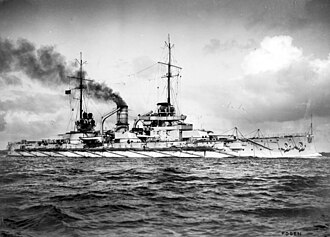
SMS Posen: The Nassau-Class Battleship at Jutland
When the age of the dreadnought began, naval powers around the world were forced to reconsider what a battleship should be. The launch of HMS Dreadnought in 1906 made the mixed-caliber battleships of the previous generation increasingly obsolete and triggered a new phase of the Anglo-German naval arms race. Germany responded with the Nassau class, its first true dreadnought battleships. Among the four ships of this pioneering class was SMS Posen, a heavily armored and unusually configured battleship that would become one of the most active German capital ships of the First World War.
Named after the Prussian province of Posen, Posen was constructed by Germaniawerft at Kiel. Her keel was laid down on 11 June 1907, she was launched on 12 December 1908, and she entered service with the Imperial German Navy on 31 May 1910. Measuring more than 146 meters in length and displacing over 20,000 tonnes fully loaded, she was an enormous ship by the standards of the period. Her main battery consisted of twelve 28 cm guns mounted in six twin turrets, while extensive armor protection gave her the resilience expected of a German battleship.
Posen spent most of her operational career with the High Seas Fleet, participating in fleet exercises and wartime sorties in the North Sea before becoming involved in the Baltic campaign of 1915. Her most important combat experience came during the Battle of Jutland, where she fought British light forces during some of the most confused nighttime action of the battle. Unlike several German capital ships, Posen escaped Jutland without serious damage. She remained in service until the end of the war, after which she was surrendered to the Allies and eventually broken up in the Netherlands. Her career provides an excellent illustration of the strengths and limitations of Germany’s first generation of dreadnoughts.
The Birth of SMS Posen
Germany’s First Dreadnought Battleships
The Nassau-class design originated in the years before HMS Dreadnought was completed. German naval designers had already recognized that battleship armament was moving toward increasingly powerful guns, and studies for a new type of capital ship were underway by the early 1900s. The development process was influenced by reports about foreign battleships, the Anglo-German naval competition, and lessons emerging from the Russo-Japanese War.
By 1906, German designers had settled on a battleship armed with twelve 28 cm guns. The resulting design differed significantly from Britain’s Dreadnought, despite being developed in response to the same changing naval environment. The Nassau class retained triple-expansion steam engines rather than adopting turbines, and its main guns were arranged in a distinctive hexagonal pattern. Four ships were constructed: Nassau, Westfalen, Rheinland, and Posen. All were laid down in 1907 or 1908 and entered service by 1910.
Posen was therefore not simply another battleship in the expanding German fleet. She represented a major technological transition. Her design was significantly more powerful than Germany’s preceding pre-dreadnoughts, yet it already contained several features that would soon be regarded as conservative. This makes the ship particularly interesting from a naval-history perspective because she stood between two generations of battleship design.
The ship’s construction was conducted under considerable secrecy, reflecting the sensitivity surrounding German naval expansion. Germaniawerft in Kiel laid down Posen on 11 June 1907, and the completed hull was launched on 12 December 1908. After fitting out and trials, she was commissioned on 31 May 1910. Her entry into service gave the Imperial German Navy another modern capital ship at a time when Germany was attempting to narrow Britain’s traditional naval advantage.
Design and Armament
The Unusual Hexagonal Battery
The most immediately recognizable feature of Posen was her main armament arrangement. She carried twelve 28 cm SK L/45 guns in six twin turrets. One turret was positioned forward on the centerline and another aft, while four additional turrets were arranged in pairs along the sides of the ship. Viewed from above, the arrangement formed a distinctive hexagonal pattern.
The layout allowed German designers to mount twelve heavy guns while working within the limitations of their chosen hull design, but it was not as efficient as the centerline arrangements that became standard on later dreadnoughts. Eight of Posen‘s twelve main guns could fire in a conventional broadside. The wing turrets also consumed considerable weight and internal space. Nevertheless, twelve 28 cm guns represented a formidable armament for a battleship commissioned in 1910.
The main battery was supported by twelve 15 cm SK L/45 secondary guns and sixteen 8.8 cm weapons. The ship also carried six submerged 45 cm torpedo tubes. This layered armament reflected the tactical assumptions of the period, when battleships were expected to fight enemy capital ships at long range while retaining the ability to defend themselves against cruisers and destroyers at closer distances.
The 28 cm guns were somewhat smaller than the 30.5 cm guns mounted aboard HMS Dreadnought and many of her successors, but German naval ammunition and gunnery doctrine were capable of making effective use of the weapons. The Nassau class was therefore not simply inferior because of its smaller caliber. Its designers compensated in other areas, particularly through protection and structural strength.
Armor and Protection
Protection was one of Posen‘s strongest characteristics. Her main armor belt reached approximately 270 mm in its thickest areas, while her main gun turrets were protected by armor up to approximately 280 mm. The conning tower received exceptionally heavy protection, reaching approximately 400 mm, and the armored decks provided additional protection against plunging fire.
German battleship designers placed great emphasis on survivability. The ship’s internal subdivision and underwater protection system were intended to limit flooding and contain the effects of torpedo explosions. The broad hull of the Nassau class provided considerable space for these protective systems, although the arrangement also increased the ship’s beam and contributed to a relatively high displacement.
This emphasis on protection would become one of the defining characteristics of German capital-ship design. Rather than seeking maximum speed or concentrating exclusively on offensive firepower, German naval architects attempted to create battleships that could remain in action after suffering substantial damage. The experience of Posen and her sisters during the First World War demonstrated the practical value of that approach.
Machinery and Performance
Triple-Expansion Power
One of the most notable aspects of Posen‘s engineering was her use of three triple-expansion steam engines. Twelve coal-fired water-tube boilers supplied steam to the engines, which drove three propeller shafts. The machinery was rated at approximately 22,000 horsepower and gave the battleship a maximum speed of about 20 knots.
The decision to use reciprocating engines rather than turbines was deliberate. At the time the Nassau class was being designed, turbine technology was still relatively expensive and German manufacturers had not yet developed the same large-scale turbine production capabilities that would become available later. Admiral Alfred von Tirpitz and elements of the German naval construction establishment therefore favored proven triple-expansion machinery.
This choice had advantages and disadvantages. Reciprocating engines were well understood and reliable, but turbines generally offered better performance for large warships as technology matured. The decision meant that Posen was slower than some of her British contemporaries. Nevertheless, approximately 20 knots was sufficient for operations with the German battle fleet, and the ship’s range of around 8,300 nautical miles at 12 knots gave her substantial endurance.
Peacetime Service Before 1914
Following her commissioning, Posen became part of the High Seas Fleet’s I Battle Squadron, where she served alongside her three Nassau-class sisters. Her early years consisted largely of the routine activities expected of a modern battleship: training cruises, gunnery exercises, fleet maneuvers, and large-scale exercises designed to prepare German crews for a potential war against Britain’s Royal Navy.
These exercises were far more than ceremonial displays. Operating a battleship required coordination among hundreds of sailors and officers responsible for propulsion, navigation, artillery, communications, damage control, and many other tasks. Fleet maneuvers also required individual ships to maintain formation while changing speed and direction, often under difficult weather conditions.
Germany’s strategic problem was that its fleet remained smaller than Britain’s. The High Seas Fleet therefore had to develop tactics that would allow it to challenge a numerically superior opponent without risking destruction in a single engagement. Posen was part of the battle force being developed for precisely this purpose.
When the First World War began in 1914, the ship entered a completely different phase of her career. The training exercises of the preceding years suddenly became preparation for actual combat.
SMS Posen in the First World War
North Sea Fleet Operations
During the early years of the war, Posen participated in German fleet operations in the North Sea. The High Seas Fleet frequently operated in support of battlecruiser raids against the British coast, with the heavier battleships providing distant support in case the Royal Navy responded with its own capital ships.
These operations were shaped by the numerical imbalance between the German and British fleets. Germany hoped to lure portions of the British Grand Fleet into situations where they could be attacked by concentrated German forces. Britain, meanwhile, sought to maintain the blockade and prevent the High Seas Fleet from breaking into the Atlantic.
The German battleships consequently spent considerable amounts of time at sea without encountering the enemy’s main battle line. For crews aboard Posen, wartime service involved long periods of preparation and patrol punctuated by sudden episodes of intense combat.
The Gulf of Riga
In August 1915, Posen was transferred to the Baltic as part of a major German operation against Russian naval forces in the Gulf of Riga. She operated alongside her sister ship Nassau during the campaign, with the German force attempting to penetrate the gulf and support the land offensive on the Eastern Front.
The operation demonstrated the difficulties of using large battleships in restricted waters. Mines were a major threat, while shallow channels limited maneuverability. Russian coastal defenses and naval forces added further complications. Even a battleship with enormous guns could be placed in danger by comparatively small obstacles when operating in confined waters.
Posen and Nassau engaged the Russian pre-dreadnought Slava during the campaign. The German ships possessed a considerable advantage in firepower, but the overall operation was not the decisive victory that had been hoped for. The combination of mines, geography, and Russian resistance prevented the German fleet from achieving all of its objectives.
After the Baltic operation, Posen returned to the North Sea and resumed service with the High Seas Fleet.
The Battle of Jutland
Into the Greatest Naval Battle of the War
The most important episode of Posen‘s career came on 31 May and 1 June 1916, when the German High Seas Fleet and British Grand Fleet fought the Battle of Jutland. The engagement was the largest surface battle of the First World War and involved dozens of major warships.
Posen formed part of the German battle line during the fighting. The daytime engagement involved long-range artillery exchanges, rapid maneuvering, and attacks by battlecruisers and light forces. As darkness fell, however, the nature of the battle changed dramatically.
Night combat was extremely dangerous. Identification was difficult, visibility was poor, and destroyers could approach capital ships closely enough to launch torpedoes. German and British ships repeatedly encountered one another in confused clashes. Posen became heavily involved in this nighttime fighting, engaging British light forces and contributing her guns to the German fleet’s efforts to reach safety.
At approximately 21:20, Posen engaged British battlecruisers of the 3rd Battlecruiser Squadron and later fired on British light forces. Her gunnery was effective enough to score a hit on HMS Princess Royal and straddle HMS Indomitable during the fighting. Later in the night, Posen became involved in close-range encounters with British destroyers, making extensive use of her secondary and main batteries.
One of the remarkable aspects of Posen‘s performance at Jutland is that she emerged without the serious damage suffered by some other ships. Accounts of the battle indicate that the Nassau-class battleships generally suffered only limited damage from smaller-caliber hits, and Posen escaped the serious shell damage that might otherwise have threatened her survival.
Jutland ended without the decisive fleet annihilation sought by either side. Germany inflicted heavier losses in ships and personnel during the battle, but Britain retained command of the North Sea. The High Seas Fleet remained a powerful force, but it never again fought a battle on the same scale.
The Final Years of SMS Posen
Following Jutland, Posen continued serving with the German fleet. She participated in further operations and remained one of the older dreadnoughts available to the High Seas Fleet. As the war continued, however, the strategic importance of battleships increasingly competed with that of submarines, mines, destroyers, and other naval forces.
The German fleet’s situation became increasingly difficult during 1917 and 1918. The British blockade continued to restrict Germany’s access to supplies, while the German submarine campaign became a central element of naval strategy. The High Seas Fleet remained largely intact but had fewer opportunities to challenge the Grand Fleet directly.
In the final months of the war, the German Navy was ordered to conduct a major fleet operation. The plan provoked the Kiel Mutiny, as sailors refused to participate in what many regarded as an unnecessary and potentially suicidal final battle. The mutiny spread and became one of the events contributing to the collapse of the German Empire in November 1918.
With the armistice, Posen‘s career as a German battleship effectively ended.
Surrender and Scrapping
After Germany’s defeat, the surviving High Seas Fleet was subjected to Allied restrictions. The newest and most important German capital ships were interned at Scapa Flow, where many were ultimately scuttled by their crews in June 1919. The Nassau-class battleships were among the older German dreadnoughts and were not part of the original Scapa Flow internment force. Nevertheless, the scuttling created a requirement for replacement ships.
Posen was ultimately ceded to the victorious Allied powers as a war prize. She was struck from the German naval register in November 1919 and transferred to Britain in 1920. Like her sister ships, she had no meaningful future as an operational battleship. The rapid development of naval technology had made the first generation of dreadnoughts increasingly obsolete, while the postwar treaties imposed strict limitations on German naval power.
Posen was eventually sold to a British shipbreaking company and dismantled at Dordrecht in the Netherlands. Her scrapping was completed in 1922. Thus, barely a dozen years after entering service, Germany’s first generation of dreadnought battleships had disappeared from the world’s fleets.
The Historical Legacy of SMS Posen
SMS Posen occupies an important position in the history of naval warfare because she was part of the class that introduced Germany to the dreadnought era. Her design demonstrated both the ambitions and limitations of German naval engineering in the years immediately following the appearance of HMS Dreadnought.
Her unusual twelve-gun hexagonal arrangement is perhaps her most recognizable feature, but her importance goes beyond her appearance. The ship represented a deliberate German approach to battleship design in which armor, internal subdivision, and survivability received enormous attention. Her triple-expansion engines were conservative compared with turbine propulsion, while her 28 cm guns were somewhat smaller than those carried by several contemporary foreign battleships. Yet she remained a capable frontline warship and demonstrated her durability during the intense conditions of Jutland.
Her career also illustrates how rapidly naval warfare evolved. When Posen entered service in 1910, she was a cutting-edge capital ship. By the end of the First World War, battleship warfare had become only one element of a much broader naval conflict involving submarines, mines, aircraft, destroyers, and increasingly sophisticated fire-control systems. The ship had survived the war, but the world of naval warfare that had produced her was disappearing.
Perhaps the most revealing part of Posen‘s story is that she was never decisively destroyed in battle. She survived the Gulf of Riga, fought at Jutland, and remained operational until the end of the war. Her ultimate fate was determined not by an enemy shell but by Germany’s defeat and the postwar dismantling of the Imperial German Navy.
For this reason, SMS Posen deserves to be remembered as more than one of four early German dreadnoughts. She was a product of the naval arms race, a veteran of the High Seas Fleet, a participant in one of history’s greatest naval battles, and an example of how quickly technological progress could transform a modern warship into an obsolete one. Her career lasted only about a decade, but within that period she witnessed one of the most dramatic transformations in naval history.
Technical Specifications of SMS Posen
| Specification | Details |
|---|---|
| Ship type | Dreadnought battleship |
| Class | Nassau class |
| Builder | Germaniawerft, Kiel |
| Laid down | 11 June 1907 |
| Launched | 12 December 1908 |
| Commissioned | 31 May 1910 |
| Length | 146.1 m |
| Beam | 26.9 m |
| Draft | Approximately 8.9 m |
| Normal displacement | Approximately 18,873 tonnes |
| Full-load displacement | Approximately 20,535 tonnes |
| Propulsion | 3 triple-expansion steam engines |
| Boilers | 12 water-tube boilers |
| Propeller shafts | 3 |
| Power | Approximately 22,000 PS |
| Maximum speed | Approximately 20 knots |
| Range | Approximately 8,300 nautical miles at 12 knots |
| Main armament | 12 × 28 cm SK L/45 guns |
| Main turrets | 6 × twin turrets |
| Secondary armament | 12 × 15 cm SK L/45 guns |
| Light armament | 16 × 8.8 cm guns |
| Torpedo armament | 6 × 45 cm torpedo tubes |
| Main belt armor | Up to approximately 270 mm |
| Turret armor | Up to approximately 280 mm |
| Conning tower armor | Up to approximately 400 mm |
| Deck armor | Up to approximately 80 mm |
| Crew | Approximately 40 officers and 968 enlisted personnel |
| Major wartime operations | North Sea fleet sorties, Gulf of Riga, Battle of Jutland |
| Postwar fate | Ceded to Allied powers |
| Final fate | Sold for scrap and dismantled at Dordrecht, Netherlands, in 1922 |
SMS Posen was ultimately a transitional battleship, standing at the beginning of Germany’s dreadnought era and at the same time embodying design decisions that would soon be overtaken by newer technology. Her twelve 28 cm guns, formidable armor, unusual turret layout, and conservative triple-expansion machinery made her distinctive among the great battleships of the First World War. Her service in the Baltic and North Sea, particularly her intense involvement in the nighttime fighting at Jutland, demonstrated that she was a serious combat vessel rather than merely an experimental response to British naval developments. Although she ended her career at a Dutch scrapyard only a few years after the war, Posen remains an important part of the story of the Imperial German Navy and the extraordinary transformation of battleship design between 1900 and 1918.
