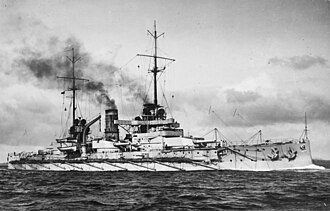
SMS Rheinland: The Nassau-Class Battleship That Fought at Jutland and Met Its Fate in Finland
At the beginning of the twentieth century, battleship design was changing at a remarkable speed. The introduction of HMS Dreadnought in 1906 transformed expectations of what a modern capital ship should be, and the major naval powers soon began building vessels equipped with batteries of heavy guns capable of engaging an enemy at unprecedented ranges. For the German Empire, this transformation was especially important. Germany had invested heavily in creating the Kaiserliche Marine, and the rapid development of the British fleet threatened to leave its existing battleships behind. The answer was the Nassau class, Germany’s first dreadnought battleships, and among them was SMS Rheinland.
Built by AG Vulcan at Stettin, Rheinland was laid down on 1 June 1907, launched on 26 September 1908, and commissioned on 30 April 1910. She was the third vessel of the four-ship Nassau class, following Nassau and Westfalen and preceding Posen. Like her sisters, she carried twelve 28 cm guns in six twin turrets, giving her a formidable main battery by the standards of the period. Yet the unusual arrangement of those turrets, her reliance on triple-expansion engines rather than turbines, and the considerable emphasis placed on armor made her different from many contemporary British battleships.
During the First World War, Rheinland became a veteran of the High Seas Fleet. She participated in operations in the North Sea, supported German naval activity in the Baltic, fought at the Battle of Jutland, and later played a role in Germany’s intervention in the Finnish Civil War. It was this final campaign that brought her active career to an abrupt end. In April 1918, Rheinland ran aground in the Åland Islands and suffered such severe structural damage that she was never returned to combat service. Her guns and large quantities of armor had to be removed before she could be refloated. She ended the war as a barracks ship and was ultimately surrendered to the Allies and scrapped in the Netherlands.
The Construction of SMS Rheinland
Germany Enters the Dreadnought Era
The story of Rheinland begins with the extraordinary naval competition between Britain and Germany. The German government had embarked on an ambitious program of naval expansion under Admiral Alfred von Tirpitz, seeking to create a fleet powerful enough to influence British strategic calculations. The arrival of Dreadnought changed the nature of that competition. Rather than relying on battleships carrying a mixture of heavy and medium-caliber guns, the new generation concentrated its principal offensive power into a large number of heavy weapons.
Germany’s Nassau class was the Imperial Navy’s answer to this new era. Although the design work had begun before Dreadnought entered service, the British battleship’s appearance accelerated the importance of the project. The four Nassau-class vessels were laid down in 1907 and 1908 and became the foundation of Germany’s modern dreadnought fleet. Rheinland, constructed by AG Vulcan at Stettin, was the third ship of the class. She was launched in September 1908 and entered service in April 1910.
At approximately 146.1 meters in length and 26.9 meters in beam, Rheinland was an imposing ship. Her maximum displacement was approximately 20,535 tonnes, while her normal displacement was around 18,873 tonnes. Her broad hull was characteristic of German battleship construction and provided considerable internal volume for machinery, ammunition, fuel, and protective arrangements. The ship’s beam also contributed to stability, which was particularly valuable for a heavily armed vessel operating in the rough waters of the North Sea.
An Unconventional Main Battery
The most distinctive feature of Rheinland was her main armament arrangement. She carried twelve 28 cm SK L/45 guns, distributed among six twin-gun turrets. Two turrets were mounted on the centerline, one forward and one aft, while four wing turrets were positioned in a staggered arrangement around the central superstructure. The resulting layout was broadly hexagonal.
This configuration was unusual and would not become the standard arrangement for later dreadnoughts. The wing turrets allowed the ship to carry twelve heavy guns without adopting the centerline arrangement that later became almost universal, but they also imposed significant limitations. Eight guns could fire in a broadside, rather than all twelve, and the wing turrets occupied considerable space and added weight. The design nevertheless gave Rheinland a very substantial broadside for her time.
Her heavy guns were complemented by twelve 15 cm guns and sixteen 8.8 cm weapons. Six submerged 45 cm torpedo tubes provided another offensive option, although torpedoes were generally a secondary weapon aboard battleships whose principal purpose was long-range artillery combat. The combination gave Rheinland the layered armament expected of a major fleet unit in the years immediately before the First World War.
Armor and Engineering
Built to Survive Heavy Gunfire
German naval architects placed considerable emphasis on protection, and Rheinland was no exception. Her main belt armor reached approximately 270 mm, while the turrets were protected by armor up to around 280 mm. The conning tower received exceptionally heavy protection, reaching approximately 400 mm. Deck armor varied by location and was significantly lighter than the main belt, reflecting the different threats designers expected from horizontal and vertical fire.
This extensive protection was part of a broader German philosophy that emphasized the ability of a battleship to remain operational after suffering damage. Internal subdivision and a heavily protected central citadel were important elements of this approach. A battleship did not merely need powerful guns; it needed to survive the return fire long enough to use them.
The Nassau-class ships therefore represented an interesting balance between offensive and defensive characteristics. Their 28 cm guns were smaller than the 30.5 cm weapons carried by HMS Dreadnought, but German ammunition and armor-piercing technology were capable of producing considerable battlefield effectiveness. Meanwhile, the substantial armor protection made the German ships difficult opponents in a fleet engagement.
Conservative Machinery
Another notable characteristic of Rheinland was her propulsion system. Instead of steam turbines, she was equipped with three triple-expansion steam engines, each driving one propeller shaft. Twelve water-tube boilers supplied steam to the engines. The machinery produced approximately 27,117 shaft horsepower according to German naval reference data, giving the ship a maximum speed of about 20 knots.
This was an important technological distinction. Britain had embraced turbine propulsion aboard Dreadnought, while Germany initially remained more cautious. Triple-expansion machinery was proven and familiar, but turbine propulsion offered important advantages as naval engineering developed. Later German battleships would increasingly adopt turbines, making Rheinland representative of an intermediate stage in the evolution of dreadnought propulsion.
Her range was nonetheless respectable. At 10 knots, Rheinland could reportedly travel approximately 9,400 nautical miles, giving her sufficient endurance for the operations expected of the High Seas Fleet.
Early Career in the Imperial German Navy
After entering service in 1910, Rheinland joined the High Seas Fleet and became part of the II Division of the I Battle Squadron alongside her three sister ships. The years before the First World War were characterized by exercises, fleet maneuvers, gunnery practice, and training cruises. These activities were essential because modern battleships were enormously complicated machines, and their effectiveness depended upon crews being able to operate them as part of large formations.
The German fleet was preparing for a possible confrontation with Britain, but no one could know precisely how such a confrontation would unfold. The Royal Navy possessed numerical superiority, while Germany’s geographical position meant that its main fleet was concentrated in the North Sea. The resulting strategy emphasized concentrated fleet operations and attempts to draw portions of the British fleet into engagements where German forces could exploit local advantages.
When war broke out in 1914, Rheinland became part of this strategy. She participated in several fleet advances and operations intended to support German battlecruiser raids against the British coast. These operations did not produce the decisive fleet battle Germany hoped for, but they gradually brought the opposing naval forces into increasingly dangerous proximity.
Service in the Baltic Sea
The Gulf of Riga
Although Rheinland is primarily associated with the High Seas Fleet and the Battle of Jutland, she also served in the Baltic Sea. In 1915, she participated in German operations supporting the Battle of the Gulf of Riga, an attempt to penetrate the Gulf and neutralize Russian naval forces operating there.
The Baltic presented a different operating environment from the open North Sea. Mines, coastal artillery, shallow waters, and restricted channels posed serious hazards to large warships. A battleship could possess enormous firepower and still be vulnerable to relatively inexpensive underwater weapons or navigational accidents.
The operation illustrated the difficulties involved in deploying modern battleships in confined waters. Nevertheless, Rheinland survived the campaign and returned to the North Sea, where she remained part of the German battle fleet.
SMS Rheinland at the Battle of Jutland
Entering the Greatest Battleship Battle of the War
The defining combat experience of Rheinland came at Jutland, fought on 31 May and 1 June 1916. The battle was the largest surface engagement of the First World War and brought virtually the entire German High Seas Fleet against the British Grand Fleet.
Rheinland formed part of the German battle line during the engagement. The daylight fighting involved long-range exchanges between battleships and battlecruisers, but the most chaotic action occurred after darkness fell, when the German fleet attempted to pass through British forces and return toward its bases. At night, identification became difficult, ranges contracted dramatically, and destroyers and cruisers became especially dangerous.
During the nighttime action, Rheinland became heavily engaged with British light forces. She fired at British destroyers and cruisers at relatively short ranges, conditions very different from the long-range gunnery exchanges that characterized portions of the daylight battle. Her heavy armor was particularly valuable in this environment, where the threat of torpedoes and rapid gunfire was constant.
The Nassau-class ships proved useful during the chaotic retreat. Their strong protection allowed them to withstand the hazards of close-range combat while their heavy secondary batteries could engage enemy light forces. Rheinland emerged from the battle damaged but operational.
Jutland failed to produce the decisive destruction of the British Grand Fleet that German naval planners had hoped for. Germany inflicted severe losses on the British, but the Royal Navy retained strategic control of the North Sea. For Rheinland, however, the battle demonstrated that her armor, guns, and machinery could withstand the demands of a major fleet action.
The Final Chapter in Finland
Germany Intervenes in the Finnish Civil War
By 1918, Germany’s strategic position had changed dramatically. The Russian Empire had collapsed following revolution, while Finland descended into civil war between the Red and White factions. Germany intervened on the side of the White Finns, sending troops and naval forces to support the anti-Bolshevik government.
Rheinland and her sister Westfalen were assigned to the Baltic expedition. The battleships arrived in the Åland Islands in March 1918, where they formed part of the German naval presence supporting the intervention.
The mission soon became a disaster for Rheinland. On 11 April 1918, while sailing from the Åland Islands toward Helsinki in heavy fog, she ran aground on Lagskär Island. The accident was catastrophic. Two men were killed, several boiler rooms flooded, and the inner hull suffered serious damage. Initial efforts to free the ship were unsuccessful.
The only practical solution was to make the battleship dramatically lighter. Crews and salvage workers removed her main guns, sections of armor, and other heavy equipment. Approximately 6,400 metric tons were removed before the ship could finally be refloated in July 1918. The operation was an extraordinary salvage effort, requiring floating cranes, pontoons, and assistance from other vessels.
After being towed back toward Germany, naval authorities concluded that repairing Rheinland as a fighting ship was not economically or practically worthwhile. She was therefore decommissioned on 4 October 1918 and converted into a barracks ship for the remainder of the war.
The End of the Battleship
The collapse of the German Empire in November 1918 brought an end to the Imperial German Navy. The surviving German capital ships became subject to Allied control and eventual disposal. Rheinland was struck from the naval register on 5 November 1919.
The ship was subsequently ceded to the Allies and sold to Dutch shipbreakers. She was towed to Dordrecht in July 1920 and dismantled during the early 1920s, with her scrapping completed in 1921. Unlike some of the famous German ships interned at Scapa Flow, Rheinland therefore did not end her career in a dramatic act of self-scuttling. Her final disappearance was the more ordinary but equally definitive process of being broken down for scrap.
One physical reminder of the ship survives. Her bell is preserved at the Bundeswehr Military History Museum in Dresden, providing a tangible connection to a battleship that otherwise vanished from the world’s naval landscape more than a century ago. (Wikipedia)
The Legacy of SMS Rheinland
SMS Rheinland was not the largest or most technologically advanced battleship of the First World War, but her career illustrates the rapid transformation of naval warfare during the early twentieth century. She belonged to Germany’s first generation of dreadnoughts, a class created during the intense competition that followed the arrival of HMS *Dreadnought. Her twelve 28 cm guns made her a powerful fleet unit, while her heavy armor reflected the German preference for survivability and protection.
Her unusual turret arrangement also tells an important story about technological transition. Naval designers had entered an era in which battleship armament was being standardized around heavy guns, but they had not yet settled on the centerline turret layouts that would dominate later designs. Rheinland therefore represents a fascinating stage between the traditional pre-dreadnought battleship and the mature fast battleships that followed.
Her combat record was substantial. She served in the North Sea, took part in Baltic operations, survived the enormous clash at Jutland, and later joined Germany’s intervention in Finland. Ironically, it was not an enemy battleship, submarine, or mine that ended her fighting career. Instead, a navigation accident in fog left her so badly damaged that she had to be stripped of thousands of tons of equipment before she could even be moved.
That ending makes Rheinland particularly memorable. She was designed to survive enemy gunfire and torpedoes, yet the unforgiving geography of the Baltic ultimately proved more dangerous than the British battle fleet. Her career is a reminder that the history of naval warfare is shaped not only by battles and weapons, but also by weather, navigation, geography, engineering limitations, and sheer circumstance.
Technical Specifications of SMS Rheinland
| Specification | Details |
|---|---|
| Ship type | Dreadnought battleship |
| Class | Nassau class |
| Builder | AG Vulcan, Stettin |
| Laid down | 1 June 1907 |
| Launched | 26 September 1908 |
| Commissioned | 30 April 1910 |
| Length | 146.1 m |
| Waterline length | 145.6 m |
| Beam | 26.9 m |
| Draft | Approximately 8.6–8.8 m |
| Normal displacement | Approximately 18,873 tonnes |
| Maximum displacement | Approximately 20,535 tonnes |
| Propulsion | 3 triple-expansion steam engines |
| Boilers | 12 water-tube boilers |
| Propeller shafts | 3 |
| Power | Approximately 27,117 shp |
| Maximum speed | Approximately 20 knots |
| Range | Approximately 9,400 nautical miles at 10 knots |
| Main armament | 12 × 28 cm SK L/45 guns |
| Main turrets | 6 × twin turrets |
| Secondary armament | 12 × 15 cm SK L/45 guns |
| Light armament | 16 × 8.8 cm guns |
| Torpedo armament | 6 × 45 cm submerged torpedo tubes |
| Main belt armor | Up to approximately 270 mm |
| Turret armor | Up to approximately 280 mm |
| Conning tower armor | Up to approximately 400 mm |
| Deck armor | Approximately 38–58 mm, depending on location |
| Crew | Approximately 1,000 personnel |
| Major wartime service | North Sea operations, Gulf of Riga, Battle of Jutland, Finnish Civil War intervention |
| Decommissioned | 4 October 1918 |
| Struck from register | 5 November 1919 |
| Final fate | Ceded to Allies and scrapped at Dordrecht, Netherlands, in 1921 |
SMS Rheinland remains an intriguing example of Germany’s first generation of dreadnought battleships. She entered service at a moment when naval technology was changing faster than ever, fought in one of history’s greatest fleet battles, and survived years of wartime operations before an accident in the Åland Islands brought her frontline career to an unexpected end. Her story is therefore not simply that of another battleship of the Imperial German Navy; it is a story of technological ambition, naval rivalry, combat, engineering resilience, and ultimately the limits imposed by the sea itself.
