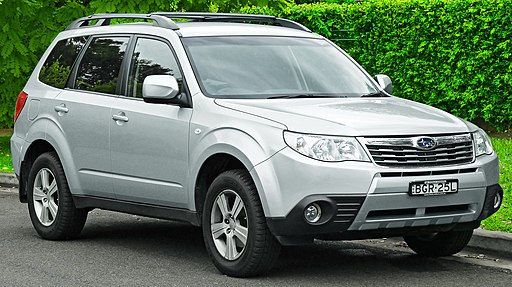
Subaru Forester faults
Below is a categorized list of the most frequently reported issues on Subaru Forester models, along with how they typically appear and the usual remedies or workarounds.
Engine & Oil Consumption
- Excessive oil consumption on turbocharged models High-mileage 2.5 XT Foresters (especially 2014–2018) can burn oil at rates up to 1 L per 1 000 km. Owners notice frequent low-oil warnings between services. Shortening oil-change intervals, using Subaru-approved 0W-20 oil, and regularly checking levels help. In severe cases, a top-end rebuild or piston-ring replacement under warranty may be required.
- Head gasket failures on older engines Foresters from 1998–2011 sometimes develop leaks at the cylinder-head seal, leading to coolant loss, white exhaust smoke, or overheating. Subaru issued warranty extensions for affected years. A head gasket replacement resolves the issue permanently.
Powertrain & Transmission
- CVT shudder and pulley wear Models with the Lineartronic CVT (notably 2014–2015) can exhibit judder or hesitation under acceleration and cruising. The belt-and-pulley assembly may glaze or the valve body wear out, triggering transmission fault codes. A fluid and filter change with Subaru’s CVT fluid (SP-III) often restores smoothness; beyond that, a valve-body overhaul or full-unit replacement may be necessary.
- Diesel injector seal leaks Diesel Foresters built between 2013–2018 occasionally leak at the high-pressure injector seals, causing rough idling and oil pools in the engine bay. Subaru recall kits include upgraded seals and new clamp bolts. Dealers perform the repair under warranty at no cost.
Cooling & Thermal Management
- Radiator and CVT cooler hose degradation On 2015 and 2019 models, flexible cooler hoses can crack, leading to coolant or transmission-oil leaks. Drivers spot fluid stains beneath the vehicle after parking. Replacing hoses with revised-spec rubber lines cures the issue, often covered by extended warranty campaigns.
Electrical & Infotainment
- Air conditioning compressor failures Belt-driven A/C compressors may seize or lose cooling capacity around 100 000 km, noticeable as warm air at low speeds. Recharging refrigerant provides a temporary fix; a full compressor swap and receiver-drier replacement delivers a lasting solution.
- Infotainment glitches First-generation Starlink units can lock up, reboot, or lose presets. A soft reset clears the module, while dealers apply software updates or, in persistent cases, replace the head unit under Subaru’s two-year electronics warranty.
Body & Glass
- Windshield spontaneous cracking Forester windshields (particularly 2010–2013) sometimes develop star-shaped cracks without impact, due to laminated-glass stress. Subaru covers replacement under certain glass-warranty or recall programs if damage isn’t collision-induced.
Safety Systems
- Airbag (SRS) warning lamp Faulty seat-belt buckle sensors or passenger-mass units can trigger a persistent SRS-warning light, disabling airbag-status alerts. Diagnostic scans pinpoint the failing sensor; replacing it restores full safety functionality.
Suspension & Steering
- Rear suspension clunks Early-generation Foresters may develop play in trailing-arm bushings or anti-roll-bar links, heard as knocks over bumps. Lubricating links or fitting updated nylon bushings eliminates noise and restores chassis stability.
Tyres & Alignment
- Uneven front-tyre wear Hard cornering and toe-out drift can cause accelerated inner-edge wear on front tyres after 20 000–30 000 km. A steering-angle sensor calibration followed by a four-wheel alignment to Subaru specifications stops further wear.
Before buying a used Forester, ask for a full service history and confirm that any recalls or extended-warranty campaigns addressing these faults have been completed. A targeted pre-purchase inspection focusing on these areas can save unexpected repair bills and ensure the vehicle has been properly maintained.
Subaru Forester as a used car
Subaru Forester as a Used Car: A Comprehensive Guide
Buying a used Subaru Forester combines the brand’s renowned all-wheel-drive capability with boxer-engine robustness. Whether you prioritize off-road performance or daily practicality, understanding its specifications, reliability nuances, and ownership costs is crucial to making a confident purchase.
Technical Specifications
Engine and Powertrains
Subaru’s hallmark horizontally opposed “boxer” petrol engine powers the core Forester lineup. The latest iteration features a 2.0 litre direct-injection unit producing 100 kW (136 PS) at 5 600 rpm and 182 Nm at 4 000 rpm, fed by a 48-litre fuel tank and running on a 12.5:1 compression ratio.
A mild-hybrid e-BOXER variant couples the petrol engine with a 3-phase AC synchronous motor rated at 12.3 kW (16.7 PS) and 66 Nm, enhancing low-speed torque without altering the full-time symmetrical all-wheel-drive system.
Earlier turbocharged “XT” Foresters delivered sportier performance, with second-generation 2.0 litre turbo models making 177 HP and 245 Nm, and third-generation 2.5 litre turbo units peaking at 230 HP and 320 Nm.
Drivetrain and Transmission
Every Forester is equipped with Subaru’s active torque-split symmetrical all-wheel-drive paired to a Lineartronic continuously variable transmission (CVT). The D-range spans ratios from 3.601 down to 0.513, while manual mode offers seven stepped ratios for enhanced driver control. A final-drive axle ratio of 3.900:1 ensures balanced power delivery across varied terrain.
Performance and Efficiency
The non-hybrid 2.0 i Forester accelerates from 0–100 km/h in 12.2 seconds, topping out at 188 km/h. Fuel consumption varies between 7.0 L/100 km in demanding cycles and 8.3 L/100 km under light loads, with a combined rating of 8.1 L/100 km and CO₂ emissions of 183 g/km. Diesel-powered Foresters consume between 5.1 and 6.3 L/100 km, translating to up to 46 mpg on WLTP testing, while the turbo XT variant averages around 33 mpg in mixed driving.
Dimensions and Weight
Measuring 4 670 mm in length, 1 830 mm in width, and 1 730 mm in height, the modern Forester rides on a 2 670 mm wheelbase. Ground clearance sits at 220 mm, and the cargo area expands to 1 731 L with rear seats folded. Kerb weight ranges from 1 693 to 1 722 kg, depending on engine and equipment level.
Market Depreciation and Pricing
Forester values typically drop by 15–20% in the first year, then about 10% annually in subsequent years. Early fourth-generation models (2013–2016) now change hands for approximately €8 000–€12 000, while recent fifth-generation units (2019–2021) command €18 000–€25 000 in Western Europe. Diesel and mild-hybrid variants often sustain value slightly better due to their fuel-economy edge and added efficiency.
Reliability and Common Issues
Known Faults
Boxer engines are celebrated for longevity, yet certain model years exhibit specific concerns. Owners of 2010–2013 Foresters have reported oxygen sensor failures that trigger spurious check-engine lights and occasional SRS-airbag warning lamps, both addressed via targeted recalls and sensor replacements.
Higher-mileage turbocharged XT versions sometimes display elevated oil consumption beyond Subaru’s service intervals, prompting vigilant oil-level monitoring and potential top-end rebuilds on extensively driven examples. Diesel models built between 2013 and 2018 may require injector-seal repairs and CVT-cooler-pipe replacements under warranty to avert transmission overheat incidents.
Best and Worst Years
Reliability data rank early 2000–2004 Foresters among the most dependable, with low complaint volumes across major powertrains. In contrast, 2015 and 2019 models see increased reports of transmission cooler hose fatigue and infotainment software glitches. The refreshed 2021–2022 lineup, by contrast, boasts smoother CVT behavior and fewer warranty visits, making sub-three-year-old examples desirable picks.
Maintenance and Ownership Costs
Service Intervals
Routine servicing aligns with these guidelines: oil and filter changes every 10 000–15 000 km; spark plug replacement at 60 000 km on petrol engines; brake fluid swaps biennially; and coolant system checks at 60 000 km intervals. Regular software updates via dealer networks help prevent electronic gremlins.
Running Costs
Fuel expenses vary by powertrain, with petrol Foresters averaging €80–€100 monthly on combined driving, and diesel drivers spending €50–€65 for the same distance. Annual inspections and minor services typically cost €200–€300. Wear items such as brake pads and tyres align with segment norms, with tyres lasting around 40 000 km and costing €120 each on average.
Pre-Purchase Checklist
- Inspect complete service history and confirm all recalls and software updates have been applied.
- Verify oil-consumption levels, especially on high-mileage turbo Foresters.
- Conduct a test drive focusing on CVT smoothness and symmetrical AWD engagement.
- Examine underbody and strut assemblies for corrosion or fluid leaks.
- Run a diagnostic scan for stored fault codes in engine, transmission, and airbag systems.
Conclusion
A well-chosen used Subaru Forester delivers a compelling mix of off-road prowess, boxer-engine endurance, and everyday usability. By understanding its technical makeup, pinpointing model-year hotspots, and budgeting for routine care, buyers can secure a reliable mid-size SUV that stands the test of time.
_XS_wagon_(2011-11-18)_01.jpg)