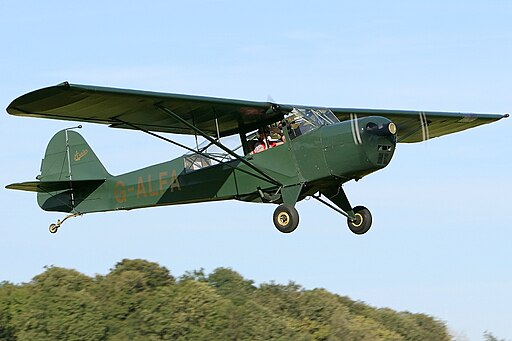
The Taylorcraft Auster: Britain’s Wartime Artillery Spotter
The Taylorcraft Auster was a family of light, high-wing liaison and observation aircraft built in the United Kingdom during the Second World War. Developed from the American Taylorcraft design, the Auster became the standard Air Observation Post (AOP) aircraft of the British Army and Royal Air Force. It was employed primarily for artillery spotting, liaison, communication, and short-range reconnaissance.
From its introduction in 1942, the Auster proved rugged, versatile, and easy to operate from unprepared strips close to the front lines. Its simplicity and adaptability ensured that it became one of the most widely used British liaison aircraft of the war, with its influence extending into the post-war years through later Auster variants.
Development Background
The origins of the Taylorcraft Auster can be traced to the Taylorcraft Aeroplanes (England) Limited, which produced licensed versions of the American Taylorcraft design beginning in the late 1930s. When war broke out, the British Army identified the need for a light aircraft capable of operating as an artillery spotter.
In 1941, a military evaluation program led to the adaptation of the Taylorcraft design into a specialized observation aircraft. The resulting Taylorcraft Auster Mk I entered service in 1942, with successive versions (Mk II, Mk III, Mk IV, and Mk V) incorporating refinements in performance, equipment, and load capacity.
The name “Auster” was adopted to give the aircraft a distinctly British identity. The series went on to serve not only with the British Army and RAF but also with Commonwealth forces.
Design Characteristics
The Auster was a high-wing monoplane with a fixed tailwheel undercarriage. Its high-wing layout gave excellent downward visibility, a critical requirement for artillery spotting and battlefield observation.
The fuselage was of steel-tube construction, while the wings were primarily wooden, both covered in fabric. This made the aircraft light, simple to repair, and relatively inexpensive to manufacture.
The cabin featured space for a pilot and one or two passengers, depending on the variant. Large side windows and a well-glazed cockpit enhanced the aircraft’s observation capability.
Engines varied by model, but the most common powerplants included the de Havilland Gipsy Major inline engine or the American Lycoming O-290, providing between 130 and 165 horsepower.
The Auster was not armed but could carry radios and light supplies. Its main role was observation, artillery coordination, and liaison flights, not combat.
Operational Use
The Taylorcraft Auster played a crucial role in Allied operations from 1942 onward. It was employed extensively in the North African campaign, the invasion of Italy, and the European theatre after D-Day.
Its ability to take off and land from very short grass fields close to the front lines allowed artillery officers to maintain direct contact with battlefield operations. Pilots often flew low and slow, directing artillery fire with remarkable accuracy, despite being vulnerable to ground fire.
Beyond artillery spotting, Austers were used for liaison, casualty evacuation (with a single stretcher in some modifications), and communication duties.
After the war, the Auster continued to serve in the British Army Air Observation Post units and was exported to many countries, including India, Canada, and Australia. It also formed the basis for post-war civil aircraft, such as the Auster Autocrat.
Technical Specifications (Taylorcraft Auster Mk V)
-
Role: Air Observation Post and liaison aircraft
-
Crew: 2 (pilot and observer)
Dimensions
-
Length: 22 ft 7 in (6.88 m)
-
Wingspan: 36 ft 0 in (11.0 m)
-
Height: 7 ft 10 in (2.39 m)
-
Wing area: ~174 sq ft (16.2 m²)
Weights
-
Empty weight: ~1,100 lb (500 kg)
-
Maximum takeoff weight (MTOW): ~1,800 lb (816 kg)
Powerplant
-
1 × de Havilland Gipsy Major I engine, four-cylinder inverted inline piston
-
Power output: 145 hp (108 kW)
Performance
-
Maximum speed: ~130 mph (209 km/h, 113 knots)
-
Cruise speed: ~100 mph (161 km/h, 87 knots)
-
Stall speed: ~40 mph (64 km/h, 35 knots)
-
Range: ~300 miles (480 km)
-
Service ceiling: ~13,000 ft (3,960 m)
-
Rate of climb: ~750 ft/min (3.8 m/s)
Other Features
-
Short takeoff and landing (STOL) capability
-
Fixed tailwheel undercarriage suitable for grass or improvised fields
-
Excellent visibility due to high wing and large cockpit glazing
-
Radio equipment for artillery coordination
Legacy
The Taylorcraft Auster became one of Britain’s most successful wartime utility aircraft. It was not glamorous, nor heavily armed, but it provided an indispensable service by enabling artillery units to conduct highly accurate fire support.
Its ruggedness and practicality made it a favorite with pilots and observers. More than 1,600 Austers of various marks were built during the war, and many continued in military and civilian roles well into the 1950s and 1960s.
The Auster’s lineage extended into post-war aviation, inspiring civilian touring aircraft such as the Auster J/1 Autocrat and continuing with military designs like the AOP.6 and AOP.9.
Today, surviving Austers are prized by vintage aircraft collectors and aviation heritage groups, flown at airshows and preserved in museums as a reminder of the aircraft’s quiet but vital contribution to victory.
