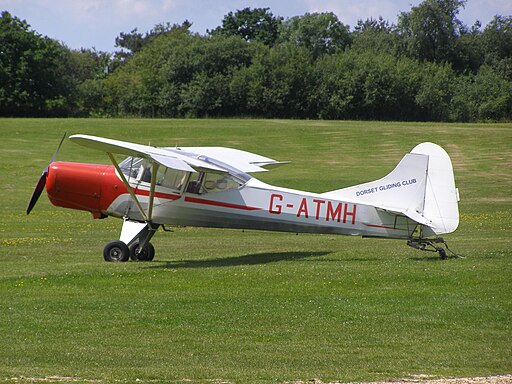
The Beagle Husky is a British light aircraft designed and produced during the 1960s by Beagle Aircraft Limited. Developed primarily as a utility and trainer aircraft, the Husky was intended to serve both civil and military markets. Its design emphasized versatility, ruggedness, and ease of maintenance, making it suitable for short takeoff and landing (STOL) operations. Although it was not produced in large numbers, the Beagle Husky remains notable for its innovative design and practical functionality for small airfields and bush flying conditions.
Development and Design
The Beagle Husky emerged from the postwar demand for affordable, multi-role light aircraft. Its airframe was a high-wing monoplane constructed largely of all-metal materials, with fabric-covered control surfaces to save weight. The aircraft featured a fixed tailwheel undercarriage, contributing to its robust and low-maintenance design. The Husky’s high-wing layout provided excellent downward visibility for observation and training purposes, while also allowing safe operations on rough or unprepared strips.
The cockpit was designed for dual control, making it suitable for flight instruction. The seating configuration was typically for two occupants, including the pilot, with some versions offering limited cargo or passenger flexibility. Large, glazed panels in the cabin offered improved visibility, enhancing its utility in aerial survey, reconnaissance, and photography missions.
Powerplant and Performance
The Beagle Husky was powered primarily by a Lycoming O-360 series engine, a four-cylinder, horizontally opposed piston engine delivering approximately 180 horsepower. This engine provided reliable performance while remaining economical and straightforward to maintain. The Husky’s propeller was a fixed-pitch unit, optimized for short-field operations and consistent cruise efficiency.
The aircraft’s performance characteristics included a maximum cruising speed of around 105 knots and a maximum range of approximately 400 nautical miles, depending on fuel load and operating conditions. The takeoff distance to clear a 50-foot obstacle was roughly 800 feet, demonstrating its STOL capabilities. Service ceiling was typically in the range of 14,000 feet, which allowed safe operation in varied terrain and weather conditions.
Airframe and Aerodynamics
The Beagle Husky featured a conventional high-wing design with strut bracing, providing structural simplicity and excellent lateral stability. The wingspan measured approximately 33 feet, and the wing incorporated full-span ailerons and manually operated flaps to enhance lift during takeoff and landing. The fuselage was constructed using semi-monocoque techniques, providing a strong yet lightweight structure.
The tail assembly consisted of a conventional vertical stabilizer and horizontal tailplane with a fixed-incidence design, providing predictable handling and stability. The aircraft’s control surfaces were cable-actuated, allowing responsive handling without the need for complex hydraulic systems.
Avionics and Instrumentation
Standard avionics for the Beagle Husky included a basic VHF communication radio, a magnetic compass, airspeed indicator, altimeter, turn and slip indicator, and engine monitoring instruments. Optional equipment could include navigation aids such as a VOR receiver or a basic autopilot for longer cross-country flights. Despite its simplicity, the instrument panel was ergonomically arranged for ease of use during both training and operational flights.
Landing Gear and Ground Handling
The Husky employed a fixed tailwheel undercarriage with robust, shock-absorbing main gear. This design allowed operations from unprepared airstrips and minimized maintenance requirements compared to retractable gear systems. The tailwheel configuration also contributed to better propeller clearance during rough field operations and provided excellent maneuverability on the ground.
Operational Roles and Usage
The Beagle Husky was used in a variety of roles, including private pilot training, observation flights, aerial photography, and light transport. Its STOL capabilities made it particularly valuable in remote or rugged regions where conventional airstrips were not available. Several air forces and flying clubs experimented with the Husky for training and liaison duties, though its commercial adoption remained limited.
Dimensions and Specifications
-
Length: 23 feet 9 inches
-
Wingspan: 33 feet 0 inches
-
Height: 7 feet 10 inches
-
Wing area: 160 square feet
-
Empty weight: 1,450 pounds
-
Maximum takeoff weight: 2,300 pounds
-
Engine: Lycoming O-360, 180 horsepower
-
Propeller: Two-blade fixed-pitch
-
Maximum speed: 110 knots
-
Cruising speed: 105 knots
-
Stall speed: 45 knots
-
Range: 400 nautical miles
-
Service ceiling: 14,000 feet
-
Takeoff distance (50 ft obstacle): 800 feet
-
Landing distance (50 ft obstacle): 750 feet
Legacy and Conclusion
Although the Beagle Husky was produced in limited quantities and did not achieve widespread commercial success, it remains a significant example of postwar British light aircraft engineering. Its rugged design, STOL performance, and practical versatility made it a reliable aircraft for both training and utility missions. Collectors and aviation enthusiasts continue to value the Husky for its historical significance and its distinctive place in the evolution of light utility aircraft.
