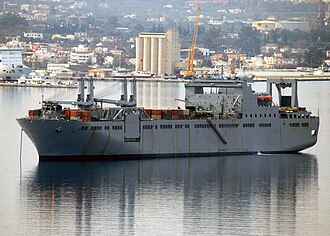
USNS Bob Hope (T-AKR-300)
The Massive Strategic Sealift Ship That Helped Redefine American Global Military Logistics
Modern military power depends on far more than fighter aircraft, missiles, tanks, or warships. Behind every combat operation lies a vast and often invisible logistical network responsible for moving troops, armored vehicles, ammunition, fuel, helicopters, engineering equipment, and supplies across oceans and continents. Without strategic transportation capability, even the most technologically advanced armed forces quickly lose operational effectiveness. In the modern era, few organizations understand this reality more clearly than the United States military, whose global commitments require the ability to project enormous amounts of combat power to distant regions at extraordinary speed. One of the most important vessels supporting this logistical architecture is the USNS Bob Hope (T-AKR-300), a giant roll-on/roll-off strategic sealift ship operated by the United States Navy’s Military Sealift Command.
The ship belongs to the Bob Hope-class of large, medium-speed roll-on/roll-off vessels, commonly abbreviated as LMSR ships. These vessels were specifically designed to solve one of the most difficult problems in modern military strategy: how to transport massive quantities of heavy military equipment quickly across intercontinental distances while maintaining operational flexibility and rapid unloading capability.
Unlike traditional cargo ships that rely heavily on cranes and port infrastructure, roll-on/roll-off vessels are designed around direct vehicle movement. Tanks, trucks, armored personnel carriers, trailers, engineering machinery, and other wheeled or tracked vehicles can literally drive aboard the ship using ramps and internal cargo decks. This dramatically accelerates loading and unloading operations while reducing dependence on specialized port facilities.
USNS Bob Hope therefore represents something essential but often overlooked in military affairs: strategic mobility.
The ship was created during a period when the United States military recognized that future conflicts could emerge suddenly in distant regions where large-scale military infrastructure did not already exist. Rapid deployment capability became central to American strategic planning following the Cold War and especially after the 1991 Gulf War demonstrated the enormous logistical requirements involved in modern expeditionary warfare.
The vessel also symbolizes the evolution of maritime logistics itself.
For centuries, military supply at sea depended on relatively slow cargo handling methods involving cranes, pallets, and manual labor. Modern sealift vessels like Bob Hope transformed this process through integrated cargo deck systems, internal ramps, vehicle staging areas, computerized loading management, and optimized transport architecture.
The ship’s operational importance extends beyond wartime deployments alone.
Strategic sealift vessels support humanitarian operations, disaster relief missions, multinational exercises, equipment prepositioning, and rapid crisis response. In many situations, the ability to move engineering vehicles, generators, fuel systems, medical equipment, and transport trucks becomes just as important as transporting combat platforms.
USNS Bob Hope is also part of a much larger system involving the Military Sealift Command, or MSC, one of the most critical yet least publicly visible components of American military capability. MSC operates support vessels worldwide, including replenishment ships, prepositioning vessels, hospital ships, oceanographic platforms, and strategic transport vessels.
The Bob Hope-class ships became among the largest and most capable sealift vessels ever operated by the United States.
Constructed during the 1990s, they emerged from lessons learned during Operation Desert Shield and Operation Desert Storm, where strategic transportation demands pushed military logistics systems to extraordinary levels.
What makes USNS Bob Hope especially fascinating is that despite its enormous size and capability, the vessel rarely attracts the public attention associated with aircraft carriers, destroyers, or submarines. Yet military professionals understand that wars are won not merely through tactical engagements but through sustained logistical capacity.
A tank without fuel is useless.
Aircraft without spare parts cannot fly.
Troops without food, ammunition, and transportation cannot operate effectively.
Ships like USNS Bob Hope make global military operations possible.
The vessel therefore occupies a unique and critically important place within the broader structure of American naval and military power. It is not a combat ship in the traditional sense, but it supports combat capability on a massive scale.
Understanding the story of USNS Bob Hope requires examining not only the vessel itself but also the broader evolution of strategic sealift, military logistics, expeditionary warfare, and maritime transportation technology.
The Origins of Strategic Sealift Modernization
To fully appreciate the significance of USNS Bob Hope, it is necessary to understand the strategic environment that led to the creation of the Bob Hope-class sealift ships.
During much of the Cold War, American military planning focused heavily on Europe and the potential for large-scale conflict with the Soviet Union. Significant quantities of equipment were already stationed overseas because planners expected limited warning time before major conflict.
However, the end of the Cold War transformed strategic assumptions.
The United States increasingly found itself responding to regional crises in areas lacking permanent American military infrastructure. Rapid deployment capability became a central requirement for expeditionary operations.
The 1991 Gulf War dramatically highlighted both the strengths and weaknesses of American strategic logistics.
Operation Desert Shield required transporting enormous quantities of military equipment to the Middle East in a relatively short period. Tanks, helicopters, trucks, fuel systems, engineering machinery, ammunition, and support vehicles all had to cross oceans before offensive operations could begin.
Sealift carried the overwhelming majority of this cargo.
Although airlift provided rapid transportation for personnel and light equipment, heavy armored vehicles and large support systems depended almost entirely on ships.
The Gulf War therefore reinforced a critical military reality: strategic sealift remained indispensable despite advances in air transportation technology.
Military planners also recognized shortcomings in the existing sealift fleet.
Some vessels were aging. Others lacked sufficient cargo flexibility or rapid unloading capability. Future operations might require faster deployment to austere environments with limited port infrastructure.
The solution involved constructing a new generation of large, highly efficient roll-on/roll-off strategic sealift vessels.
These ships became the Bob Hope class.
The Bob Hope-Class Design Philosophy
The Bob Hope-class LMSR ships represented a major leap forward in strategic maritime logistics capability.
The design emphasized several core principles simultaneously: massive cargo capacity, operational speed, flexibility, survivability, and rapid loading and unloading efficiency.
Traditional cargo ships often relied heavily on containerized freight and port cranes. Military planners instead required vessels optimized specifically for combat vehicles and military hardware.
Roll-on/roll-off architecture solved many of these challenges.
Vehicles could drive directly aboard using stern and side ramps. Internal ramps connected multiple cargo decks, allowing efficient movement throughout the vessel.
This design dramatically accelerated operational timelines.
Instead of unloading cargo piece by piece using cranes, entire convoys of military vehicles could disembark rapidly under their own power.
USNS Bob Hope was built to transport thousands of tons of military cargo while maintaining relatively high operational speeds for a vessel of its size.
The “medium-speed” designation within LMSR terminology reflected an important balance between cargo capacity and deployment responsiveness.
Strategic sealift vessels must move quickly enough to support expeditionary timelines while retaining the enormous carrying capacity required for armored forces and support infrastructure.
The class also emphasized survivability and operational redundancy.
Military logistics ships may operate near conflict zones or within contested maritime environments. Reliability therefore becomes critically important.
The Bob Hope-class ships incorporated modern navigation systems, cargo management technology, and robust propulsion systems supporting long-duration global operations.
These ships effectively became floating logistical bases.
Construction of USNS Bob Hope
USNS Bob Hope (T-AKR-300) was constructed by Avondale Industries in New Orleans, Louisiana, one of America’s major shipbuilding centers.
The ship was laid down in the mid-1990s during a period of significant military logistical modernization.
It was launched in 1997 and entered service shortly afterward under the Military Sealift Command.
The vessel’s name carried enormous symbolic significance.
Bob Hope was one of the most famous entertainers in American history, but his relationship with the U.S. military extended far beyond entertainment alone. For decades, Hope traveled extensively to perform for American service members stationed around the world.
His tours became legendary among military personnel.
During World War II, the Korean War, Vietnam, and later conflicts, Hope’s performances boosted morale and reinforced connections between deployed troops and home.
Naming a strategic sealift ship after Bob Hope recognized his extraordinary contribution to military morale and support.
The decision also reflected the broader tradition of naming Military Sealift Command vessels after important American figures associated with public service or national contribution.
USNS Bob Hope therefore combined symbolic cultural meaning with strategic military function.
The ship itself represented one of the largest and most capable sealift vessels ever built for the United States.
Its enormous cargo decks, internal ramps, and heavy vehicle capacity reflected the scale of modern military logistics requirements.
The Military Sealift Command and Global Logistics
USNS Bob Hope operates under the Military Sealift Command, commonly known as MSC.
MSC plays one of the most important logistical roles within the United States military system. While combat ships attract most public attention, MSC vessels quietly sustain global military operations every day.
The command operates civilian-crewed ships supporting Navy, Army, Marine Corps, Air Force, and joint operations worldwide.
These vessels transport fuel, ammunition, vehicles, helicopters, supplies, construction equipment, and humanitarian aid.
MSC effectively serves as the maritime logistical backbone of American global military presence.
USNS Bob Hope belongs specifically to MSC’s strategic sealift fleet.
Strategic sealift differs from tactical naval operations because it focuses on transporting large quantities of equipment across long distances rather than direct combat engagement.
Yet strategic sealift capability strongly influences military effectiveness.
Rapid deployment often determines whether military forces can respond effectively during crises.
The ability to transport armored brigades, engineering units, medical systems, and logistical infrastructure quickly across oceans provides enormous strategic flexibility.
Ships like Bob Hope therefore function as essential instruments of national power projection.
Unlike warships operated directly by Navy crews, MSC vessels typically use civilian mariners employed by the government or contracted operators.
This hybrid operational structure allows military logistics systems to maintain high operational efficiency while reducing demands on active-duty naval personnel.
The civilian mariners serving aboard MSC vessels possess highly specialized expertise in navigation, cargo handling, engineering, and maritime logistics.
Their work remains critical to global military readiness.
Engineering and Vessel Architecture
USNS Bob Hope was engineered specifically around large-scale military transport requirements.
The vessel measures approximately 950 feet in length, making it one of the largest non-combat ships within the U.S. military support fleet.
Its enormous hull contains multiple internal cargo decks connected through extensive ramp systems.
The scale of the ship becomes especially impressive when viewed in operational context.
The vessel can transport massive quantities of wheeled and tracked military vehicles simultaneously while supporting rapid deployment operations.
Cargo capacity aboard Bob Hope reaches hundreds of thousands of square feet.
This allows transportation of tanks, armored vehicles, trucks, trailers, fuel systems, helicopters, engineering equipment, and support infrastructure.
The internal configuration resembles a gigantic floating parking structure optimized for military hardware.
Vehicle movement efficiency remains central to the design philosophy.
Internal ramps permit rapid transit between decks, while loading plans maximize operational unloading sequences.
Military logisticians carefully organize cargo placement according to deployment priorities.
The ship’s propulsion system supports relatively high speeds considering its enormous displacement and cargo burden.
Operational speed matters because strategic deployment timelines can influence military outcomes significantly.
The vessel’s engineering systems also emphasize reliability and endurance.
Sealift operations frequently involve transoceanic voyages requiring sustained performance under varied weather and operational conditions.
The ship therefore incorporates robust navigation systems, redundant operational infrastructure, and advanced cargo management capability.
Roll-On/Roll-Off Technology and Military Efficiency
The roll-on/roll-off concept fundamentally transformed maritime logistics.
Traditional cargo loading methods often required cranes, extensive port labor, and significant unloading time. Military operations, however, demand speed and operational flexibility.
Roll-on/roll-off vessels solved many of these limitations elegantly.
Vehicles simply drive aboard through ramps and park within designated cargo areas.
This process drastically reduces loading complexity while improving operational efficiency.
USNS Bob Hope was specifically optimized for military roll-on/roll-off operations.
Heavy tracked vehicles such as tanks require reinforced deck structures and carefully engineered loading systems. The vessel was built to handle these requirements safely and efficiently.
The ship’s internal architecture supports organized staging of military convoys.
This organizational capability becomes critically important during rapid deployment operations where unloading sequences directly affect combat readiness timelines.
In practical terms, a vessel like Bob Hope can help deploy substantial portions of an armored force across intercontinental distances with remarkable efficiency.
This capability dramatically expands strategic mobility.
The vessel also supports operations in ports lacking extensive cargo infrastructure because roll-on/roll-off unloading depends less heavily on cranes or specialized terminals.
Such flexibility proves valuable during humanitarian operations and military contingencies alike.
Strategic Sealift and Expeditionary Warfare
Modern American military doctrine depends heavily on expeditionary capability.
Unlike geographically isolated defense strategies, expeditionary warfare requires the ability to deploy forces rapidly to distant regions worldwide.
Strategic sealift forms one of the foundations of this capability.
Aircraft can transport personnel rapidly, but heavy military hardware still depends overwhelmingly on maritime transportation.
A single armored brigade requires enormous logistical infrastructure.
Tanks alone weigh tens of tons each. Additional vehicles, ammunition, fuel systems, engineering equipment, medical support, maintenance tools, and spare parts multiply transportation requirements dramatically.
USNS Bob Hope exists specifically to support these operational realities.
The vessel allows heavy military equipment to arrive in operational theaters prepared for immediate deployment.
This capability influences deterrence as well.
Potential adversaries understand that the United States possesses the logistical means to reinforce distant regions relatively quickly.
Strategic mobility therefore contributes directly to geopolitical influence.
The vessel’s role also extends beyond large-scale warfare.
Peacekeeping operations, disaster response missions, multinational exercises, and humanitarian interventions frequently depend on sealift capability.
Military engineers, transport trucks, field hospitals, generators, and relief supplies all require transportation capacity.
Ships like Bob Hope therefore support both military and humanitarian objectives.
Operations in the Post-Cold War Era
USNS Bob Hope entered service during a period of major geopolitical transition.
The Cold War had ended, but global instability persisted across multiple regions. American military operations increasingly involved rapid deployment to unpredictable crisis zones rather than preparation for singular superpower confrontation.
This strategic environment emphasized flexibility and readiness.
The ship participated in exercises, deployments, and logistical support operations connected to evolving military requirements.
Sealift vessels often operate quietly in the background of global events, but their operational contributions remain enormous.
During overseas deployments, the arrival of strategic sealift ships often determines when heavy forces can become operational.
The ship likely supported operations connected to Middle Eastern deployments during the late twentieth and early twenty-first centuries.
The post-9/11 strategic environment further reinforced the importance of global logistical capability.
Operations in Afghanistan and Iraq required sustained transportation of equipment, vehicles, engineering assets, and supplies.
Sealift remained indispensable throughout these efforts.
USNS Bob Hope therefore became part of the broader logistical infrastructure supporting American expeditionary operations during a transformative period in military history.
Humanitarian Assistance and Disaster Relief
Although designed primarily for military logistics, vessels like USNS Bob Hope also possess enormous humanitarian value.
Natural disasters frequently destroy local transportation infrastructure, making maritime logistics critically important.
Earthquakes, hurricanes, tsunamis, and floods often create urgent needs for engineering equipment, transport vehicles, generators, medical supplies, and temporary shelter systems.
Strategic sealift vessels can transport these resources rapidly across long distances.
The roll-on/roll-off design proves especially valuable during humanitarian operations because relief vehicles and support systems can disembark quickly.
Military logistics capability therefore often becomes humanitarian capability during crises.
The ship’s enormous cargo capacity allows transportation of substantial aid quantities in a single voyage.
This dual-use nature reflects broader characteristics of military logistics infrastructure.
Systems designed for combat support frequently become essential tools during civilian emergencies.
USNS Bob Hope therefore contributes indirectly to international disaster response and humanitarian assistance capability.
Life Aboard a Strategic Sealift Vessel
Life aboard USNS Bob Hope differs significantly from service aboard traditional naval combat ships.
Military Sealift Command vessels typically operate with civilian mariner crews supported by smaller military detachments depending on mission requirements.
The operational atmosphere emphasizes professional maritime logistics rather than direct combat readiness.
Crew members include engineers, navigators, cargo specialists, communications personnel, cooks, maintenance technicians, and operational officers.
Because strategic sealift operations involve long-distance voyages, endurance and reliability become central aspects of daily shipboard life.
Cargo operations can be particularly demanding.
Loading and unloading military vehicles requires precise coordination, careful safety procedures, and detailed logistical planning.
Heavy equipment movement aboard ships involves substantial technical complexity.
Crew members aboard Bob Hope therefore possess specialized expertise in maritime cargo handling and operational logistics.
Extended deployments create unique social and psychological environments.
Sealift crews may spend long periods crossing oceans while supporting military readiness objectives indirectly rather than participating in visible combat operations.
Yet their contribution remains essential.
Without strategic logistics, frontline operations become unsustainable.
The professional identity of MSC mariners therefore often centers on reliability, technical competence, and operational support.
The Economics of Strategic Mobility
One of the less publicly discussed aspects of strategic sealift involves its economic efficiency.
Transporting heavy equipment by air remains extraordinarily expensive and limited by aircraft cargo capacity. Maritime transportation, although slower, provides vastly greater carrying capability at significantly lower cost.
USNS Bob Hope embodies this economic reality.
A single sealift ship can transport cargo quantities impossible for most airlift fleets to replicate efficiently.
This cost-effectiveness matters enormously for sustained military operations.
Modern warfare consumes vast quantities of fuel, ammunition, spare parts, and equipment. Maintaining overseas deployments therefore requires continuous logistical support.
Sealift provides the backbone for this support structure.
The vessel’s large cargo capacity also reduces operational complexity by consolidating transportation requirements.
Instead of coordinating numerous smaller shipments, logisticians can move major equipment packages aboard single strategic transport vessels.
The ship therefore contributes to both operational efficiency and economic sustainability within military logistics systems.
Technological Evolution in Maritime Logistics
USNS Bob Hope emerged during an era of rapidly evolving logistics technology.
Modern military transportation increasingly depends on digital cargo tracking, computerized planning systems, satellite communications, and integrated logistical databases.
The vessel reflects this technological transformation.
Cargo management aboard modern sealift ships involves sophisticated planning software coordinating loading sequences, unloading priorities, and operational timelines.
These systems improve efficiency while reducing deployment delays.
Navigation technology has also evolved dramatically.
Satellite navigation, weather forecasting systems, electronic charting, and global communications networks significantly enhance operational capability.
Sealift operations today therefore differ substantially from earlier generations of military transportation.
The vessel also supports interoperability with broader military logistics systems.
Modern expeditionary operations require coordination between sea, air, and land transportation infrastructure.
USNS Bob Hope functions within this integrated logistical ecosystem.
Strategic Importance in the Pacific and Beyond
Although strategic sealift vessels operate globally, the Pacific region remains especially important.
The Pacific Ocean’s enormous distances create extraordinary logistical challenges for military planners.
Transporting heavy equipment across thousands of miles requires substantial maritime capability.
USNS Bob Hope therefore contributes directly to operational flexibility within one of the world’s most strategically significant regions.
Potential contingencies in Asia-Pacific environments would depend heavily on maritime logistics infrastructure.
Sealift capability influences not only wartime planning but also alliance reassurance, multinational exercises, and regional presence operations.
The vessel’s global mobility allows rapid reassignment according to changing strategic requirements.
This flexibility remains one of the defining strengths of maritime logistics systems.
Unlike fixed infrastructure, sealift vessels can reposition dynamically in response to geopolitical developments.
The Legacy of Bob Hope Himself
The ship’s namesake deserves special attention because Bob Hope’s relationship with the military became historically extraordinary.
For decades, Hope entertained American troops across multiple conflicts and global deployments. His tours became iconic symbols of morale support and cultural connection between service members and home.
Hope traveled to difficult and dangerous environments repeatedly.
World War II, Korea, Vietnam, the Persian Gulf, and numerous overseas bases all became destinations for his performances.
Service members often viewed these visits as reminders that their sacrifices remained recognized and appreciated by the broader public.
Naming a strategic sealift vessel after Bob Hope therefore carried deep emotional symbolism.
Just as Hope supported troops psychologically and culturally, the ship bearing his name supports military operations logistically and materially.
Both forms of support contribute fundamentally to military effectiveness.
The naming also humanized a highly technical vessel class associated primarily with cargo transportation and logistical infrastructure.
USNS Bob Hope therefore connects operational capability with broader cultural memory.
The Future of Strategic Sealift
The importance of strategic sealift continues growing in the twenty-first century.
Global military operations increasingly require flexible logistical systems capable of responding rapidly to crises, disasters, and geopolitical instability.
At the same time, military technology continues evolving.
Future sealift vessels may incorporate greater automation, improved fuel efficiency, advanced cargo management systems, and enhanced interoperability with autonomous transportation networks.
Yet the fundamental principles underlying ships like USNS Bob Hope remain unchanged.
Heavy equipment still requires maritime transportation.
Global operations still depend on logistical sustainability.
Strategic mobility still shapes military effectiveness.
The vessel therefore represents not merely a temporary logistical solution but part of an enduring strategic reality.
As long as nations maintain expeditionary military capability, strategic sealift will remain essential.
Conclusion
USNS Bob Hope (T-AKR-300) stands as one of the most important logistical vessels in modern American maritime operations. Although it lacks the dramatic public visibility of aircraft carriers or destroyers, the ship performs a function absolutely essential to global military capability: transporting the heavy equipment and infrastructure necessary for sustained expeditionary operations.
Constructed as part of the Bob Hope-class large, medium-speed roll-on/roll-off strategic sealift program, the vessel emerged from lessons learned during the post-Cold War era and the Gulf War. Military planners recognized the urgent need for faster, more efficient transportation of armored vehicles, engineering equipment, and logistical infrastructure across intercontinental distances.
The result was a ship specifically optimized for rapid military mobility.
Its roll-on/roll-off architecture, enormous cargo capacity, advanced loading systems, and operational flexibility transformed strategic maritime logistics capability.
Operated by the Military Sealift Command, USNS Bob Hope supports not only combat readiness but also humanitarian operations, multinational exercises, and rapid crisis response missions.
The vessel’s name adds another layer of historical meaning.
Bob Hope’s decades-long commitment to supporting American troops made him a beloved figure within military culture. Naming a strategic sealift ship after him symbolically connected morale support with logistical support—both indispensable components of military effectiveness.
Ultimately, USNS Bob Hope demonstrates a fundamental truth about modern military power: operational success depends not only on weapons and tactics but also on the ability to move people, equipment, and supplies efficiently across the globe.
Without ships like Bob Hope, global military operations on the modern scale would simply not be possible.
Technical Parameters of USNS Bob Hope (T-AKR-300)
| Parameter | Specification |
|---|---|
| Vessel Name | USNS Bob Hope |
| Hull Classification | T-AKR-300 |
| Vessel Type | Large, Medium-Speed Roll-on/Roll-off Ship (LMSR) |
| Class | Bob Hope-class |
| Operator | Military Sealift Command |
| Owner | United States Navy |
| Builder | Avondale Industries |
| Construction Location | New Orleans, Louisiana, USA |
| Launched | 1997 |
| Entered Service | 1998 |
| Length | Approximately 950 ft (289.6 m) |
| Beam | Approximately 106 ft (32.3 m) |
| Draft | Approximately 34.5 ft (10.5 m) |
| Full Load Displacement | Approximately 62,644 tons |
| Propulsion System | Diesel engines |
| Propellers | 2 × controllable-pitch propellers |
| Maximum Speed | Approximately 24 knots |
| Cargo Capacity | Approximately 380,000 sq ft of cargo space |
| Vehicle Cargo | Tanks, trucks, armored vehicles, trailers, helicopters |
| Cargo Handling System | Roll-on/roll-off ramps and internal ramps |
| Aviation Facilities | Helicopter landing platform |
| Crew | Civilian mariners and support personnel |
| Operating Organization | Military Sealift Command (MSC) |
| Primary Mission | Strategic sealift and military logistics |
| Operational Range | Global deployment capability |
| Loading Method | Stern and side ramp vehicle loading |
| Key Capability | Rapid deployment of heavy military equipment |
| Strategic Role | Expeditionary logistics support |
| Humanitarian Capability | Disaster relief and emergency transport support |
| Namesake | Entertainer and military supporter Bob Hope |
Sources used for factual verification: (en.wikipedia.org)
_at_anchorage_in_Souda_harbor.jpg)