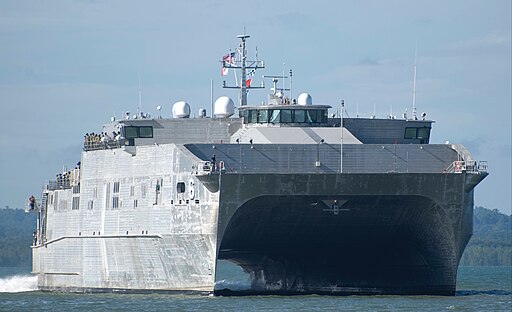
USNS Brunswick (JHVS-6/T-EPF-6) is a Spearhead-class expeditionary fast transport vessel operated by the Military Sealift Command (MSC) for the United States Navy. Originally designated as T-EPF-6, the ship was reclassified as JHVS-6 (Joint High-Speed Vessel) under updated Navy nomenclature. Brunswick is designed to provide rapid intra-theater transport of troops, military vehicles, and equipment, bridging the gap between large sealift ships and smaller landing craft. Built for versatility, speed, and shallow-draft operations, the ship enables flexible logistics in both combat and humanitarian missions.
Construction and Background
USNS Brunswick was built by Austal USA at its shipyard in Mobile, Alabama, as the sixth vessel in the Spearhead-class series. The class was developed from the commercial high-speed ferry designs pioneered by Austal, modified for naval logistics, military payloads, and modular mission configurations. Brunswick’s keel was laid in July 2013, it was launched in May 2014, and delivered to the U.S. Navy in January 2016.
The vessel’s aluminum catamaran hull design provides exceptional speed and stability, with large internal volume and roll-on/roll-off (Ro-Ro) vehicle access. Named after the city of Brunswick, Georgia, the ship symbolizes rapid maritime response and community partnership across the coastal United States.
General Specifications
-
Class and Type: Spearhead-class expeditionary fast transport (JHVS / T-EPF)
-
Builder: Austal USA, Mobile, Alabama
-
Operator: Military Sealift Command (MSC)
-
Laid Down: July 2013
-
Launched: May 2014
-
Commissioned (Delivered): January 14, 2016
-
Homeport: Norfolk, Virginia (operational assignments vary)
Physical Characteristics
-
Displacement (full load): Approximately 2,400 tons
-
Length overall: 338 feet (103 meters)
-
Beam: 93.5 feet (28.5 meters)
-
Draft: 12.5 feet (3.8 meters)
-
Hull type: Aluminum twin-hull catamaran
-
Flight deck: Capable of operating a CH-53E Super Stallion, MH-60 Seahawk, or equivalent helicopter
-
Vehicle deck area: Over 20,000 square feet of cargo space
-
Ramp capability: Roll-on/roll-off vehicle ramp rated for M1A2 Abrams tank weight (limited use, primarily tactical vehicles)
The catamaran configuration allows for stability at high speeds and reduces wake, while the shallow draft provides access to austere and underdeveloped ports not suitable for deep-draft ships.
Propulsion and Performance
Brunswick’s propulsion system emphasizes speed, maneuverability, and fuel efficiency.
-
Propulsion type: Waterjet propulsion system
-
Engines: Four MTU 20V 8000 M71L diesel engines
-
Power output: Approximately 9,100 kW (12,200 hp) per engine
-
Propulsors: Four Wärtsilä steerable waterjets
-
Maximum speed: In excess of 40 knots (74 km/h) when lightly loaded
-
Range: Over 1,200 nautical miles at 35 knots; 5,600 nautical miles at 15 knots (economical speed)
-
Fuel capacity: Approximately 135,000 gallons (510,000 liters) of diesel
-
Endurance: 5 to 10 days of autonomous operation depending on load and mission profile
The waterjet system enables exceptional shallow-water operations and high-speed maneuvering, making Brunswick ideal for rapid coastal insertion and evacuation scenarios.
Navigation and Control Systems
-
Integrated Bridge System (IBS) with multifunction displays
-
Electronic Chart Display and Information System (ECDIS)
-
Dynamic Positioning (DP) capabilities for precision station-keeping
-
Satellite communication systems for global command and control integration
-
Autopilot and voyage data recorder (VDR) for enhanced navigational safety
The ship’s control system allows single-operator helm management, with integrated automation and diagnostics reducing crew workload during high-speed transits.
Crew and Accommodations
-
Core civilian crew (MSC): Approximately 26 personnel
-
Mission personnel capacity: Up to 312 troops or passengers
-
Vehicle and cargo crew support: Space for 100+ additional mission-specific staff
-
Berthing: Modular, reconfigurable berthing for troops, medical teams, or cargo handlers
-
Habitability: Air-conditioned quarters, galley, medical bay, fitness area, and communications lounge
Habitability is optimized for extended deployments and multi-day missions, ensuring comfort and efficiency even during high-tempo operations.
Cargo and Mission Capabilities
Brunswick is designed for roll-on/roll-off operations with direct beach access or use of austere ports:
-
Vehicle ramp: Capable of deploying vehicles up to M1 Abrams tank weight onto unimproved piers or logistics causeways
-
Vehicle storage: 20,000 square feet for Humvees, MRAPs, light trucks, and containers
-
Cargo payload: Up to 600 short tons of vehicles, containers, and equipment
-
Container fittings: Configurable tie-downs for ISO containers
-
Cargo deck height: 16 feet clear height for large vehicles
This configuration allows Brunswick to deliver fully loaded vehicles directly to forward areas without dependence on large port facilities.
Aviation Facilities
-
Flight deck: Capable of operating large rotary-wing aircraft, including the MH-60R/S Seahawk and CH-53E Super Stallion
-
Support facilities: Flight operations center and refueling station
-
No hangar: Aircraft operations are limited to launch and recovery, not storage
The aviation capability allows rapid personnel transport, medevac, and resupply missions, particularly useful in joint or humanitarian operations.
Communications and Electronics
-
Secure and non-secure satellite communications
-
HF/VHF/UHF radios for line-of-sight and extended range comms
-
Link-16 data integration capability (as configured per mission)
-
Shipboard LAN and Wi-Fi for data processing and command use
These systems enable Brunswick to integrate seamlessly into Navy task forces, humanitarian relief networks, or special operations communication structures.
Mission Roles
USNS Brunswick fulfills multiple operational roles across military and civilian mission spectrums:
-
Rapid intra-theater transport of troops and vehicles
-
Humanitarian assistance and disaster relief (HADR)
-
Medical evacuation and mobile medical support platform
-
Special operations support and logistics resupply
-
Joint logistics over-the-shore (JLOTS) operations
-
Coalition and partner-nation maritime training missions
Its flexibility allows the ship to transition rapidly between military and non-combat roles, supporting global presence and rapid response objectives.
Operational History
Since entering service in 2016, USNS Brunswick has participated in numerous exercises and deployments across the Indo-Pacific and Africa Command areas of responsibility. The ship has supported missions such as:
-
Pacific Partnership humanitarian operations
-
Logistics support exercises with partner navies in Southeast Asia
-
Disaster relief following regional typhoons and earthquakes
-
Medical readiness and community assistance deployments
Its ability to access remote ports and deliver supplies directly to shorelines makes it a key asset in flexible naval operations and multinational humanitarian engagements.
Maintenance and Upgrades
Regular refits and lifecycle maintenance are performed at U.S. naval facilities and Austal USA shipyards. Upgrades have included:
-
Improved communications suites
-
Enhanced fuel efficiency and automation systems
-
Upgraded navigation electronics
-
Habitability improvements and crew comfort systems
These upgrades ensure Brunswick remains operationally relevant within evolving naval logistics and expeditionary doctrines.
Role Within the Spearhead-Class Fleet
As the sixth vessel of its class, Brunswick operates alongside sister ships such as USNS Spearhead (T-EPF-1), USNS Choctaw County (T-EPF-2), and USNS Fall River (T-EPF-4). Each vessel supports distributed maritime operations, providing inter-theater agility and reinforcing the Navy’s expeditionary capability.
The class collectively represents a modular logistics platform capable of integrating with amphibious ready groups, humanitarian response task forces, and special operations units.
Strategic Importance
USNS Brunswick exemplifies the Navy’s strategy of rapid, flexible maritime mobility. Its combination of speed, cargo capacity, and shallow-draft access allows it to bypass traditional infrastructure, ensuring that forces, relief supplies, and critical personnel can reach areas of need quickly.
In modern naval strategy, where distributed operations and agile logistics are essential, Brunswick’s design fills a vital niche — bridging the logistical gap between large amphibious ships and smaller coastal craft.
Summary
USNS Brunswick (JHVS-6/T-EPF-6) is a high-speed, shallow-draft transport vessel providing rapid, flexible logistical support to naval and joint forces. Built with an aluminum catamaran hull, waterjet propulsion, and expansive cargo decks, it enables fast, reliable intra-theater mobility. Its capacity for troops, vehicles, and modular missions allows Brunswick to perform a spectrum of operations — from combat logistics and special operations support to humanitarian assistance and disaster relief.
_arrives_at_Tawau,_Malaysia,_on_21_April_2018_(180421-N-OU129-022)_(cropped).jpg)