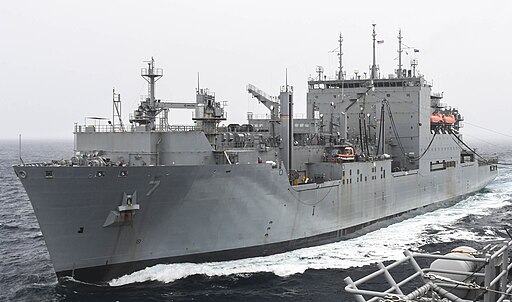
USNS Carl Brashear (T-AKE-7) is a Lewis and Clark-class dry cargo and ammunition ship operated by the Military Sealift Command (MSC) for the United States Navy. Designed to deliver vital logistical support to naval forces at sea, the ship transports ammunition, food, repair parts, fuel, and other essential supplies. The vessel is named in honor of Master Chief Carl Maxie Brashear, the U.S. Navy’s first African American master diver and the first amputee to be certified as a Navy diver, symbolizing courage, resilience, and service.
As part of the Navy’s Combat Logistics Force (CLF), USNS Carl Brashear provides underway replenishment (UNREP) capabilities that ensure the operational endurance of carrier strike groups, amphibious ready groups, and other deployed naval forces worldwide.
Construction and Background
USNS Carl Brashear was built by General Dynamics NASSCO (National Steel and Shipbuilding Company) in San Diego, California, one of America’s leading naval shipbuilders. It is the seventh ship in the Lewis and Clark (T-AKE) class, designed to replace the earlier Kilauea-class ammunition ships and Mars-class combat stores ships.
-
Keel laid: April 2, 2007
-
Launched: May 18, 2008
-
Delivered to MSC: March 4, 2009
-
Homeport: San Diego, California
The Lewis and Clark class was developed under the T-AKE program to modernize naval logistics by integrating dry cargo and limited fuel transfer in a single hull. The design focuses on efficiency, automation, and environmentally conscious propulsion systems.
General Characteristics
-
Class and Type: Lewis and Clark-class dry cargo/ammunition ship
-
Hull Number: T-AKE-7
-
Builder: General Dynamics NASSCO, San Diego, California
-
Operator: Military Sealift Command (MSC)
-
Named for: Master Chief Carl M. Brashear, USN
-
Delivered: March 2009
-
Crew Composition: Civil service mariners (CIVMARs) and a small military detachment
Physical Specifications
-
Displacement (full load): Approximately 41,000 tons
-
Length overall: 689 feet (210 meters)
-
Beam: 106 feet (32.3 meters)
-
Draft: 30 feet (9.1 meters)
-
Hull type: Single-hull steel construction with double-bottom fuel tanks
-
Cargo capacity: 6,675 metric tons (dry and refrigerated goods) plus limited fuel storage
-
Complement: About 124 civilian mariners and 11 military personnel
The ship’s design emphasizes cargo efficiency, incorporating a large midships superstructure, cargo-handling cranes, and multiple replenishment stations for simultaneous transfer to other ships at sea.
Propulsion and Machinery
USNS Carl Brashear is powered by a modern, fuel-efficient diesel-electric propulsion system designed to provide reliability and reduced maintenance demands.
-
Propulsion type: Integrated diesel-electric system (IDES)
-
Engines: Four MAN B&W 9L48/60 diesel generators
-
Total power output: Approximately 35 megawatts (47,000 horsepower equivalent)
-
Propeller configuration: Twin-screw fixed-pitch propellers driven by electric motors
-
Maximum speed: 20 knots (37 km/h)
-
Range: 14,000 nautical miles at 20 knots
-
Endurance: Capable of extended independent operations without frequent port resupply
This propulsion system minimizes vibration and noise, enhancing shipboard comfort while meeting the Navy’s environmental and performance standards.
Cargo Handling and Storage Systems
The Lewis and Clark-class design centers on rapid and efficient logistics transfer operations. USNS Carl Brashear carries both dry cargo and limited quantities of fuel and ordnance, with automated systems to streamline loading and offloading.
Cargo Systems
-
Cargo holds: Multiple holds for dry and refrigerated goods
-
Cargo elevators: Vertical lifts connecting storage decks to transfer stations
-
Cargo cranes: Two heavy-duty cranes for vertical replenishment (VERTREP) and pier-side loading
-
Cargo transfer stations:
-
Two port-side and two starboard Connected Replenishment (CONREP) stations
-
Stern station for astern refueling or transfer operations
-
Storage Capacities
-
Dry/refrigerated cargo: Approximately 6,675 metric tons
-
Ammunition: Separate magazine compartments with blast protection
-
Fuel: Roughly 500,000 gallons (limited compared to full oiler ships)
-
Water: Freshwater generation and storage for ship operations and transfer
The ship’s cargo management system is computer-controlled for efficient monitoring and inventory tracking, optimizing underway replenishment schedules.
Navigation and Control Systems
USNS Carl Brashear is equipped with a suite of advanced navigation and ship control systems, ensuring precision handling and safety during complex operations.
-
Integrated Bridge System (IBS) with digital displays
-
Electronic Chart Display and Information System (ECDIS)
-
Automatic Radar Plotting Aid (ARPA)
-
Dynamic Positioning (DP) for station-keeping during replenishment operations
-
Global Positioning System (GPS) and inertial navigation integration
-
Automated steering and propulsion monitoring systems
Automation reduces the need for large bridge crews and enhances accuracy during UNREP, anchoring, and close-proximity operations with fleet units.
Crew and Accommodations
The crew primarily consists of civil service mariners (CIVMARs) employed by MSC, supported by a small Navy detachment responsible for communications, supply coordination, and defense systems.
-
Crew complement: Approximately 124 civilian mariners and 11 Navy personnel
-
Habitability features:
-
Private and semi-private berthing
-
Fully equipped galley and dining facilities
-
Medical and dental care spaces
-
Fitness center, library, and recreation lounges
-
The vessel’s design emphasizes comfort and habitability for long deployments, consistent with MSC’s focus on crew welfare.
Replenishment Capabilities
The primary mission of USNS Carl Brashear is to provide underway replenishment (UNREP) support to U.S. and allied naval forces.
Replenishment Features
-
Connected Replenishment (CONREP): Fuel and cargo are transferred via tensioned cables and hoses while ships steam side by side.
-
Vertical Replenishment (VERTREP): Utilizes helicopters (typically MH-60S Seahawk) to transfer pallets of cargo to other ships.
-
Fuel Delivery: Transfer capability for both diesel and aviation fuel (JP-5).
-
Simultaneous transfer operations: Capable of servicing two or more ships concurrently.
This logistical capacity enables strike groups and amphibious task forces to remain on station for extended periods without returning to port.
Aviation Facilities
USNS Carl Brashear features a robust flight deck for vertical replenishment operations.
-
Flight deck: Aft-mounted deck capable of supporting MH-60S Seahawk or CH-46 Sea Knight operations
-
Helicopter facilities:
-
Dual-spot landing area
-
Aviation refueling and firefighting systems
-
Helicopter control station and lighting systems
-
-
Hangar: No permanent hangar; aircraft operations are limited to VERTREP and logistics transfers
The flight deck extends the ship’s ability to deliver supplies rapidly across large distances and to smaller vessels unable to perform CONREP operations.
Communications and Electronics
The vessel is equipped with a robust suite of communication and mission coordination systems to operate seamlessly with U.S. and allied naval units.
-
Secure and non-secure satellite communications (SATCOM)
-
HF/VHF/UHF radio networks
-
Shipboard Local Area Network (LAN) for inventory and logistics management
-
Automated Supply and Cargo Data System (SCADS)
-
Interoperability with Navy Command and Control (C2) systems
These capabilities ensure reliable coordination with supported fleets and operational commands during underway replenishment and global deployments.
Mission Profile
USNS Carl Brashear supports the Combat Logistics Force (CLF) by enabling sustained naval operations at sea. Its missions include:
-
Supplying food, ammunition, and spare parts to deployed ships
-
Supporting carrier strike groups, amphibious ready groups, and destroyer squadrons
-
Participating in humanitarian assistance and disaster relief (HADR) efforts
-
Conducting joint operations with allied navies under multinational task forces
By serving as a floating supply hub, the ship ensures uninterrupted readiness and extended operational endurance for the U.S. Navy worldwide.
Operational History
Since her delivery in 2009, USNS Carl Brashear has conducted extensive operations across the Pacific, Indian Ocean, and Middle East theaters. Key deployments include:
-
Support missions in the U.S. 5th and 7th Fleet Areas of Responsibility
-
Participation in Operation Enduring Freedom and regional maritime security operations
-
Humanitarian missions, including disaster relief logistics in Southeast Asia and the Pacific
-
Multinational naval exercises with allied fleets
The ship has consistently demonstrated reliability and versatility in both peacetime and operational environments.
Maintenance and Modernization
USNS Carl Brashear undergoes scheduled maintenance and modernization at NASSCO and MSC facilities to sustain readiness and extend service life. Upgrades have included:
-
Enhanced cargo handling automation
-
Updated environmental compliance systems (emissions and waste management)
-
Communications and navigation system modernization
-
Energy efficiency and propulsion system refinements
These improvements ensure the ship remains mission-ready for decades of continued service.
Role Within the Lewis and Clark-Class Fleet
The Lewis and Clark-class represents the backbone of the Navy’s modern logistics fleet. Other ships in the class include USNS Lewis and Clark (T-AKE-1), USNS Amelia Earhart (T-AKE-6), and USNS Matthew Perry (T-AKE-9). Each vessel provides multi-mission resupply and logistics support, ensuring global reach and sustained naval presence.
As the seventh vessel, USNS Carl Brashear contributes directly to distributed maritime operations and the Navy’s strategy of maintaining combat readiness through forward logistics.
Strategic Importance
In the modern maritime environment, logistical support defines operational endurance. USNS Carl Brashear serves as a critical node in the Navy’s “sea base” logistics network, enabling forward-deployed units to remain combat-ready and self-sufficient. Its ability to deliver ammunition, parts, and supplies at sea underpins naval dominance and rapid response capability.
The ship’s dual-capacity design—integrating both dry cargo and limited fuel transfer—embodies the Navy’s emphasis on flexibility, sustainability, and global reach.
Summary
USNS Carl Brashear (T-AKE-7) stands as a cornerstone of the U.S. Navy’s Combat Logistics Force. Built by General Dynamics NASSCO and operated by the Military Sealift Command, the ship combines advanced automation, efficient propulsion, and multi-mission cargo handling systems. With a displacement of over 40,000 tons, twin diesel-electric propulsion, and the ability to replenish multiple ships simultaneously, Carl Brashear enables extended naval operations across the globe.
_(cropped).jpg)