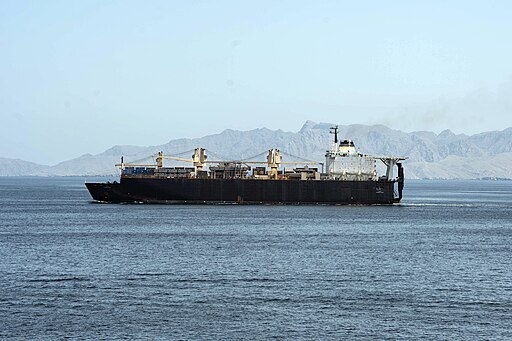
USNS PFC Dewayne T. Williams (T-AK-3009) is a United States Navy dry cargo ship operated by the Military Sealift Command (MSC) as part of the Maritime Prepositioning Ship (MPS) program. Named in honor of Private First Class Dewayne T. Williams, a Medal of Honor recipient, the ship plays a vital role in the rapid deployment of U.S. Marine Corps forces by prepositioning essential military equipment, vehicles, and supplies in strategic locations around the world. This ship is a critical component of the Navy’s logistics and strategic mobility capabilities, designed to ensure combat readiness by enabling swift equipment delivery in times of crisis or conflict.
Design and Construction
The USNS PFC Dewayne T. Williams was built to meet the demanding requirements of rapid military cargo transport and sustained deployment. The ship’s design focuses on maximizing cargo capacity, ease of cargo handling, and operational flexibility to support Marine Corps expeditionary forces. Constructed in the late 20th century, the vessel’s design reflects a hybrid between commercial cargo ship standards and naval auxiliary ship features, providing the durability and capabilities necessary for military prepositioning. The hull form and superstructure are optimized to facilitate quick loading and offloading of heavy and oversized military vehicles and equipment under diverse sea and port conditions.
Dimensions and Displacement
The ship measures approximately 673 feet in length overall with a beam around 105 feet, giving it a broad and stable platform for carrying heavy cargo. The full-load draft is roughly 32 feet, enabling access to a wide range of ports globally while maintaining substantial cargo capacity. The displacement of the vessel, when fully loaded with vehicles, supplies, and equipment, can exceed 45,000 tons. These large dimensions enable the ship to store vast amounts of military cargo and maintain stability and seaworthiness even in challenging ocean conditions.
Cargo Capacity and Storage
USNS PFC Dewayne T. Williams is designed primarily to carry dry cargo, including tactical vehicles, ammunition, spare parts, and other essential equipment needed to support Marine Corps operations ashore. The ship features multiple large cargo holds equipped with roll-on/roll-off (Ro-Ro) ramps and heavy-duty cranes to facilitate rapid loading and unloading of wheeled and tracked vehicles. Cargo capacity exceeds 160,000 square feet of storage space, including deck areas and internal holds, allowing for the prepositioning of entire Marine Expeditionary Brigade equipment sets. The ship’s internal configuration is adaptable, accommodating a mix of containerized supplies, palletized cargo, and heavy equipment, enabling it to support a wide variety of missions.
Propulsion and Performance
The propulsion system of the USNS PFC Dewayne T. Williams consists of diesel engines driving a single propeller shaft, providing reliable and efficient power for long-range operations. The diesel engines deliver a combined output sufficient to propel the ship at speeds up to approximately 20 knots, a speed capable of keeping pace with convoy operations and minimizing transit times during rapid deployments. The propulsion system is designed for fuel efficiency and operational endurance, enabling the ship to traverse thousands of nautical miles without refueling, thereby supporting sustained forward deployment.
Cargo Handling Systems
One of the defining features of the ship is its sophisticated cargo handling capability. The vessel is equipped with heavy-duty cranes, including pedestal-mounted units capable of lifting tens of tons, to move vehicles and supplies on and off the ship independently of port infrastructure. Additionally, its roll-on/roll-off ramps provide rapid access for vehicle operations, minimizing turnaround time in port or at forward operating bases. The combination of cranes and ramps allows the USNS PFC Dewayne T. Williams to operate in austere or damaged ports where shore-based equipment may be unavailable, ensuring mission readiness in a variety of operational environments.
Aviation Facilities
While primarily a cargo ship, the vessel includes a flight deck designed to support helicopter operations. This feature enables vertical replenishment and personnel transfer, enhancing logistical flexibility. The flight deck can accommodate medium-sized helicopters used for cargo delivery, reconnaissance, or medical evacuation, adding a critical dimension to the ship’s operational support capabilities. The ability to launch and recover helicopters allows the vessel to extend its resupply reach beyond conventional port facilities and supports joint operations with naval and ground forces.
Crew and Operations
The ship is operated by a civilian crew under the Military Sealift Command, typically numbering around 50 to 60 mariners. This civilian-military crew model reduces operational costs while maintaining high standards of seamanship and logistics expertise. Additionally, a contingent of Navy personnel may be embarked to oversee military cargo handling and communications during deployments. Crew accommodations are designed for extended missions, providing sufficient living space, recreational facilities, and support services to sustain morale and efficiency during prolonged at-sea periods.
Defensive Systems and Survivability
As a non-combatant auxiliary vessel, USNS PFC Dewayne T. Williams is lightly armed and relies primarily on escort ships for protection during operations in contested areas. The ship may carry basic self-defense weapons such as machine guns and small arms to provide limited protection against small boat threats or asymmetric attacks. It is equipped with standard damage control systems, fire suppression, and compartmentalization to enhance survivability in the event of accidents or hostile actions. The design emphasizes redundancy and damage resilience to ensure the ship can continue to perform its mission even after sustaining damage.
Operational Role and Strategic Importance
The USNS PFC Dewayne T. Williams serves as a floating warehouse and transport hub, prepositioning Marine Corps combat equipment in key global theaters such as the Pacific, Indian Ocean, or Middle East. This strategic prepositioning capability significantly shortens the time required to deploy forces, as equipment is already staged close to potential conflict zones, reducing reliance on vulnerable sea or airlift logistics. The ship supports joint and combined operations, humanitarian missions, and rapid response to crises, enhancing the United States’ ability to project power and provide assistance worldwide. Its role as a Maritime Prepositioning Ship ensures that Marine Expeditionary Brigades can be equipped and ready for operations within days rather than weeks.
Summary
USNS PFC Dewayne T. Williams (T-AK-3009) embodies the critical logistics backbone necessary for modern expeditionary warfare. Through a combination of large cargo capacity, advanced handling systems, and strategic deployment, it enables rapid force projection by ensuring Marine Corps equipment and supplies are positioned for immediate use. Though lightly armed and operated largely by civilian mariners, the ship’s role is indispensable in maintaining operational readiness and supporting a flexible and responsive naval expeditionary force capable of meeting global challenges.
_underway_in_the_Strait_of_Hormuz_on_17_April_2020_(200417-N-PI330-0057).JPG)