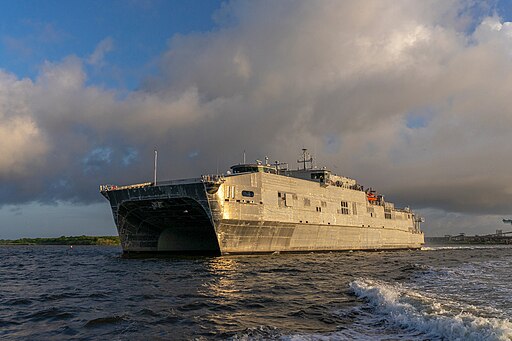
USNS Puerto Rico (T-EPF-11) is a high-speed expeditionary fast transport vessel operated by the United States Navy’s Military Sealift Command. As the eleventh ship in the Spearhead-class of Expeditionary Fast Transports (EPF), Puerto Rico embodies a new generation of versatile, rapid transport platforms designed to support a broad range of military operations, including intra-theater lift, humanitarian assistance, and special operations. Its emphasis on speed, flexibility, and shallow draft enables it to operate in austere ports and littoral zones, bridging the gap between traditional sealift vessels and smaller amphibious craft.
Design and Construction
USNS Puerto Rico is built upon the modular catamaran hull design characteristic of the Spearhead-class, a concept that leverages proven commercial ferry technologies tailored for military utility. Constructed by Austal USA in Mobile, Alabama, the ship’s aluminum hull structure optimizes for lightweight strength and high-speed performance while maintaining operational endurance. The vessel’s twin-hull configuration provides exceptional stability and maneuverability at high speeds and in varying sea conditions. Its relatively shallow draft allows it to access ports and waterways unavailable to deeper-draft vessels, enhancing operational flexibility in constrained environments. The design also emphasizes rapid loading and unloading capabilities, with large cargo decks configured to support roll-on/roll-off (Ro-Ro) operations of vehicles and equipment.
Dimensions and Displacement
USNS Puerto Rico measures approximately 338 feet in length overall, with a beam of about 85 feet, including its twin hulls. The vessel draws roughly 15 feet of water, a shallow draft that permits operations close to shorelines and within shallow harbors. Its lightweight aluminum construction results in a displacement of approximately 1,850 tons when fully loaded. Despite its relatively modest displacement compared to larger naval auxiliaries, the vessel’s design prioritizes cargo volume and speed over sheer payload tonnage, making it ideal for rapid intra-theater transportation rather than heavy strategic sealift.
Propulsion and Performance
The ship is powered by four MTU 20V8000 M71L diesel engines that collectively generate around 32,000 shaft horsepower, driving waterjet propulsion systems located in each hull. This propulsion arrangement enables USNS Puerto Rico to achieve maximum speeds in excess of 43 knots, allowing rapid transit between operational areas. The use of waterjets provides enhanced maneuverability and reduced draft, while minimizing underwater noise and vibration, beneficial for littoral and special operations. The ship’s range extends approximately 1,200 nautical miles at cruising speeds near 35 knots, balancing high-speed capability with operational endurance. Fuel efficiency and maintenance ease are enhanced through the modern diesel engine design and automation integrated into the engineering plant.
Cargo and Vehicle Capacity
USNS Puerto Rico offers a large, open vehicle and cargo deck spanning approximately 3,500 square meters, designed to accommodate a variety of wheeled and tracked military vehicles, containers, and general cargo. The Ro-Ro deck supports the rapid embarkation and debarkation of vehicles using a hydraulically operated stern ramp capable of handling heavy loads. The cargo deck can support up to 600 short tons of payload, which typically includes light armored vehicles, trucks, and containers critical for expeditionary operations. The configuration supports flexible mission sets, including troop transport, logistics resupply, humanitarian assistance, and disaster relief operations. The ship’s internal arrangement allows for quick reconfiguration depending on mission needs, with tie-downs and securing points distributed throughout the cargo area.
Aviation and Auxiliary Capabilities
While USNS Puerto Rico does not have a permanently embarked aviation detachment, it features a flight deck capable of supporting helicopter operations, including medium-lift helicopters such as the UH-60 Black Hawk or CH-47 Chinook. This flight deck enables vertical replenishment, casualty evacuation, and personnel transfers, expanding the ship’s operational versatility. The design accommodates temporary landing operations but lacks a hangar or permanent aviation support facilities. In addition to cargo and aviation capabilities, the ship is outfitted with modern communications and command-and-control systems, facilitating integration with joint and coalition forces during complex operations.
Crew and Habitability
Operated by a civilian crew under the Military Sealift Command, USNS Puerto Rico typically carries about 26 mariners responsible for navigation, engineering, and ship operations. The small crew size is made possible through extensive automation and system redundancies. For embarked troops or mission personnel, the ship provides accommodations for up to 312 embarked personnel, including seating and berthing facilities designed for short to medium duration voyages. Habitability spaces are configured for efficiency and comfort, with mess halls, sanitary facilities, and climate control systems supporting personnel during deployments. The vessel’s layout supports rapid embarkation and debarkation to maintain high operational tempo.
Defensive Systems and Survivability
As a non-combatant transport vessel, USNS Puerto Rico is lightly armed, typically relying on non-lethal self-defense systems such as small arms and crew-served weapons operated by embarked security personnel or escorts. The ship’s primary survivability measures lie in its high speed, maneuverability, and the ability to operate in shallow and constrained environments where larger combatants may be less effective. Its aluminum construction includes fire-resistant materials and compartmentalization to reduce vulnerability to damage and enhance crew safety. The vessel operates in conjunction with naval escorts and air cover when transiting contested or high-threat areas.
Operational Role and Strategic Significance
USNS Puerto Rico fills a unique niche in the Navy’s logistics and expeditionary architecture. It enables rapid intra-theater transport of vehicles, equipment, and personnel between established ports and austere locations, reducing reliance on airlift and traditional sealift assets. The ship’s speed and shallow draft make it particularly valuable in supporting forward-deployed forces, humanitarian missions, and special operations requiring quick response times. Its ability to integrate with joint and multinational task forces enhances the United States’ operational agility and resilience in diverse environments, from littoral combat zones to disaster relief operations. The vessel’s design supports distributed maritime operations and aligns with modern naval concepts emphasizing flexibility and rapid mobility.
Summary
USNS Puerto Rico (T-EPF-11) exemplifies the modern expeditionary fast transport’s role in enabling agile, high-speed maritime logistics and personnel movement. Its catamaran hull, advanced propulsion system, and flexible cargo capacity make it an essential asset for rapid intra-theater deployment of military and humanitarian resources. Operated by a lean civilian crew and capable of supporting significant embarked forces, Puerto Rico offers a blend of speed, versatility, and operational reach that strengthens the Navy’s ability to respond to emerging global challenges. As part of the Spearhead-class EPF fleet, it continues to advance the U.S. Navy’s strategic mobility and expeditionary capabilities in the 21st century.
_successfully_completed_the_first_integrated_sea_trials_on_22_August_2019.jpg)