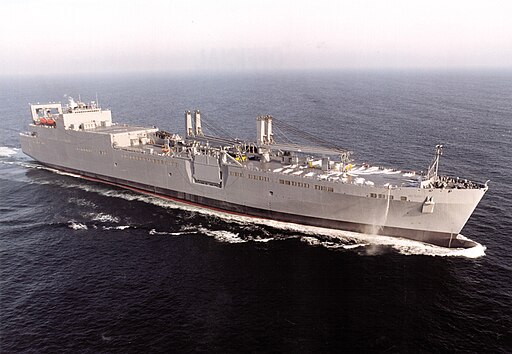
The USNS Red Cloud (T-AKR 313) is a large, high-speed roll-on/roll-off (Ro-Ro) cargo ship operated by the United States Navy’s Military Sealift Command (MSC). It is part of the Bob Hope-class of vehicle cargo ships, designed specifically to provide rapid strategic sealift capability for transporting military vehicles, equipment, and supplies worldwide. The ship’s primary mission is to support U.S. military operations by delivering essential cargo to overseas theaters in a timely and efficient manner. As a non-combatant auxiliary ship, the Red Cloud plays a crucial role in enhancing the logistical reach of the U.S. armed forces, ensuring that ground forces receive their necessary equipment and materiel in expeditionary environments.
Design and Construction
Constructed by Northrop Grumman Ship Systems, the USNS Red Cloud was launched in the mid-1990s and subsequently commissioned into service. The Bob Hope-class design emphasizes a combination of cargo volume, speed, and versatility. The ship’s hull is optimized to accommodate large quantities of wheeled and tracked vehicles, with expansive cargo decks that allow for easy loading and unloading through a sophisticated system of ramps and elevators. The Red Cloud features a welded steel hull with reinforced decks to support the weight of heavy military vehicles, including tanks and armored personnel carriers. The superstructure is positioned aft, providing maximum uninterrupted cargo space forward, a layout that facilitates quick loading and discharge operations in ports or at specialized military roll-on/roll-off terminals.
Dimensions and Displacement
The USNS Red Cloud measures approximately 273 meters (896 feet) in length overall, with a beam of about 40.8 meters (134 feet), providing vast cargo deck area for transport operations. The fully loaded displacement of the ship is around 62,000 tons, reflecting its capability to carry a significant volume and weight of military equipment. The draft when fully loaded is approximately 11.6 meters (38 feet), which allows the ship to access a wide range of ports while still maintaining stability during ocean transits. These dimensions make the Red Cloud one of the largest vehicle cargo ships in the U.S. strategic sealift fleet, capable of carrying an entire brigade’s worth of vehicles and support equipment in a single voyage.
Propulsion and Performance
The propulsion system aboard the USNS Red Cloud is designed to provide a balance of speed and fuel efficiency. Powered by four General Electric LM2500 gas turbine engines, the ship produces a combined output exceeding 100,000 shaft horsepower, which drives two controllable pitch propellers. This setup enables the vessel to achieve a maximum speed of approximately 24 knots (around 28 miles per hour), making it one of the faster large cargo ships in its class. This speed is vital for rapid deployment missions, allowing the Red Cloud to quickly transit long distances and reduce response times in support of military operations. The ship’s fuel capacity and efficient propulsion system provide a range of several thousand nautical miles, enabling extended operations without frequent refueling stops.
Cargo Capacity and Loading Systems
The hallmark feature of the USNS Red Cloud is its enormous cargo capacity combined with advanced loading and unloading capabilities. The ship boasts over 240,000 square feet of cargo space distributed across multiple decks, including four main cargo decks connected by a network of ramps and elevators. This configuration allows simultaneous loading and unloading of vehicles on different levels, significantly speeding up cargo operations. The ship can carry up to 380 standard military vehicles or a comparable volume of oversized equipment and containers. It is equipped with both stern and side ramps, which provide flexible access points for vehicles to roll on and off the ship quickly, even when docked at austere or undeveloped ports. This versatility is crucial for military logistics, allowing deployment in varied operational environments.
Crew and Operational Role
The USNS Red Cloud is operated primarily by a civilian crew under the Military Sealift Command, with a complement typically numbering around 30 to 40 mariners who handle navigation, engineering, and cargo operations. Military personnel may also embark to coordinate cargo handling or oversee mission-specific tasks. The ship’s operational role centers on strategic sealift and pre-positioning of combat equipment to support rapid military deployments worldwide. It frequently participates in joint exercises, contingency operations, and humanitarian missions, demonstrating its importance as a logistical force multiplier. Its ability to move heavy equipment quickly and efficiently ensures that U.S. forces remain equipped and ready in diverse theaters of operation.
Defensive Systems and Support Infrastructure
Though not designed as a combat vessel, the USNS Red Cloud is equipped with basic self-defense measures to protect against asymmetric threats, including electronic warfare systems, radar, and small arms mounts that can be fitted with machine guns or other light weaponry. Its communications suite supports secure command and control integration with Navy task forces and other military units. The ship also features advanced damage control systems, fire suppression, and safety protocols tailored to the risks associated with handling large volumes of heavy cargo and fuel. These systems ensure that the ship maintains operational integrity even under challenging conditions, supporting prolonged deployments and logistical sustainment efforts.
Conclusion
The USNS Red Cloud (T-AKR 313) stands as a pivotal element in the United States’ strategic sealift capability, marrying speed, capacity, and versatility to meet the demands of modern military logistics. Its technical specifications—from powerful gas turbine propulsion and extensive cargo space to advanced loading systems—reflect a design optimized for rapid and efficient transport of critical military assets across the globe. As a component of the Military Sealift Command’s auxiliary fleet, the Red Cloud provides essential support that enables sustained military operations, power projection, and rapid response capabilities essential to U.S. national security interests.
