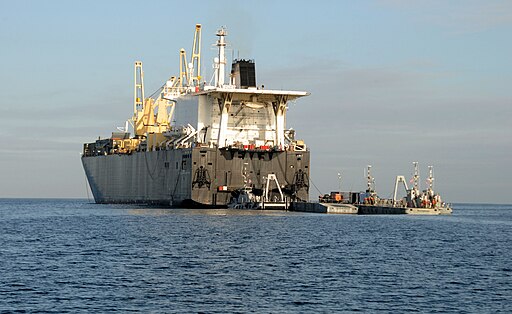
USNS Sgt. William R. Button (T-AK-3012) is a large prepositioning cargo ship operated by the United States under the Military Sealift Command. Designed to support rapid deployment of Marine Corps and joint-force units, the vessel serves as a floating warehouse stocked with vehicles, ammunition, sustainment supplies, and engineering equipment. Rather than transporting forces only after a crisis erupts, ships like Sgt. William R. Button remain forward-positioned, significantly reducing response times in regions of strategic importance.
The ship belongs to the Sgt. Matej Kocak-class, a group of prepositioning vessels optimized for maritime prepositioning squadrons. These ships allow ground forces to fly into a theater and marry up with equipment already staged aboard the vessels. In this operational concept, the cargo ship becomes a crucial enabler of expeditionary warfare, bridging the gap between sealift logistics and forward combat readiness.
General Characteristics and Dimensions
USNS Sgt. William R. Button is constructed as a heavy cargo vessel with substantial internal volume and reinforced deck strength to accommodate a wide range of military hardware. The hull design balances cargo density with long-range ocean endurance, ensuring sustained operations far from continental supply hubs.
Key technical specifications include:
- Class: Sgt. Matej Kocak-class prepositioning cargo ship
- Displacement (full load): approximately 50,000–55,000 metric tons
- Deadweight tonnage (DWT): roughly 35,000–40,000 tons
- Length overall: approximately 265 meters (870 feet)
- Beam: around 32 meters (105 feet)
- Draft: approximately 11 meters (36 feet)
- Cargo capacity: more than 300,000 square feet of usable stowage area
The vessel’s large beam contributes to transverse stability, which is critical when carrying heavy armored vehicles and stacked container loads. The hull incorporates multiple watertight compartments to enhance survivability and limit progressive flooding in the event of structural damage.
Hull Structure and Deck Configuration
The structural framework of Sgt. William R. Button is engineered to handle high point loads from armored vehicles and palletized munitions. Cargo decks are reinforced with heavy-gauge steel plating supported by longitudinal girders and transverse frames. This reinforcement ensures the vessel can safely carry main battle tanks, amphibious vehicles, artillery systems, and engineering machinery without compromising structural integrity.
Internally, the ship features multiple cargo holds connected by ramps and elevator systems, enabling vertical movement of vehicles between decks. The configuration supports a combination of roll-on/roll-off vehicle loading and containerized cargo stowage. Adjustable securing systems allow for rapid reconfiguration depending on mission requirements.
Ventilation systems are designed to manage exhaust gases during loading operations, while integrated fire suppression systems—using water mist and foam technologies—provide layered protection against fire hazards associated with fuel, lubricants, and stored ammunition.
Propulsion and Powerplant Systems
The propulsion architecture of USNS Sgt. William R. Button reflects its mission as a long-range, heavy cargo transporter. The vessel is powered by a single slow-speed diesel engine driving a fixed-pitch propeller, optimized for fuel efficiency and sustained cruising rather than high-speed maneuvering.
Propulsion specifications include:
- Main engine: single slow-speed marine diesel engine
- Power output: approximately 20,000–24,000 shaft horsepower
- Propulsion type: single screw configuration
- Maximum speed: about 18–20 knots
- Cruising speed: 15–17 knots
- Operational range: exceeding 12,000 nautical miles at cruising speed
The slow-speed diesel design offers high torque and excellent fuel economy, essential for extended deployments in forward regions. Auxiliary diesel generators provide electrical power for navigation systems, cargo handling equipment, refrigeration units, and life-support systems.
Redundant power distribution ensures uninterrupted operation of mission-critical systems, particularly during cargo transfer operations or while operating in remote maritime environments.
Cargo Handling and Prepositioning Capability
The defining feature of Sgt. William R. Button is its role in maritime prepositioning. The ship is equipped with heavy-duty cranes and roll-on/roll-off ramps that allow independent cargo operations even in ports with limited infrastructure.
Cargo handling systems include:
- Deck cranes capable of lifting heavy containers and equipment
- Stern ramp for vehicle embarkation and debarkation
- Internal vehicle ramps connecting cargo decks
- Container cell guides for standardized ISO containers
- Advanced lashing and securing systems
This combination allows the vessel to offload directly onto piers, floating causeways, or lighterage systems. In expeditionary operations, the ship can discharge equipment to support amphibious landings or humanitarian assistance missions. The prepositioned cargo typically includes combat vehicles, engineering assets, medical supplies, spare parts, and sustainment materials sufficient to support a Marine Air-Ground Task Force for extended operations.
Navigation, Communication, and Command Systems
USNS Sgt. William R. Button is fitted with modern navigation electronics, including integrated bridge systems, radar arrays, satellite navigation, and automated steering controls. These systems ensure safe passage across global sea lanes and precise maneuvering during port approaches.
Communication equipment includes secure satellite links, encrypted fleet communication channels, and logistics data systems. These technologies allow coordination with joint force commanders, logistics hubs, and port authorities. Cargo inventory management systems enable real-time tracking of stored equipment, ensuring accurate distribution during deployment.
The ship may also embark military support personnel responsible for cargo accountability, force integration planning, and coordination with arriving units.
Crew and Operational Management
As a Military Sealift Command vessel, Sgt. William R. Button is primarily crewed by civilian mariners. The civilian crew is responsible for navigation, engineering, maintenance, and cargo handling operations. A small military detachment may be assigned depending on mission requirements.
Typical crew structure includes:
- Civilian mariners: approximately 30–40 personnel
- Military support staff: variable based on operational role
- Maintenance teams: embarked as required during extended deployments
This hybrid manning approach allows efficient peacetime operations while maintaining the flexibility to support military missions at short notice.
Survivability and Damage Control
Although not intended as a frontline combatant, the ship incorporates survivability measures designed to enhance resilience. These include compartmentalized watertight construction, fire-resistant bulkheads, redundant mechanical systems, and comprehensive damage control equipment.
The vessel is equipped with:
- Automated fire detection systems
- Fixed firefighting installations
- Portable dewatering pumps
- Emergency power supplies
In high-threat environments, the ship would operate under naval escort, leveraging fleet protection assets rather than onboard weapon systems for defense.
Strategic Importance and Operational Impact
USNS Sgt. William R. Button plays a central role in expeditionary logistics strategy. By maintaining equipment at sea in forward regions, the vessel drastically reduces the time required to assemble combat-ready forces. Personnel can be airlifted to a theater and immediately access prepositioned vehicles and supplies, accelerating operational timelines.
This capability enhances deterrence by demonstrating credible rapid-response capacity. In humanitarian contexts, the ship can deliver engineering equipment, temporary housing units, medical supplies, and heavy transport vehicles to disaster-stricken areas, supporting relief operations without delay.
Modernization and Future Outlook
Periodic upgrades ensure compliance with environmental regulations and operational requirements. Modernization efforts focus on improving fuel efficiency, upgrading navigation electronics, enhancing cargo management systems, and maintaining structural integrity.
As military logistics increasingly integrate digital tracking and predictive maintenance technologies, vessels like Sgt. William R. Button continue to evolve. Despite technological advancements, the fundamental principle remains constant: strategic mobility depends on reliable, high-capacity maritime transport.
Conclusion
USNS Sgt. William R. Button (T-AK-3012) represents a cornerstone of maritime prepositioning strategy. With its expansive cargo decks, reinforced structure, long-range diesel propulsion, and versatile loading systems, the ship enables rapid global deployment of heavy military equipment. Though operating largely outside public attention, its technical sophistication and logistical importance are indispensable to expeditionary readiness and sustained global operations.
_floats_anchored.jpg)