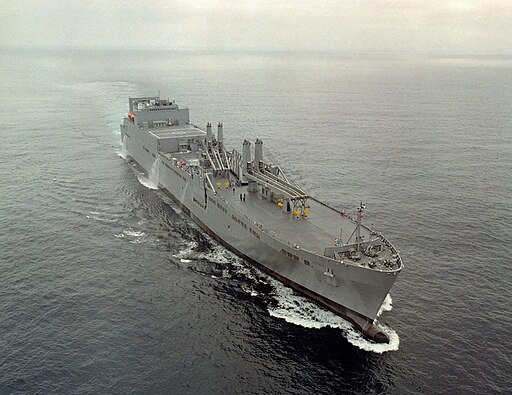
USNS Soderman (T-AKR-317) is a large medium-speed roll-on/roll-off (LMSR) vehicle cargo ship operated by the United States through the Military Sealift Command. Designed to transport heavy and oversized military equipment across global distances, the vessel forms a crucial element of strategic sealift capability. In modern force projection doctrine, rapid airlift can move personnel quickly, but the bulk of armored vehicles, artillery systems, logistics trucks, and engineering machinery must travel by sea. Ships such as Soderman provide the ocean-going backbone of large-scale deployment operations.
The LMSR concept was developed to combine commercial cargo efficiency with reinforced military-grade structural strength. Soderman’s primary mission is to transport and discharge mechanized combat units efficiently, enabling rapid buildup of land forces in distant operational theaters. Although it lacks the armament and combat systems of frontline warships, its strategic impact is profound, as sustained operations depend on reliable maritime logistics.
General Characteristics and Dimensions
USNS Soderman is among the largest purpose-built vehicle cargo ships in U.S. service. Its scale reflects the need to move entire battalion- or brigade-level equipment packages in a single voyage while maintaining transoceanic endurance.
Principal technical specifications include:
- Type: Large Medium-Speed Roll-on/Roll-off (LMSR)
- Full-load displacement: approximately 62,000–65,000 metric tons
- Deadweight tonnage (DWT): roughly 38,000–40,000 tons
- Length overall: about 290 meters (950 feet)
- Beam: approximately 32 meters (105 feet)
- Draft: around 10.8 meters (35 feet)
- Cargo capacity: over 380,000 square feet (more than 35,000 square meters) of vehicle and equipment stowage
The vessel’s broad beam enhances stability, especially when carrying tall armored vehicles on upper decks. The hull form balances hydrodynamic efficiency with maximum internal volume, ensuring economical fuel consumption during extended ocean transits.
Hull Construction and Structural Reinforcement
The structural design of Soderman is tailored for heavy military cargo. Cargo decks are reinforced to withstand concentrated axle loads from main battle tanks and tracked vehicles. Unlike commercial automotive carriers, which transport relatively lightweight passenger vehicles, this ship must endure point loads exceeding 60–70 tons per vehicle.
The internal arrangement includes multiple cargo decks connected by fixed and adjustable ramps. These ramps permit vehicles to move between decks under their own power, minimizing reliance on cranes and accelerating loading cycles. The deck surfaces are treated with abrasion-resistant coatings to withstand the wear from steel tracks and heavy-duty tires.
Watertight compartmentalization increases survivability and reduces the risk of progressive flooding. An advanced ballast control system enables fine-tuned weight distribution during loading and unloading operations, maintaining optimal trim and stability even as heavy vehicles shift onboard.
Propulsion and Engineering Systems
USNS Soderman utilizes a twin-screw diesel propulsion configuration optimized for reliability and sustained cruising speed. The propulsion system is designed to move large cargo loads efficiently across long distances rather than achieve high tactical speeds.
Key propulsion characteristics include:
- Main engines: 2 medium-speed diesel engines
- Total shaft horsepower: approximately 26,000–30,000 shp
- Propulsion arrangement: twin controllable-pitch propellers
- Maximum speed: around 24 knots
- Cruising speed: approximately 18–20 knots
- Operational range: more than 10,000 nautical miles at cruising speed
Controllable-pitch propellers provide operational flexibility, allowing efficient speed adjustments without significant engine stress. The twin-screw configuration improves maneuverability during docking, convoy operations, and restricted water navigation.
Electrical power is generated by multiple onboard diesel generators capable of supporting all shipboard systems, including lighting, cargo ventilation, communications equipment, and auxiliary machinery. Redundant power distribution enhances operational resilience during extended missions.
Roll-On/Roll-Off Cargo Handling Systems
The defining capability of USNS Soderman lies in its RO/RO design. Vehicles can be driven directly onto and off the ship, dramatically reducing loading and unloading times compared to traditional lift-on/lift-off methods.
Cargo handling features include:
- Heavy-duty stern ramp rated for vehicles exceeding 100 tons
- Side ramp for flexible docking scenarios
- Internal vehicle ramps connecting multiple cargo decks
- Extensive lashing and tie-down systems
- High-capacity ventilation for safe vehicle operation during embarkation
The stern ramp is engineered to handle extreme point loads from heavy armored platforms. Internal ramps are carefully angled to permit safe vehicle transit between levels. The ship’s lashing systems are designed to resist dynamic forces generated by ocean swell, preventing cargo shift even during heavy seas.
Fire detection and suppression systems are integrated throughout the cargo spaces, combining automatic sprinklers, foam-based suppression units, and heat sensors to mitigate fire risks associated with fuel-laden vehicles.
Navigation, Communications, and Control Systems
USNS Soderman is equipped with a modern integrated bridge system that includes advanced radar arrays, electronic chart display and information systems (ECDIS), satellite-based navigation, and autopilot controls. These systems enable safe and precise global navigation.
Communications capabilities include:
- Secure satellite communications
- Fleet coordination networks
- Civil maritime radio systems
- Logistics data transmission systems
These tools allow coordination with naval escorts, port authorities, and logistics command centers. In large-scale deployments, Soderman operates as part of an integrated sealift task group, synchronizing arrival schedules with receiving units and supply distribution networks.
Crew and Operational Structure
The vessel is operated by the Military Sealift Command and crewed primarily by civilian mariners. This model ensures cost-effective peacetime operations while preserving rapid activation capability for crisis response.
Typical crew composition includes:
- Civilian mariners: approximately 25–35 personnel
- Additional mission specialists: embarked as required
The crew is responsible for navigation, propulsion management, cargo operations, and routine maintenance. During deployments, military logistics personnel may join the ship to oversee equipment accountability and integration with arriving units.
Survivability and Operational Considerations
Although not equipped as a combat vessel, USNS Soderman incorporates passive survivability features such as compartmentalized hull construction, redundant propulsion systems, and comprehensive damage control equipment. Emergency generators and fire suppression systems ensure continued operation in case of onboard incidents.
In high-threat environments, the vessel would operate under naval escort protection. Its operational philosophy prioritizes strategic mobility rather than direct engagement capability.
Strategic Importance and Global Reach
USNS Soderman significantly enhances heavy equipment transport capacity within the strategic sealift fleet. By carrying hundreds of vehicles and thousands of tons of supplies in a single voyage, it reduces deployment timelines and logistical complexity. Its speed allows timely integration into multinational operations, while its cargo volume supports sustained ground operations.
Beyond combat deployments, the ship can transport engineering equipment and relief supplies during humanitarian missions. Its RO/RO design makes it particularly valuable in ports with limited cargo handling infrastructure.
Modernization and Lifecycle Outlook
Periodic modernization efforts ensure compliance with maritime environmental regulations and evolving operational requirements. Upgrades typically focus on navigation electronics, propulsion system efficiency, cargo deck refurbishment, and digital logistics integration.
As global supply chains increasingly rely on advanced tracking systems and predictive maintenance, vessels like Soderman continue to adapt. The LMSR design remains highly effective for large-scale mechanized transport, ensuring relevance well into the future.
Conclusion
USNS Soderman (T-AKR-317) exemplifies the strategic importance of large medium-speed roll-on/roll-off ships in modern military logistics. With its expansive reinforced cargo decks, high-capacity loading ramps, twin-diesel propulsion system, and global range, the vessel serves as a central pillar of force projection capability. Though rarely in the spotlight, its technical sophistication and logistical capacity ensure that when heavy forces must cross oceans, Soderman stands ready to carry them.
